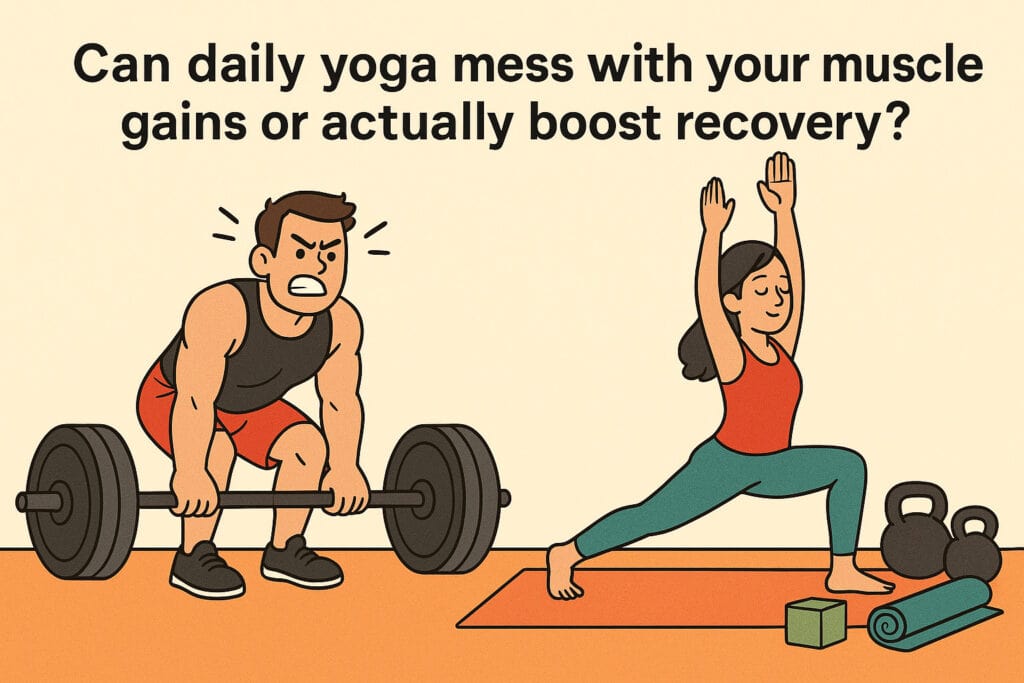
Daily yoga sounds simple.
Just roll out a mat, move a bit, repeat tomorrow.
In reality, it raises a lot of practical questions, especially if you care about strength, muscle, recovery, and not feeling beat up all the time.
Is daily yoga supposed to be intense or relaxing.
Does it help muscle growth or slowly interfere with it.
And most importantly, how do you actually use it without turning it into another full workout that competes with training.
This guide exists to answer those questions in a grounded way.
No mystical language.
No “do this every morning and your life will change” promises.
Just a realistic explanation of how daily yoga fits into a body that trains, recovers, and lives in the real world.
What Daily Yoga Is (And What It Is Not)
Daily yoga is not about doing long, exhausting sessions every day.
It’s not about chasing flexibility records.
It’s not about sweating just to feel productive.
Daily yoga simply means daily movement practice, with intensity that changes depending on what your body actually needs that day.
Some days it supports recovery.
Some days it improves mobility.
Some days it adds light strength work.
The mistake happens when every yoga session is treated like it should feel the same.
Bodies don’t work on copy-paste mode.
And neither should your yoga.
Daily Yoga and Muscle Gains (How They Actually Interact)
Let’s clear this up properly.
Yoga is not hypertrophy training.
Holding poses, even difficult ones, does not replace progressive overload with resistance.
That said, daily yoga does not automatically “kill gains” either.
What it does is improve the quality of your training environment.
Better joint positions mean better force production.
Better force production usually means better reps.
Better reps, done consistently, are what actually grow muscle over time.
Where people run into trouble is when yoga becomes a hidden second workout.
If your daily yoga leaves you exhausted, sore, and under-recovered, your lifting performance will suffer.
At that point it’s not yoga vs lifting.
It’s just too much total stress.
Used intelligently, yoga supports muscle gains indirectly by keeping your body capable of training well.
Daily Yoga and Recovery (What’s Really Happening)
Recovery isn’t just soreness disappearing.
It’s your ability to show up and perform again.
Yoga helps recovery mainly through three mechanisms.
Gentle movement improves circulation and reduces stiffness.
Slow breathing helps calm the nervous system, especially after hard training or stressful days.
Controlled ranges teach the body that movement isn’t always a threat, which reduces chronic tension.
Yoga doesn’t magically heal muscle tissue faster.
It creates a better internal environment for recovery to happen naturally.
That’s a big difference.
When to Do Yoga Compared to Training
Yoga works best after training or in a separate session later in the day, especially when it’s gentle.
Morning yoga is great when it’s light and focused on waking the body up.
What usually backfires is aggressive stretching right before heavy lifting.
That doesn’t make stretching bad.
It just means timing matters.
Like coffee.
Yoga Exercise Categories Explained (With Clear Execution and Benefits)
Instead of memorizing hundreds of pose names, it’s much more useful to understand what each category does to your body.
Once you get that, choosing exercises becomes easy.
Below you’ll find the main yoga exercise categories, with the most important poses, explained in a way that actually makes sense.
Standing Poses (Strength, Stability, Muscle Endurance)
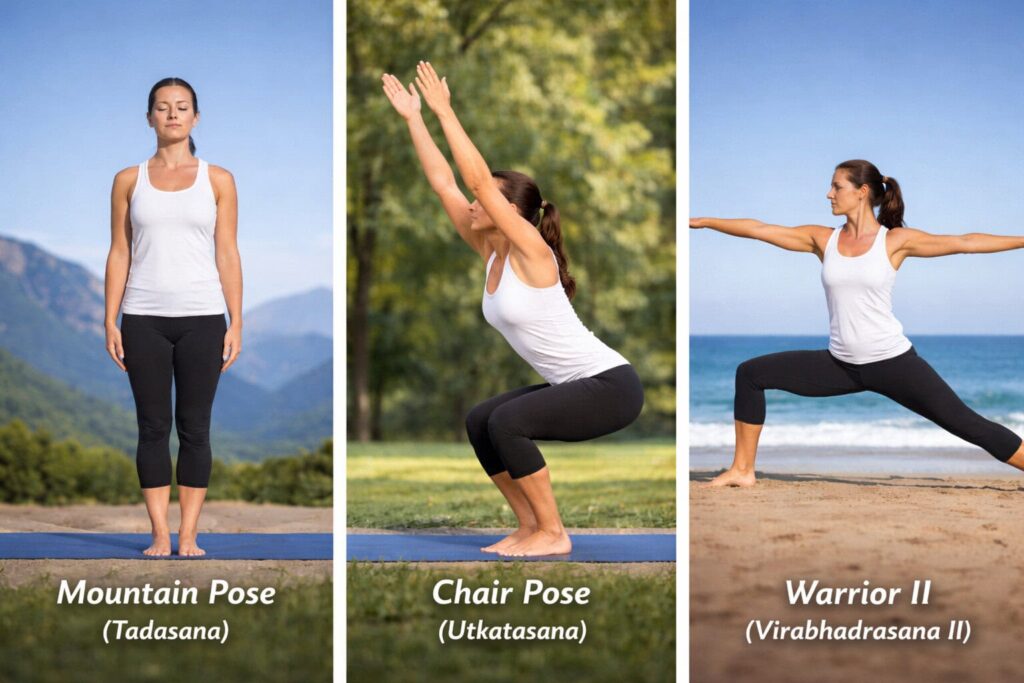
Standing poses are where yoga quietly builds strength.
They don’t look impressive.
They work anyway.
Mountain Pose (Tadasana)
What it is:
A basic standing posture focused on alignment and body awareness.
How to do it:
Stand upright with feet about hip-width apart.
Press toes and heels into the floor evenly.
Lightly tighten glutes and abs, like bracing for a gentle push.
Relax shoulders and look straight ahead.
Breathe normally.
Muscles involved:
Core stabilizers.
Glutes.
Postural muscles.
Benefits:
Improves posture and balance.
Teaches proper body alignment.
Carries over to lifting and everyday movement.
Modifications:
Widen stance for more balance.
Keep arms by your sides if shoulders feel tight.
Chair Pose (Utkatasana)
What it is:
A sustained squat-like hold that builds leg endurance.
How to do it:
From standing, bend knees and push hips back as if sitting on a chair.
Keep chest lifted and back straight.
Press heels into the floor.
Hold and breathe.
Muscles involved:
Quadriceps.
Glutes.
Core.
Benefits:
Builds leg strength and endurance.
Improves squat mechanics.
Modifications:
Raise heels slightly if ankles are tight.
Hands on hips instead of overhead.
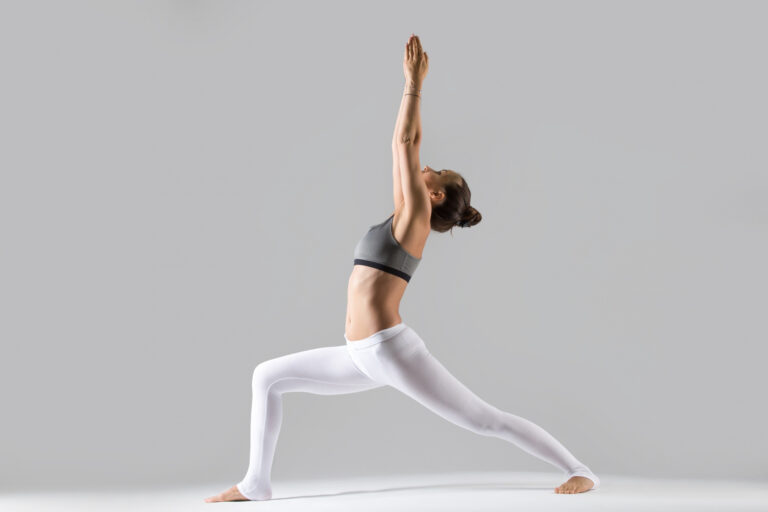
Warrior II (Virabhadrasana II)
What it is:
A wide stance pose that builds lower body and hip endurance.
How to do it:
Step feet wide apart.
Turn front foot forward and bend that knee.
Back leg stays straight.
Arms extend out to the sides.
Look over front hand.
Muscles involved:
Glutes.
Quads.
Inner thighs.
Core.
Benefits:
Improves hip stability.
Builds leg endurance.
Enhances body awareness.
Modifications:
Shorten stance.
Hands on hips instead of extended.
Forward Folds (Hamstrings, Spine, Relaxation)
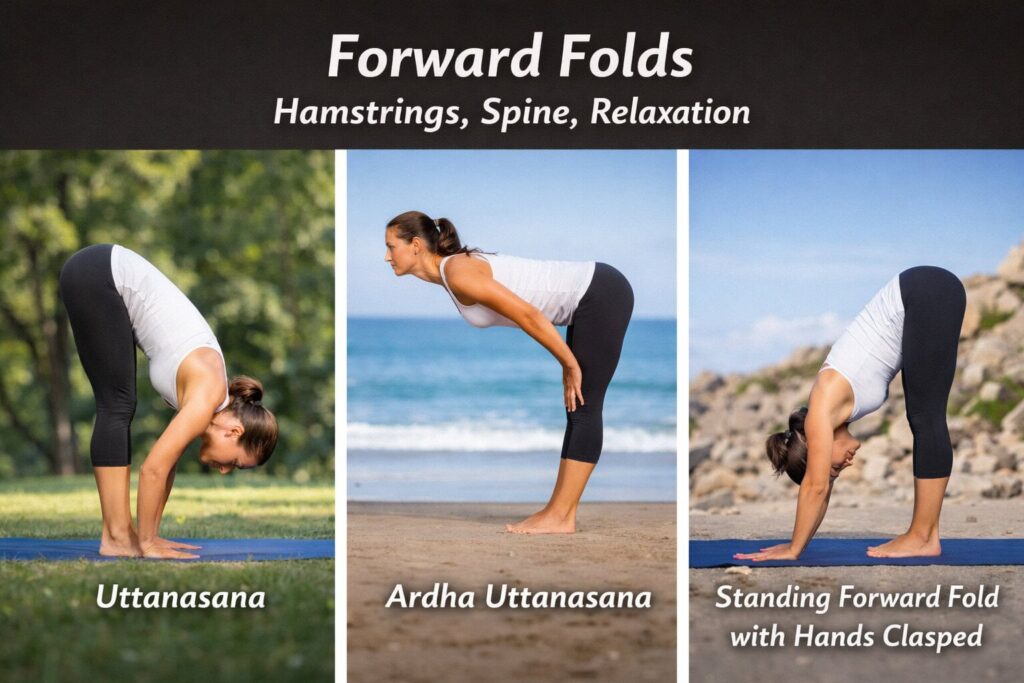
Forward folds are often abused.
Done right, they calm the body and improve tolerance.
Done wrong, they annoy the lower back.
Standing Forward Fold (Uttanasana)
What it is:
A hip-hinge stretch for the posterior chain.
Often practiced together with Ardha Uttanasana (Half Forward Fold) as a safer and more controlled variation.
How to do it:
Stand tall, hinge at the hips, and fold forward.
Bend knees slightly.
Let arms hang.
Relax neck and jaw.
Muscles involved:
Hamstrings.
Lower back muscles.
Benefits:
Improves hamstring flexibility.
Reduces tension.
Calms the nervous system.
Modifications:
Hands on thighs or blocks.
Bend knees more if needed.
Backbends (Spine Extension and Posture Balance)
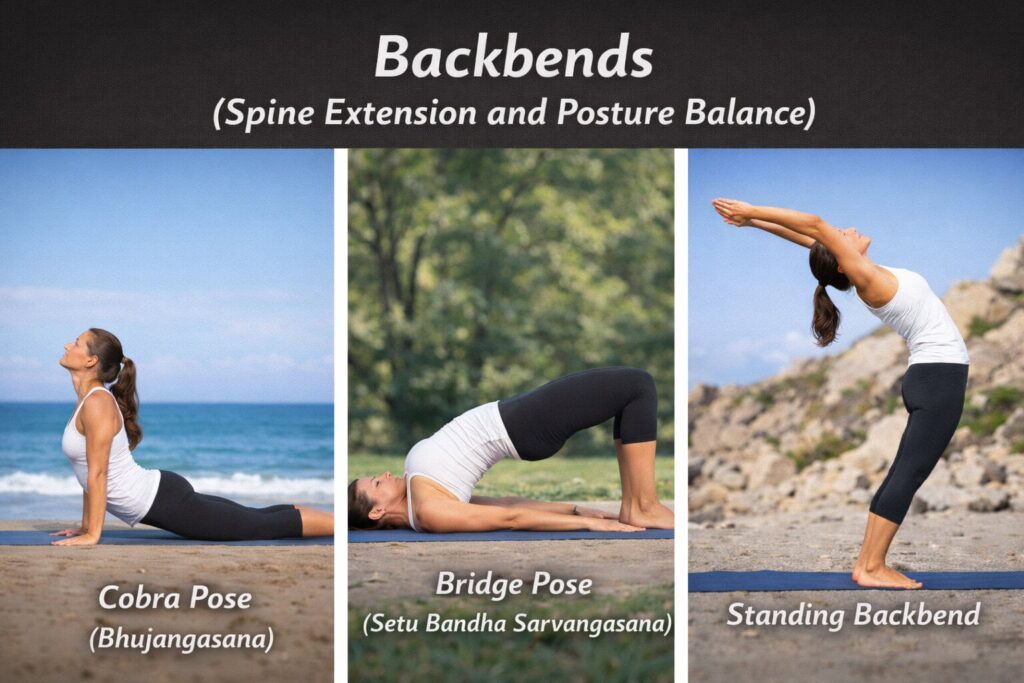
Backbends counter sitting, pressing, and slouching.
They should feel supportive, not aggressive.
Cobra Pose (Bhujangasana)
What it is:
A gentle backbend focusing on spinal extension.
How to do it:
Lie face down with hands under shoulders.
Press lightly into hands and lift chest.
Hips stay on the floor.
Elbows stay slightly bent.
Muscles involved:
Lower back.
Upper back.
Glutes (lightly).
Benefits:
Improves spinal mobility.
Counteracts sitting posture.
Modifications:
Lift only a little.
Stay on forearms instead of hands.
Bridge Pose (Setu Bandha Sarvangasana)
What it is:
A backbend done from the floor, safer for daily practice.
How to do it:
Lie on your back with knees bent and feet flat.
Press through heels and lift hips.
Squeeze glutes gently.
Lower slowly.
Muscles involved:
Glutes.
Hamstrings.
Lower back.
Benefits:
Strengthens posterior chain.
Opens hip flexors.
Modifications:
Block or pillow under hips.
Shorter holds.
Standing Backbend (Anuvittasana)
What it is:
A standing spinal extension that supports posture and balance.
How to do it:
Stand tall with feet hip-width apart.
Place hands on hips or lower back.
Lift the chest and gently lean back.
Keep glutes lightly engaged.
Neck stays long, not collapsed.
Muscles involved:
Lower back.
Glutes.
Hip flexors.
Benefits:
Improves upright posture.
Counterbalances forward-focused training.
Builds confidence in spinal extension.
Modifications:
Very small range of motion.
Hands on hips instead of reaching back.
Focus on chest lift rather than depth.
Hip Openers (Mobility With Control)
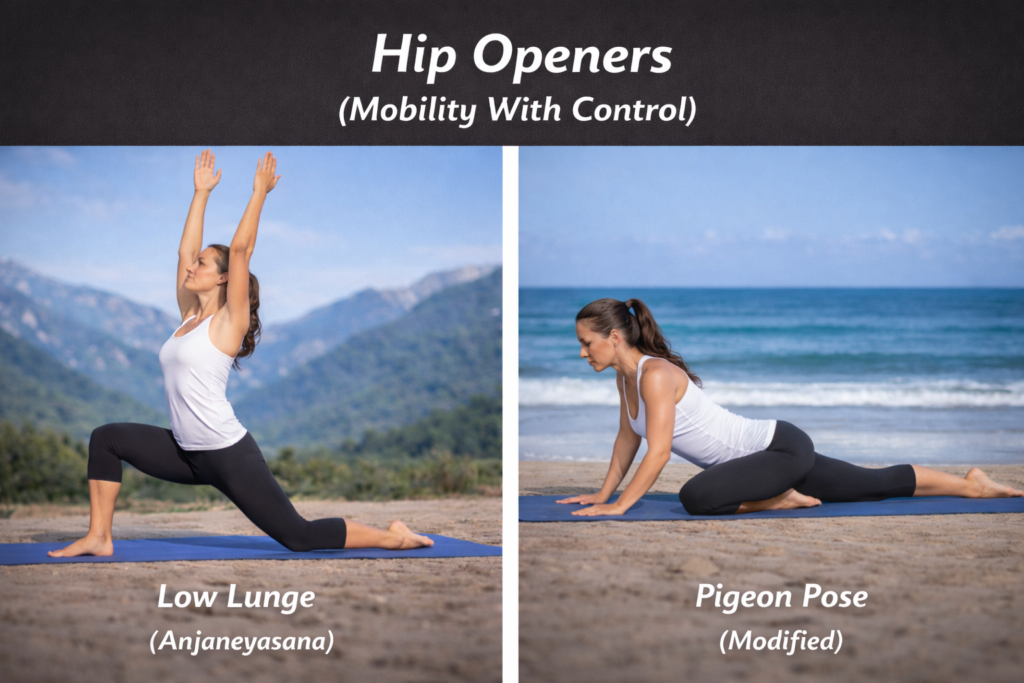
Hip mobility affects squats, lunges, and running.
Depth is optional.
Control is not.
Low Lunge (Anjaneyasana)
What it is:
A stretch for hip flexors and quads.
How to do it:
Step one foot forward, drop back knee.
Front knee over ankle.
Squeeze back-leg glute.
Lift chest without arching lower back.
Muscles involved:
Hip flexors.
Quads.
Glutes.
Benefits:
Improves hip mobility.
Helps squat depth and stride.
Modifications:
Padding under knee.
Hands on thighs.
Pigeon Pose (Modified)
What it is:
A glute-focused hip opener.
How to do it:
Bring one knee forward while back leg extends.
Stay upright or lean slightly forward.
Stop if knee discomfort appears.
Muscles involved:
Glutes.
Deep hip rotators.
Benefits:
Improves hip rotation.
Reduces hip stiffness.
Modifications:
Lying figure-four stretch.
Use blocks for support.
Twists (Spine Health and Rib Mobility)
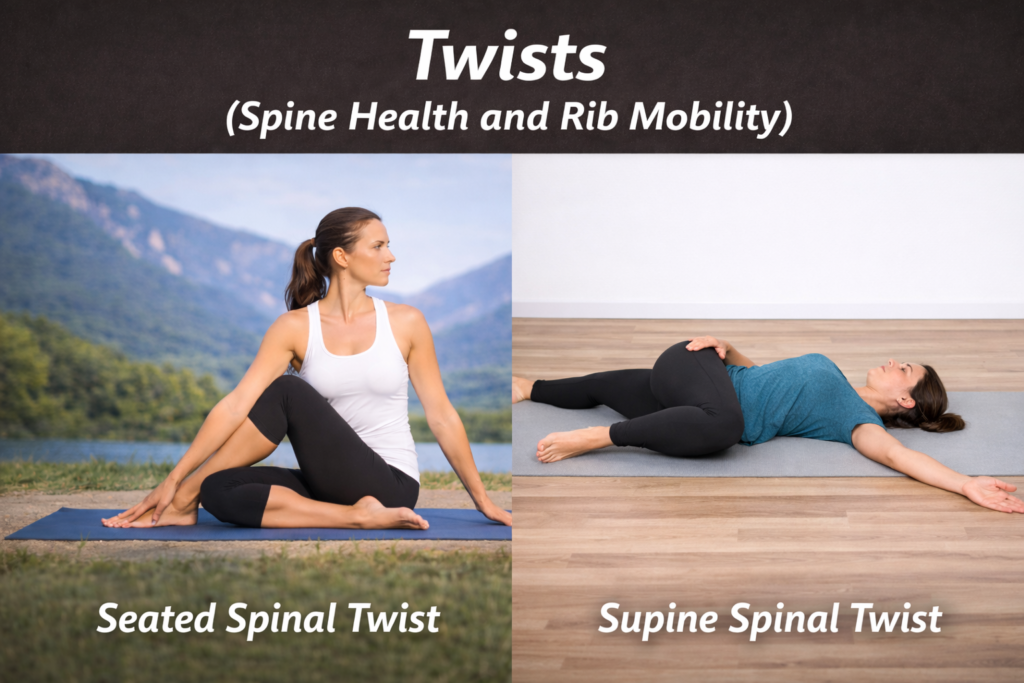
Twists improve rotation and breathing mechanics.
They should feel relieving, not forced.
Seated Spinal Twist
How to do it:
Sit tall.
Rotate upper body slowly to one side.
Keep hips grounded.
Benefits:
Improves spinal mobility.
Reduces stiffness.
Modifications:
Keep rotation small.
Supine Spinal Twist
How to do it:
Lie on your back.
Bring one knee toward the chest.
Let it fall gently across the body.
Arms open wide.
Keep shoulders relaxed on the floor.
Benefits:
Encourages spinal rotation.
Improves rib mobility.
Promotes relaxation and breathing ease.
Modifications:
Use a pillow under the knee.
Keep the twist very light.
Stay shorter if lower back feels sensitive.
Arm Supports (Upper Body Strength and Stability)
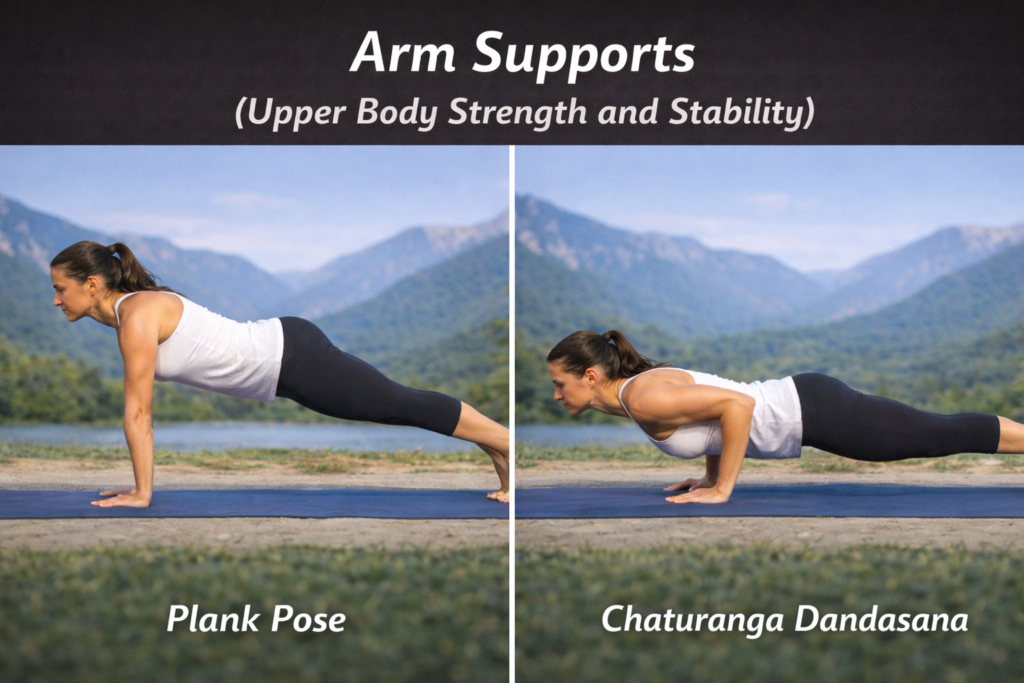
These poses blur the line between yoga and strength training.
Plank Pose
What it is:
A full-body isometric hold.
How to do it:
Hands under shoulders.
Body in a straight line.
Squeeze glutes and abs.
Hold without sagging.
Muscles involved:
Core.
Shoulders.
Chest.
Benefits:
Builds core stability.
Supports pressing strength.
Modifications:
Knees on floor.
Hands elevated.
Chaturanga Dandasana (Four-Limbed Staff Pose)
What it is:
A bent-arm plank that sits right between yoga and push-up strength work.
How to do it:
Start in Plank Pose.
Bend the elbows, keeping them close to the ribs.
Lower until shoulders and elbows are roughly in line.
Keep the body in one straight line.
Avoid dropping the hips or flaring the elbows.
Muscles involved:
Shoulders.
Triceps.
Chest.
Core.
Benefits:
Builds real pushing strength.
Improves shoulder and scapular stability.
Acts as a bridge between yoga flows and upper-body strength training.
Modifications:
Lower the knees to the floor.
Descend only halfway.
Use blocks under the shoulders for support.
Restorative Poses (Recovery and Nervous System)
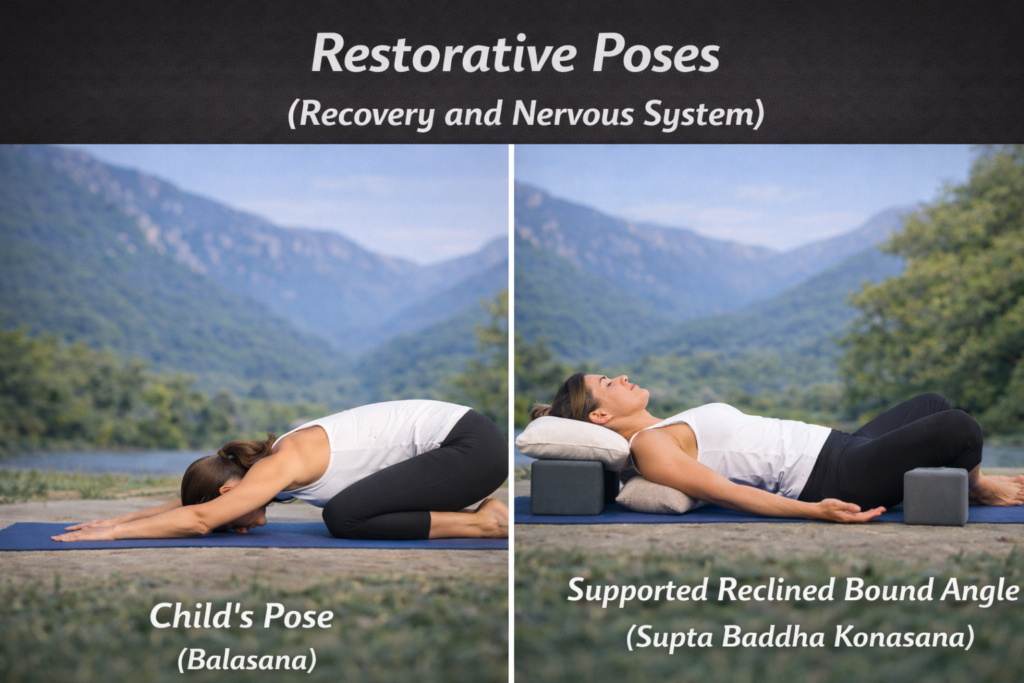
These poses don’t build muscle.
They build sustainability.
Child’s Pose (Balasana)
How to do it:
Kneel and sit back on heels.
Lower chest toward thighs.
Breathe slowly.
Benefits:
Reduces stress.
Supports recovery.
Modifications:
Pillow under chest.
Widen knees.
Supported Reclined Bound Angle (Supta Baddha Konasana)
How to do it:
Lie on your back.
Bring soles of the feet together.
Support knees with pillows or blocks.
Arms relaxed, palms up.
Benefits:
Deeply calming for the nervous system.
Encourages diaphragmatic breathing.
Excellent for full recovery days.
Modifications:
Feet farther from the hips.
Extra support under thighs or head.
Balance Poses (Coordination, Joint Control, Injury Prevention)
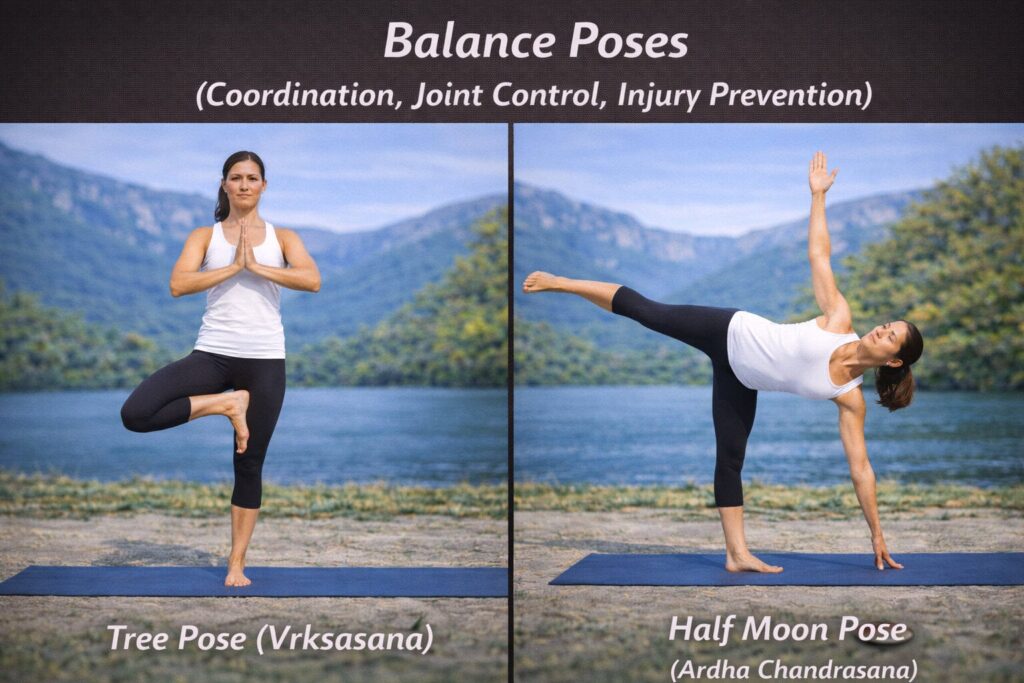
Balance poses don’t just train balance.
They train how the brain talks to joints under load.
That’s gold for lifting, calisthenics, and everyday movement.
Tree Pose (Vrksasana)
What it is:
A single-leg balance pose focusing on hip and ankle stability.
How to do it:
Stand tall and shift weight onto one foot.
Place the other foot on the ankle or inner calf (not the knee).
Bring hands together in front of chest or overhead.
Fix your gaze on one point and breathe.
Muscles involved:
Glutes.
Ankles.
Core stabilizers.
Benefits:
Improves balance and joint awareness.
Supports knee and ankle health.
Modifications:
Lightly touch a wall.
Keep toes of lifted foot on the floor.
Half Moon Pose (Ardha Chandrasana)
What it is:
A balance pose that challenges lateral strength and control.
How to do it:
From standing, hinge forward and lift one leg back.
Place one hand on the floor or a block.
Open chest to the side.
Keep standing leg strong.
Muscles involved:
Glutes.
Obliques.
Hip stabilizers.
Benefits:
Builds lateral chain strength.
Improves balance under asymmetrical load.
Modifications:
Use a block.
Keep lifted leg lower.
Side Bends & Lateral Chain Poses (Often Ignored, Very Useful)
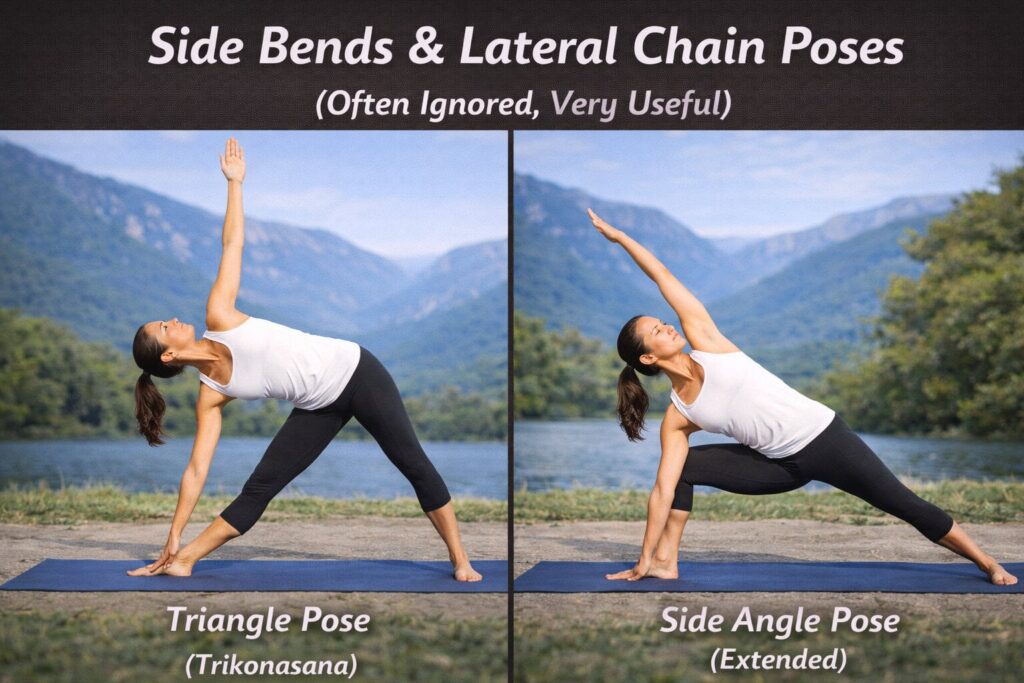
These poses hit muscles that rarely get attention in traditional training.
Triangle Pose (Trikonasana)
What it is:
A side-bending pose with rotational elements.
How to do it:
Stand with feet wide.
Turn one foot forward.
Reach front hand down toward shin or block.
Other arm reaches upward.
Muscles involved:
Obliques.
Adductors.
Glutes.
Benefits:
Improves lateral flexibility and trunk control.
Supports rotational strength.
Modifications:
Hand on thigh instead of floor.
Side Angle Pose (Extended)
What it is:
A deeper lateral chain engagement pose.
How to do it:
From a wide stance, bend front knee.
Rest elbow on thigh or reach hand to floor.
Top arm reaches overhead.
Muscles involved:
Obliques.
Quads.
Glutes.
Benefits:
Builds endurance in side chain.
Improves hip and trunk coordination.
Modifications:
Forearm on thigh.
Shorten stance.
Seated & Core-Focused Poses
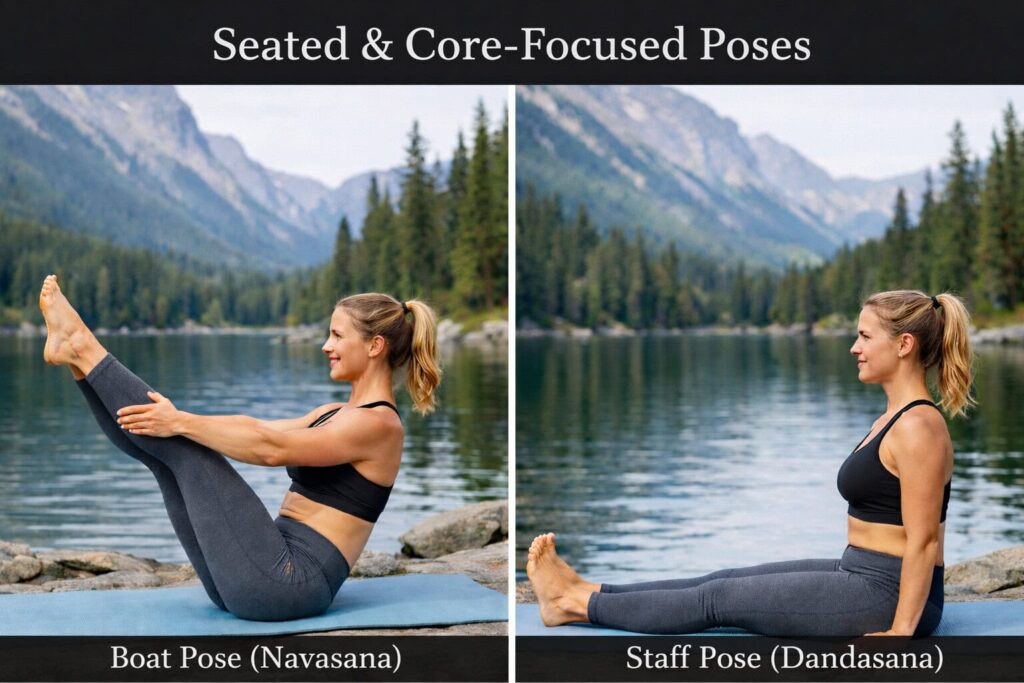
These build control, not just stretch.
Boat Pose (Navasana)
What it is:
A core endurance hold.
How to do it:
Sit on the floor and lift feet slightly.
Lean back while keeping chest lifted.
Hold balance and breathe.
Muscles involved:
Core.
Hip flexors.
Benefits:
Builds trunk stability.
Improves posture and bracing.
Modifications:
Bend knees.
Keep toes touching the floor.
Staff Pose (Dandasana)
What it is:
A seated posture for alignment and awareness.
How to do it:
Sit tall with legs extended.
Press heels forward.
Sit upright without slouching.
Muscles involved:
Core.
Postural muscles.
Benefits:
Improves seated posture.
Prepares body for other seated poses.
Modifications:
Sit on a folded towel.
Inversions & Semi-Inversions (Circulation and Shoulder Endurance)
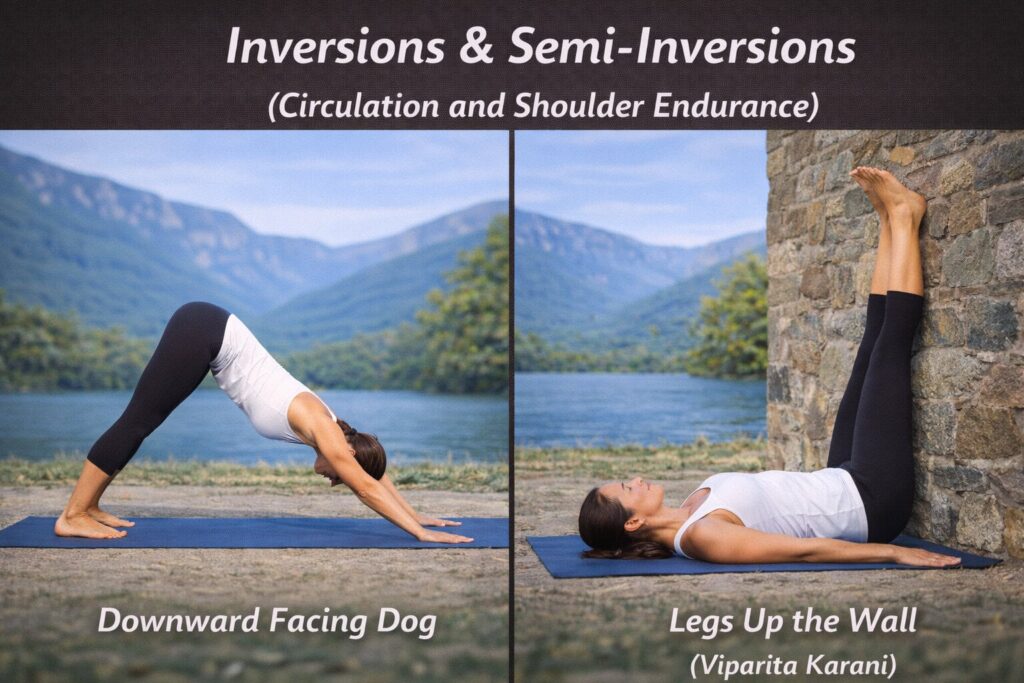
No circus tricks required.
Downward Facing Dog
What it is:
A mild inversion and full-body position.
How to do it:
Hands and feet on the floor.
Lift hips upward.
Keep spine long, knees slightly bent if needed.
Muscles involved:
Shoulders.
Hamstrings.
Calves.
Benefits:
Improves shoulder endurance.
Relieves spinal compression.
Modifications:
Bend knees.
Hands on blocks.
Legs Up the Wall (Viparita Karani)
What it is:
A restorative semi-inversion.
How to do it:
Lie on your back with legs resting up a wall.
Relax arms by your sides.
Breathe slowly.
Muscles involved:
Minimal muscular effort.
Benefits:
Reduces stress.
Improves circulation.
Modifications:
Pillow under hips.
Wrist & Shoulder Prep (Critical for Lifters and Calisthenics)
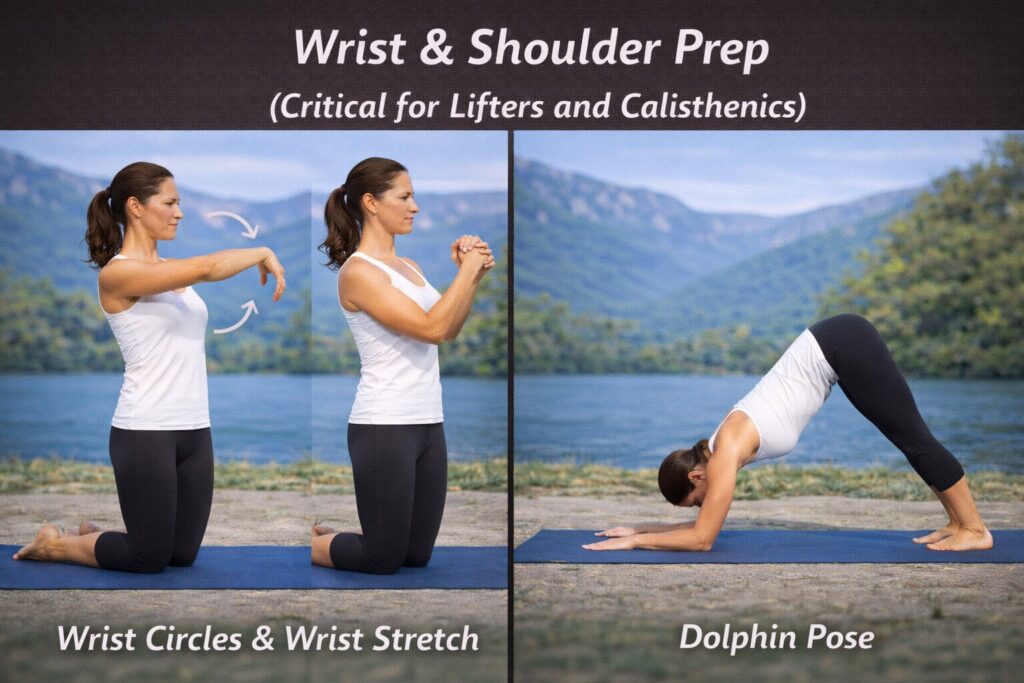
Often skipped.
Always regretted later.
Wrist Circles & Wrist Stretch
How to do it:
Hands on floor.
Gently rock weight forward and back.
Move slowly.
Benefits:
Protects wrists.
Improves load tolerance.
Dolphin Pose
What it is:
A shoulder endurance pose.
How to do it:
Forearms on floor.
Lift hips like downward dog.
Press forearms down.
Muscles involved:
Shoulders.
Upper back.
Core.
Benefits:
Builds overhead strength safely.
Modifications:
Shorter holds.
How long should a daily yoga routine be
This part surprises people.
Longer is not better.
Consistency beats duration every single time.
For most humans with jobs, stress, and some kind of training schedule, these ranges work best:
- 8–12 minutes on busy or heavy training days
- 12–20 minutes on normal days
- 20–30 minutes only when yoga is the main session
Anything longer should be intentional, not habitual.
If you’re doing 45 minutes every day and wondering why you feel flat, the answer is probably already there.
How to Build a Daily Yoga Routine That Actually Works
This is where most people mess things up.
Not because yoga is complicated.
But because routines get copied instead of designed.
Daily yoga works when it fits your training, your energy, and your life.
It stops working the moment it turns into a random flow you force yourself through just to “check the box.”
Think of your routine like a playlist.
Same artist.
Different tracks.
Daily yoga routines based on training days
This is where yoga becomes smart instead of random.
The routine should respond to what the body already did, not pretend every day is the same.
Daily yoga after a heavy lifting day
This is not the moment to chase deep stretches or heroic poses.
Your nervous system already worked hard.
The goal is downshifting, not stimulation.
Routine focus:
Spine, breathing, gentle hips, light movement
Example routine (10–15 minutes):
Start with child’s pose and slow breathing.
Move into cat-cow, slow and controlled.
Add a gentle low lunge on each side, no forcing.
Do a supine spinal twist, relaxed.
Finish with legs up the wall or a simple lying rest.
Why it works:
It reduces background tension without adding fatigue.
You walk away feeling “reset,” not drained.
If you finish this routine sweaty and shaky, you overdid it.
Daily yoga on upper-body training days
Upper body days usually leave shoulders and upper back feeling tight.
This is where yoga shines if you don’t turn it into a shoulder punishment session.
Routine focus:
Thoracic spine, shoulders, gentle chest opening
Example routine (12–18 minutes):
Start with easy seated breathing.
Move into thread-the-needle on both sides.
Add puppy pose, keeping it comfortable.
Include downward dog with bent knees.
Finish with child’s pose and long exhales.
Why it works:
Improves shoulder comfort without compromising pressing strength.
Also helps posture, which most people quietly need.
Daily yoga on leg day or after leg day
Leg day already does enough.
Yoga should not try to “win” against it.
Routine focus:
Hips, ankles, light posterior chain work
Example routine (10–15 minutes):
Start with supine knee hugs.
Move into low lunge, gentle.
Add half split with bent knee.
Include a short deep squat hold with support.
Finish with lying glute stretch.
Why it works:
Keeps hips usable without making quads and hamstrings angry.
If you feel more sore after, you pushed range instead of control.
Morning daily yoga routines (wake-up mode)
Morning yoga should feel like turning the lights on, not running a marathon.
If you need coffee after your yoga, it worked.
If you need a nap, it didn’t.
Routine focus:
Joint movement, circulation, light activation
Example routine (8–12 minutes):
Start standing with slow breaths.
Add gentle spinal rolls.
Move into cat-cow.
Include a short downward dog.
Finish with a few easy squats or lunges.
Why it works:
Gets joints moving without stressing the system.
Perfect before work or before training later in the day.
Evening daily yoga routines (recovery and sleep)
Evening yoga should feel boring in a good way.
If it’s exciting, you’re doing it wrong.
Routine focus:
Breathing, nervous system, gentle stretching
Example routine (12–20 minutes):
Start lying on your back with slow breathing.
Move into gentle spinal twists.
Add seated forward fold, very relaxed.
Include child’s pose with long exhales.
Finish with legs up the wall.
Why it works:
Supports sleep quality and recovery.
No flexibility contest allowed.
Daily yoga routines when you’re sore
Soreness is not a signal to attack the muscle harder.
It’s a signal to move gently and restore circulation.
Routine focus:
Light movement, not deep stretching
Example routine (8–12 minutes):
Gentle cat-cow.
Easy bridges for sore legs.
Supine twists.
Light breathing work.
Why it works:
Helps muscles feel usable again without delaying recovery.
Daily yoga routines when you don’t feel like doing yoga
This happens more than people admit.
Motivation is unreliable.
Systems are not.
On low-motivation days, the rule is simple.
Do the minimum effective dose.
The “bare minimum” routine (5–8 minutes):
Cat-cow.
Child’s pose.
One gentle hip stretch.
Three slow breaths.
Done.
Showing up beats skipping.
Every time.
How to rotate routines across a full week
Here’s a realistic example that doesn’t
require monk-level discipline.
Weekly structure example:
Day 1: short post-lift recovery yoga
Day 2: shoulder and spine focus
Day 3: hips and ankles
Day 4: restorative evening yoga
Day 5: light strength-style flow
Day 6: choose what feels tight
Day 7: optional or very short reset
No heroics.
No pressure.
Just smart rotation.
How to know if your routine is working
You don’t judge it by flexibility photos.
You judge it by daily life and training.
Good signs:
- Warm-ups feel easier.
- Joints feel smoother.
- Sleep improves.
- Training stays consistent.
Warning signs:
- You feel constantly drained.
- Workouts feel weaker.
- Joints feel irritated.
- That’s not “discipline.”
- That’s a signal to scale back.
RELATED:》》》 Can doing Pilates and yoga back-to-back confuse your breathing patterns?
Common Mistakes With Daily Yoga
Doing intense yoga every day without allowing any real recovery.
Pushing the same demanding flows even when the body clearly feels fatigued.
Forcing stretches to reach an “ideal” shape instead of respecting current mobility.
Chasing depth at all costs rather than control and joint stability.
Ignoring joint discomfort and brushing off warning signals as normal soreness.
Repeating movements that create pressure in knees, hips, shoulders, or wrists.
Copying random online flows without understanding who they are designed for.
Following advanced sequences that don’t match individual structure or training load.
Treating yoga like a competition instead of a long-term practice.
Comparing flexibility, balance, or endurance rather than focusing on consistency.
None of these habits support sustainable progress or joint health over time.
Who Daily Yoga Is Best For (And Who Needs Adjustments)
Daily yoga works especially well for:
- lifters with tight hips or shoulders
- calisthenics athletes
- people under high stress
- anyone who wants sustainable movement
Those with very high training volume need to keep yoga lighter and more recovery-focused.
Stress still adds up, even when the poses look easy.
If you want to learn more about yoga — and maybe get into Pilates too — check out the posts below.
》》》Yoga & Pilates《《《
Conclusion – Why Daily Yoga Works When It’s Done Right
Daily yoga doesn’t need to be dramatic.
It doesn’t need slogans or extreme flexibility goals.
It works best when it’s simple, repeatable, and supportive of everything else you do.
Think of it like brushing your teeth for movement.
Small dose.
Most days.
That’s how daily yoga becomes a real cornerstone habit instead of something you quit after three weeks.
FAQs
Is 10 minutes of yoga enough?
Yes, if done consistently.
Will daily yoga make me weaker?
Not if intensity is managed.
Can yoga replace stretching?
Yes, when done intelligently.