Sure, it almost sounds like blasphemy.
Yoga is synonymous with balance, awareness, stretching, inner peace…
And then comes this question that sounds like it came straight from a skeptical bodybuilder forum:
“But what if doing too much yoga actually weakens my core instead of strengthening it?”
Well, get ready.
Because the answer is neither yes nor no.
It’s: it depends on what you do, how you do it, and what else you’re forgetting to do.
Yoga: friend or core saboteur?
Imagine doing yoga every single day.
You feel as flexible as a rubber band, breathe like a zen monk, and your body glides from one pose to another like you were born on the mat.
But then…
You try some ab wheel rollouts, or attempt to hold an L-sit on parallettes…
And BAM.
Your core deflates like a popped balloon.
You can’t hold the position.
Your sides are shaking.
Your lower back starts complaining.
And you wonder:
“How is this even possible? I do yoga every damn day!”
Here’s where the uncomfortable truth hits.
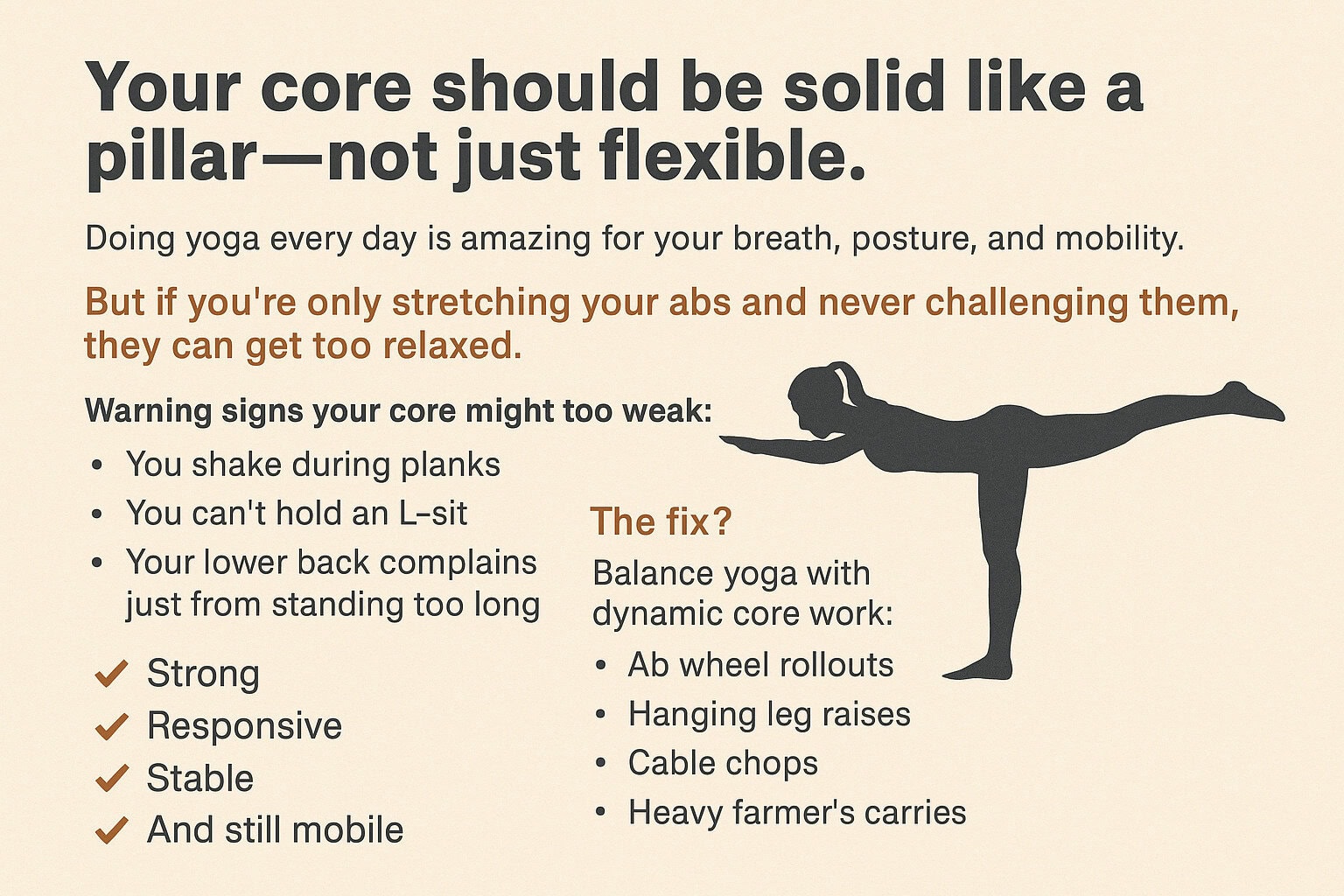
Stretching is not the same as training.
Not always.
Most yoga poses have a specific purpose: creating space, length, release.
All wonderful concepts—if you’re trying to release built-up tension, improve posture, or stop walking around like a stiff broomstick.
But…
Stretching your abdominal muscles doesn’t mean strengthening them.
Try thinking of your core as a spring.
If you always pull it and never compress it, eventually it won’t snap back.
And that’s when your core loses its main purpose: to contain, stabilize, protect.
The real role of the core: way more than a six-pack

Your core isn’t just the summer abs you dream about.
It’s a cylinder connecting your upper and lower body.
It includes:
- Deep abdominals (like the transverse abdominis)
- Internal and external obliques
- Paraspinals
- Diaphragm
- Pelvic floor
Its main task?
Stabilizing your spine while you move.
Not just in Warrior II.
But also when you lift a heavy bag.
When you sprint to catch the train.
When you jump or twist your torso quickly.
If your core is too “relaxed”, your body can’t react efficiently.
And that brings:
- Chronic back pain
- Hip injuries
- Pelvic instability
- Poor gym performance
Heads-up: some yoga habits can worsen postural patterns
Here’s another detail nobody talks about:
Some yoga teachers—overzealously—push for excessive posterior pelvic tilt (“tuck your tailbone!”, “flatten your back!”).
Over time, this can create imbalances in your postural muscles.
The pelvis gets locked in a position that shuts down the glutes, overloads the hip flexors, and makes your abs… lazy.
Literally.
Ever felt that instability in your lower back when trying a bridge or a jump?
It often starts there.
So is all yoga bad? Absolutely not. It depends on what kind you do.
Some styles, like power yoga, ashtanga, or even dynamic vinyasa, can really challenge your core.
Poses like:
Crow Pose (Bakasana)
Not just an Instagram “trick”.
It’s a position of strength and control.
- ✔️ Hands firmly on the ground, fingers spread like claws
- ✔️ Knees resting on your triceps, not directly on your elbows (or you’ll flip)
- ✔️ Weight shifted forward, gaze ahead—not down
- ✔️ Core active like an isometric crunch
💥 If your abs are working, you’re on the right track.
If you only feel your wrists… time to fix your form.
Hand Plank
Looks basic, but it’s not.
- ✔️ Hands under shoulders, fingers grounded
- ✔️ Glutes tight, core constantly engaged
- ✔️ Back flat like a table—not saggy, not arched
- ✔️ Push the ground away, activate the chest
🧠 Think of “pulling your pubic bone toward your ribs”—this truly activates the transverse.
Side Plank (Vasisthasana)
A lateral stability classic.
- ✔️ Support yourself on one arm (wrist under shoulder)
- ✔️ Legs straight, feet stacked (or front foot forward for more stability)
- ✔️ Lift your hips until your body is aligned—don’t sag!
- ✔️ Free arm raised or resting on your side
🔥 Want a real challenge? Lift the top leg too. Your abs and glutes will go wild.
Boat Pose (Navasana)
Looks easy—holding it well is brutal.
- ✔️ Sit on your sit bones, legs lifted (bent or straight), torso leaning back
- ✔️ Back straight, not rounded
- ✔️ Arms extended forward, parallel to the floor
- ✔️ Abs pulled in like you’re “sucking in” your belly button
❌ If you’re shaking like jelly and collapsing forward, you’re probably letting the hip flexors do all the work.
✅ Try to bring tension into your lower abs.
But here’s the thing: progressive overload is often missing
You don’t increase the load.
You don’t add mechanical tension.
You don’t go beyond your muscle limits.
You don’t give your body a reason to keep upgrading itself.
When that happens, the magic stops.
Your muscles adapt to the same old challenge like a student who’s memorized the test answers—they stop learning.
No new stimulus means no new strength, no extra muscle fiber recruitment, and no improvement in endurance.
It’s not that planks “don’t work.”
It’s that they stop working harder for you once you’ve mastered them.
Think of it like running the same mile every day at the same pace—you’ll maintain, but you won’t break any records.
Your core is the same.
It needs variety, extra resistance, and challenges that make it ask for reinforcements.
A bit of science to clear things up
A 2018 study published in the Journal of Strength and Conditioning Research by Saeterbakken and colleagues compared 10 weeks of dynamic core training to isometric work, measuring strength gains at the end of the program.
The verdict?
Both methods worked, but dynamic exercises gave a slight edge—especially in improving the core’s ability to generate force while moving.
When you train under tension with movement, your muscles don’t just contract—they stabilize, correct your path, respond to tiny imbalances, and do it all in real time.
In other words, your core works like a security system on high alert, recruiting more fibers and sharpening coordination.
A well-done plank is a solid foundation, no doubt.
But dynamic movements are like putting that foundation into a busy construction site—noise, movement, heavy loads to shift.
That’s when your core really learns to protect you and power you up.
How to combine yoga and strength for a balanced core
Here’s where things get practical.
If you love yoga, you don’t need to quit.
But you do need to balance it with targeted core training.
For example:
👉 After a yoga session, spend 10–15 minutes doing exercises like:
- Hanging leg raises
Hang from a bar, lift straight legs to chest height (or higher).
Slow, controlled movement.
Avoid swinging.
Focus on lower abs. - Cable chops
Standing, hold a cable machine handle at shoulder height.
Pull diagonally toward the opposite hip, rotating slightly.
Your core works to resist rotation. - Ab wheel rollouts
From your knees, slowly roll the wheel forward, keeping your body aligned.
Push hard with your core to return.
Back stays flat—no “banana shape”. - Farmer’s carry
Grab two heavy dumbbells and walk briskly, keeping your core tight and torso upright.
Zero wobbling.
Your core stabilizes every step.
👉 Or, alternate yoga days with dynamic core training (weighted or calisthenic progressions).
This balance helps you achieve:
✅ Stability and flexibility
✅ Inner strength and good posture
✅ Visible, protected abs
Bonus section: how to tell if your core is too weak because of yoga (or something else)
Got any warning signs?
Here are a few:
- Back pain when standing for too long
- Trouble stabilizing the pelvis during fast movements
- Can’t do 10 good-form hanging leg raises
- Don’t feel your abs during squats or deadlifts
- Collapse in plank or side plank positions
If you relate to at least two of these, it’s time to dial in your core training.
Another helpful tip: breathing is part of your core
Many yoga practitioners breathe too softly.
Great for the mind.
Not always great for core activation.
Train with intra-abdominal breathing too:
- Inhale and push the air downward
- Activate the transverse abdominis
- Learn to “pressurize” your core (like powerlifters do)
This type of breathing helps you:
- Better stabilize your spine
- Increase strength during exercises
- Avoid pain and compensation
The benefits of yoga your core can’t ignore
Before sounding like the Grinch of yoga, let’s get something straight:
Yoga is good for you.
And your core—when it gets the right type of stimulus—loves it.
- ✔️ Improves motor control: helps you feel every part of your trunk, even deep muscles you’d normally ignore
- ✔️ Boosts posture awareness: after 45 minutes in balance-challenging poses, you quickly notice if your hips are off or your chest is caving in
- ✔️ Supports active recovery: on days when you can’t or don’t want to train hard, yoga keeps your core “awake” without stressing it
- ✔️ Enhances functional breathing: your diaphragm (a core muscle) works overtime during flowing sequences
- ✔️ Reduces tightness in anterior and posterior chains: a locked-up core isn’t a strong one. Yoga helps unlock it
So no, it’s never the enemy.
It just needs to be framed correctly.
The issue only arises when it’s the only tool in your toolbox.
Doing yoga every day: yes or no? (Spoiler: it depends on how you do it)
It’s one of the most asked questions by people who fall in love with the mat:
“Can I do yoga every day?”
Honest answer: yes… but with a few precautions.
✅ PROS:
- You build consistency—which is gold for discipline
- You maintain flexibility and mobility every single day
- It’s a natural stress reliever and improves sleep
- Makes your body more “livable”, especially if you sit all day
❌ CONS (if poorly managed):
- Risk of overdoing passive stretching (especially in abs and hip flexors)
- You might accumulate strain in your wrists, shoulders, or lower back
- Your body doesn’t get time to absorb the stimulus if every session is intense
- You could fall into a repetitive-use pattern where your core adapts only to a few movements
👉 Solution?
Alternate dynamic yoga days with restorative or yin sessions.
And every now and then, skip yoga to lift something heavy or sprint bodyweight-style.
Your core needs to breathe, yes… but also to react.
RELATED :》》》Can yoga actually throw off your lifting gains if done daily?
Conclusion:
Yoga is a powerful art.
But like all arts, it must be practiced with awareness.
If you do it every day but never add progressive load, your core might become flexible… but also a bit floppy.
The secret is balance:
💥 Use yoga to improve your mobility and body control.
💪 Add focused core training to build stability, strength, and real endurance.
🔥 Breathe with awareness—but also with intent.
And above all, remember:
Your core isn’t just about looks.
It’s the center from which every effective movement begins.
Keep it awake.
Train it with variety.
And don’t let being “too zen” drain your power.
Yoga can be a superpower…
But even Superman deadlifts now and then. 💣
Namaste… and then abs on fire.