
I get it.
You started lifting to get stronger.
At first, cardio was just a little extra “for health.”
Later, it became something to help you get leaner.
Soon it turned into, “okay, I’ll just go for a light run.”
Before you realize it, you’re living like a side character in an RPG who only does side quests.
Legs always tired.
Weird hunger.
Sleep not great.
And then the question shows up right on time:
How much cardio is too much… when I’m also lifting?
The short answer isn’t “never” or “always.”
The useful answer is: it depends on goal, type of cardio, total volume, recovery, and especially when cardio starts stealing resources from your strength training.
Let’s break it down in a practical way, using real-world examples and clear rules you can actually apply in your training.
First rule: “too much” isn’t a number, it’s an effect
“Too much cardio” doesn’t mean “you did 30 minutes instead of 20.”
“Too much cardio” means cardio is creating a real cost you can’t pay anymore.
Cost in what?
Energy.
Muscle recovery.
Quality of strength sessions.
Sleep.
Appetite.
Systemic stress.
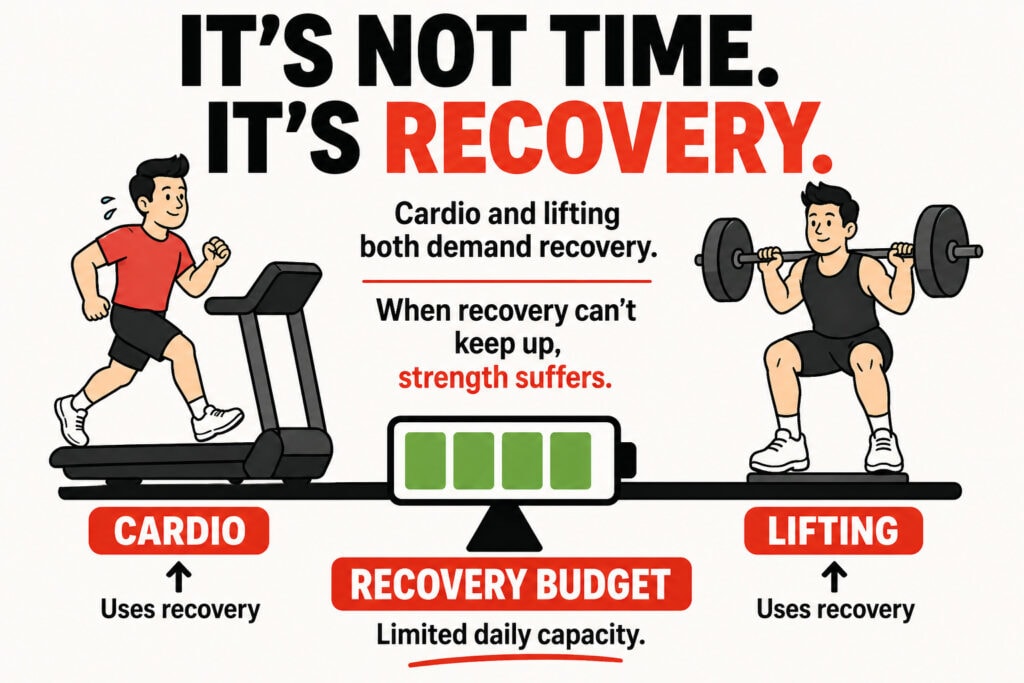
Your body has a limited recovery budget.
Cardio uses part of it.
Lifting uses part of it too.
When both keep demanding more than your body can repay, performance starts to slip.
And it’s not because cardio is bad.
It’s because you’re asking for everything at once without giving recovery a chance.
The interference problem exists, but it’s not black magic
You’ve probably heard the phrase:
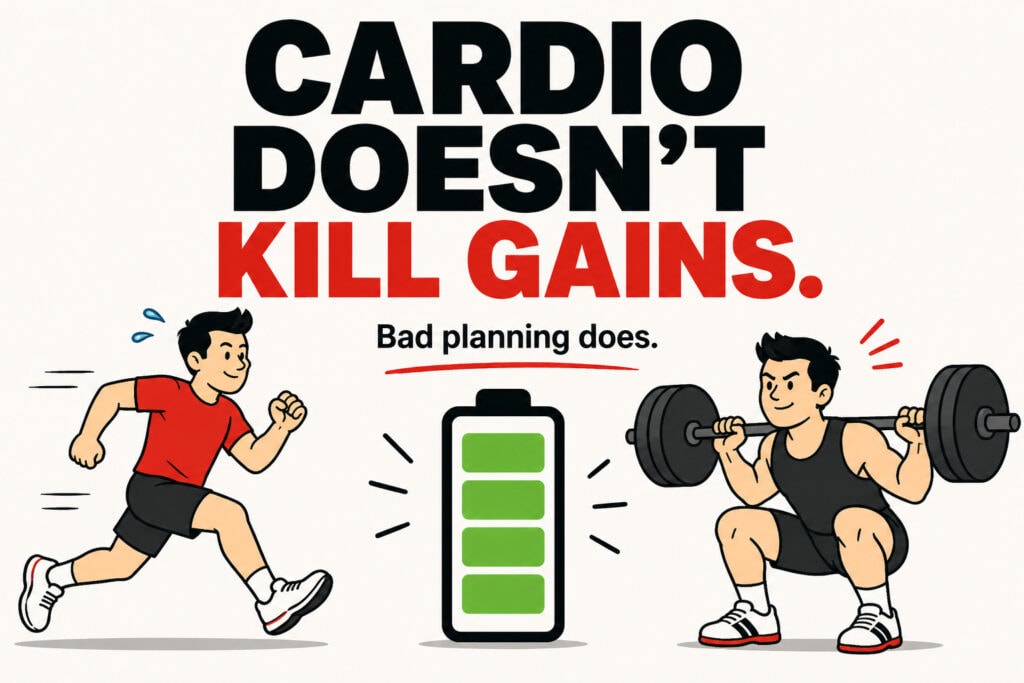
“Cardio kills gains.”
Said like that, it sounds like forbidden magic.
Reality is more boring—and more manageable.
The “interference effect” is the tendency, in some conditions, for endurance work to slightly reduce improvements in strength and hypertrophy.
It happens more easily when:
- you do a lot of cardio.
- cardio is hard and frequent.
- most of it is high-impact (like running) with high volume.
- it’s placed too close to heavy leg sessions.
- you eat too little and sleep poorly.
So cardio itself isn’t the villain.
Cardio becomes a problem when it’s basically a second full program stacked on top of the first without removing anything.
It’s like trying to max strength and endurance at the same time using the same skill points.
Possible.
But you have to distribute them wisely.
The real boundary: when cardio starts sabotaging your lifts
If you want a simple, brutal rule, here it is.
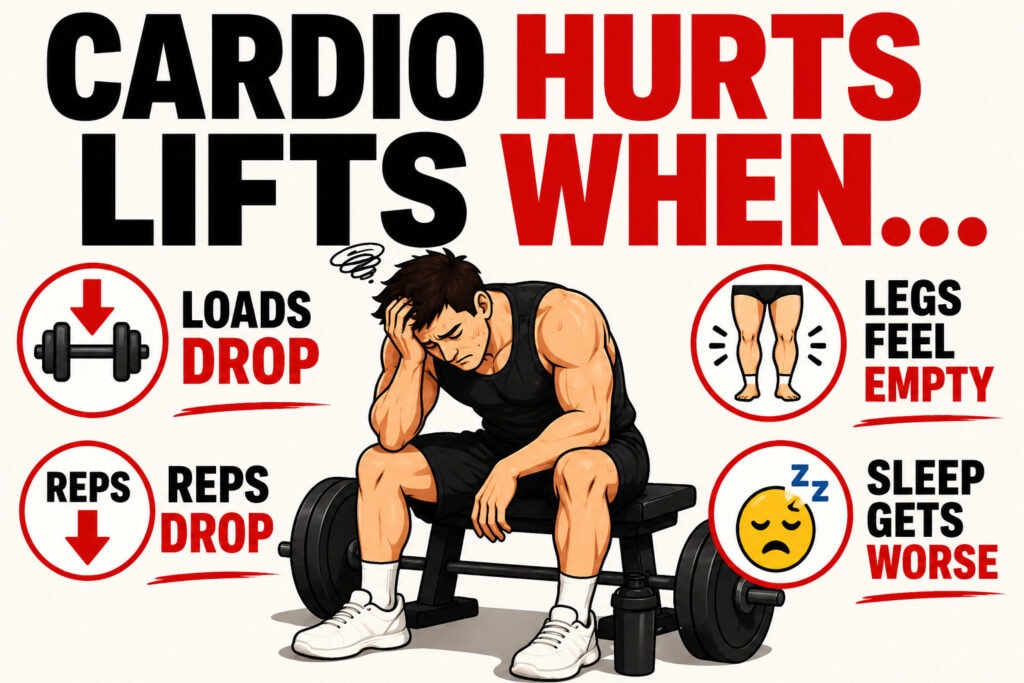
Cardio is “too much” when one of these things happens for 2–3 consecutive weeks (not just a couple bad days):
- Loads drop for no clear reason.
- Reps drop at the same perceived effort.
- Recovery between sets gets noticeably worse.
- Legs feel “empty” before you even start.
- DOMS last forever.
- Sleep worsens even though you’re exhausted.
- Hunger becomes extreme or disappears.
- Motivation drops because you feel constantly drained.
This isn’t normal training fatigue.
This is a trend.
A curve going down.
And that curve is often your body saying:
“You’re doing more work than I can absorb.”
Goal 1: strength and muscle first
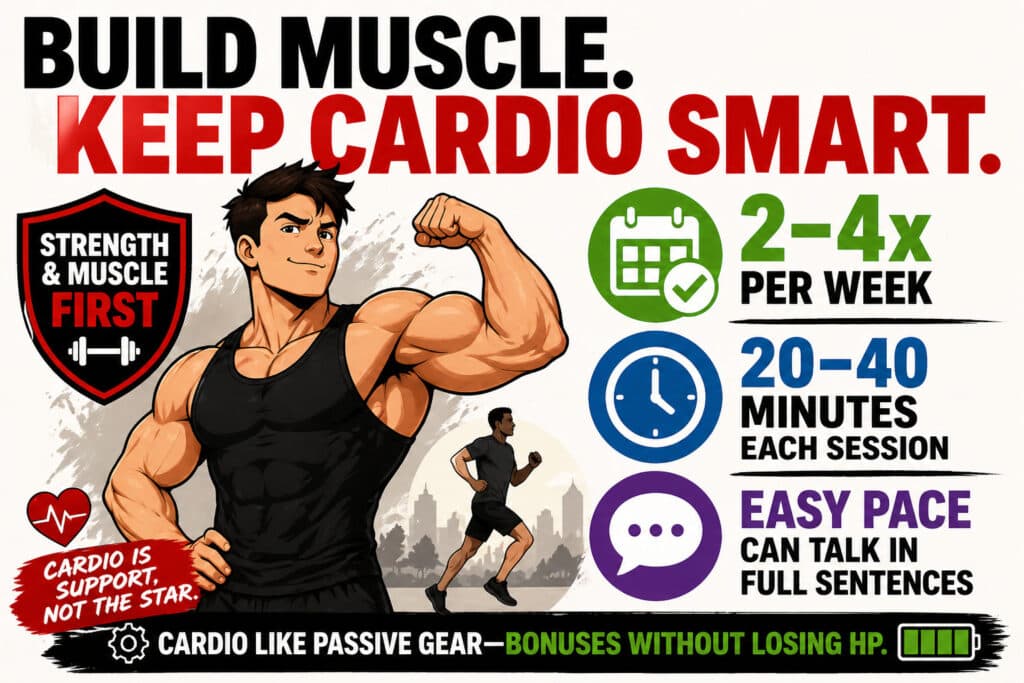
If your main goal is getting stronger and building muscle, cardio should be support.
Not a co-star stealing the spotlight.
In practice:
- enough cardio to improve health and recovery.
- not so much that it steals performance from lifting.
A solid range for many people is:
- 2–4 sessions per week of light/moderate cardio.
- 20–40 minutes each session.
- intensity where you can speak in full sentences.
Yes, it’s not much.
Yes, it works.
Yes, it feels “too easy.”
That’s why it’s sustainable.
It’s cardio like passive gear—bonuses without losing HP.
Goal 2: recomposition or fat loss
Here cardio becomes more tempting.
Because it burns calories.
Because it feels productive.
Because after a sweaty session you feel like you “earned” dinner.
The risk is using hard cardio as a shortcut while the calorie deficit is already stressful.
If you’re cutting and lifting seriously, the best cardio:
- increases energy expenditure.
- doesn’t destroy recovery.
- doesn’t turn your legs into jelly.
Translation: you want steady output, not one big move that leaves you drained.
In practice what often works:
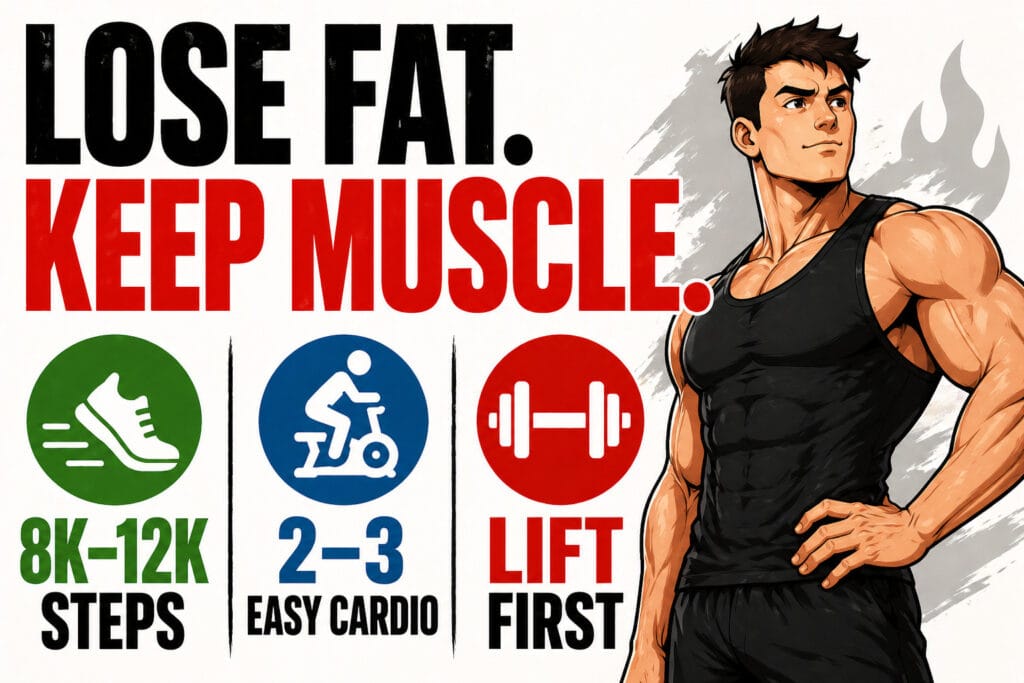
- more daily steps (NEAT).
- low-impact cardio (bike, incline walk, easy rowing).
- one intense session if you truly enjoy it—not four.
For many people cutting:
- 8,000–12,000 steps/day + 2–3 easy sessions is already a lot.
And lifting stays the priority.
Because lifting is what protects muscle while you lose fat.
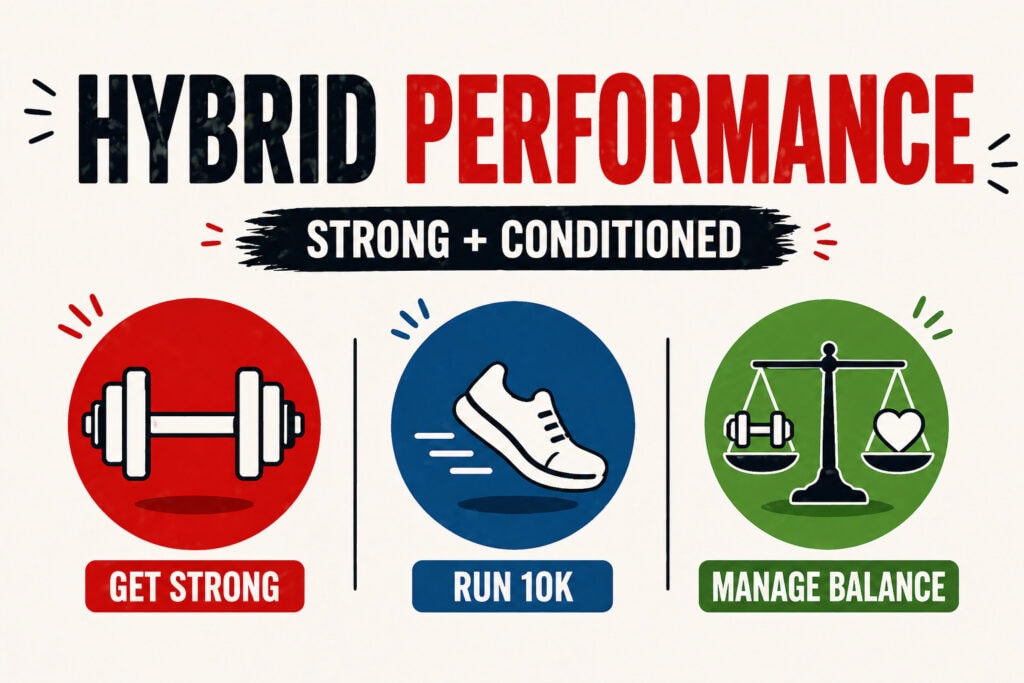
Goal 3: hybrid performance (strong + conditioned)
Now everything changes.
Because you want a hybrid build.
Something like:
“I want to squat decently and run 10K without dying.”
That’s possible.
But you must accept you’re multiclassing.
Progress will be slower in each quality compared to specializing.
But you’ll be more complete.
And often healthier.
Here “too much cardio” means:
“I’m trying to follow a runner’s plan and a powerlifter’s plan in the same month.”
Better to rotate priorities in blocks.
Or manage intensity and impact carefully.
The cardio that beats you up most is usually high-impact
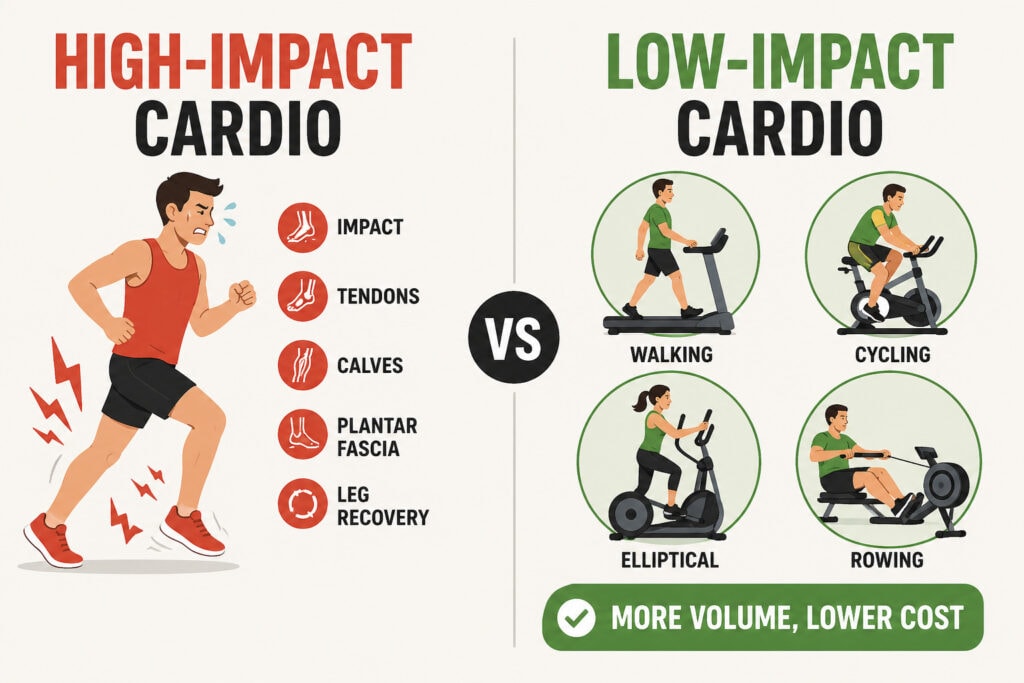
If you run a lot while also lifting heavy, pay attention.
Not because running is bad.
Because running has a high mechanical cost.
Repeated impact.
Tendons.
Calves.
Plantar fascia.
Leg recovery.
If you squat, deadlift, lunge, leg press, and also run 4–5 times per week, the body often starts charging interest.
Low-impact cardio usually allows more volume at a lower recovery cost.
Examples that are “gain-friendly”:
- brisk incline walking.
- cycling.
- elliptical.
- easy rowing.
Rowing can turn brutal fast.
Depends how you use it.
All-out rowing becomes mini-HIIT.
Easy rowing is gold.
Zone 2: the most underrated cheat code

Let’s explain Zone 2 simply.
Zone 2 is the level where:
- breathing is deeper than normal.
- you sweat a bit.
- you can talk, but not give a theatrical speech.
It’s controlled cardio.
Not an all-out sufferfest.
But it builds an aerobic base that:
- improves recovery between sets.
- improves total work capacity.
- improves cardiovascular health.
- often helps stress and sleep.
For lifters, Zone 2 is often the smartest choice.
Benefits with relatively low fatigue cost.
Literally a +1 recovery ring.
HIIT: powerful, but easy to abuse
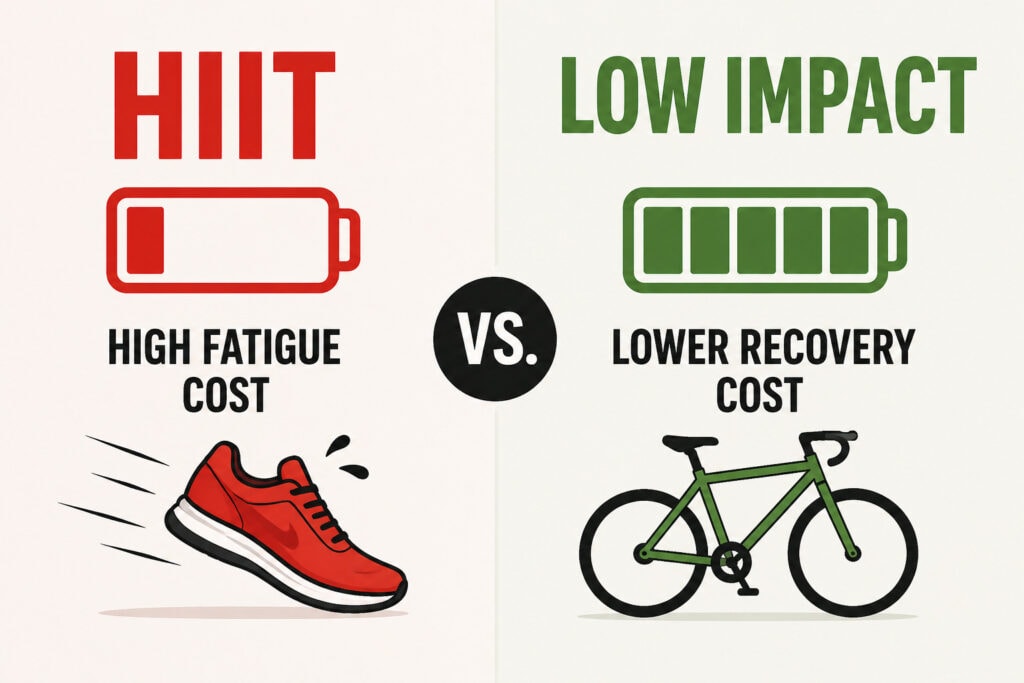
HIIT is great… until it becomes everything you do.
The issue isn’t HIIT itself.
The issue is that HIIT resembles a hard leg day in systemic fatigue.
Nervous system.
Lactate.
Central fatigue.
Stress.
If you lift hard and also do frequent HIIT, you stack hard days on hard days.
Eventually the body stops being impressed.
It just gets tired.
A practical rule for many people:
- 1–2 HIIT sessions per week max if you already push hard in the gym.
Often one is enough.
Especially if it involves legs.
To keep it manageable:
- keep HIIT short.
- use long recoveries.
- keep total volume low.
Think 6–10 short sprints, not 30 minutes of suffering.
Placement Matters a Lot
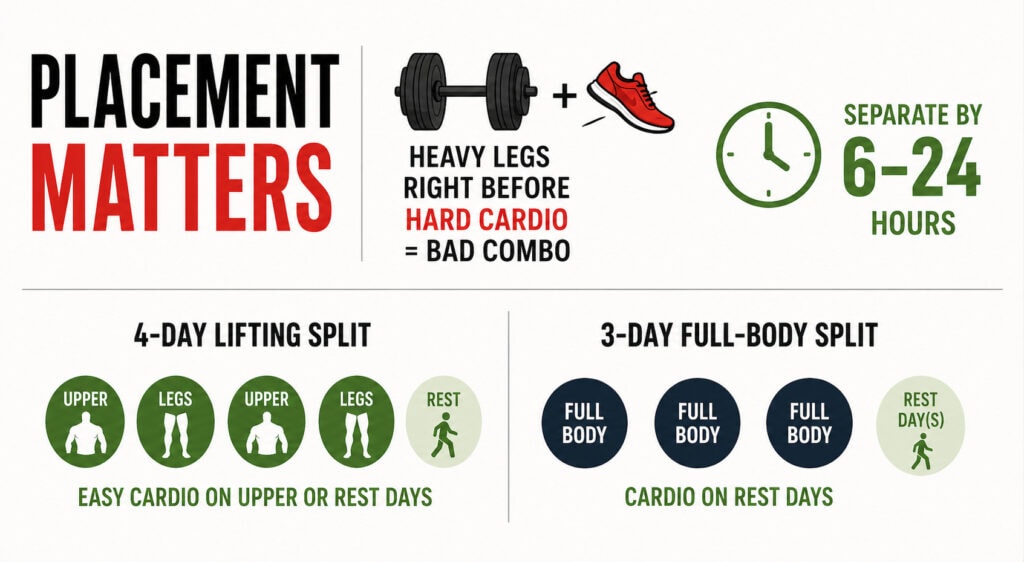
Two identical programs on paper can feel completely different just because of timing.
Heavy legs followed immediately by hard cardio is often a brutal combo.
Separating them gives you more margin.
Useful rules:
- easy cardio after lifting: often fine.
- hard cardio after lifting: usually a bad idea, especially after legs.
- hard cardio and heavy legs same day: only with experience and planning.
- separating sessions by 6–24 hours helps a lot.
If you lift 4 days:
- put easy cardio on upper days or rest days.
If you lift 3 full-body days:
- cardio on rest days works well.
How much cardio you can handle depends on your lifting volume
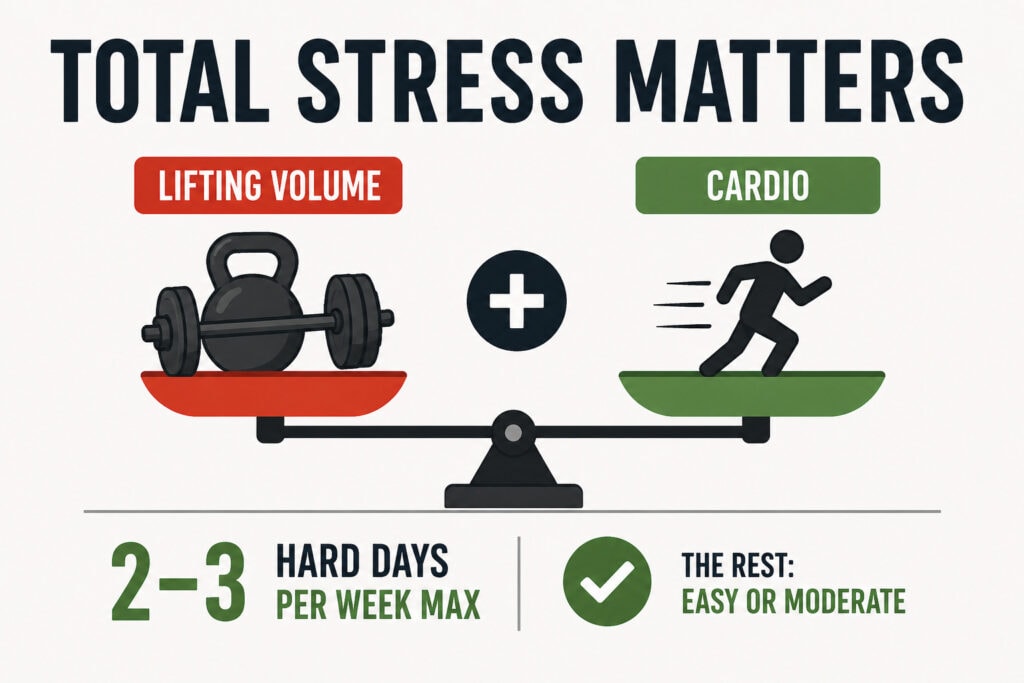
You’re not adding cardio into a vacuum.
You’re adding it on top of an existing stress load.
If you already do high weekly leg volume, recovery is taxed.
If your lifting volume is lighter or more technical, you can handle more cardio.
So the real question becomes:
How much total stress am I accumulating?
Cardio is just one line in the budget.
A simple rule:
- keep 2–3 truly hard days per week max (lifting + cardio combined).
- the rest should be easy or moderate.
If every day is “go hard,” eventually something breaks—and it’s usually you.
When Cardio Starts Costing More Than It Gives
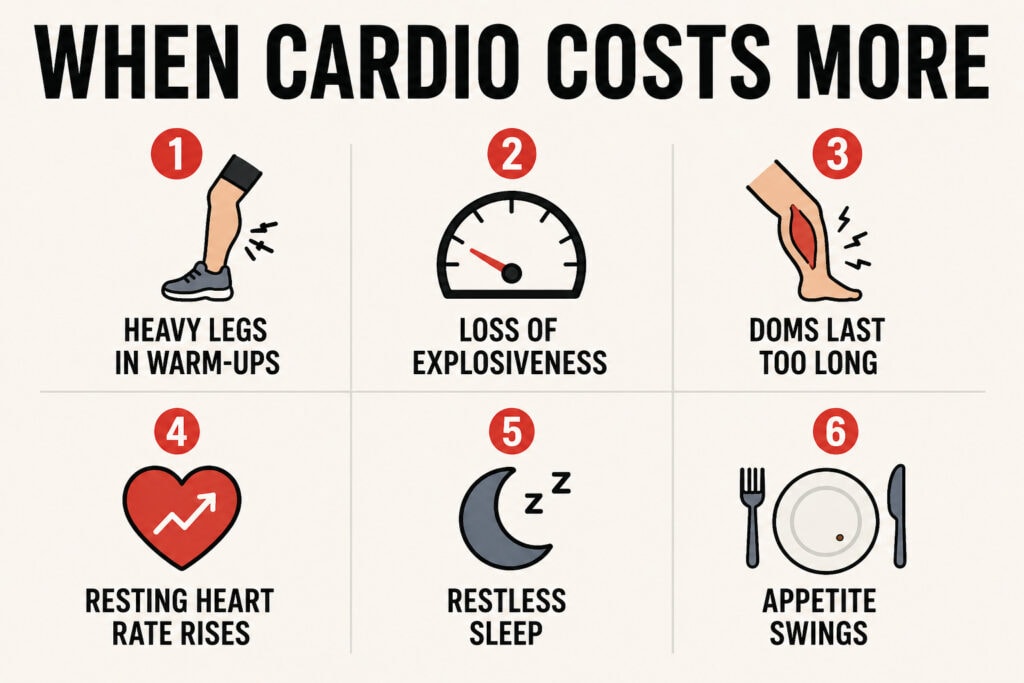
Some signals are more specific than others.
Here are the useful ones.
Cardio stops feeling “refreshing” and starts feeling draining
Good cardio usually leaves you feeling better after.
Lighter.
More awake.
But at some point, that flips.
You finish a session…
And instead of feeling recharged, you feel slightly emptied out.
Not destroyed.
Just… less than before.
That’s often the first shift.
Your baseline energy quietly drops
You don’t notice it in one day.
But across the week, something changes.
You feel a bit slower getting going in the morning.
A bit less sharp during the day.
Even simple things feel like they require more effort than usual.
That’s not laziness.
That’s accumulated fatigue showing up outside training.
Easy sessions don’t feel easy anymore
Pace stays the same.
Route stays the same.
But effort creeps up.
What used to feel automatic now needs focus.
Breathing gets heavier sooner.
Legs feel “present” in a way they didn’t before.
When easy stops being easy, recovery is already under pressure.
Rest days stop restoring you
You take a day off.
You expect to bounce back.
But the next day feels… similar.
Maybe slightly better.
But not fully reset.
That’s a sign the fatigue isn’t just from one session.
It’s stacking.
Smart cardio for lifters: NEAT, steps, micro-sessions
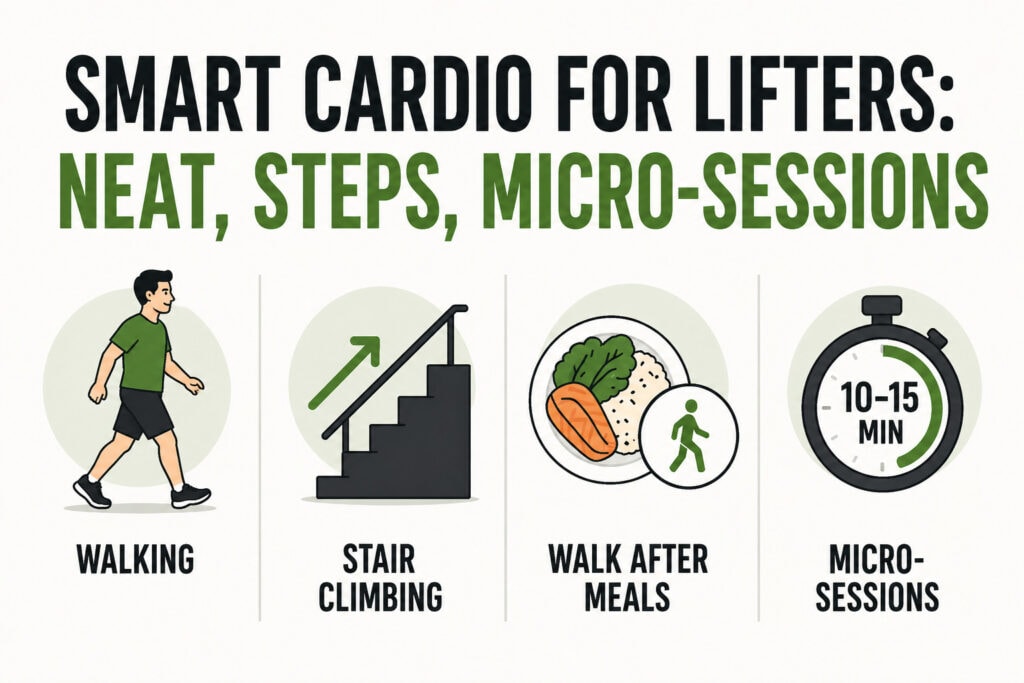
If you want fat loss or health benefits without wrecking recovery, the best choice often isn’t more HIIT.
It’s NEAT.
Daily low-stress movement.
Stairs.
10–15 minute sessions.
Why it works:
It increases expenditure without huge recovery debt.
It also helps digestion and blood sugar control.
Less epic.
More sustainable.
And sustainability is an S-tier skill.
Practical ranges you can actually use
These aren’t laws.
They’re safe starting zones.
For strength/muscle focus
- 2–4 easy cardio sessions weekly.
- 20–40 minutes.
- conversational intensity.
- 8,000–10,000 daily steps baseline.
For fat loss without losing performance
- 8,000–12,000 daily steps.
- 2–4 easy sessions.
- 1 optional HIIT.
- moderate calorie deficit.
For hybrid goals
- 3–5 total cardio sessions.
- max 2 hard days weekly.
- rest mostly Zone 2 or easy.
Solid Cardio + Lifting Layouts
Scenario A: 4 lifting days, muscle focus
Monday: upper + 20 min easy walk.
Tuesday: heavy leg day.
Wednesday: 30–40 min Zone 2 bike.
Thursday: upper + 15 min easy.
Friday: moderate leg day.
Saturday: 30 min easy walk.
Sunday: rest and steps.
Cardio supports, not steals.
Scenario B: 3 full-body days, fat loss
Monday: full body.
Tuesday: 45 min incline walk.
Wednesday: full body.
Thursday: 30–40 min easy bike.
Friday: full body.
Saturday: long walk + light mobility.
Sunday: rest.
High expenditure, manageable recovery.
Scenario C: hybrid
Monday: upper.
Tuesday: easy run 30–45 min.
Wednesday: heavy leg day.
Thursday: short quality run.
Friday: upper.
Saturday: light leg day or technique work.
Sunday: easy walk.
Running exists—but doesn’t crush legs daily.
When Cardio Starts Costing Muscle
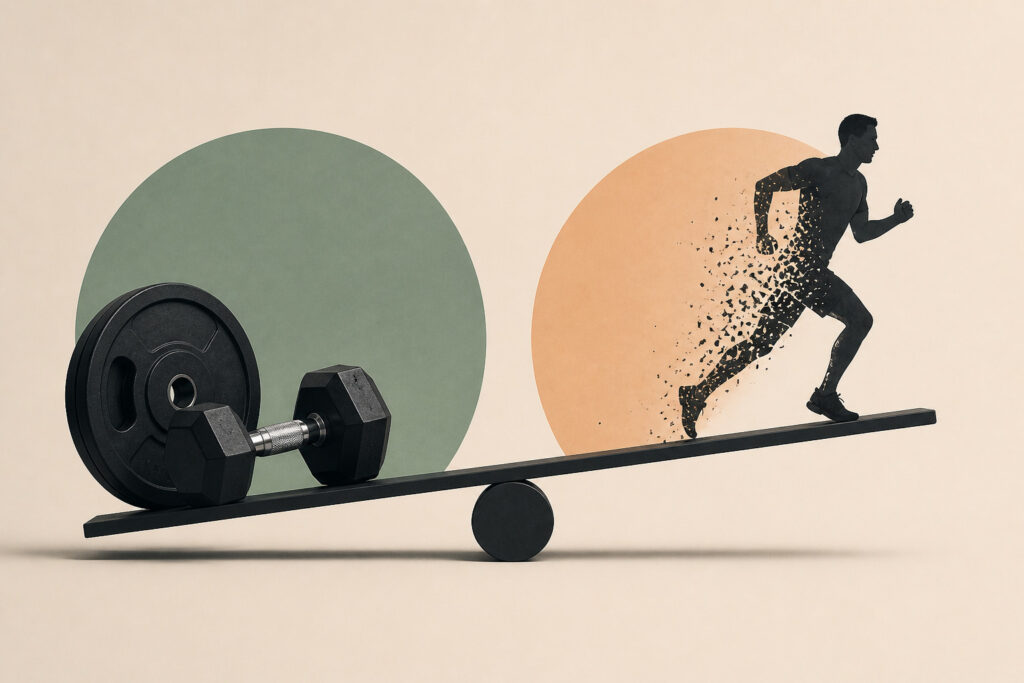
Feelings matter.
But objective markers help.
Track 2–3 indicators for 3–4 weesks:
- performance on key lifts.
- bodyweight trends.
- circumference measurements.
- sleep quality.
- real energy levels.
If bulking and:
- weight isn’t rising.
- performance isn’t rising.
- fatigue is high.
Cardio may be too high—or calories too low—or both.
Often both.
Cardio and calories: the “I burned it so I earned it” trap
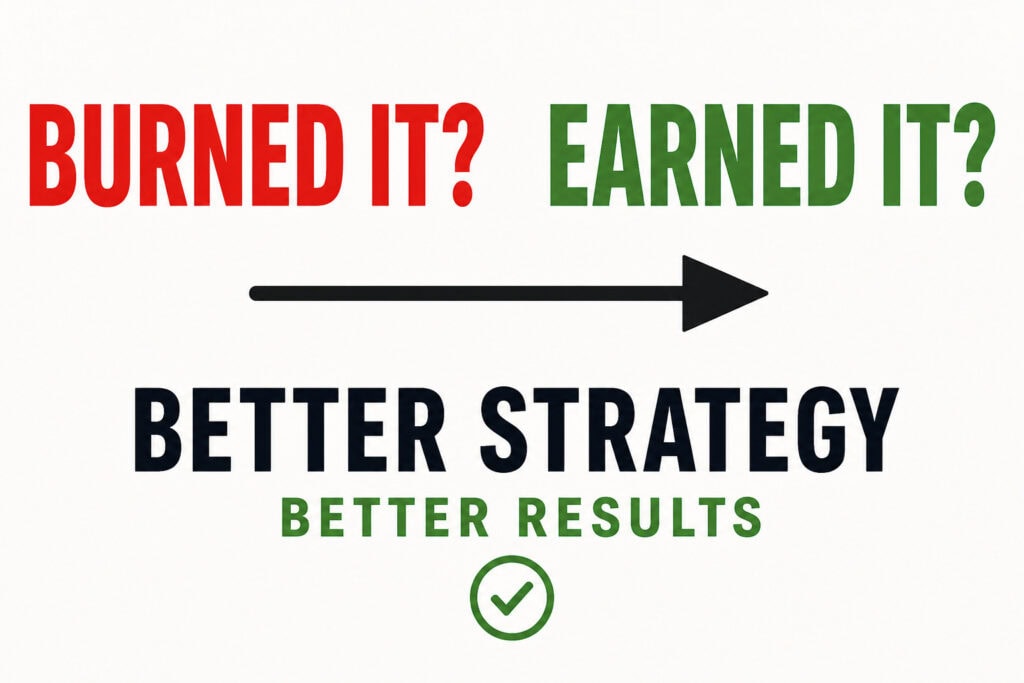
Common scenario:
You do a lot of cardio.
Eat “normally.”
End up in a huge deficit and poor recovery.
Or:
Do a lot of cardio.
Hunger explodes.
Deficit disappears.
Fatigue stays high.
Solution: treat cardio as part of your energy equation.
If cardio increases, decide:
- faster fat loss? accept some fatigue.
- maintain performance? eat more and keep cardio easy.
Carbs are fuel.
And lifting + cardio needs fuel.
When you’re actually doing too little cardio
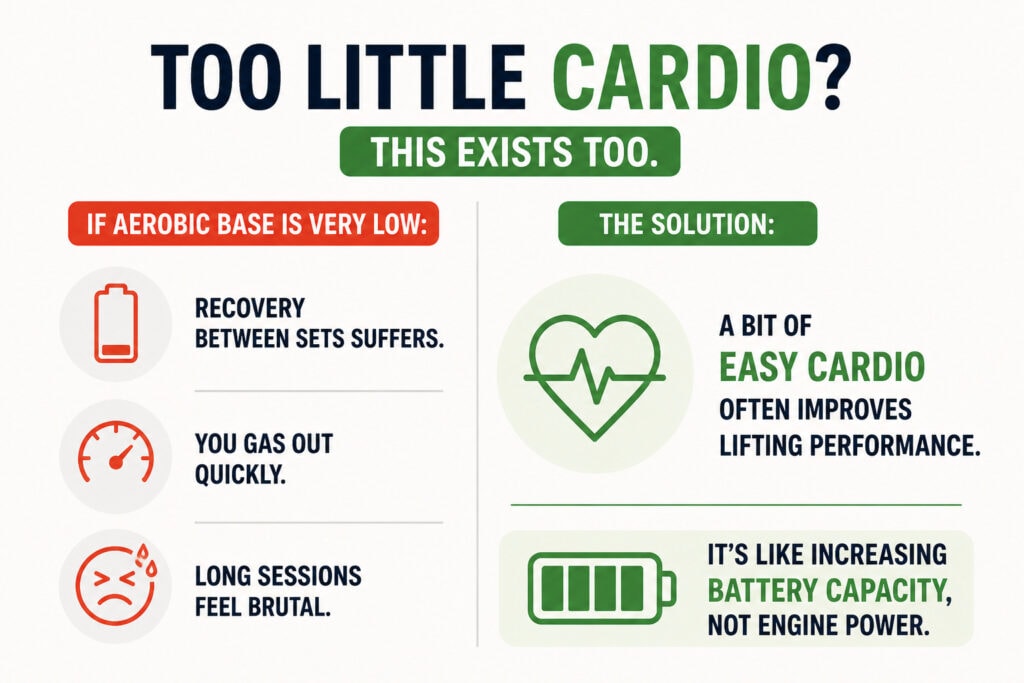
This exists too.
If aerobic base is very low:
- recovery between sets suffers.
- you gas out quickly.
- long sessions feel brutal.
A bit of easy cardio often improves lifting performance.
It’s like increasing battery capacity, not engine power.
Conclusion: cardio isn’t the enemy, it’s a useful tool if you don’t let it run the program.
Cardio is a tool.
Not a moral test.
Used well, it improves health, recovery, and work capacity.
Used poorly, it steals energy and dulls your sessions.
So keep it simple:
- choose your main goal.
- match cardio to support it.
- keep intensity rare.
- use Zone 2 as a base.
- monitor real signals for a few weeks.
If lifts start climbing again and sessions feel alive, you’ve found the right level.
If fatigue keeps building and numbers drop, you don’t need more willpower.
You need less debt.
And more strategy.
If you want, tell me:
- how many days you lift per week,
- what cardio you do (type and duration),
- and your main goal.
I can help you design a week that minimizes interference and actually works in real life.