
Cable crunches definitely play a real role in building the muscles that make up your abs.
They train your core with enough resistance to actually grow, not just burn.
But even though they’re a powerful tool for shaping that “six-pack” structure, they don’t have any control over whether those abs show through your midsection.
Visibility comes down to what sits on top of the muscle — mainly body fat, genetics, and overall conditioning.
So cable crunches can absolutely upgrade the strength and density of your abs, but revealing them is a separate project that happens outside the cable machine.
What Cable Crunches Actually Do To Your Abs
Cable crunches are a loaded spinal flexion exercise.
That means you’re training the front of your core by rounding your spine against resistance.
The main muscles doing the work are:
- Rectus abdominis (the famous “six-pack” area)
- Obliques (especially when you adjust angle and rotation)
Instead of endless bodyweight crunches, cable crunches let you add weight in a controlled way.
This turns your ab training from “just burning” into a real strength and hypertrophy stimulus.
Kind of like switching from tapping the gas pedal to actually stepping on it.
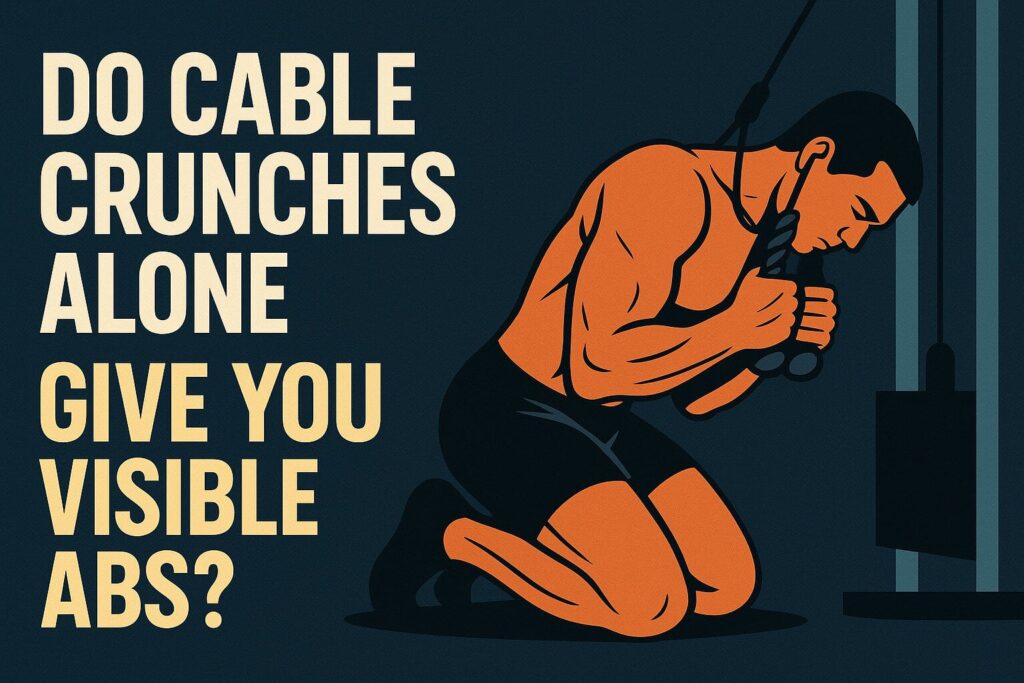
Do Cable Crunches Alone Give You Visible Abs?
Here’s the part nobody likes but everybody needs.
Cable crunches can make your abs thicker, stronger, and more defined in shape.
They do not control how much fat sits on top of those abs.
Visible abs are mostly a combo of:
- Total body fat level
- Genetics (where your body prefers to store fat)
- Muscle thickness of the abs
So you can absolutely build powerful abs with cable crunches and still not see them clearly if your body fat is higher.
Why Cable Crunches Are Still Worth Doing
Even if you don’t have “shredded” abs yet, cable crunches are not a waste of time.
They can help you:
- Build stronger trunk flexion for squats and deadlifts
- Improve bracing and stability in heavy compound lifts
- Reduce the “no core” feeling during rows, presses, and overhead work
- Get that deep, dense ab look once you lean out
They also let you train your abs like any other muscle group.
Progressive overload, clear technique, trackable progress.
That’s a lot better than just doing random crunch marathons on the floor and hoping for the best.
Why You Can Do 1,000 Cable Crunches And Still Not See Abs
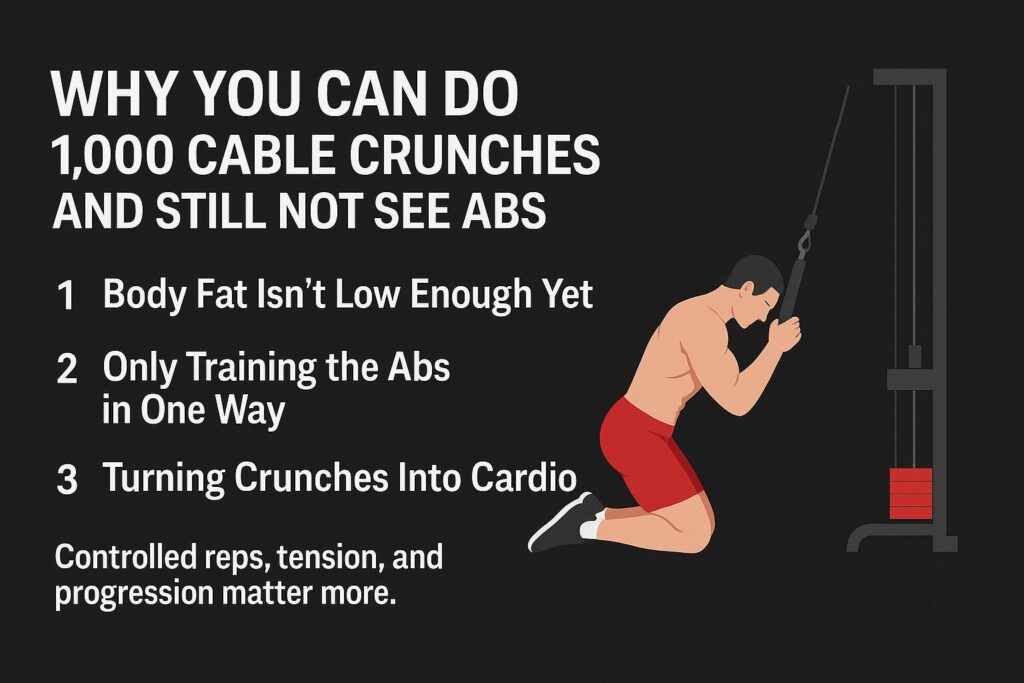
There are three big reasons people get disappointed.
Reason 1: Body fat isn’t low enough yet
You can’t out-crunch a calorie surplus.
If your nutrition doesn’t create at least a mild calorie deficit, the fat covering your abs will stay.
You might actually feel your abs getting stronger under there.
You just won’t see them clearly.
Reason 2: Only training the abs in one way
Cable crunches train spinal flexion, but your core also needs:
- Anti-extension (planks, ab-wheel, dead bugs)
- Anti-rotation (Pallof press, suitcase carry)
- Lateral stability (side planks, carries, Copenhagen planks)
Doing only cable crunches is like training only bench press and ignoring your back.
Something will feel off in the long run.
Reason 3: Turning them into cardio
If you’re using very light weight and just rushing through reps until your soul leaves your body, you’re not really building strength or size.
You’re mostly doing ab cardio.
That burn is not a bad thing, but it’s not the main metric that matters.
Controlled reps, tension, and progression matter more.
How To Do Cable Crunches With Clean, Safe Form
Done wrong, cable crunches turn into a weird kneeling head-bob with a rope on your neck.
Done right, they feel like your abs are doing a strict “body curl” against the weight.
Set-up
- Use a high cable with a rope attachment
- Kneel facing the machine, a step or two back from the stack
- Grab the rope and bring it near the sides of your face or slightly above your forehead
- Keep your hips roughly over your knees, not sitting all the way back on your heels
You want enough distance so the cable pulls slightly forward and down.
Body position
- Start in a tall, neutral spine position
- Ribcage down slightly, not flared
- Glutes lightly engaged, core gently braced
Think “proud chest, long spine” before you start each rep.
Execution
- Start the movement by bringing your ribcage toward your pelvis
- Round your upper and mid-back slightly as you crunch down
- Let your elbows travel toward your thighs, but don’t focus on the elbow movement
- Pause 1 second at the bottom and squeeze your abs hard
- Slowly uncurl back up under control, returning to neutral
Imagine doing a slow, precise bow instead of head-butting an invisible wall.
Breathing
- Inhale at the top before you start the rep
- Exhale as you crunch down and squeeze
- Take a small breath as you reset at the top
Proper breathing helps you keep tension and avoid just bouncing.
What you should feel
- Strong tension through the front of your abs
- Less stress in your neck
- Minimal pulling in your lower back
If your neck takes the beating, reduce the weight, slow down, and focus on curling the spine rather than yanking the rope.
Programming Cable Crunches For Real Results
You don’t need to do cable crunches every single day.
Treat them like any other hypertrophy exercise.
How many sets and reps
Solid starting guidelines:
- 2–4 sets per session
- 10–20 reps per set
- 60–90 seconds rest between sets
Lower reps (8–10) with heavier weight = more strength focus.
Moderate reps (12–20) with controlled tempo = great for size and control.
How heavy should you go
Pick a weight where:
- Last 3–4 reps are challenging
- You still control the movement
- You’re not swinging or cutting the range of motion in half
If the stack flies up and down like you’re trying to launch it into orbit, it’s too heavy.
How often per week
Most people do well with:
- 2–3 cable crunch sessions per week
That gives enough stimulus without turning your abs into a permanently sore brick.
Where Cable Crunches Fit In Your Overall Core Plan
Cable crunches are just one tool in the toolbox.
A well-rounded core week could look like this.
Movement types to cover
Try to include:
- Flexion: cable crunches, reverse crunches
- Anti-extension: planks, ab-wheel rollouts, dead bugs
- Anti-rotation: Pallof press, single-arm carries
- Lateral stability: side planks, suitcase carries
You don’t need all of them every workout, but across the week, it helps to touch each category.
Placing cable crunches in your workout
Good options:
- After your main compound lifts (squats, deadlifts, presses)
- Superset with a non-core isolation exercise (like curls or lateral raises)
- As part of a short, focused core block at the end of your session
You want enough energy to execute them with control, but not so early that they fatigue your bracing before heavy lifting.
What About Neck Pain, Hip Flexors, Or Lower Back Discomfort?
If cable crunches feel “wrong” instead of hard, something in the setup probably needs adjusting.
Neck pain
Common causes:
- Pulling the rope with your arms and neck
- Letting your chin jam toward your chest aggressively
Fixes:
- Keep your neck neutral, eyes roughly toward the floor in front of you
- Think “chest to pelvis” instead of “head to floor”
- Use a lighter weight and slower tempo until control improves
Hip flexors doing all the work
If you mainly feel the front of your hips, you might be sitting back too far.
Fixes:
- Keep hips more stacked over knees
- Initiate from the ribs, not by sitting your butt back
- Try a slightly smaller range of motion at first, focusing on the mid-range squeeze
Lower back discomfort
If your lower back complains, it might be:
- Over-arching at the top
- Collapsing too hard at the bottom
- Using too much weight and losing control
Fixes:
- Start from neutral instead of exaggerated extension
- Keep the movement smooth and controlled
- Drop the weight and rebuild technique before going heavy again
Abs, Diet, And Expectations: The Boring But Honest Part
You can’t talk about “getting abs” and skip food.
Cable crunches help build the muscle.
For most people, visible abs usually require:
- A consistent calorie deficit over time
- Enough protein to maintain muscle
- Training that keeps your whole body strong
The exact body fat percentage where your abs pop is individual.
Some see them around 15–18%, others have to go lower.
That part is genetics plus lifestyle, not the cable machine’s fault.
Doing cable crunches while ignoring nutrition is like installing a performance engine and never tuning the car.
Sample Week With Cable Crunches
Here’s one way to plug cable crunches into a normal lifting week.
This is just an example, not a fixed law of the universe.
Day 1 – Lower body + core
- Squats or leg press
- Romanian deadlift or hip hinge variation
- Leg accessories
Core block:
- Cable crunches – 3 x 12–15
- Side planks – 3 x 20–30 seconds per side
Day 3 – Upper body + core
- Bench press or dumbbell press
- Row variation
- Shoulder and arm accessories
Core block:
- Pallof press – 3 x 10–12 per side
- Cable crunches – 2–3 x 15–20
Day 5 – Full body + core
- Deadlift or trap-bar deadlift
- Pull-ups or lat pulldown
- Push accessory
Core block:
- Ab-wheel or stability ball rollout – 3 x 8–12
- Light cable crunches – 2 x 15, focusing on control
Are Cable Crunches Enough On Their Own?
If the question is:
“Can cable crunches help build the muscle that becomes visible abs?”
Then yes, they are a strong choice.
If the question is:
“Can I get a shredded six-pack just by doing cable crunches and ignoring everything else?”
Then no, that’s not how the body works.
Think of cable crunches as:
- A powerful main move for your front core
- One piece of a bigger core training puzzle
- A long-term investment in how your torso looks and performs
Pair them with:
- A sensible nutrition plan
- Full-body strength training
- Other core patterns (anti-extension, anti-rotation, lateral stability)
Do that consistently, and cable crunches stop being a “magic trick” and become what they really are.
A solid, reliable tool that helps your abs actually grow, so when your body fat comes down, there’s something impressive to show.
Final Takeaway
Cable crunches do help give you abs, in the sense that they build actual ab muscle.
They don’t control your body fat, and they’re not the only core move you’ll ever need.
Use them with clean form, smart programming, and a realistic plan for nutrition and overall training.
Then your abs stop being a mystery and start being a project.