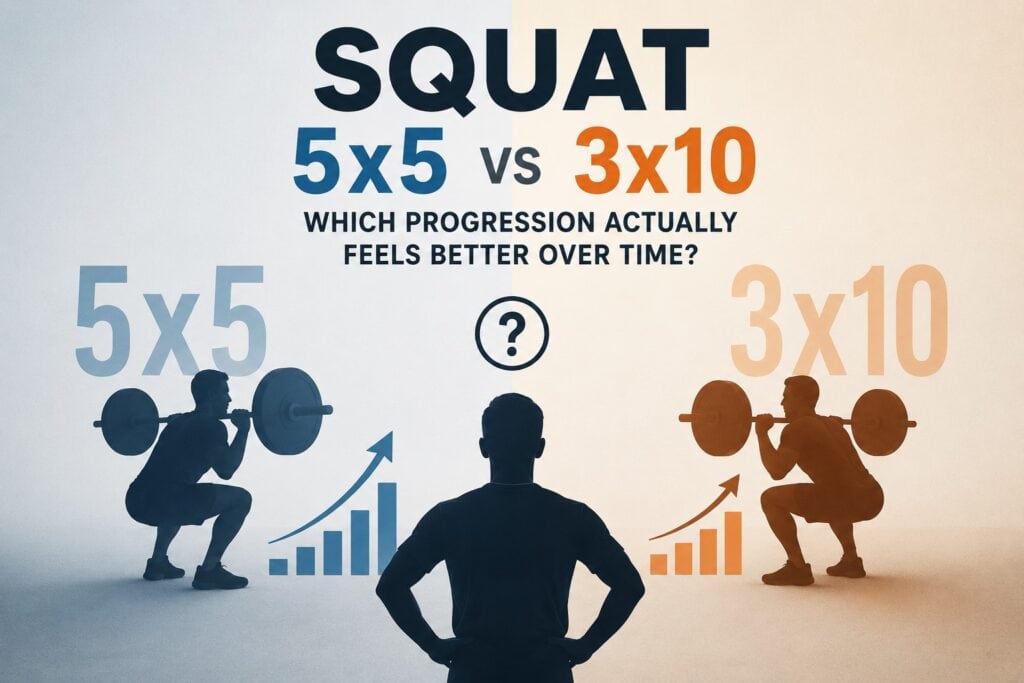
Squat 5×5 vs 3×10 sounds like a simple set-and-rep choice.
Then the bar settles across your back, the warm-up starts, and the rack suddenly gets very honest.
I’ve run both squat progressions, and the difference is not just “heavy strength work” versus “higher-rep leg work.”
The real difference shows up in the rack.
Warm-up plates, awkward walkouts, slowing reps, and one slightly humbling barbell tell you more than the program name ever could.
The Rack Changes Before the Set Even Starts
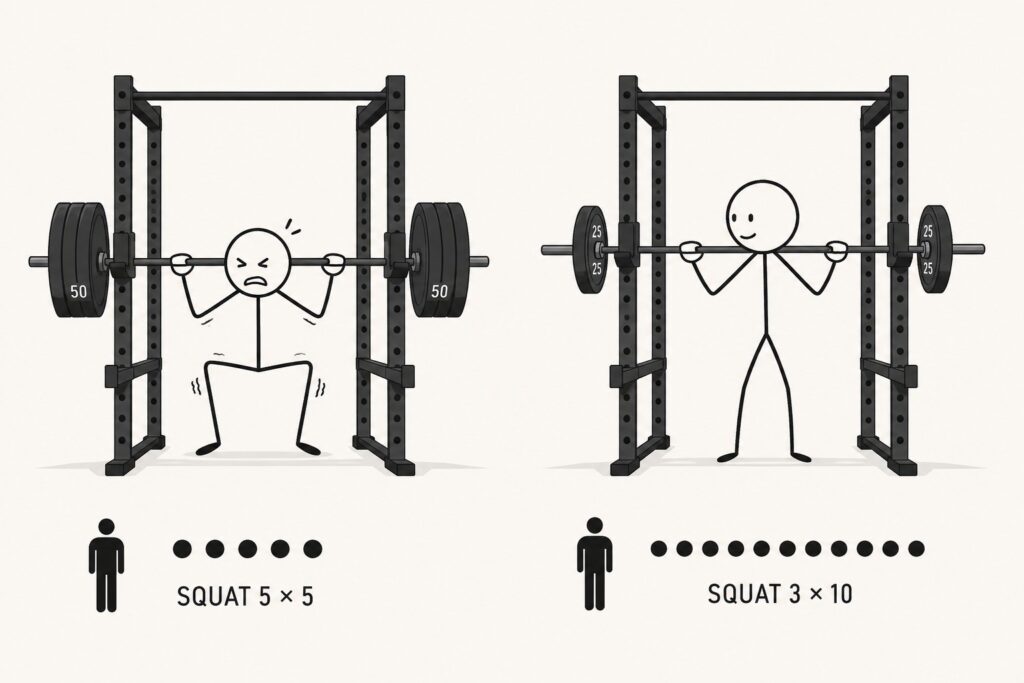
The 5×5 squat session has a different mood before the first working rep.
The plates go on slower.
The rack height gets checked twice because one bad unrack can ruin the whole party.
Hands grab the bar, the upper back tightens, and suddenly the gym sounds a little quieter than it did five minutes earlier.
A 3×10 squat session begins with less pressure.
The bar looks lighter.
The warm-up reps move smoothly.
Confidence walks in wearing sunglasses.
Then the set keeps going, and rep eight reminds everybody that lighter does not mean easy.
That is the first useful difference I notice.
The 5×5 approach feels serious early.
The 3×10 version becomes serious after fatigue has had time to sneak into the room.
Five-by-Five Makes Me Respect the First Rep
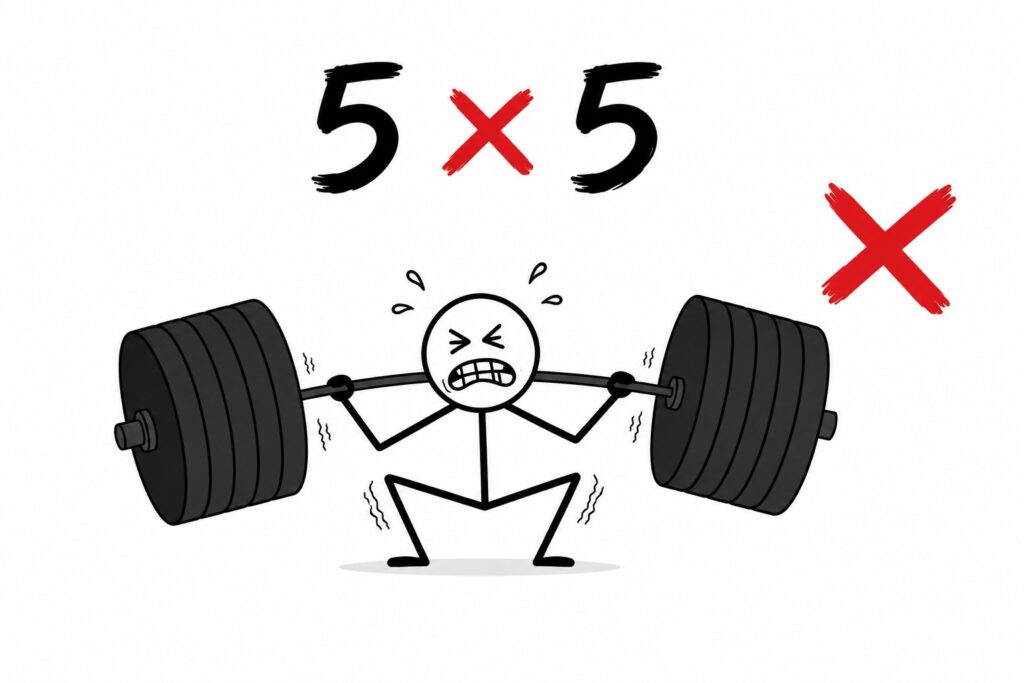
With 5×5, the first rep matters more than I want it to.
A messy start usually turns the whole set into damage control.
The walkout has to be calm.
Feet need to land where they can push the floor without shifting around.
The bar has to sit solid across the upper back instead of rolling slightly every time the body moves.
A good squat begins by bending the knees and hips together.
The hips travel down between the legs.
The knees move in line with the toes.
The torso leans only as much as your body shape needs.
Quads help straighten the knees.
Glutes help drive the hips up.
The trunk keeps the middle of the body firm so the legs can actually work.
During a good 5×5 day, the bar path stays boring in the best possible way.
Down.
Up.
Clean.
No weird twisting.
No last-second bargaining.
During a bad 5×5 day, the warning arrives before the lift looks bad.
The unrack feels heavier than expected.
The first step back feels clumsy.
The bar sits across the back like it brought paperwork.
I used to ignore that.
The notebook said to add weight, so I added weight.
Very scientific.
Very dumb.
A useful 5×5 squat progression usually works best when:
- warm-up sets move with control
- the first working rep does not already feel slow
- depth stays consistent
- the torso does not fold forward out of the bottom
- the knees stay in line with the toes
- the last rep is hard but still looks like a squat
Five-by-five teaches strength, but it also teaches honesty before the set even starts.
Three-by-Ten Tricks Me Because the First Reps Behave
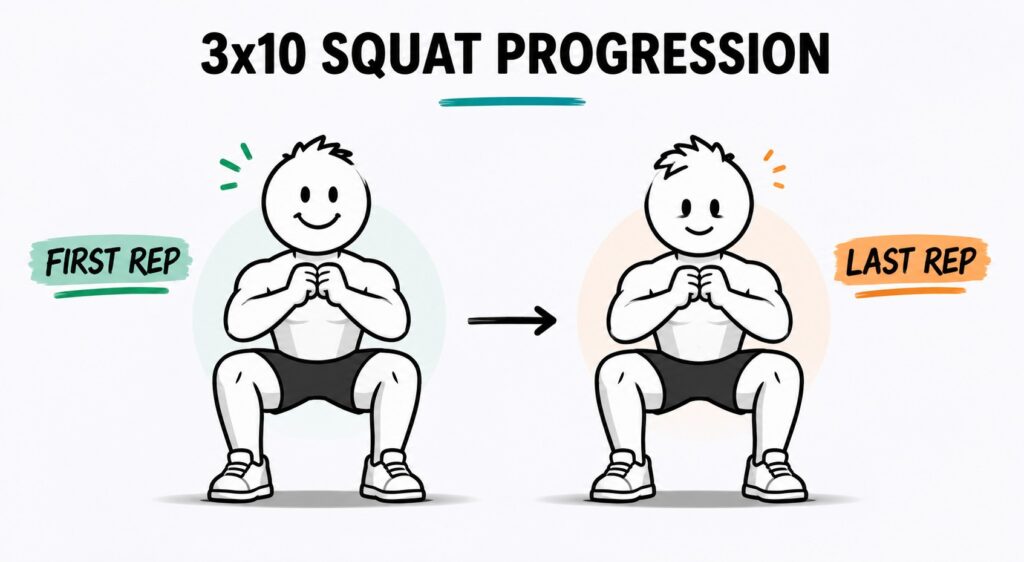
A 3×10 squat set usually starts with fake kindness.
Rep one feels almost too smooth.
Rep three still feels controlled.
Rep five makes me think the weight choice was brilliant.
Then rep seven arrives, and the room becomes educational.
The legs begin to fill with heat.
The bottom position takes more attention.
Standing up still works, but the movement wants to get shorter, faster, and messier.
That is where 3×10 gives its lesson.
The weight is lighter, but the set leaves more time for technique to leak.
A good 3×10 squat needs rhythm.
Lower under control.
Reach a depth that can be repeated.
Stand up without bouncing, twisting, or turning the final reps into panic-flavored half squats.
One bad choice I make with 3×10 is starting like I’m trying to finish before the music changes.
The first five reps fly.
The last five look like the easy weight finally remembered it was still a squat.
A useful 3×10 squat progression usually works best when:
- the first rep and last rep still look related
- the load allows all ten reps to stay controlled
- breathing stays organized enough to keep the torso firm
- leg fatigue does not become lower-back pressure
- depth does not disappear near the end
- the set stops before creativity enters the movement
Three-by-ten is not easier than 5×5.
It is easier to underestimate.
The Better Progression Is the One That Breaks Less Ugly
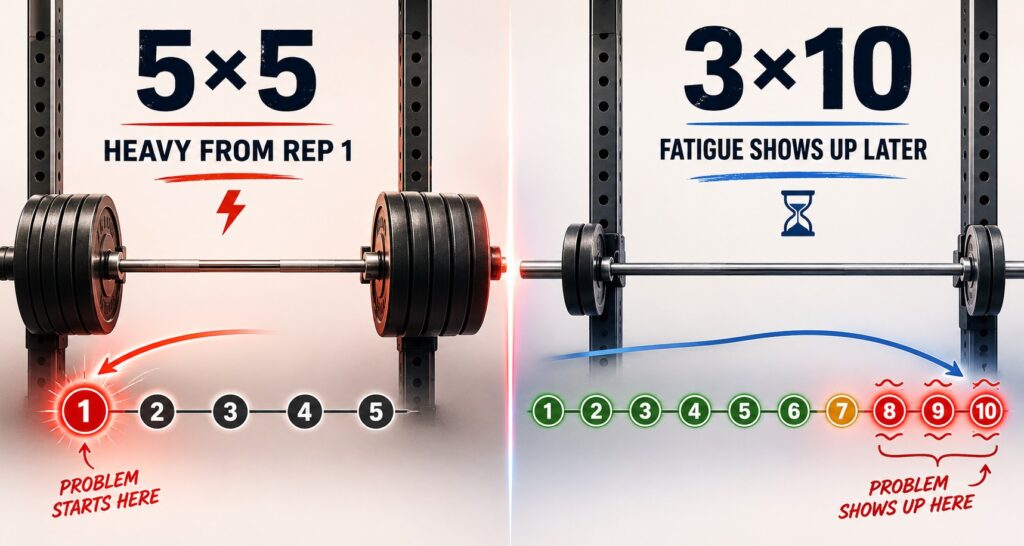
Most basic comparisons say 5×5 is better for strength and 3×10 is better for muscle.
That is useful, but it misses the part I actually care about in the rack.
Where does each progression start falling apart?
With 5×5, trouble usually shows up before or during the first reps.
The load gets ambitious.
The walkout feels unstable.
The body gets tense before the descent.
Depth gets shallower because the bar feels heavier than planned.
With 3×10, trouble usually appears later inside the set.
The load seems fine.
The early reps pass cleanly.
Fatigue builds.
Suddenly rep nine has a different personality from rep two.
That difference changes what I watch during the set.
During 5×5, I pay attention to:
- the unrack
- the first step back
- the first descent
- bar speed out of the bottom
- whether I need too much mental hype before starting
During 3×10, I pay attention to:
- pacing
- depth near the final reps
- knee control as fatigue builds
- whether the torso starts leaning more
- whether the set still looks controlled after rep six
Five-by-five tells you if the load is too much for your current strength.
Three-by-ten tells you if your technique can survive fatigue without turning into a different lift.
That is the useful comparison most lifters can actually use.
Beginners Usually Need a Squat They Can Repeat
A beginner walking straight into 5×5 can make the squat feel heavier than it needs to feel.
A beginner jumping into hard 3×10 can also get buried in fatigue before the movement is learned.
I’ve had sessions where the smartest squat choice looked almost embarrassingly simple.
One dumbbell.
One quiet corner.
A goblet squat that made me realize my barbell squat had more confidence than control.
A goblet squat is simple.
Hold one dumbbell close to the chest.
Keep the feet around shoulder width.
Point the toes slightly out if that helps the knees move comfortably.
Squat down between the legs.
Stand up by pushing the floor away.
That version teaches balance without making the barbell part of the problem.
A box squat can also help.
Sit back toward a box or bench, touch it lightly, then stand back up.
The box gives a depth target, which makes every rep easier to judge.
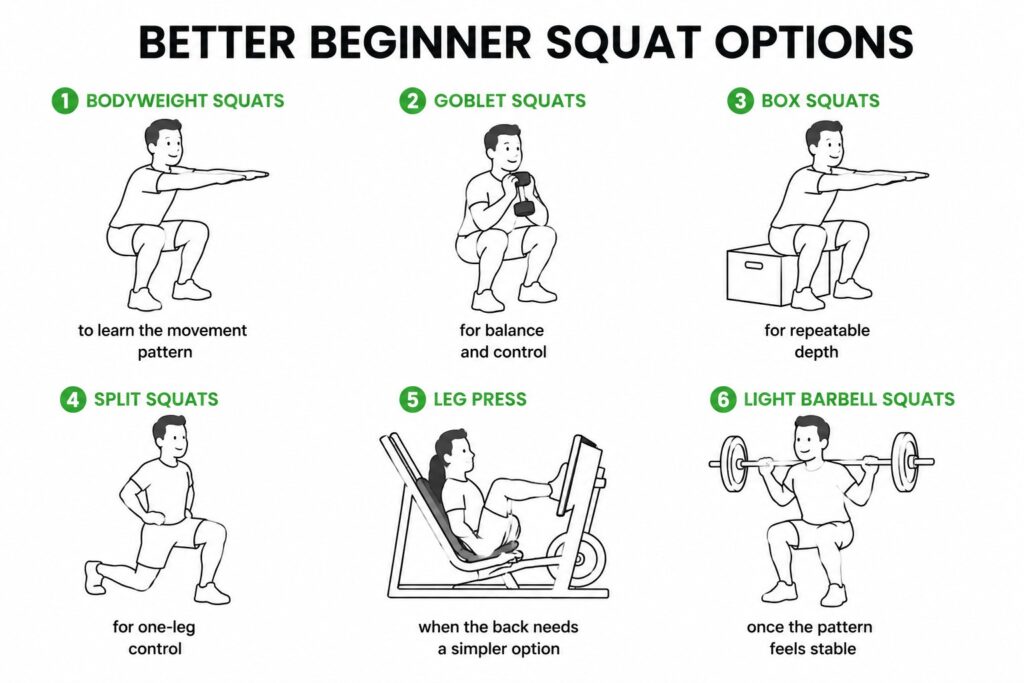
Better beginner squat options include:
- bodyweight squats for learning the pattern
- goblet squats for balance and control
- box squats for repeatable depth
- split squats for one-leg control
- leg press when the back needs a simpler option
- light barbell squats once the pattern feels stable
A beginner does not need the hardest progression first.
A beginner needs reps that can be repeated without the body inventing a new sport halfway through.
Five-by-Five Gives Me Clearer Strength Feedback
The best part of 5×5 is how obvious the feedback feels.
Add a little weight.
Do five clean reps.
Repeat across the sets.
Either the bar moves with control, or it does not.
There is less guessing.
A strong 5×5 squat day feels focused.
The warm-ups build neatly.
The working sets have a clear target.
The legs push hard, but the set ends before the squat starts losing its shape.
Heavy loads tend to improve maximal strength especially well, while muscle growth can happen across a wider range of loads when sets are challenging enough, according to a 2017 review and meta-analysis by Schoenfeld and colleagues.
That matches what I notice in the rack.
Heavy fives make me better at handling heavier fives.
Shocking, I know.
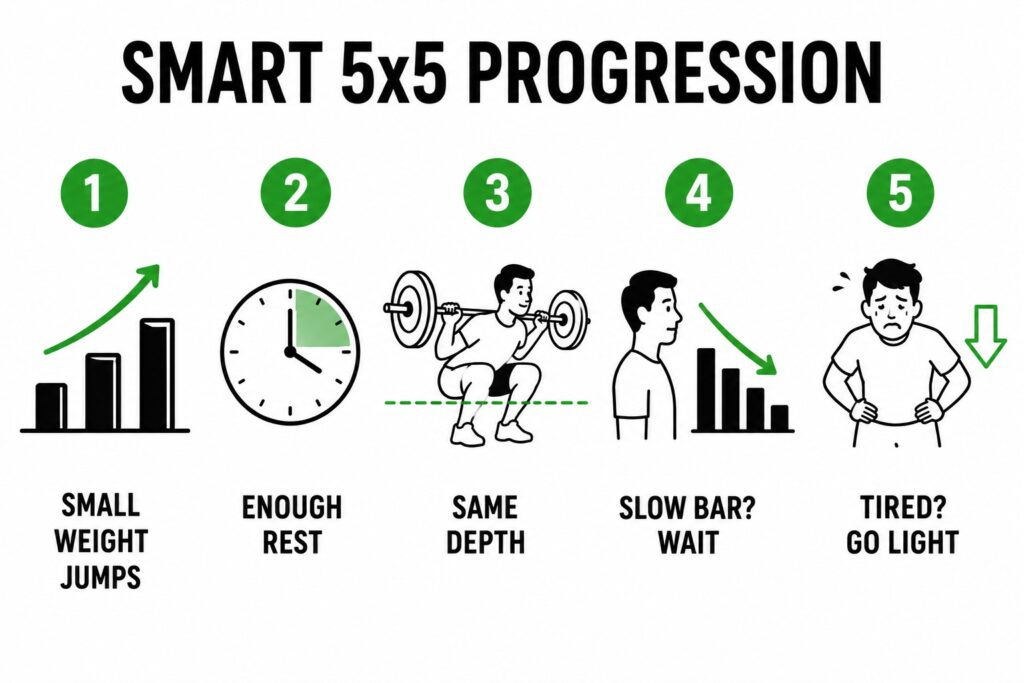
A smart 5×5 progression usually needs:
- small weight jumps
- enough rest to make each set clean
- consistent depth before adding load
- patience when the bar speed slows
- lighter sessions when the body clearly arrives undercooked
The wrong move is treating 5×5 like a legal contract.
Some days the weight should stay where it is.
A few days, the better choice is taking weight off and keeping the reps worth counting.
Three-by-Ten Gives Me More Practice Without Making Every Set Heavy
Three-by-ten gives the squat more repetition.
More reps mean more chances to practice the movement.
More reps also mean the legs spend more time working.
That can be useful when the goal is muscle, control, and confidence under the bar.
The lighter load also changes the mind.
Standing under a manageable bar lets the body relax enough to move better.
That matters more than people admit.
During 3×10, I notice the squat rhythm more.
The descent needs patience.
The bottom position needs consistency.
The final reps need discipline instead of speed.
A good 3×10 progression usually needs:
- a load that leaves one or two clean reps available
- steady pacing from the beginning
- a depth target that does not change
- fewer reps if form starts drifting
- a variation that matches the body that day
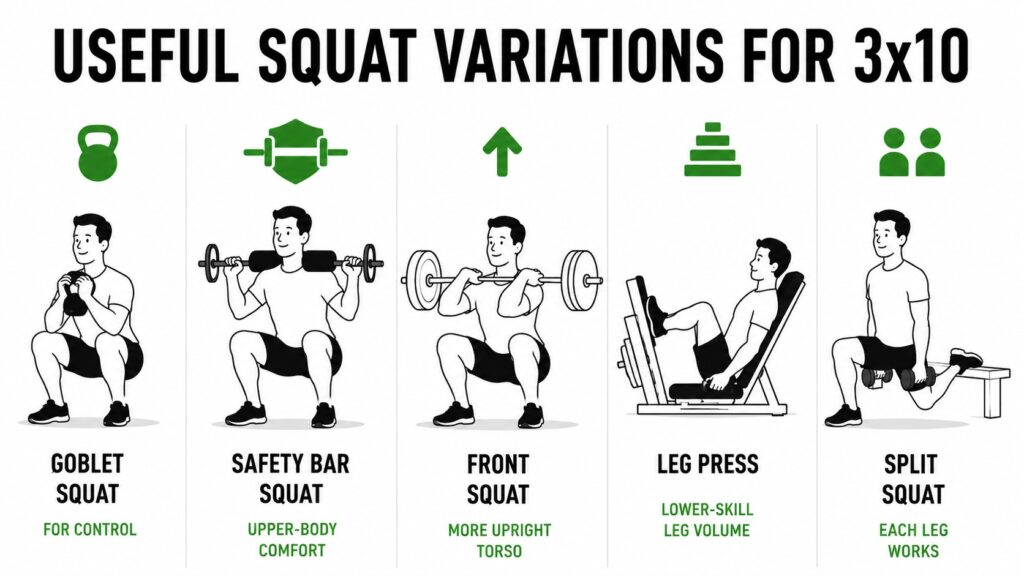
Useful squat variations for 3×10 include:
- goblet squat for control
- safety bar squat for a more comfortable upper-body position
- front squat for a more upright torso
- leg press for lower-skill leg volume
- split squat when both legs need individual work
Three-by-ten becomes a problem when every set is taken too close to failure.
Hard leg work is useful.
Dragging the last reps across the floor like a broken shopping cart is less useful.
Is there a formula to calculate squat weight for 5×5 and 3×10?
Yes.
The easiest way is to start from your estimated one-rep max.
Your one-rep max is the heaviest weight you could lift for one clean squat.
You do not need to test it directly.
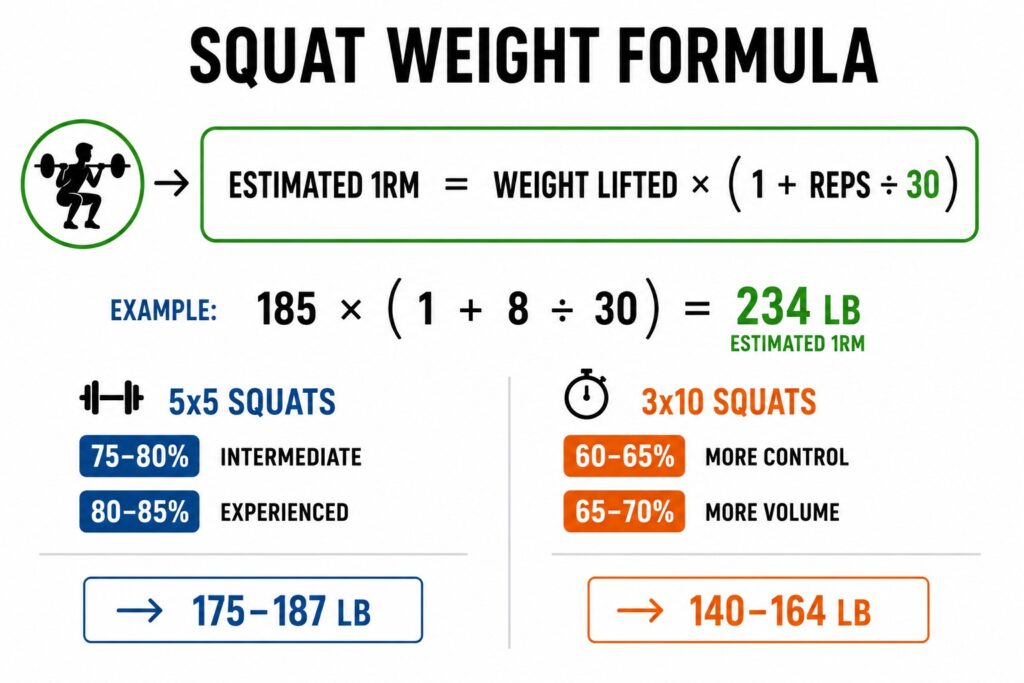
You can estimate it with this simple formula:
Estimated 1RM = weight lifted × (1 + reps ÷ 30)
Example:
If you squat 185 lb for 8 clean reps, the calculation looks like this:
185 × (1 + 8 ÷ 30) = 234 lb estimated 1RM
From there, use a percentage.
For 5×5 squats, a good starting range is usually:
- 75–80% of estimated 1RM if you want clean, repeatable sets
- 80–85% of estimated 1RM if you are more experienced and the reps stay solid
For 3×10 squats, a good starting range is usually:
- 60–65% of estimated 1RM if you want more control
- 65–70% of estimated 1RM if your technique stays stable through all ten reps
Using the example above:
- 5×5 at 75–80% of 234 lb = about 175–187 lb
- 3×10 at 60–70% of 234 lb = about 140–164 lb
That gives you a starting number, not a law carved into the squat rack.
If the first set already looks shaky, lower the weight.
If all sets move cleanly and you still have a couple of good reps left, add a small amount next time.
Final Takeaway
Squat 5×5 vs 3×10 is not just a choice between strength and muscle.
Five-by-five feels better when heavier, cleaner reps make the squat feel focused, measurable, and controlled.
Three-by-ten feels better when more practice, more leg work, and less load make the session easier to repeat.
The better squat progression over time is the one that keeps your reps honest when the set starts getting hard.
FAQs
Why does 3×10 sometimes make my lower back tired?
Even with lighter weight, 3×10 gives your torso more time to work.
Your trunk has to keep the body firm through more total reps.
When the legs fatigue, the body may lean forward more to finish the set.
That can shift extra work to the lower back.
Lower the load, slow the early reps, and stop before the squat turns into a tired hip hinge.
Should I use the same squat stance for 5×5 and 3×10?
Usually yes, but not always.
A stance that feels strong for heavy 5×5 may feel awkward during longer 3×10 sets.
A very narrow stance, for example, can work for a few heavy reps but feel cramped once fatigue builds.
The goal is not to change your squat every session.
Use the stance that keeps your heels planted, knees tracking well, and depth consistent.
Which one feels worse the next day, 5×5 or 3×10?
For me, 3×10 usually creates more obvious leg soreness.
More reps mean more total work, especially with consistent depth.
Five-by-five can leave a different kind of fatigue.
Less burn, more overall heaviness.
Soreness is useful feedback, but it is not the scoreboard.
A squat session can be productive even if stairs are still friendly the next morning.