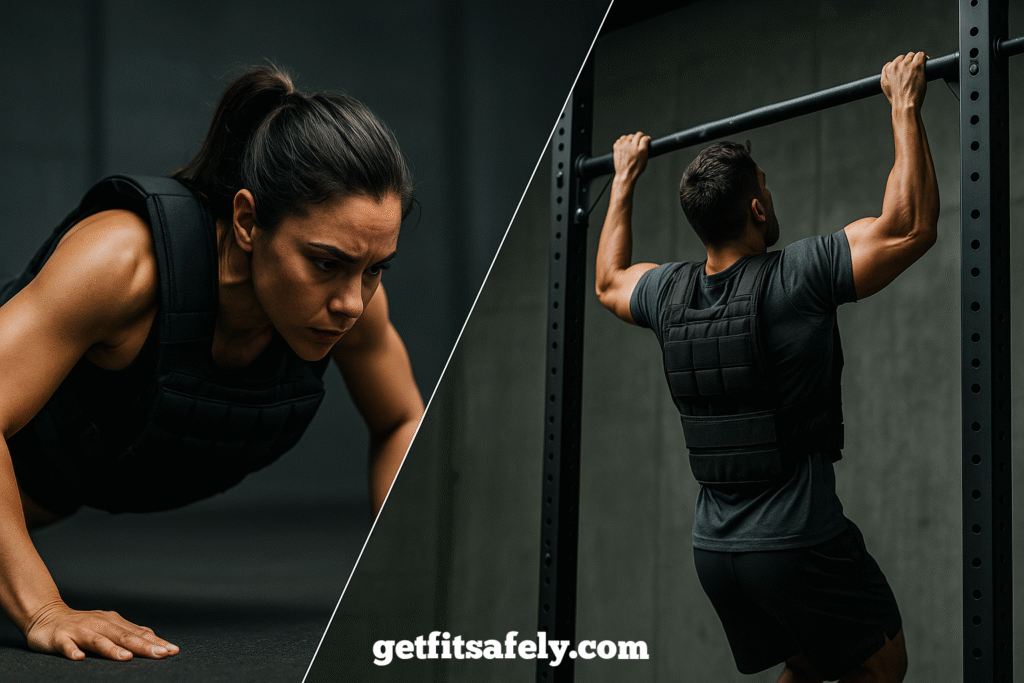
Wearing a weighted vest for the first time feels like joining some secret elite training unit — until gravity reminds you who’s boss.
Suddenly, push-ups set your chest on fire, pull-ups turn into survival drills, and even walking feels like cardio.
It’s tough, uncomfortable, and weirdly addictive, because deep down, there’s that thought: if it’s this hard, it’s probably working.
That’s the twisted beauty of weighted vest training — it makes every move you already know feel brand new.
So, let’s dig into what really happens when you start carrying your own personal backpack of pain and call it “progress.”
| Weighted Vest Programming | |
|---|---|
| Frequency that works |
|
| 7-week wave plan |
|
| Contrast sessions | One day vest on pushes, next day vest on pulls. Keep 8–12 tough sets per pattern across the week. |
| Quality cues |
|
| Sample split |
|
What a Weighted Vest Actually Does

Think of a weighted vest as sneaky progressive overload.
You’re not reinventing your workout — you’re just increasing the challenge without adding a single dumbbell.
When your own bodyweight starts feeling too easy, a vest is like hitting the “next level” button.
More resistance means your muscles have to push harder, stabilize better, and recruit more fibers to get the job done.
In short: it turns bodyweight exercises back into strength training again.
When Extra Weight Becomes a Game-Changer
The trick with a vest isn’t just wearing it — it’s knowing how to wear it.
Add too much too soon, and you’ll turn a good session into joint torture.
Start light — 5 to 10 pounds is plenty — and let your muscles adapt to the new load.
What happens next is where the magic begins: your stabilizers fire up, your balance improves, and your nervous system learns to coordinate under pressure.
That’s the kind of adaptation that translates into real-world strength.
And yes, when you take the vest off, your body suddenly feels like it’s moving in low gravity.
It’s wild.
Push-Ups With a Twist (or a Heavier Chest)
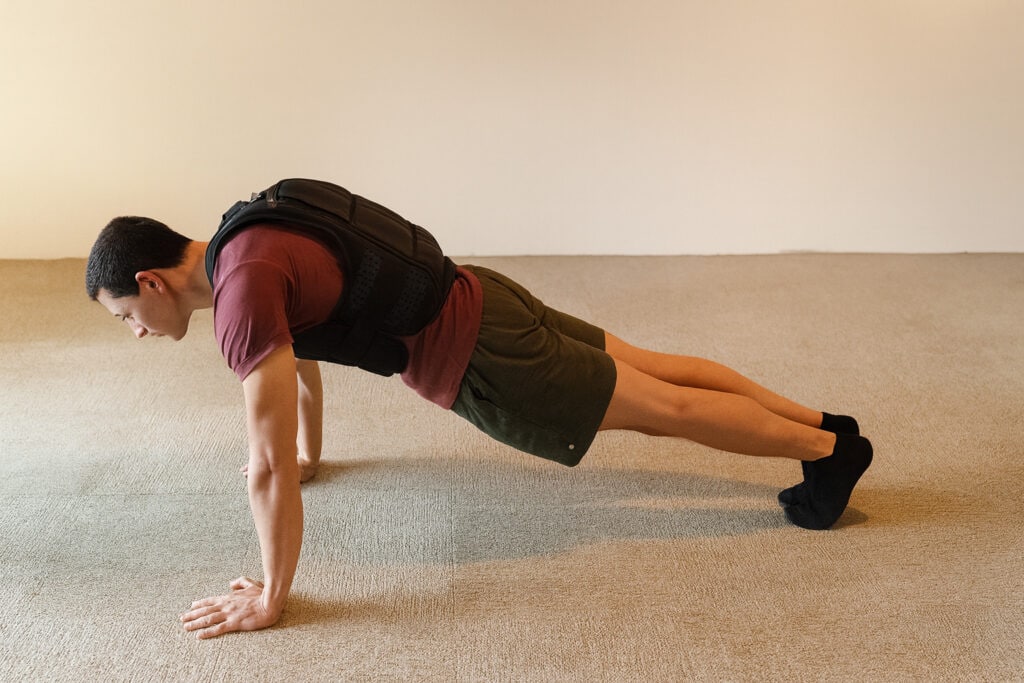
Weighted push-ups are like rediscovering the move you thought you’d already mastered.
The chest, triceps, and front delts all work overtime, but it’s your core and scapular stabilizers that really start screaming.
Your whole body has to cooperate just to keep your form tight.
If you’re chasing strength, keep the reps low and the weight moderate — around 5 to 10 tough reps per set.
If endurance or definition is your goal, go lighter and aim for higher reps.
Either way, the vest forces you to slow down, control every inch of the movement, and earn every single rep.
Pull-Ups Under Pressure
There’s something humbling about doing pull-ups with a weighted vest.
One moment you’re flying over the bar; the next, you’re barely getting your chin up and questioning your life choices.
But that’s exactly why it works.
Adding even a small amount of weight — 10 to 15 pounds — can dramatically boost how much force your lats and biceps generate.
After a few weeks of consistent practice, regular pull-ups will feel lighter, and your rep count usually jumps without trying.
The key is control.
Don’t swing, don’t kip, and definitely don’t rush.
Weighted pull-ups reward patience, not ego.
👉 Adjustable Weight Vest with Steel Plates Shop on Amazon
How Adding Weight Changes Your Movement
Muscles grow and strengthen when they face enough tension for long enough.
A weighted vest increases both.
Research on resistance training consistently shows that external load enhances muscle activation — especially in the chest, shoulders, and back.
But there’s a second layer to it: coordination.
Training with added weight forces your body to stabilize through micro-adjustments, which helps build joint integrity and full-body control.
That’s why climbers, gymnasts, and tactical athletes often use weighted vests — not to get bigger, but to move more powerfully with their own body.
Weighted Vest 101
Here’s the no-BS version of how to actually use a vest without wrecking yourself.
Start small.
Even 5 pounds can make your muscles feel the difference.
Don’t skip the warm-up.
You’re asking your joints to do extra work.
Treat them kindly.
Cycle it.
Use the vest for 3–4 weeks, then go back to bodyweight to recover and rebuild.
Mix it smart.
Try weighted push-ups with unweighted pull-ups, then switch the combo next session.
And if your form breaks halfway through a set, drop the ego — and maybe the vest — before something snaps.
Can Adding Load Redefine Your Strength?
Absolutely — but only when you earn it.
A weighted vest doesn’t magically make you stronger; it magnifies the effort you’re already putting in.
If your foundation is solid, it’ll push your strength, endurance, and control to the next level.
If your form sucks, it’ll just push you closer to an injury.
So think of it less like a “shortcut” and more like a spotlight: it shows you exactly where your limits are.
Load With Intention, Not Just Weight
Let’s be real — most people wear weighted vests like they’re in a movie montage.
They throw it on, crank out random sets, and expect magic to happen.
But here’s what really separates smart training from wasted effort: intention.
Your vest isn’t just “extra weight.”
It’s a variable that changes your biomechanics, breathing, and tempo.
For example, push-ups with a vest shift your center of gravity slightly forward — which means your shoulders take on more stress.
If you ignore that and just grind through reps, you’re setting yourself up for impingement or rotator cuff issues.
So instead of just counting reps, start feeling how the load shifts through your joints.
If you can keep the same smooth form as your bodyweight version, you’re doing it right.
If not, lower the weight — because strength built on bad mechanics isn’t strength at all.
How Weighted Vests Can Boost Core Strength Without Crunches
One underrated perk of training with a vest is core activation.
You might think it’s just your arms or chest doing the work, but your midsection turns into a stabilization powerhouse.
During push-ups, your abs and obliques fight to keep your hips from sagging.
During pull-ups, your lower back and deep core muscles prevent you from swinging like a pendulum.
That’s a full-on isometric core workout hidden inside your main lifts.
And the best part — no sit-ups required.
If you’re using your vest regularly, you can build a stronger, tighter midsection just by moving well under load.
Weighted Vests vs. Dumbbells: When to Pick Each
A lot of people wonder why not just hold dumbbells or throw a plate on your back.
Here’s the difference: distribution.
A vest spreads weight evenly across your torso, keeping your spine aligned and your hands free for movement.
That makes it safer for exercises where balance matters — like push-ups, dips, or even lunges.
Dumbbells are great for isolated tension and muscle symmetry, but they shift leverage.
You’re more likely to cheat form when fatigue sets in.
So if you’re chasing functional strength — that “move better, feel solid” kind of power — the vest wins.
Save the dumbbells for hypertrophy-focused work or accessory lifts.
RELATED:>>> Can One Pair of Weights Replace an Entire Home Gym?
The Smallest Gains That Hit the Hardest
You don’t need to jump straight from 10 to 20 pounds like you’re entering a new difficulty level on a video game.
The real game-changer is tiny weight jumps.
I’m talking 1-pound increments — barely noticeable, but your body sure feels them after a week or two.
Slide a couple of small plates or sandbags into your vest pockets.
Every 10 days or so, add a little more.
Nothing dramatic.
You’ll adapt without frying your joints or wrecking your recovery, and when you finally go back to bodyweight-only work, it’ll feel like you’re training on the moon.
Slow climbs build strong peaks.
Going Down Slow, Coming Back Strong
If you really want to turn your vest sessions into a strength lab, slow down your descents.
That’s where the real gold is.
During push-ups or pull-ups, take 3–5 seconds to lower yourself.
Feel every bit of tension stretch through the muscle.
That’s called eccentric loading — and it’s effective for building strength, control, and even size.
You don’t need to do it for every set.
One or two slow-burn sets per workout are enough to shock your system in the best possible way.
You’ll wake up sore in muscles you didn’t even realize were working.
🔎 Weighted Vests: View priced on Amazon
New Angles, New Muscles, Same Pain
If you’re always doing the same grip, same angle, same setup, you’re getting really good at that one movement pattern.
But real functional strength comes from variety.
Try rotating grips on pull-ups — wide, neutral, chin-up style.
For push-ups, play with hand placement, slight inclines, or even rings if you’ve got them.
Each change hits different muscle fibers, and your joints get a break from repetitive stress.
The vest makes every angle feel fresh — and brutally honest.
You’ll find out fast where you’re strong and where you’re just pretending to be.
What Training Heavy Really Does to Your Head
No one talks about this, but training with extra weight does something to your head.
It’s not just physical pressure — it’s mental conditioning.
You start getting used to discomfort.
You learn to breathe through fatigue instead of panicking.
And then one day, you take the vest off, and life just feels lighter — not just your workouts, but everything.
That’s the underrated gift of weighted training: it teaches you to stay calm when things get heavy.
Because eventually, it’s not about how much weight you can carry — it’s about how long you can keep moving with it.
RELATED:》》》Are Fractional Plates Worth Buying for Progressive Overload?
Final Thoughts
Adding weight to your training is more than just resistance — it’s perspective.
You learn how to stay composed when everything feels heavier, how to move with control even when your body screams to stop.
And when you take the vest off, you realize how much stronger you’ve become.
So yeah, throw it on once in a while.
Challenge yourself.
Because progress doesn’t always come from fancy equipment or gym mirrors — sometimes, it comes from simply adding a little weight and refusing to quit under it.