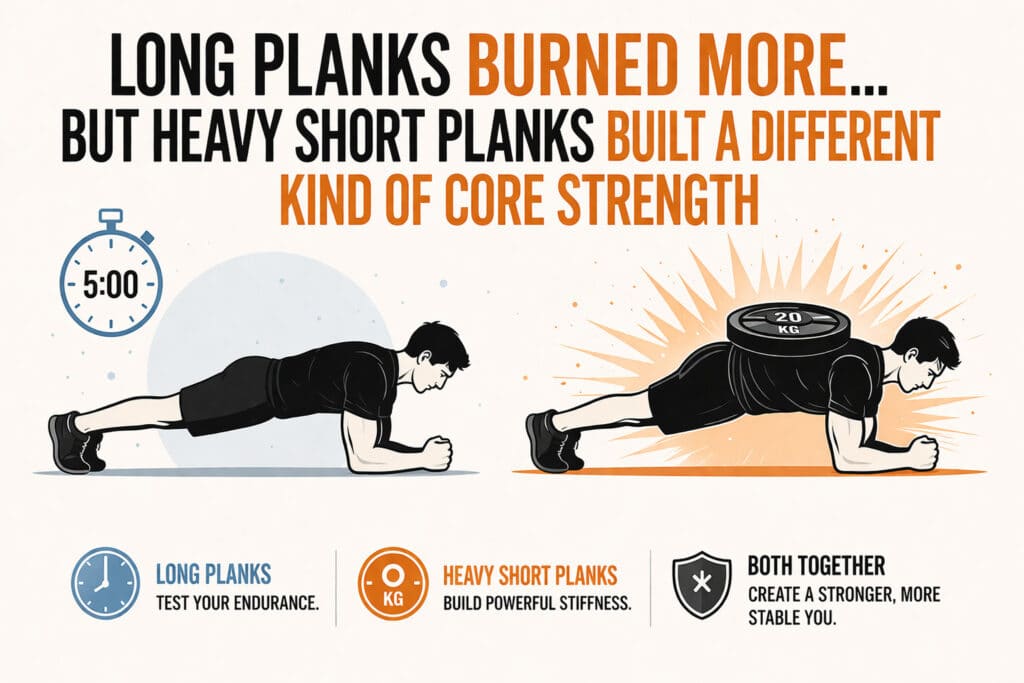
You probably think a plank becomes harder only when the timer keeps running.
Stay there long enough and the abs start burning.
That was exactly how I approached planks for a long time.
Just hold the position and wait until the core starts screaming.
Then one small change flips the whole experience.
Instead of chasing longer holds, I place weight on my back and shorten the timer.
Thirty seconds suddenly feels completely different.
That small shift changes the entire way I think about plank training.
The Long Plank Era: Chasing the Clock
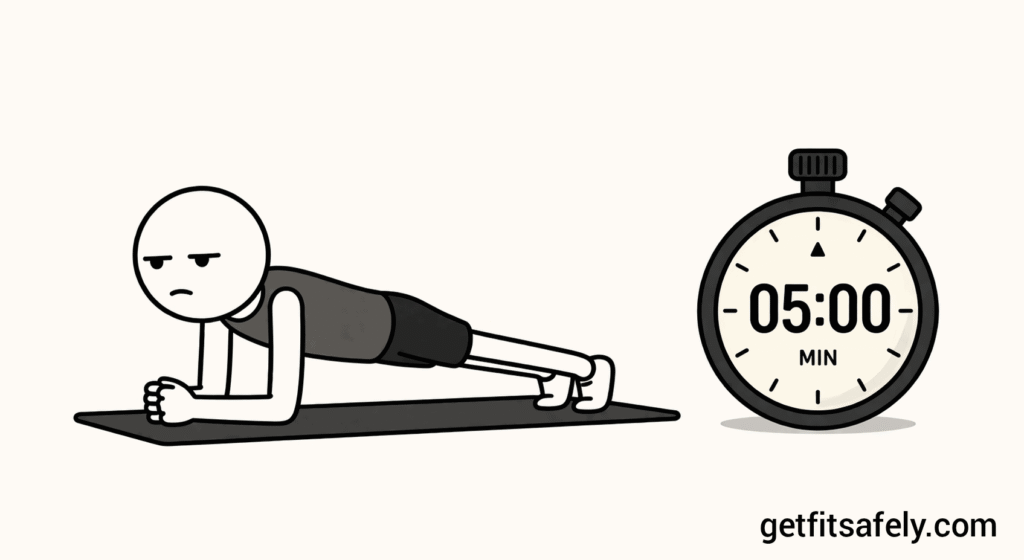
At the beginning my entire plank routine revolves around time.
The longer I last, the more productive the workout must be.
So the sessions start looking like this.
Three rounds of planks with a stopwatch.
First round: 90 seconds.
Second round: 2 minutes.
Third round: whatever I can squeeze out before gravity slowly convinces my hips to sink toward the floor.
Inside the First 3 Minutes of a Plank
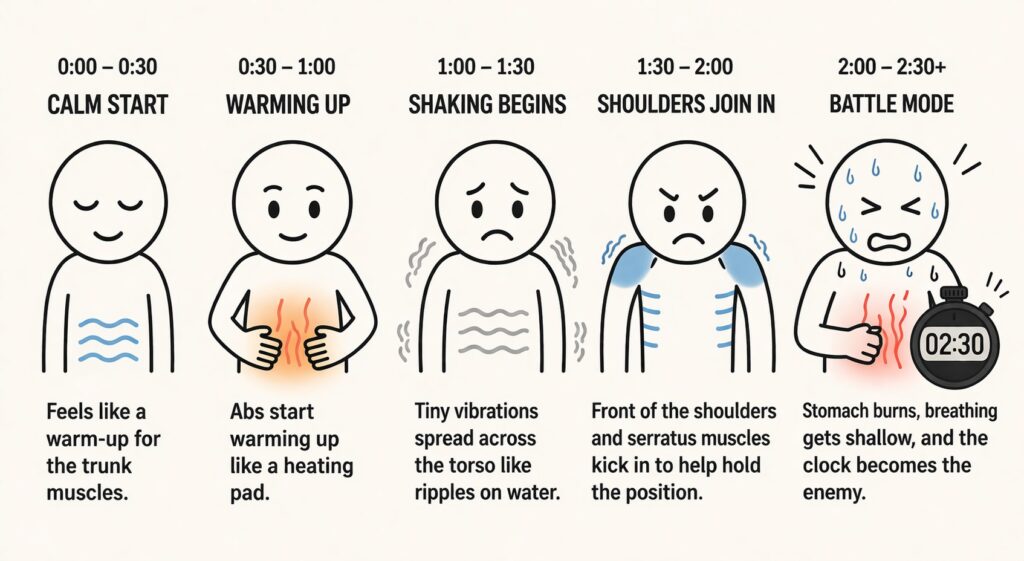
During those long holds the sensation builds in stages.
The first 30 seconds feel surprisingly calm, almost like a warm-up for the trunk muscles.
At around the one-minute mark the abs start warming up like a heating pad placed across the stomach.
Nothing scary yet, just a steady reminder that muscles are working.
After ninety seconds the shaking begins.
Tiny vibrations in the lower abs and obliques spread across the torso like ripples on water.
Around two minutes the shoulders get involved in a bigger way.
The front of the shoulders and the serratus muscles along the ribs begin helping hold the body position.
At around two and a half minutes the plank turns into a battle with the clock.
The stomach burns, breathing becomes shallow, and I start glancing at the timer every few seconds hoping the numbers magically jump forward.
Typical Long Plank Session
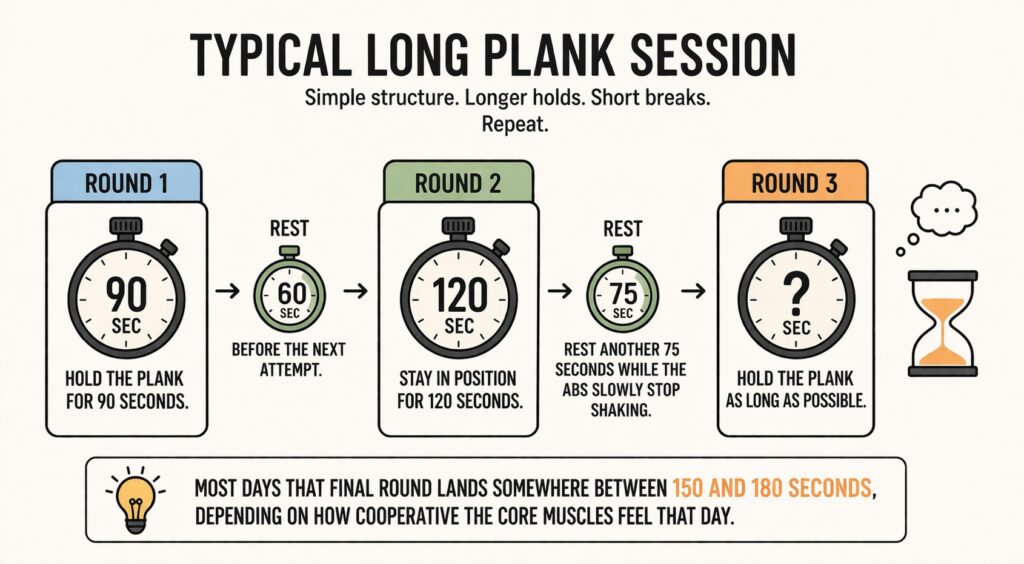
A normal session during that period follows a simple structure.
Very straightforward.
Just a series of increasingly longer plank holds with short breaks between them.
Round 1
Hold the plank for 90 seconds.
Rest 60 seconds before the next attempt.
Round 2
Stay in position for 120 seconds.
Rest another 75 seconds while the abs slowly stop shaking.
Round 3
Hold the plank as long as possible.
Most days that final round lands somewhere between 150 and 180 seconds, depending on how cooperative the core muscles feel that day.
Inside a Heavy 30-Second Plank
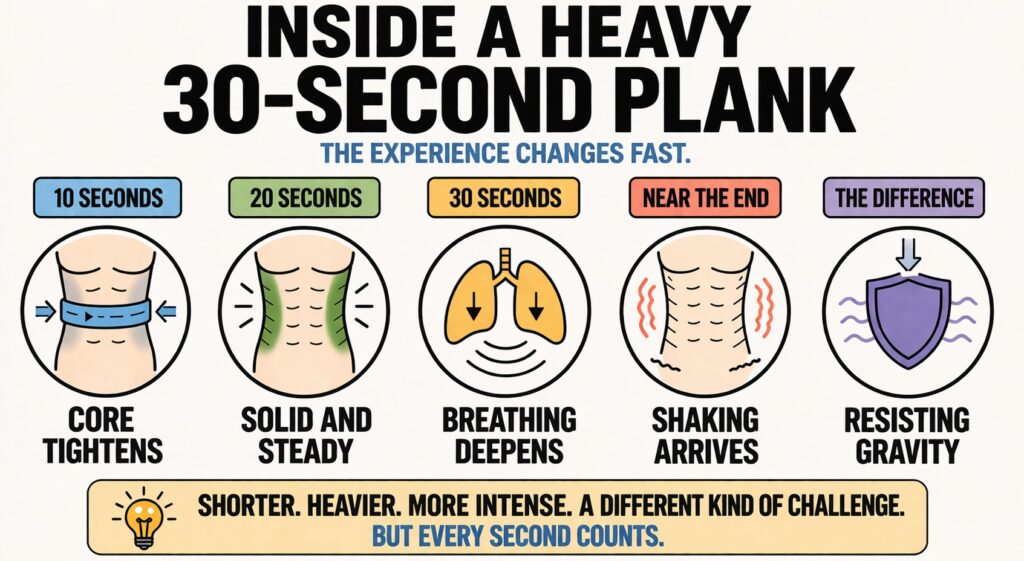
During a weighted plank the experience changes quickly.
At around 10 seconds the abdominal wall tightens like a thick belt around the stomach.
The pressure spreads across the obliques and even into the muscles along the spine.
By 20 seconds the trunk feels extremely solid.
Not shaky like a long plank.
More like the body is trying to resist being folded in half.
Around 30 seconds breathing becomes slower and deeper because the core muscles are working so hard to stabilize the torso.
The shaking finally appears near the end of the hold.
But it feels different from the long plank fatigue.
Instead of a burning wave creeping upward, the sensation is more like the torso trying to stay rigid while gravity presses down.
How I Run Short Heavy Plank Holds
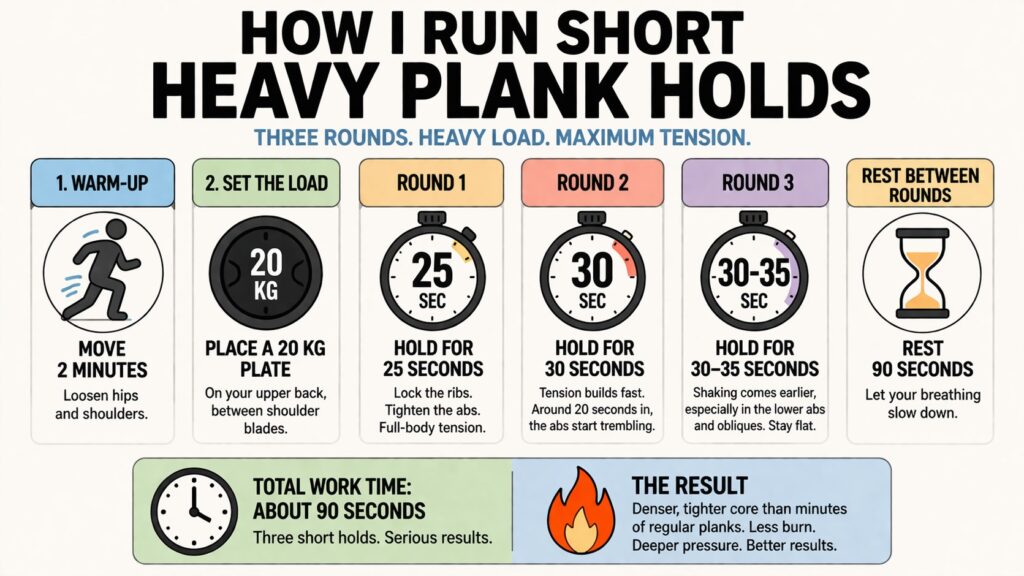
A session with loaded planks looks very different from the long holds I used to chase earlier.
I move around for a couple of minutes just to loosen the hips and shoulders.
Then the weight plate goes on my upper back and the real work starts.
The first round is usually the most controlled one.
A 20-kilogram plate sits across the upper back, right between the shoulder blades.
I lock the ribs down, tighten the abs, and start the timer.
The hold lasts about 25 seconds.
That short window is enough to make the entire trunk tighten up like someone pulled a thick belt around the waist.
After coming out of the position, I rest about a minute and a half, letting the breathing slow down again.
The second round is almost identical, but the tension shows up faster.
The plate is still 20 kg, but this time the hold stretches to 30 seconds.
Around the twenty-second mark the abdominal wall starts trembling slightly as it fights to keep the spine from sagging.
Another short break follows before the final round.
By the third round the body already knows what is coming.
The plate stays in place and I aim for 30 to 35 seconds of solid tension.
The shaking appears earlier this time, especially across the lower abs and obliques.
When the timer passes the thirty-second mark, maintaining a flat torso suddenly feels like holding a heavy suitcase with both hands stretched forward.
Across all three rounds the actual work time barely reaches 90 seconds.
Yet when I stand up afterward, the core feels denser and tighter than it ever did after several minutes of regular planks.
The burning from long holds is not as strong.
But the deep pressure around the ribs and stomach tells a different story.
Basic Form for a Loaded Plank
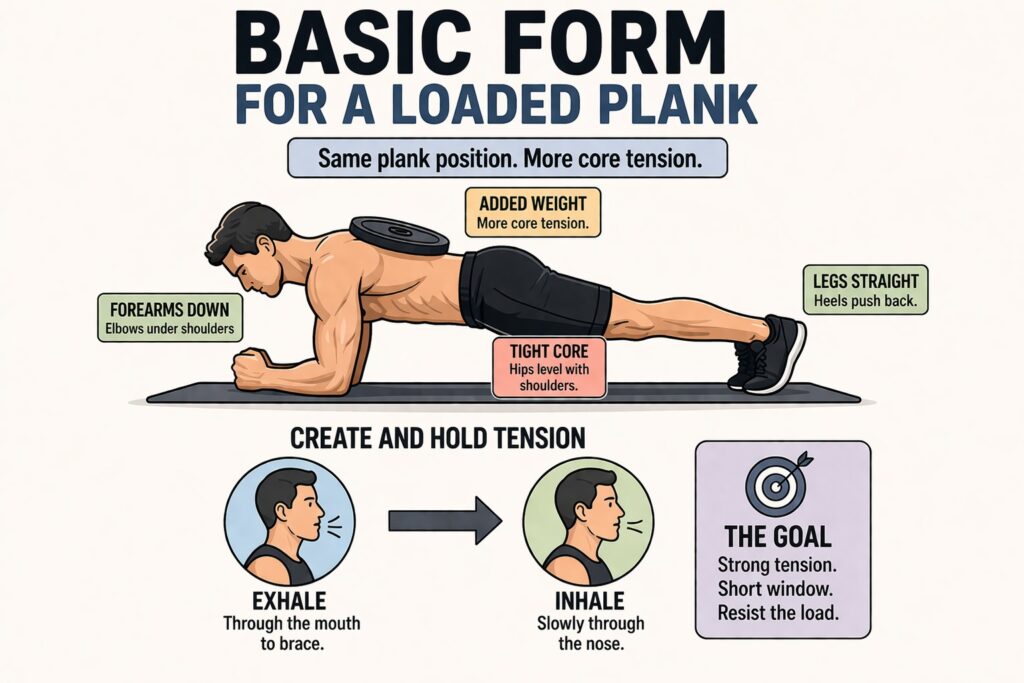
The body position is almost identical to a regular plank.
The main difference is that the added weight forces the core to create much stronger tension to keep the torso stable.
Here is how I usually organize the position.
Forearms on the floor with the elbows directly under the shoulders.
Hands relaxed and pointing forward.
Legs straight with the heels pushing slightly backward.
The abdominal wall tightens so the hips stay level with the shoulders.
A small exhale through the mouth helps create tension around the waist.
That tension stays in place while breathing slowly through the nose.
The goal is not to hold the position forever.
The goal is to maintain strong tension for a short window while resisting the extra load.
Why Heavy Planks Feel So Different
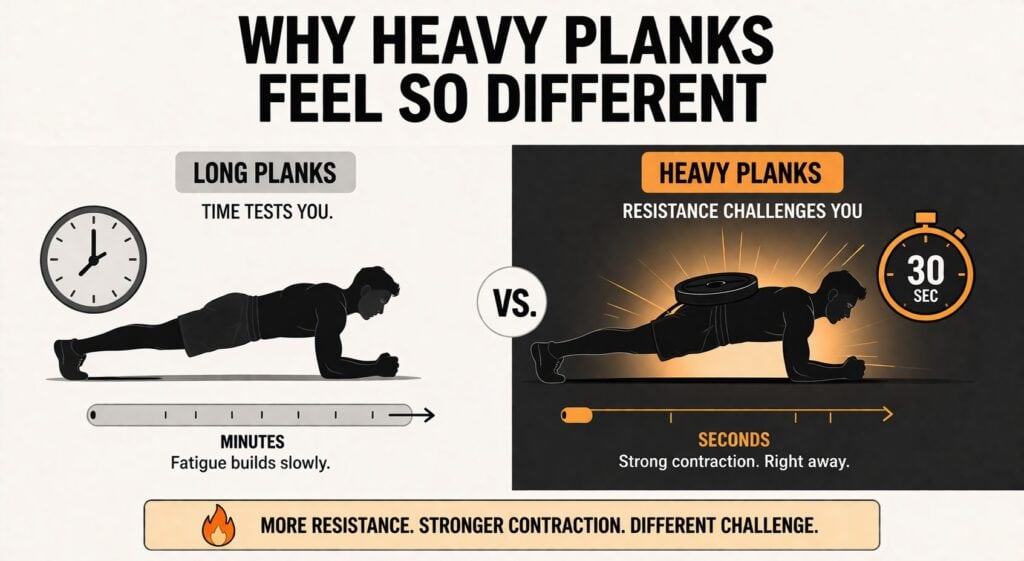
The main difference comes from how much tension the core has to create.
Long planks are mostly about staying in position while fatigue slowly builds over time.
Heavy planks are more about resisting a stronger load for a shorter window.
Now I don’t want to repeat myself about all the mechanics behind it, so here’s a simple way to picture it.
Imagine holding a grocery bag.
Holding an empty bag for five minutes eventually becomes annoying.
But holding a bag filled with heavy bottles for thirty seconds requires much stronger muscles right away.
The abdominal muscles behave in a very similar way.
More resistance forces the muscles to contract harder immediately instead of slowly accumulating fatigue over time.
That stronger contraction challenges the core differently than simply staying in position during a long endurance hold.
What Each Plank Style Develops
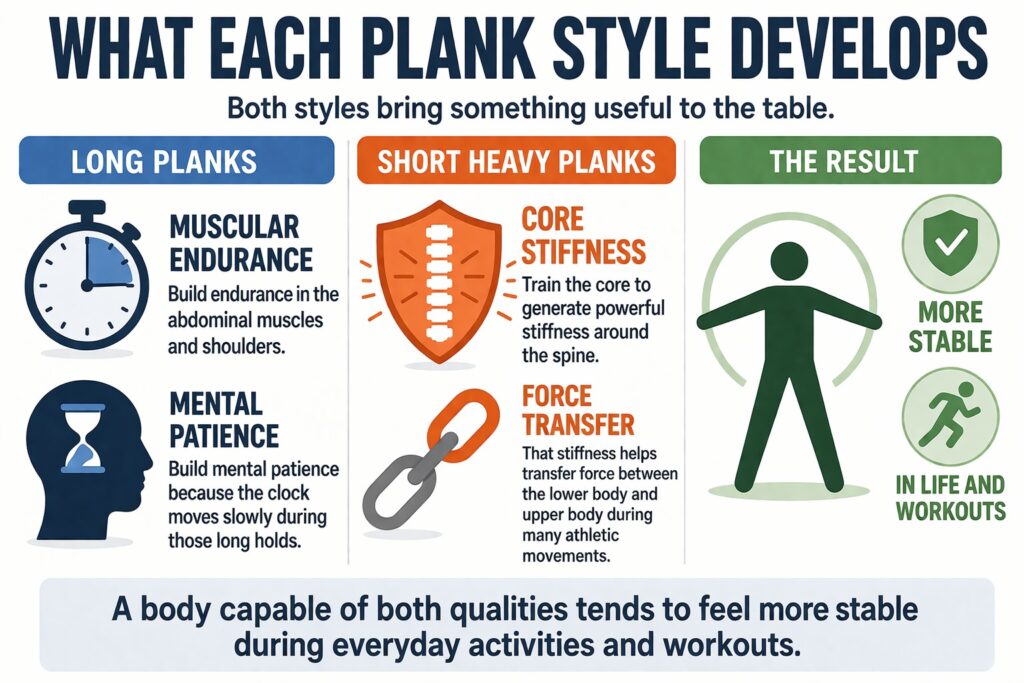
Both styles bring something useful to the table.
Long planks develop endurance in the abdominal muscles and shoulders.
They also build mental patience because the clock moves slowly during those long holds.
Short heavy planks train the core to generate powerful stiffness around the spine.
That stiffness helps transfer force between the lower body and upper body during many athletic movements.
A body capable of both qualities tends to feel more stable during everyday activities and workouts.
Conclusion
After months of alternating between long holds and loaded planks, the biggest realization is simple.
A strong core is not defined by how long someone can stare at the floor during a plank.
Nor is it defined by how much weight sits on the back.
The real change appears in how the torso behaves during movement.
When lifting something heavy from the ground, carrying groceries, or doing pull-ups, the trunk feels steady and controlled instead of loose or wobbly.
Those moments reveal what the planks have been quietly building all along.
Long holds teach the muscles to endure.
Heavy short holds teach them to lock down and resist force.
Together they create a core that can stay steady whether the challenge lasts three minutes or thirty seconds.
FAQs
Why Do Heavy Planks Sometimes Feel Harder on the First Round Than on the Last One?
Something strange often happens with heavy planks.
The first round can actually feel the most awkward.
The body is still figuring out how much tension the torso needs to produce to resist the load.
During the second or third round the abdominal wall usually activates faster.
The muscles “remember” the level of tension required.
The hold may still be difficult, but the body often feels more organized and stable compared to the first attempt.
Why Do My Forearms Get Tired Before My Abs During Planks?
This happens more often than people expect.
When the forearms press into the floor they help create stability through the shoulders and upper body.
If that pressure is too light, the shoulders and arms end up working harder to maintain the position.
Pressing the forearms firmly into the floor usually distributes the effort more evenly across the torso.
When that happens, the abdominal muscles start doing more of the work instead of the arms taking over.
Why Do Heavy Planks Make My Breathing Slower?
During heavy planks the abdominal wall tightens strongly to keep the torso stable.
That tension reduces how much the belly can expand during breathing.
Instead of quick shallow breaths, the body often switches to slower and deeper breathing patterns.
Each breath feels like pushing air into a tight container.
This is normal and actually helps train the body to stabilize the torso while still breathing.
Why Do Long Planks Start Shaking After a While?
The shaking usually appears when the muscles begin losing efficiency during the hold.
Tiny motor units inside the abdominal muscles start taking turns producing force.
Some fibers fatigue while others jump in to help.
That rapid switching creates the small trembling sensation people notice during long plank holds.
It does not mean the exercise is failing.
It simply means the muscles are working continuously to maintain the position.
Why Does a Weighted Plank Sometimes Feel Easier on a Hard Floor Than on a Soft Mat?
A softer surface can make the plank slightly less stable.
When the forearms sink into a thick mat the shoulders have to work harder to keep the body steady.
On a firm surface the arms can press into the ground more effectively.
That pressure travels through the shoulders and into the torso, allowing the core muscles to create stronger overall tension.
Why Do Heavy Planks Sometimes Activate the Back Muscles Too?
The core is not just the abdominal muscles.
Muscles along the spine also help maintain stability during plank positions.
When extra weight is added, those muscles become more active to prevent the torso from collapsing.
That is why some people feel tension not only in the stomach but also along the lower back during loaded planks.
Both sides of the torso are working together to keep the body aligned.
Can I Do Long Planks and Heavy Planks in the Same Training Week?
Yes, both styles can easily fit into the same weekly routine.
One session can focus on longer plank holds that build endurance in the abdominal muscles.
Another session can focus on shorter weighted planks that force the core to create stronger tension.
A simple way to organize it could look like this.
Day A – Long plank holds
- plank hold around two minutes
- repeat for three rounds
Day B – Heavy plank holds
- weighted plank for about 25–30 seconds
- repeat for four rounds
Leaving a couple of days between these sessions usually gives the abdominal muscles enough time to recover while still training different qualities.
The total time spent doing planks remains fairly small.
But the core receives two very different types of stimulus during the week.
Can You Do Planks Every Day?
Yes, planks can be done every day.
The core muscles usually recover fairly quickly, especially when the sessions are short.
Some people choose to train abs every day, using lighter plank holds as part of a daily routine.
However, longer planks or heavy weighted planks place more stress on the abdominal muscles and the spine.
In those cases, leaving a day or two between harder sessions can help the core recover and maintain better performance.
Is a Plank Better Than Crunches for Core Strength?
Planks and crunches train the core in different ways.
Crunches focus on movement, shortening the abdominal muscles as the torso curls forward.
Planks focus on stability, teaching the core to resist movement and keep the spine steady.
Crunches help develop abdominal strength through motion.
Planks train the torso to stay rigid during exercises like squats, carries, or lifting.
Both can be useful.
Crunches build dynamic strength, while planks build core stability.