Walking into the gym on leg day used to give me a weird sense of confidence — until someone casually told me to add lunges.
I went in expecting a smooth, simple movement.
Two steps later, my body reacted like it had just stepped on an unexpectedly wobbly carnival ride.
There was this moment where I genuinely looked around as if the floor had shifted.
Meanwhile, squats still felt like home base.
Both feet planted.
Both legs cooperating.
Everything familiar.
Lunges didn’t offer that comfort.
They had this unpredictable edge — almost like trying to hold a conversation while balancing a plate of food at a crowded party.
And from what I’ve learned, that early struggle is extremely common.
SIGNS YOU’RE NO LONGER STRUGGLING WITH LUNGES
- The front knee starts tracking naturally without conscious effort.
- The wobble fades during the lowering phase.
- The step length becomes consistent rep after rep.
- The torso stays upright without feeling stiff.
- The back leg feels like it’s helping rather than just tagging along.
Those tiny improvements mean your nervous system is adapting, and the pattern is becoming automatic.
How Lunges Challenge the Body More Than Squats
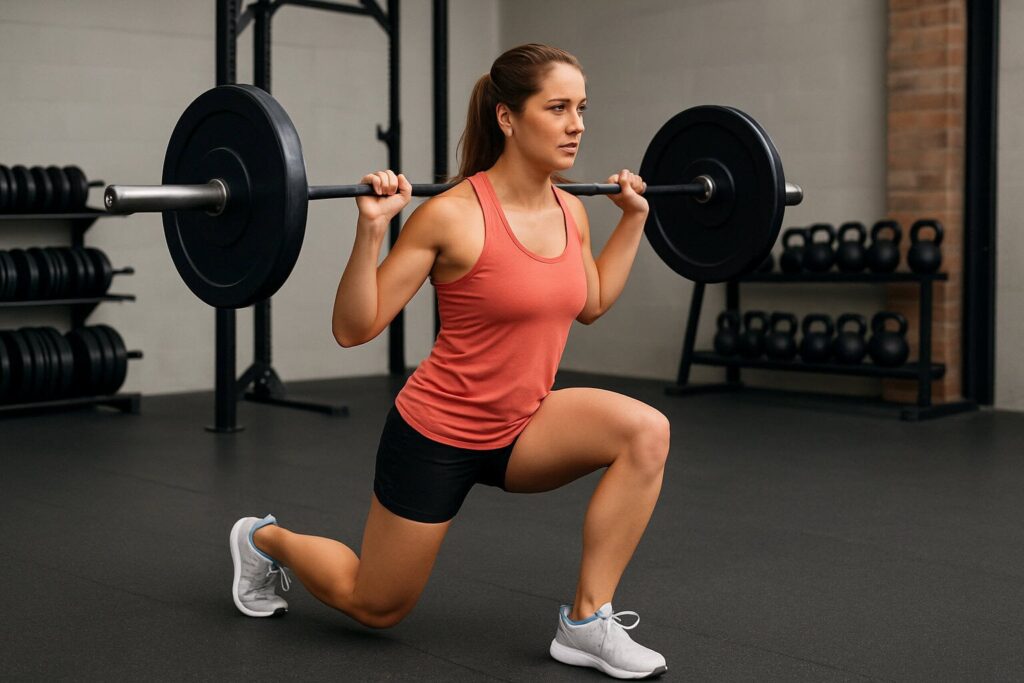
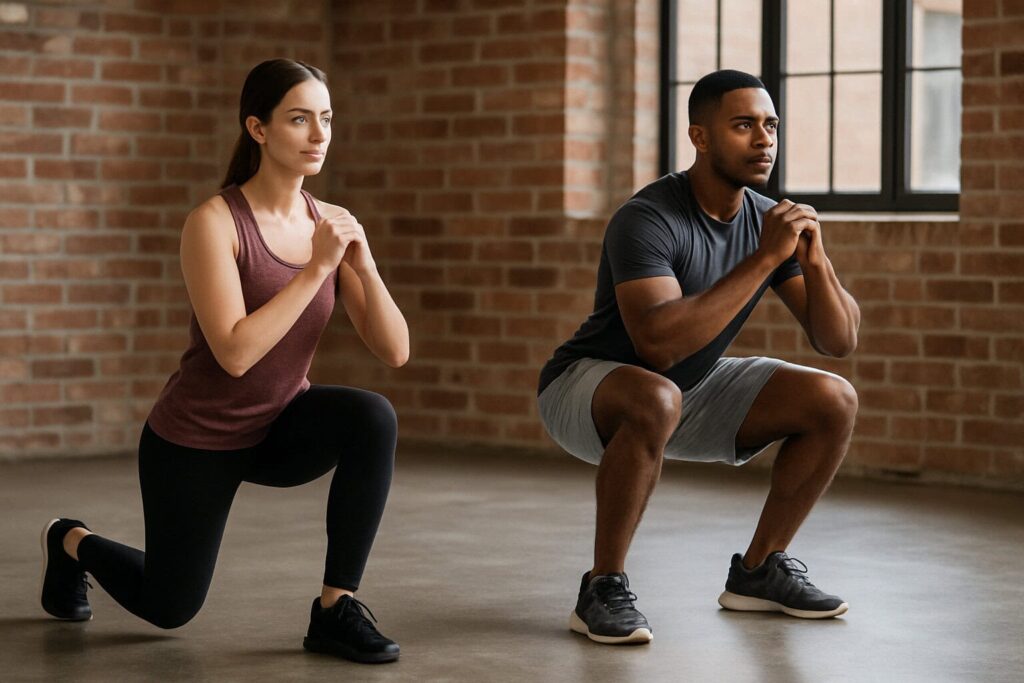
Separating the legs changes everything.
One side becomes the engine, while the other plays support, and the body has to juggle that workload in real time.
The moment the stance opens up, stabilizers that usually stay in cruise mode suddenly jump to attention.
Hips tighten to keep you upright.
Ankles react to every small shift.
Your midsection braces before you even realize it.
With squats, the force spreads evenly.
Nothing unpredictable happens.
Your body follows a neat little elevator ride up and down.
A lunge is more like stepping off that elevator and discovering a slight slope you didn’t see coming.
The Balance Puzzle Behind Lunges
Balance becomes the hidden boss fight of lunges.
That long stride and split stance make stability feel delicate.
Even a tiny lean changes how the front and back legs share the job.
Muscles around the pelvis activate to keep your hips level, and every little adjustment gives your nervous system something new to manage.
It’s wild how much the ankle of the front leg works just to keep you from rolling inward or outward.
Even the back leg tries to contribute, but it does so from an angle the body isn’t used to coordinating.
Squats rarely challenge balance like this.
You stay grounded.
Nothing moves out from under you.
Your center of mass stays predictable.
Lunges vs Squats: Where Imbalances Show Up Fast

Everyone has a stronger side, but lunges make it embarrassingly obvious.
The “good” leg handles the movement and you think, “Okay, I got this.”
Switch sides and it feels like someone loosened the screws in your joints.
The knee sways.
The hip rotates.
The whole pattern feels foreign.
Nothing is wrong — lunges simply don’t let the dominant leg babysit the weaker one.
Squats do.
Squats disguise asymmetries under shared effort.
Lunges expose them with perfect accuracy.
A Small Story That Made Me Realize Lunges Aren’t the Villain
There was a day in a group class when everyone had to do walking lunges across the room.
Halfway through, I glanced around and saw people wobbling in every direction like a herd of baby giraffes learning the ropes.
Something clicked:
the chaos wasn’t personal — the movement is just inherently awkward at the beginning.
And that realization made lunges feel a lot less intimidating.
Why Coordination Makes Lunges Feel Like a Brand-New Skill
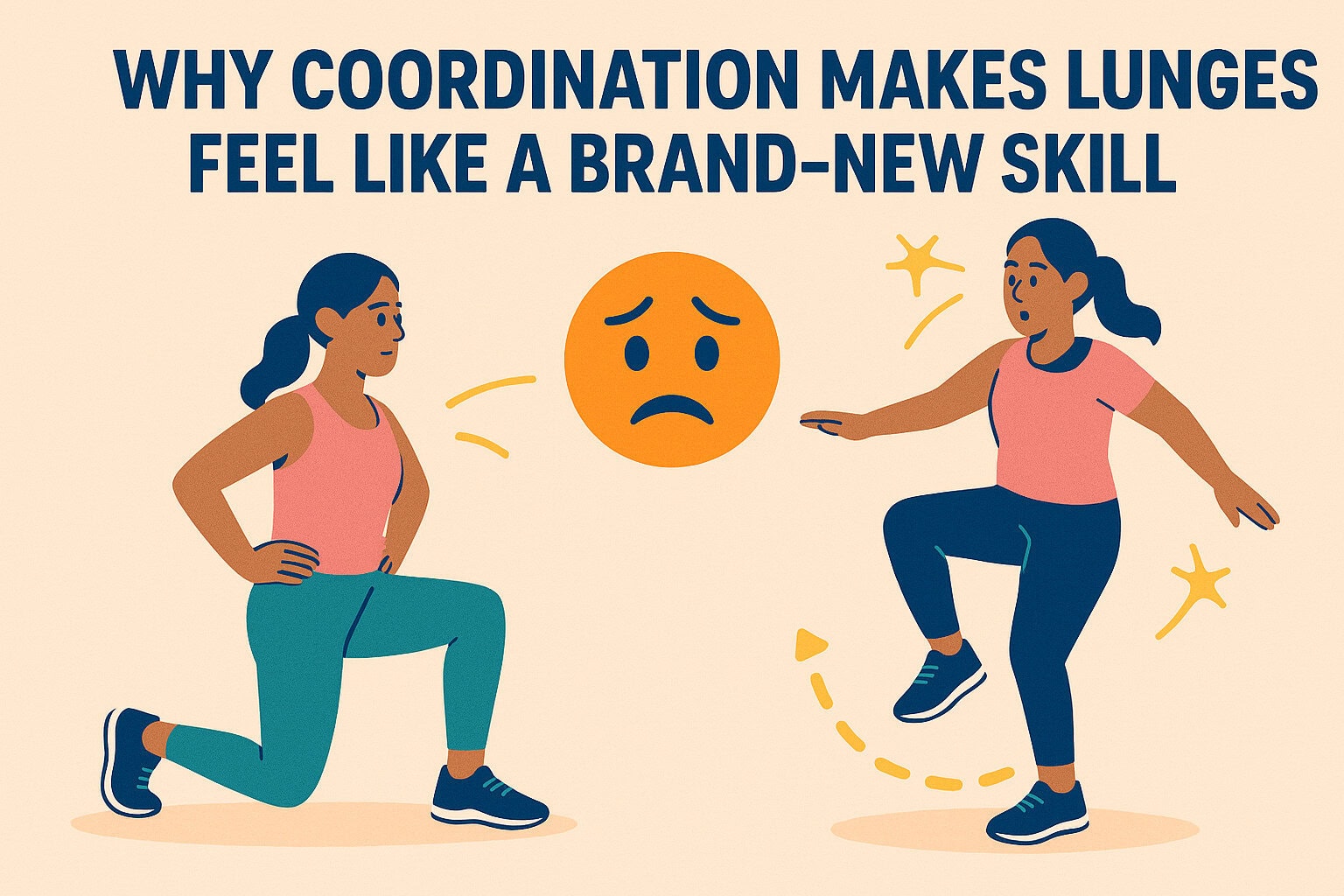
There’s a timing element to lunges that takes practice.
The step, the drop, the angle, the pressure on the front foot — all of it has to settle into a rhythm.
If anything is slightly off, the whole movement feels “scratchy,” like someone dragging a chair across the floor.
Squats never require that much mental bandwidth.
Your feet stay in the same place.
Your hips travel in a clean vertical line.
Your body doesn’t have to negotiate directions mid-rep.
A lunge asks the legs and core to sync up in a way that’s much closer to a real-life movement.
It’s controlled, but not robotic.
More athletic.
More three-dimensional.
The Weird Quirks All Beginners Experience With Lunges
There are little patterns almost everyone goes through:
Some people lean too far forward without realizing it.
Others shorten their step so much the back leg barely participates.
A few end up drifting sideways instead of straight down.
And plenty of beginners sink too quickly because they assume lunges should feel like squats.
None of these quirks are “mistakes.”
They’re just signals that the movement hasn’t settled into muscle memory yet.
Muscle Activation During Lunges vs Squats Hits Differently
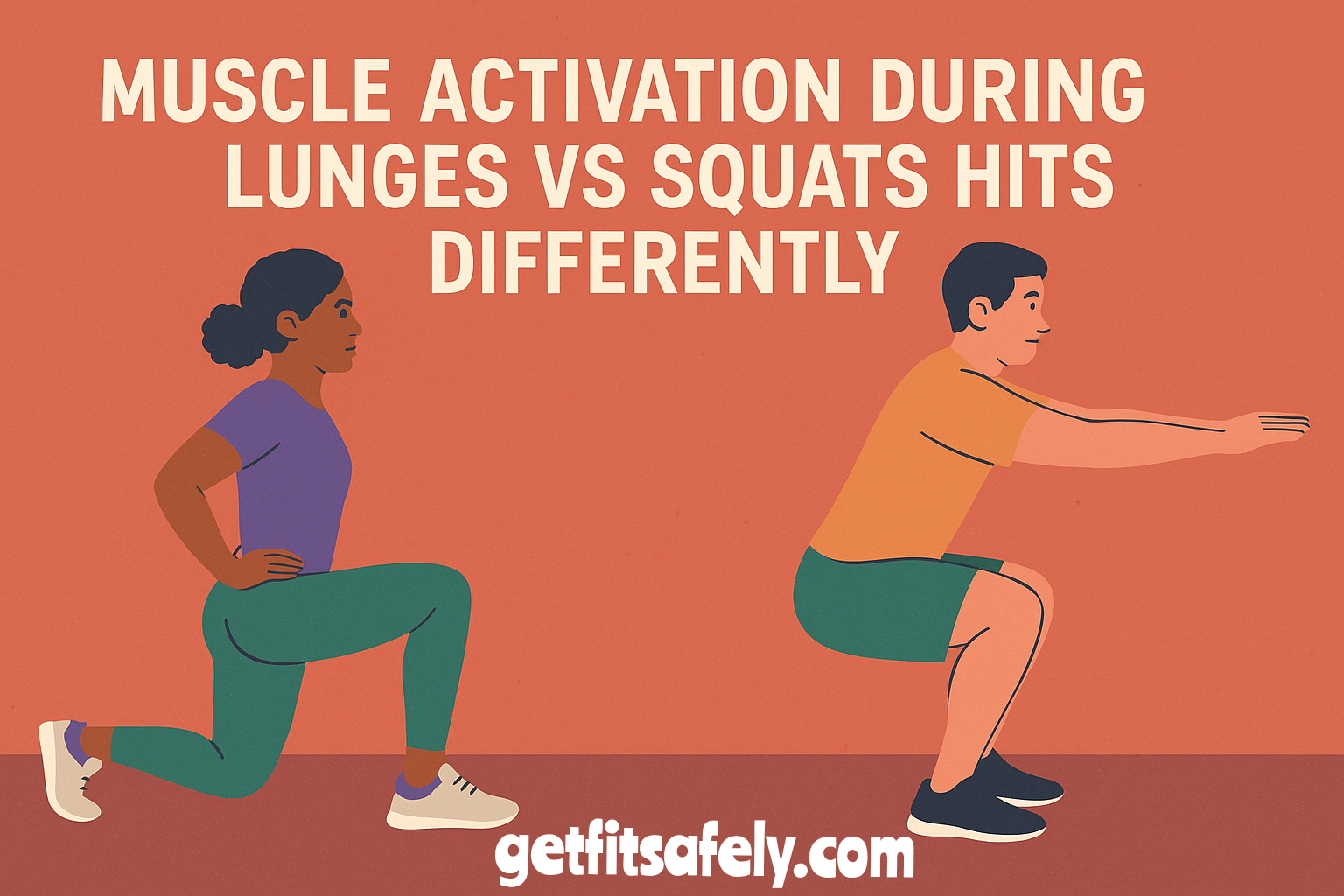
Once the body enters a staggered stance, the tension spreads differently.
The front thigh ends up doing most of the heavy lifting, which explains the sudden quad fire even with light weight.
Around the hip, the outer glute muscles tighten to keep your pelvis steady.
That area barely gets involved during squats, but it becomes crucial here.
Along the backside, the hamstring on the front leg acts like a stabilizing cable that prevents the pelvis from twisting.
And at the torso, the core fights against tipping or rotating — something squats rarely force you to confront.
The movement isn’t just a drop-and-rise pattern.
It’s a coordination puzzle with tension spread across multiple planes.
What Helped Lunges Finally Feel Natural for Me
Progress didn’t come from loading weight — it came from smoothing the pattern.
Smaller steps helped me find control instead of chasing depth.
A slower descent gave my legs time to organize instead of panicking.
Light fingertip support on a bench kept my torso aligned while learning the pattern.
Starting with the side that usually felt shaky built confidence instead of avoidance.
And focusing on the front foot — almost like I was trying to “anchor” it into the floor — made the whole movement feel more stable.
Why Lunges Belong in Every Beginner Routine
Nothing builds real-world leg strength like a movement that forces each side to work independently.
Stairs feel easier.
Walking gets smoother.
Balance improves without you even noticing.
A squat builds horsepower.
A lunge builds control.
Both matter.
Both make you stronger, but in different ways.
And putting them together creates the kind of lower-body strength that actually shows up in your daily life.
RELATED:》》》Can Lunges and Extensions Replace Squats?
Final Thoughts: Struggling With Lunges Means You’re Right on Track
Wobbling through lunges doesn’t say anything about your strength — it says everything about your learning curve.
Every shaky rep is your body figuring out a new pattern.
Every uneven step is a sign your stabilizers are waking up.
Every awkward set is progress hiding in plain sight.
Give it time.
Let the pattern settle.
Stay patient with the imbalance.
And remember this:
no lower-body exercise teaches coordination, balance, and raw control in one package quite like a lunge.