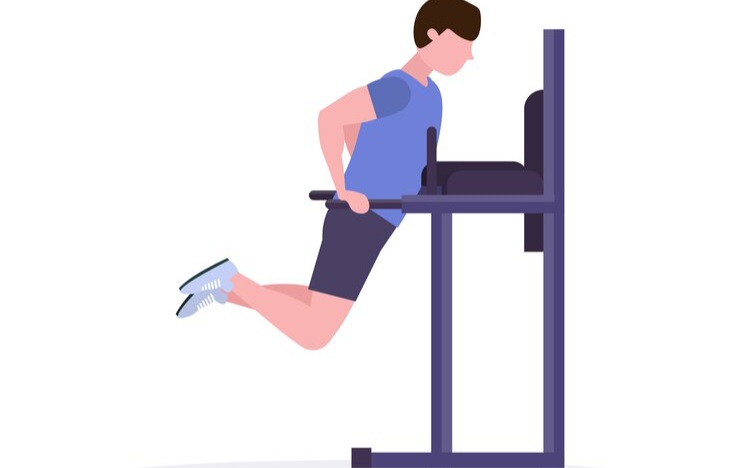
You train consistently.
You control your form, respect the angles, stick to proper tempo.
You’ve learned to actually feel your triceps working—no mindless pushing.
And yet… something feels off.
You catch your reflection and realize one arm looks fuller, stronger, more defined.
The other one?
Still playing catch-up.
No, it’s not a genetic glitch.
It’s a common neuromuscular imbalance.
Even in movements that look symmetrical, the body finds sneaky shortcuts.
This article breaks down why it happens, how to spot it, and most importantly, how to fix it.
We’re all asymmetrical (even if we like to pretend we’re not)
You have a dominant arm.
Everyone does.
It’s the one you write with, open doors with, throw pillows with when looking for the remote.
That arm just has more coordination, more control, and – spoiler alert – usually more strength.
The problem?
When you’re doing an exercise that seems balanced, like bodyweight dips, that arm tends to do the dirty work.
You’re not splitting the effort 50/50, even if it feels like you are.
It’s more like 60/40, or worse.
The dominant arm takes charge, while the other watches from behind like a clueless intern.
The result:
- One triceps grows
- The other takes a vacation
But aren’t dips supposed to be a “balanced” exercise?
In theory, yes.
In practice… it depends.
Your body is great at compensating.
Maybe you dip slightly lower on one side.
Maybe your left shoulder has more mobility than your right.
Or maybe, when you’re tired, your torso rotates just a bit.
These are barely visible to the naked eye, but they add up when you repeat them hundreds of times each week.
Even if you film yourself with your phone, you might not catch it at first.
But your mirror, or worse, your tight t-shirt, will.
When Biomechanics Shift the Load (Without Your Permission)
Every compound movement – and dips are one – involves multiple muscles:
- triceps
- front delts
- pecs
- scapular stabilizers
If one of them slacks, another picks up the load.
Here’s where your dominant arm steps in.
It compensates, pushes, adjusts, stabilizes.
Without even being asked.
But it does so at the cost of muscular balance.
And that’s where asymmetry is born: not from a single rep, but from chronically repeating a tiny mistake.
What happens if you ignore the problem?
A little asymmetry is totally normal.
But if you let it go on unnoticed, it can become annoying.
Here’s what might happen:
- Visible differences between your triceps
- Elbow pain or discomfort, especially on the weaker side
- Loss of strength in bilateral pushing movements (bench, military press)
- Compensatory overload on shoulders, scapulae, even lower back
And trust me: doing push-ups or overhead presses with one triceps more developed is like pushing a shopping cart with one stuck wheel.
You’ll still move forward… just not in a straight line.
How do you fix it? (without trashing your entire workout)
You don’t need to stop doing dips.
Actually, dips are awesome.
They torch the long head of the triceps (the one that pops on the beach) and add real size to your arm.
But if you want to fix unbalanced growth, here’s what you can do:
🔸 Slow it down
Perform dips with controlled tempo: 3 seconds down, 1 second pause, 2 seconds up.
🔸 Go unilateral
Add movements like single-arm overhead extensions or single-handle pushdowns.
🔸 Film your dips
A simple side or front view can reveal everything: tilts, rotations, weight distribution.
🔸 Start with the weaker side
Begin with the “smaller” arm and let the other only match its reps.
🔸 Activate, stretch, awaken
You might have tight shoulders, lazy scapulae, or inactive secondary muscles.
Should I train the weak side more? Or just better?
Million-dollar question.
Short answer: don’t overdo it. Be strategic.
Doubling the reps on the weaker side may seem logical, but often just causes fatigue or inflammation.
Instead, try this:
- Focus on quality muscle activation on the weaker side
- Keep volume similar on both sides, but always begin with the lagging one
- Be patient: correcting asymmetry takes weeks, not days
It’s not weakness, it’s disconnection (and it can be reactivated)
Sometimes the “smaller” triceps isn’t actually weaker.
It’s just less neurologically active.
Your brain doesn’t “switch it on” well, maybe because it’s trusted the other arm for years.
This often happens when you have:
- tight scapulae
- neck tension
- limited elbow rotation
All of these slow down neural signals, trigger compensations, and weaken the “neural highway” to the lazy side.
The good news?
You can rewire it.
But it takes focus. It takes repetition. It takes mindfulness.
During dips, lock your attention on the weaker side.
Visualize that triceps firing.
If needed, touch it between sets.
Talk to it. Engage it.
Want something concrete?
Here are 3 killer activations to do before dips:
🔥 Light single-arm band presses
🔥 Overhead triceps stretch holds
🔥 Slow, voluntary contractions without weight
When asymmetry comes from an old injury (and you don’t even know it)
Sometimes, the cause of asymmetry isn’t new.
It could be a shoulder sprain from years ago.
An inflamed elbow you shrugged off. Or just months spent using a mouse with the same arm.
The result?
Joint stiffness.
Reduced activation.
And a triceps that gets fewer signals even if it does the same exercises.
In these cases, you can:
- Perform an active range-of-motion test (arm overhead, arm behind back)
- Check for visible compensations (uneven shoulders, unstable scapulae)
- Consult a physical therapist for a quick assessment, even online
What if the solution is… changing your grip?
Insider tip: hand position changes everything.
Hands turned too far forward recruit more pecs.
Hands slightly angled inward (neutral grip with thumbs up) activate the triceps more symmetrically.
You can also try ring dips – they force your body to stabilize and don’t allow unconscious favoritism between sides.
Sure, they’re harder.
But that’s exactly why… they train control, not just brute strength.
If your problem comes from always performing the same unbalanced pattern, changing your grip might reset the muscular chain.
How much does aesthetics really matter here?
I get it.
You noticed the asymmetry in the mirror.
And it probably annoyed you.
But let’s take a step back.
Your body is a work in progress.
Not a finished product to judge at 5:32 PM today.
A bigger triceps doesn’t mean you’re screwing up.
It means you’re training hard enough to notice the details.
And noticing the details is exactly what separates a mindful athlete from a beginner copying random Instagram routines.
Yes, work on the asymmetry.
But don’t let it steal the joy of training.
RELATED:》》Are Dips Superior to Push-ups?
Conclusion
Perfect symmetry?
A stage myth.
But functional balance?
That’s what really counts.
A bigger triceps won’t ruin your gains.
But ignoring an unbalanced motor pattern can slow you down, stall you, or hurt you.
Listen to your body.
Ask smart questions.
Slow down when needed. Isolate when it matters.
Then go back to your beloved dips with more control, more precision, more power.