
The pros and cons of exercising 6 days a week become very clear when Saturday arrives and your training shoes are waiting by the door.
Some weeks, I put them on and feel ready for a short session.
Other weeks, I look at them, look at the couch, and suddenly the couch has a very convincing argument.
Training six days can make you stronger, more consistent, and better at the exercises you care about.
It can also turn a good habit into a tiring obligation if every day becomes a hard day.
| The Short Answer |
| Exercising 6 days a week can work well if you balance hard sessions with easier movement and enough recovery. It is not necessary for progress, and fewer training days are often better when sleep, work, soreness, or motivation start slipping. |
| Six Days May Work Well If… | Fewer Days May Work Better If… |
|---|---|
| You keep several sessions light, sleep well, recover between workouts, and enjoy shorter training sessions. | You are new to training, work a physical job, feel constantly tired, have pain, or turn every workout into a hard session. |
What Exercising 6 Days a Week Actually Looks Like
A six-day schedule starts with a decision that sounds innocent.
“I will train a little more often.”
That sounds far more reasonable than saying, “I am about to organize my life around a foam roller and a water bottle.”
Monday is usually the day that makes six training days look brilliant.
Energy is decent.
The gym feels fresh.
Even the guy using three benches at once has not managed to annoy you yet.
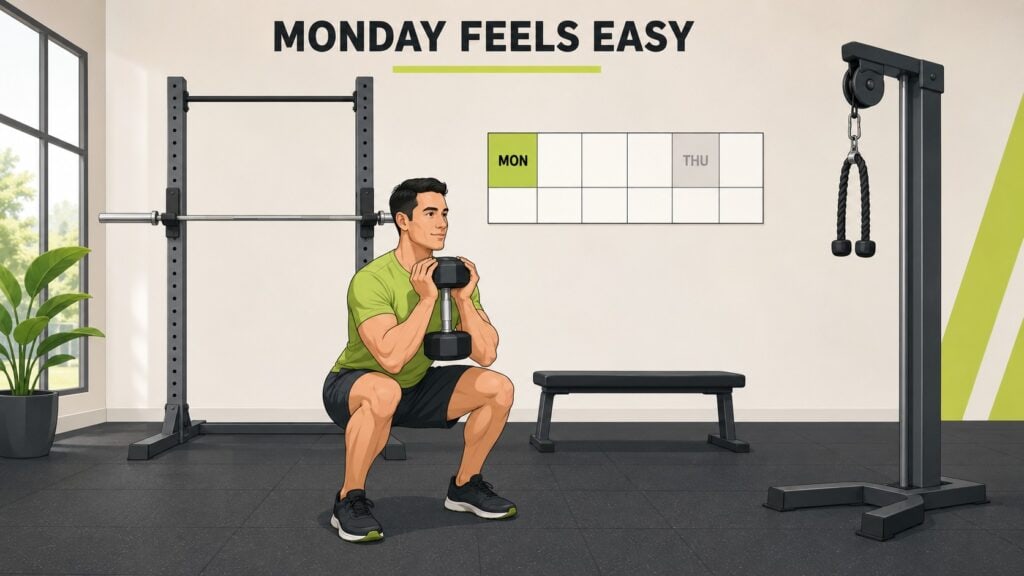
I often begin with a strength session.
That might include a squat, a press, a pulling exercise, and a carry.
A squat starts from standing with your feet planted on the floor.
You bend at the knees and hips, lower your body under control, then stand up again by pushing through your feet.
Your thighs and glutes do much of the work, while your trunk keeps your torso steady.
For a beginner, a chair or bench behind you can make the movement less intimidating.
Touch the bench lightly with your hips, then stand again.
Later, holding a dumbbell close to your chest makes the squat harder without turning it into an advanced circus act.
On Monday, three sets of 8 to 10 controlled squats can feel smooth.
You sit down afterward feeling like a person who has his life under control.
That feeling is useful.
It is also slightly dangerous, because Monday can make you forget that Thursday exists.
More Practice Is One of the Real Benefits
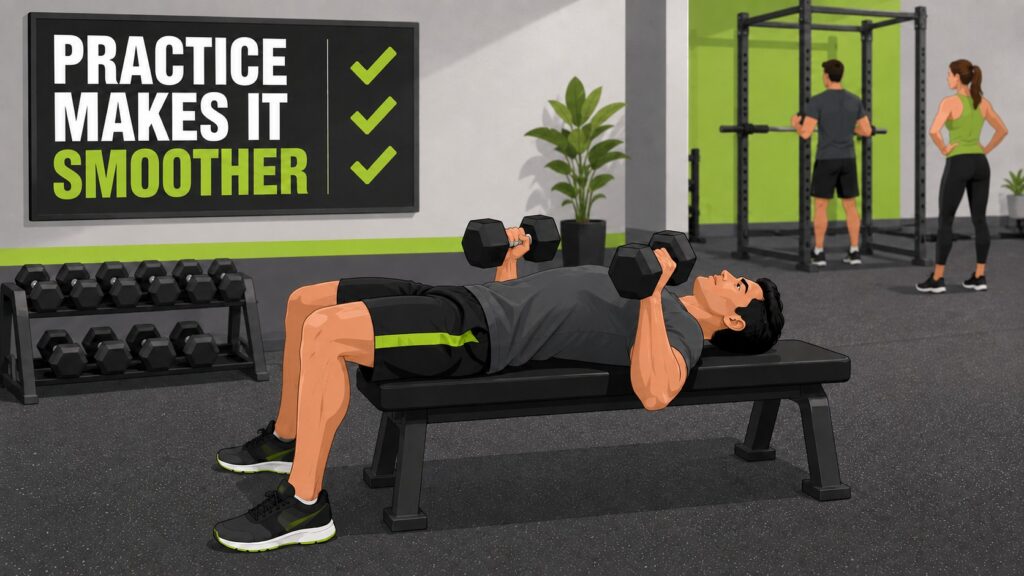
Frequent training gives you more chances to learn.
That is one of the biggest pros of exercising 6 days a week.
A movement becomes less confusing when you repeat it often enough to notice the little details.
During a dumbbell bench press, for example, you lie on a flat bench with one dumbbell in each hand.
Start with the weights above your chest and your feet firmly on the floor.
Lower the dumbbells slowly toward the outer part of your chest, then press them upward until your arms are straight without forcing your elbows hard at the top.
Your chest, shoulders, and triceps help move the weights.
Beginners often start with dumbbells because each arm can find a comfortable path.
One shoulder may prefer a slightly turned hand position.
That is normal.
Forcing both hands into an awkward angle just because a video showed it that way is rarely a great idea.
I have had sessions where the first set feels clumsy, then the second set settles down, and the third set finally feels like I am pressing the weights rather than negotiating with them.
More frequent practice creates more of those moments.
Research also shows that six weekly sessions can produce results when the workload is managed properly.
One study involving 27 resistance-trained men compared lifting three and six days per week while keeping total weekly training volume the same.
After six weeks, both groups gained upper- and lower-body strength and increased several measures of muscle thickness, with no significant differences between the two schedules.
This suggests that training six days a week can be effective, but it is not automatically better than training three days.
The practical advantage may be the ability to spread the same weekly work across shorter sessions.
In normal gym language, six days can work—but the extra sessions do not guarantee extra results.
Six Days Can Keep Each Session Human-Sized
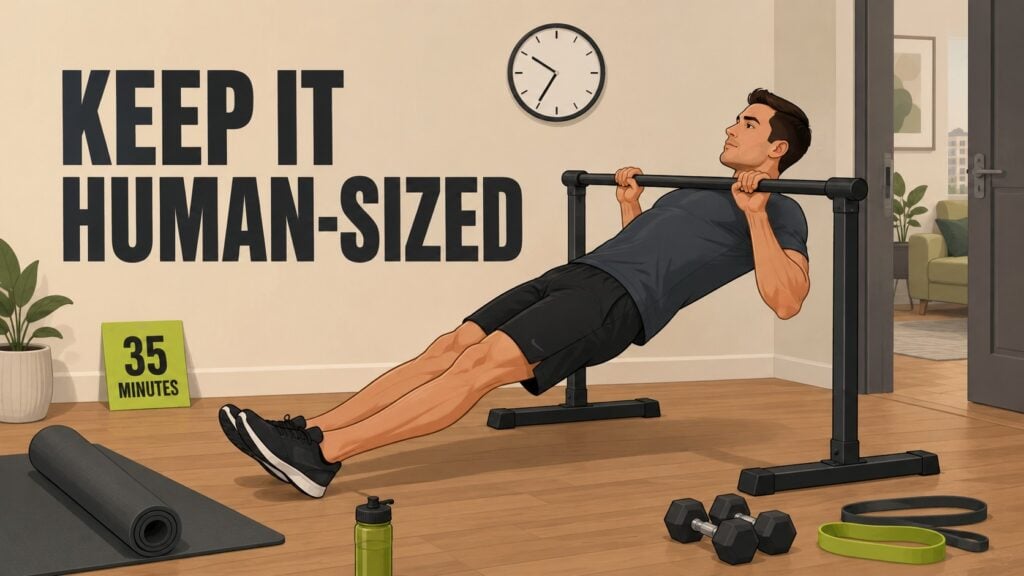
Long workouts have their place.
Still, a two-hour session after work can feel less like self-care and more like an unpaid second shift.
Six days give you permission to do less in one visit.
That is a relief for people who train at home in a tight space or stop at the gym before dinner.
One day can focus on legs.
Another can involve upper-body pushing.
A third can be easy cardio and mobility.
Later in the week, you return to the main movements with fewer exercises and a lighter load.
Here are a few ways that can look without becoming a rigid program:
- A 35-minute session with squats, dumbbell rows, and push-ups.
- A walk at a brisk but comfortable pace for 25 to 40 minutes.
- A short home session with resistance-band rows, incline push-ups, and gentle stretching.
- A gym visit built around one main lift, followed by two smaller exercises.
- A park session with a pull-up bar, a bench, and a few bodyweight movements.
A bodyweight row works well in a home gym or park.
Use a low bar, sturdy rings, or a strong table only if it is genuinely stable.
Hold the bar with both hands, walk your feet forward, and lean back until your body forms a straight line.
Pull your chest toward the bar by squeezing your upper back and bending your elbows.
Lower yourself slowly.
Your back and arm muscles do the pulling, while your abdominal muscles stop your hips from sagging toward the floor.
Bend your knees to make it easier.
Straighten your legs and place your heels farther forward to make it harder.
A few controlled sets on Wednesday can keep your back work moving forward without turning Friday into a marathon.
That is the practical advantage of six days.
You can spread the work around.
Six Training Days Can Build a Consistent Routine
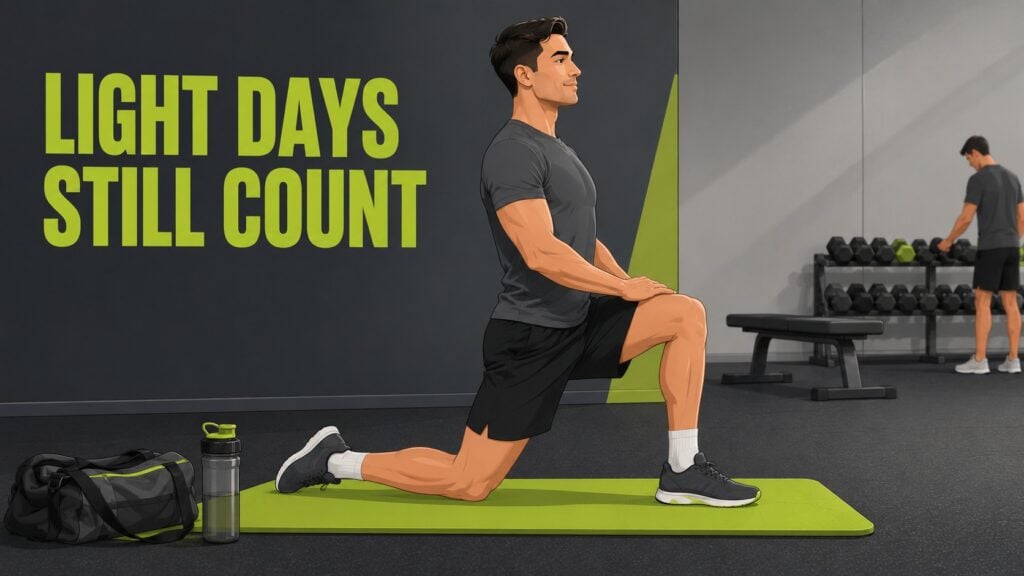
Training often removes one of the hardest parts of exercise: deciding whether to begin.
The bag is already packed, the shoes are near the door, and after dinner I know I am doing something.
That “something” does not always need a barbell and an hour of determination.
Sometimes it is a short gym session.
Sometimes it is an easy bike ride or a walk that would barely impress my fitness watch.
Six active days taught me that useful movement does not have to leave me drenched and staring at the wall.
One evening, I reached the gym after a stiff day at work and planned to train my legs.
The first few bodyweight squats felt as welcoming as a plastic chair at an airport.
Instead of forcing the planned workout, I moved to a quiet corner and did a kneeling hip stretch.
Place one knee on the floor with the other foot in front of you.
Keep your torso upright, then gently move your hips forward until you feel a mild stretch at the front of the kneeling hip.
Hold for 20 to 30 seconds while breathing normally, then change sides.
Sharp pain means you should stop or reduce the stretch.
Nobody nearby will applaud this display of athletic excellence.
Still, my hips usually feel less stiff afterward, and the next leg session starts more comfortably.
That lighter evening still counts.
Consistency is not about making every training day hard.
It is about returning regularly and choosing the amount of movement your body can actually use.
Fatigue Often Appears Later in the Week
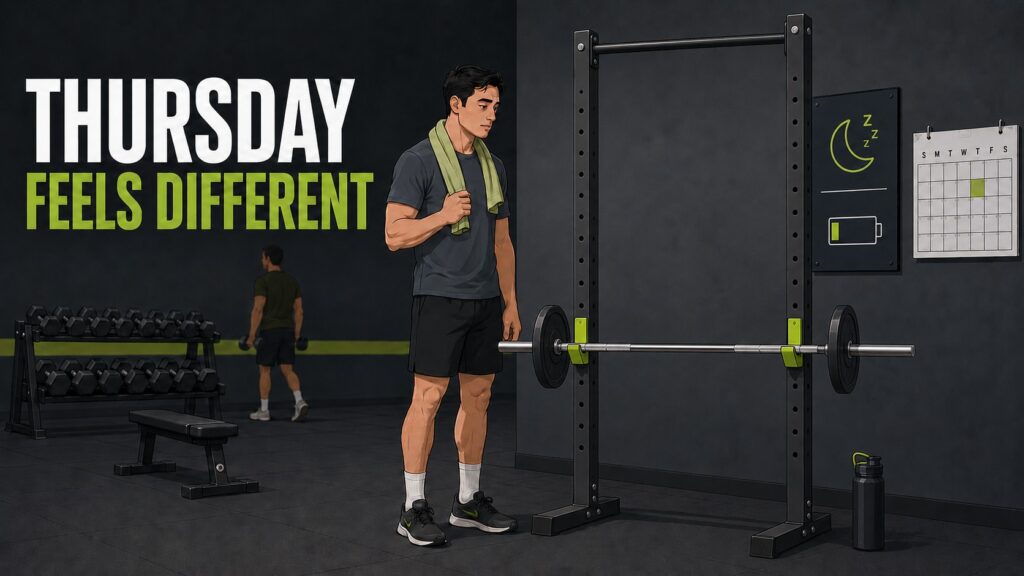
By Thursday, the week starts giving you information.
A hard session may still feel fine.
Or you may stand in front of a barbell and realize your body has brought the enthusiasm of a sleepy housecat.
That is where the downside of exercising 6 days a week appears.
More days are only helpful when your body can recover from them.
I learned this after adding a sixth session to a week that already had plenty of heavy work.
My logic was poor but familiar.
The earlier workouts had gone well, so I assumed adding more would make everything better.
Instead, Friday felt flat.
The weights moved, but nothing felt crisp.
My legs did not hurt badly.
They just felt uninterested in being asked another question.
That is a useful distinction.
Severe pain deserves attention.
Low energy, poor sleep, and several dull sessions in a row also deserve attention.
They are often signs that the total workload is becoming too high.
Watch for these changes:
- Your usual warm-up feels much harder than normal.
- A weight you normally control well feels unusually heavy for several sessions.
- You need more caffeine just to begin a workout.
- Sleep becomes restless even though you are tired.
- You are constantly hungry or have little appetite.
- A joint hurts more as you continue exercising.
- You feel guilty during a rest day instead of relieved.
One of those signs may simply mean you had a rough night.
Several together are a reason to reduce the load.
Hard Days Need Easier Neighbors

Six hard workouts lined up across one week may look productive on a calendar.
By Thursday, the body often has a different opinion.
I usually notice it during the warm-up.
The empty bar feels heavier than expected, my legs move like they have been left outside in cold weather, and the workout I planned suddenly looks far too ambitious.
This happens most often when I arrive at the gym after a demanding day at work and still expect to deadlift.
For a deadlift, place a barbell or two dumbbells close to your legs.
Push your hips backward, bend your knees enough to reach the weight, and keep your back steady as you grip it.
Stand by pressing your feet into the floor and bringing your hips forward.
Your glutes, hamstrings, thighs, upper back, and abdominal muscles work together to control the load.
It is an excellent exercise when the body is ready for it.
After hours of lifting, carrying, bending, or climbing at work, it can also be a terrible guest at the end of the day.
I have ignored those tired signals and continued anyway.
Forty minutes later, I had completed a weak version of my workout and earned the exciting prize of feeling even more tired.
Now I let hard days have easier neighbors.
That might mean:
- Easy cycling for 15 minutes.
- Two relaxed sets of bodyweight squats to a bench.
- A few light dumbbell presses.
- A walk with no distance or pace target.
- Full rest and an earlier night.
One easier session does not erase the work already completed.
Quite often, it is the reason the next hard workout feels strong again.
| Physical Jobs Already Add Training Stress | |
|---|---|
| Type of Work | What to Consider |
| Construction and manual trades | Your back, legs, hands, and shoulders may already be fatigued before training begins. |
| Warehouse and delivery work | High-repetition tasks and long periods on your feet can make extra leg volume harder to recover from. |
| Healthcare, retail, and hospitality | Long shifts and limited breaks may leave less energy for lengthy gym sessions. |
| Cleaning, landscaping, and farm work | Repetitive movements and outdoor conditions can increase the need for lighter sessions, food, fluids, and rest. |
| Can training still help? Yes. In a randomized study, slaughterhouse workers with chronic pain completed 10 minutes of strength training three times per week for 10 weeks.The training helped prevent a decline in their ability to perform their jobs compared with ergonomic training alone.》》Read the study. 《《This does not mean every manual worker should complete six hard workouts, but short and focused sessions can still be useful when recovery is managed carefully. | |
The Schedule Can Become a Rule You Fear Breaking

This is the mental side that catches people.
At first, a six-day rhythm feels motivating.
Soon, you may start believing that a rest day means you are falling behind.
I have been there.
The body wanted a quiet evening.
The schedule wanted a workout.
For a while, the schedule won too often.
That can slowly take the fun out of training.
A useful routine gives you structure.
An unhealthy routine makes you feel nervous when life interrupts it.
There will be poor sleep.
There will be travel, long workdays, family plans, colds, and moments when the gym is crowded enough to make you wonder whether everyone received a secret invitation.
A flexible six-day week has room for those things.
You can move the hard session.
You can shorten it.
You can turn it into an easy session.
You can take the day off without trying to “make up” for it tomorrow.
That last part took me a while to understand.
Adding an extra brutal workout after one missed session often creates more fatigue and very little progress.
Training does not work like unpaid parking tickets.
You do not need to clear the balance by Sunday.
When Six Days Usually Fit Well
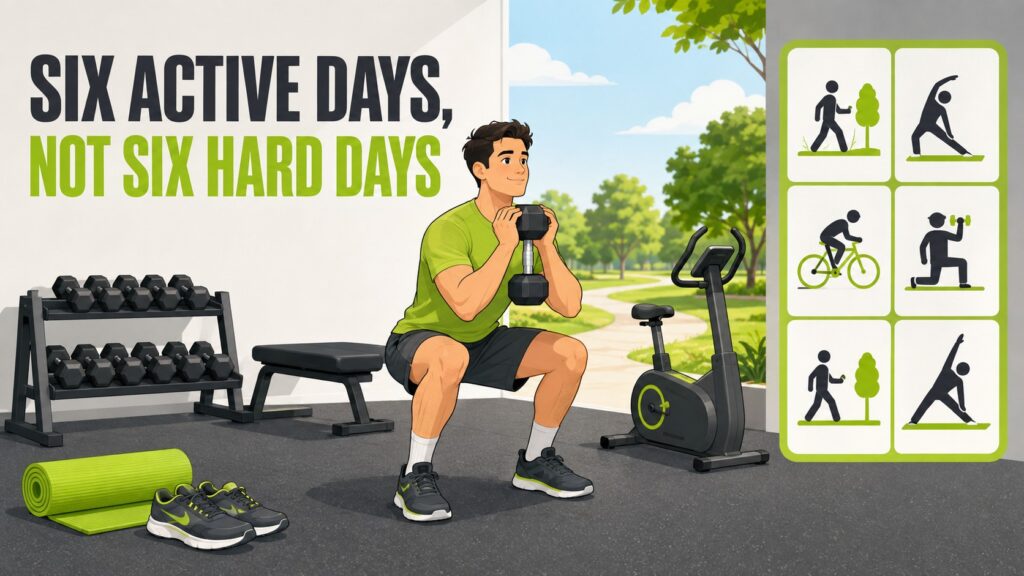
Six training days can suit you when frequent movement makes life easier rather than heavier.
It often works best for people who enjoy short workouts and can tell the difference between “I am a little tired” and “I need to back off.”
You may enjoy this approach when:
- You prefer 30 to 50 minutes of exercise instead of a long gym visit.
- You have a mix of goals, such as strength, walking, mobility, bodyweight skills, or cycling.
- You sleep reasonably well most nights.
- You eat enough to support your training.
- Your work and home life leave room for recovery.
- You can make a hard session easier without feeling like you failed.
- You already know the basic versions of your exercises.
Beginners can use six active days too.
The key is keeping several days light.
Three resistance-training sessions, two easy walks, and one mobility session are six active days.
That is very different from trying to lift heavy weights six times because an influencer says Monday through Saturday builds “mental toughness.”
It may build something.
For many beginners, it mainly builds a strong relationship with exhaustion.
When Fewer Days Are the Better Move
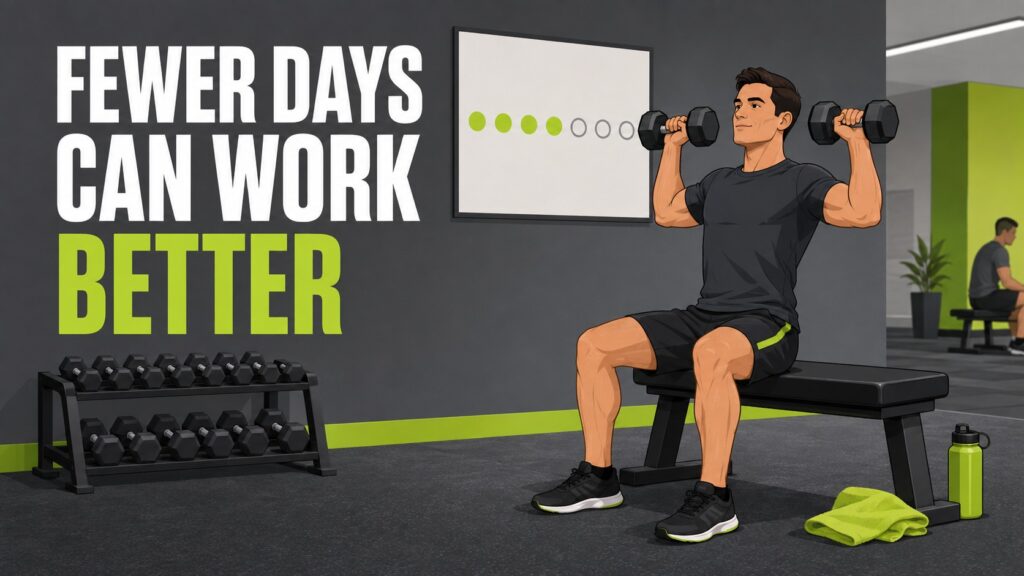
Four or five training days can be more productive when you are learning exercises, returning after illness, managing pain, or already exhausted by work.
Fewer days can also help when every session becomes difficult without you meaning for that to happen.
Ask yourself a simple question after most workouts:
Could I have done a little more with good form?
If the answer is almost always no, reduce the workload.
Start by removing one exercise.
Stop a set with one to three clean repetitions still available.
Take a full rest day when needed.
Sharp pain, dizziness, chest pain, faintness, unusual shortness of breath, or extreme fatigue are reasons to stop and speak with a healthcare professional.
The number of days is not a fitness score.
It is only a tool.
Let the Sixth Day Be Useful, Not Impressive
My sixth day is usually short and light.
A few controlled exercises, an easy bike ride, or a long walk often fits better than another hard workout.
I have forced that final session before, only to spend most of it tired and watching the clock.
Now, if the warm-up feels unusually heavy, I reduce the work or go home.
The pros and cons of exercising 6 days a week depend largely on recovery.
Exercising 6 days a week works best when the final session still adds something useful instead of more fatigue.
Frequently Asked Questions
Is exercising 6 days a week too much for a beginner?
It can be if every session is hard or lasts a long time.
A beginner can stay active six days by combining three strength workouts with walking, light cycling, or mobility work on the other days.
Can I build muscle by working out 6 days a week?
Yes, as long as each muscle gets enough time to recover before you train it hard again.
Shorter workouts can make this easier because you spread your weekly exercises across more days.
Can I do cardio every day if I lift weights 6 days a week?
Easy cardio, such as walking or relaxed cycling, can fit well on most days.
Hard running, demanding intervals, or long cardio sessions may interfere with recovery when your strength training is already challenging.
Is working out 6 days a week good for weight loss?
It can help you burn more energy and build a regular movement habit.
Weight loss still depends mainly on your overall eating pattern, and training too hard can make hunger, fatigue, and late-night snacking harder to manage.
What is a good 6-day workout split?
Many people do well with push movements, pull movements, and leg work spread across the week.
For example, you can train pushing exercises on two days, pulling exercises on two days, legs on one day, and use the final day for easy cardio or mobility.