
A few years ago, deloads sounded to me like flossing.
Everyone said it was “obviously important,” but somehow it always felt optional until the consequences showed up.
My joints were the consequences.
Not pain that stops you, just the kind that keeps showing up at the wrong time.
That’s when I started wondering something simple.
If I actually deload every four weeks, do my joints feel better, or does nothing really change?
The honest answer up front
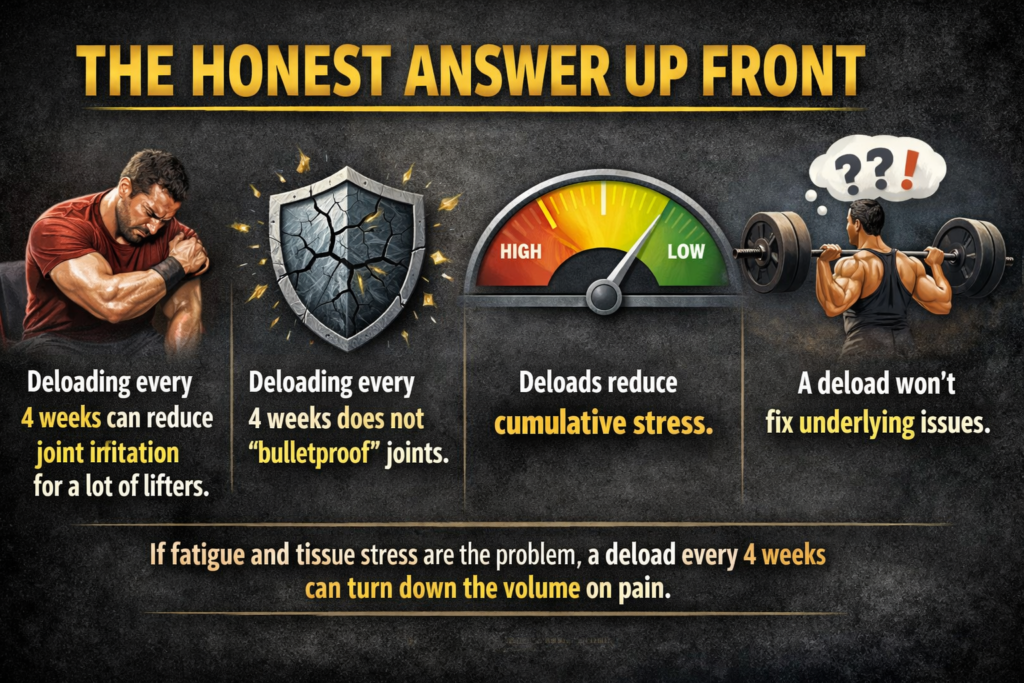
Deloading every 4 weeks can absolutely reduce joint irritation for a lot of lifters.
Deloading every 4 weeks does not magically “bulletproof” joints by itself.
Joint comfort usually improves because deloads reduce cumulative stress, not because a deload is a special healing spell.
If the underlying problem is technique, exercise selection, loading choices, or recovery habits, a 4-week deload schedule might only hide the issue until it pops back up.
If the underlying problem is simply accumulated fatigue and repetitive tissue stress, a deload every 4 weeks can feel like turning down the volume on pain.
That’s the real pattern I saw in my tests.
What “protect your joints” actually means
Joints are not glass.
Most joint pain in training is not “your cartilage is disintegrating in real time.”
Most of the time, it’s irritated tissues around the joint.
Tendons.
Bursae.
Joint capsule structures.
Sometimes muscle attachments that get angry when they’re overworked or loaded in a way they don’t like.
In other words, “joint pain” is often “your system is tired of your current deal.”
A deload protects joints only if it reduces the specific type of stress that’s irritating them.
That’s the key.
If you deload by doing the same painful movement with slightly lighter weight, you might not change the “deal” enough.
If you deload by reducing total loading and giving tissues a break from the most aggravating angles, you usually feel the difference fast.
The experiment I ran on myself
I’m going to describe this like a lab report, except the lab is a crowded gym and the scientist is me pretending not to be emotionally attached to lifting heavy.
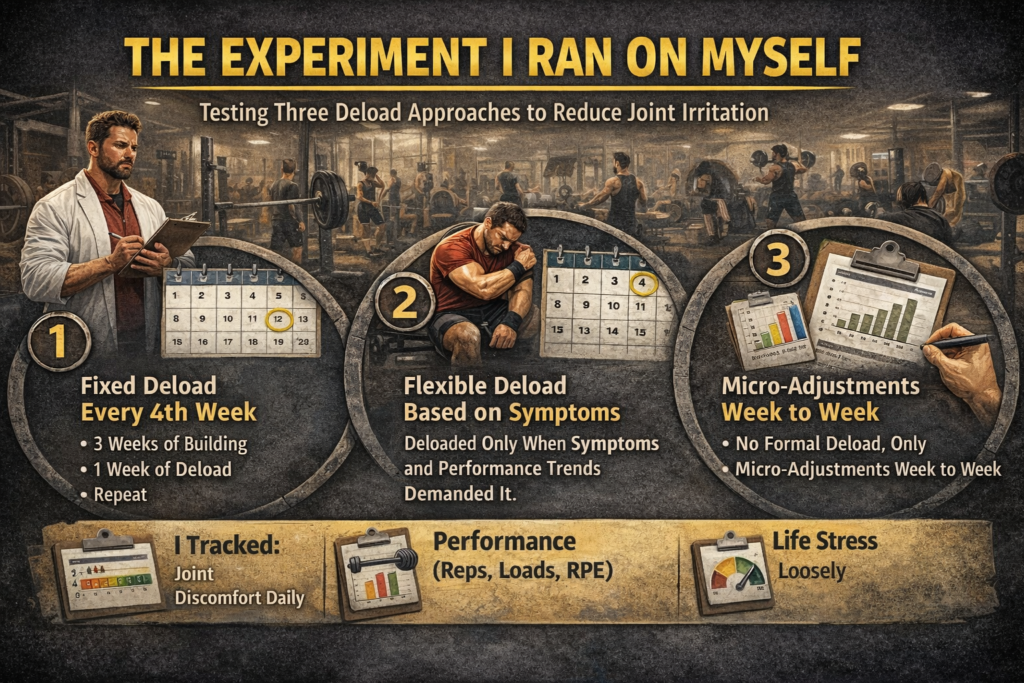
I ran three main approaches over multiple training blocks.
I tracked joint discomfort daily with a simple 0–10 scale.
I tracked performance with reps, loads, and RPE.
I tracked “life stress” loosely, because pretending stress doesn’t count is how you end up arguing with your elbow at 2 a.m.
I focused on three areas that historically complained the most.
- Elbows during pressing and pulling volume.
- Shoulders during heavy pressing.
- Knees during squat volume and high-frequency leg work.
The three approaches were these.
- A fixed deload every 4th week.
- A flexible deload only when symptoms and performance trends demanded it.
- No formal deload, only micro-adjustments week to week.
Test #1: Fixed deload every 4th week
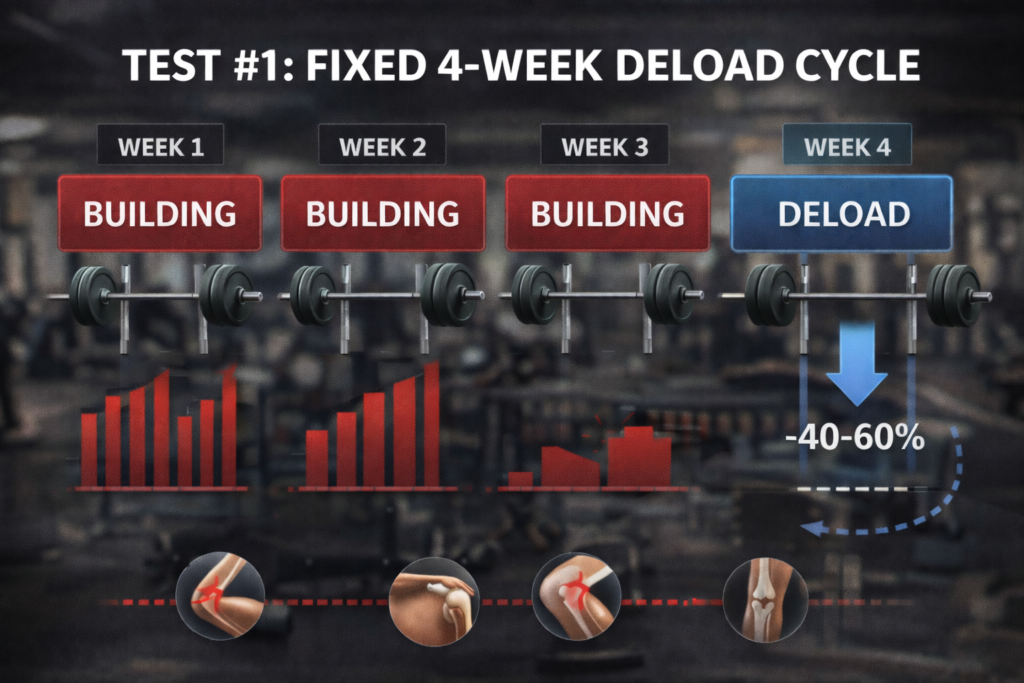
This was the classic plan.
Three weeks of building.
One week of deload.
Repeat.
I kept the same exercises and the same overall structure.
I reduced volume first, then intensity if needed.
My default deload looked like this.
I kept the same training days.
I cut working sets by about 40–60%.
I kept reps a little farther from failure.
I avoided grinders and anything that made joints feel “pinchy” or sharp.
I treated the deload week like maintenance, not punishment.
The joint results were honestly impressive
- Elbow irritation dropped noticeably during deload weeks.
- Shoulders felt smoother, especially on the first heavy session back.
- Knees felt less “inflamed,” especially the day after squats.
The performance results were also good.
- Week 1 back after deload often felt snappy.
- Bar speed improved.
- RPE dropped at loads that had felt heavy two weeks earlier.
Then I noticed something important.
- Symptoms didn’t just drop during deload week.
- Symptoms dropped because the whole system stopped accumulating stress forever.
That sounds obvious, but it matters.
The deload wasn’t “healing my joints.”
The deload was stopping me from slowly outspending my recovery budget.
The best part was predictability.
I didn’t have to “wait until it got bad.”
I didn’t have to interpret every elbow twinge like a fortune teller reading tea leaves.
The downside was also predictable.
Sometimes week 4 arrived and I felt great.
Deloading anyway felt like hitting the brakes on a highway with no traffic.
Motivation dipped a little on those blocks.
That matters, because consistency is a joint-protection strategy too.
What I learned from the fixed 4-week cycle
The cycle worked best when volume was high and exercise repetition was high.
The cycle mattered more during phases with lots of pressing, lots of squats, or lots of repetitive patterns.
The cycle mattered less during phases where training was already varied and fatigue-managed.
So the 4-week deload didn’t feel like a universal rule.
It felt like a tool that was more useful when training stress was predictable and heavy.
Test #2: Flexible deload based on signals
This approach was less neat on paper.
It was also more realistic for actual humans.
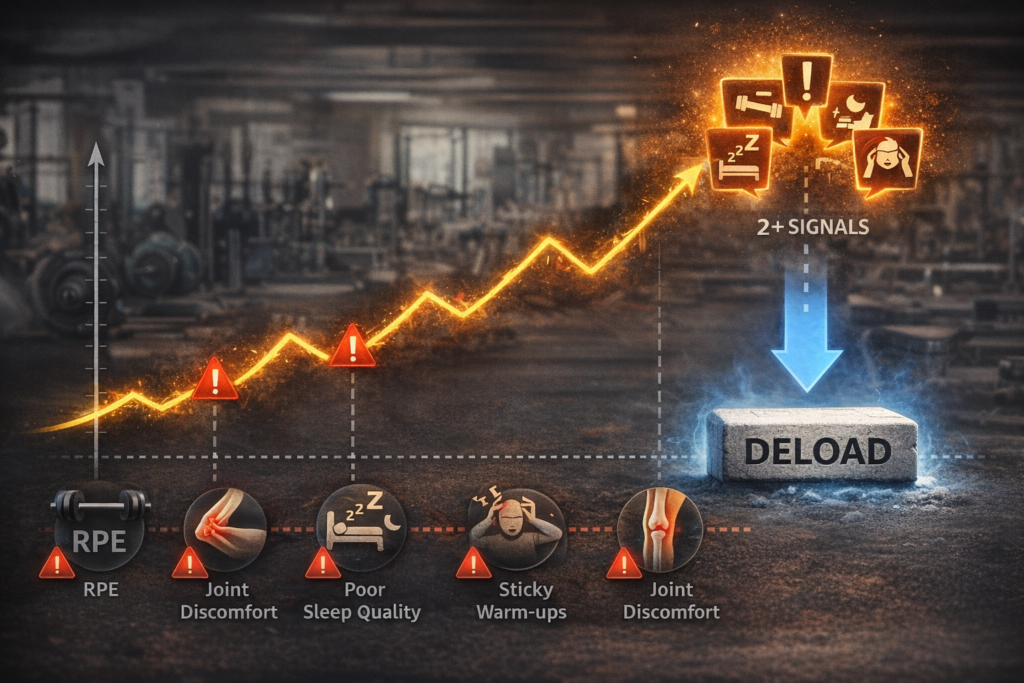
I deloaded only when at least two of these showed up together.
Performance stagnated for more than a week.
RPE climbed at loads that should have felt normal.
Joint discomfort rose for several sessions in a row.
Sleep quality dipped or life stress spiked.
Warm-ups felt unusually “sticky,” like the joints needed extra convincing.
When two or more signals lined up, I deloaded the following week.
My flexible deload looked similar to the fixed deload.
Volume down 40–60%.
Intensity down slightly or kept moderate.
More pain-free variations.
No grinders.
More attention to movement quality.
Here’s what happened
- When I deloaded at the right time, joint relief was as good as the fixed schedule.
- Sometimes it was even better, because I caught the irritation early.
- When I waited too long, the deload week didn’t fully reset things.
It helped, but it felt like putting out a campfire after it already lit the forest.
The big advantage was I didn’t waste deloads when I felt great.
The big disadvantage was I had to be honest.
Honesty is hard when you love the idea that you’re “fine.”
My elbow did not care about my personal brand.
What I learned from the flexible approach
Flexible deloading can protect joints very well if you have good self-awareness.
Flexible deloading fails when you ignore early signs because you’re attached to momentum.
Flexible deloading is basically like driving with a fuel gauge instead of refueling every 300 miles no matter what.
It’s more efficient.
It also requires you to look at the dashboard.
Test #3: No formal deload, only micro-adjustments
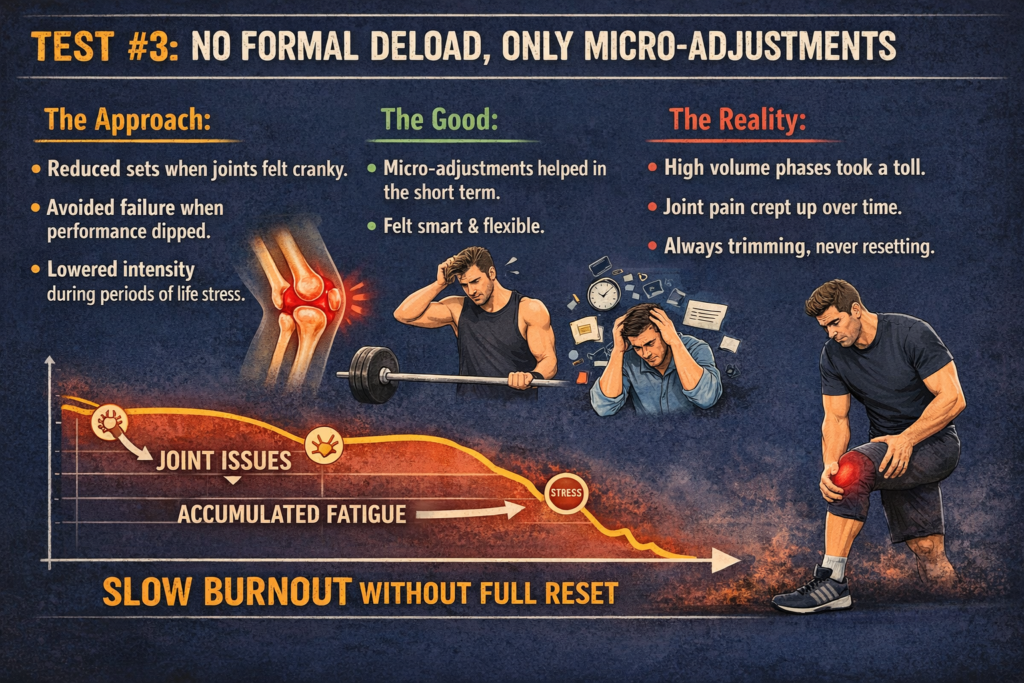
This was my “let’s see if I can be an adult about training” phase.
No planned deload weeks.
Instead, I adjusted week to week.
If joints felt cranky, I reduced sets slightly.
If performance dipped, I avoided pushing failure.
If life stress rose, I lowered intensity for a few sessions.
It sounds smart.
It can be smart.
In practice, here’s what happened
- Micro-adjustments helped a lot for short periods.
- Micro-adjustments did not fully replace a real deload during high-volume phases.
- Joint irritation crept up slowly, because I was always trimming a little instead of resetting the baseline.
The results felt like this:
- I avoided major flare-ups.
- I also lived at a slightly higher level of “background ache” than I wanted.
- The difference was subtle but consistent.
- My joints felt like they were always paying rent late.
- Nothing got evicted.
- Nobody felt relaxed either.
What I learned from the micro-adjustment approach
This approach worked best when training volume was moderate and exercise variety was higher.
This approach worked worst when I ran repeated heavy patterns for multiple weeks.
This approach demanded constant attention.
Constant attention is tiring, which is funny, because the whole point was reducing fatigue.
So does deloading every 4 weeks protect joints
Based on my own testing, yes, it often does.
It does so mainly by lowering cumulative joint and tendon stress before irritation becomes persistent.
It also helps because it reduces overall fatigue, and fatigue changes how you move.
Fatigue makes technique sloppier.
Fatigue makes bracing worse.
Fatigue makes small compensations bigger.
That extra slop often shows up as joint crankiness.
Deloading every 4 weeks is basically a scheduled “movement quality refund.”
Not because you suddenly become a perfect lifter.
Because you stop training like your tissues have unlimited customer support.
Why joints get irritated in the first place
Most joint issues in lifting are not about one bad rep.
Most are about repeated exposure.
High volume in the same patterns.
High intensity without enough recovery.
Too much failure training.
Too many grinders.
Poor exercise fit for your body structure.
Technique drift under fatigue.
A big one that surprised me was exercise selection.
Some movements just don’t love some joints.
My elbows tolerate dumbbell pressing far better than certain barbell angles.
My shoulders behave better when I keep pressing volume but vary the grips and planes.
My knees prefer certain squat variations depending on how much other leg volume I’m doing.
A deload helps, but it doesn’t change whether your joints actually like the movements you’re forcing on them.
That’s a separate conversation, and it matters.
The connective tissue reality nobody loves

Muscles adapt relatively fast.
Tendons adapt slower.
Joint-related tissues often adapt slower than your ego does.
That mismatch is where trouble lives.
A deload is one way to respect that mismatch.
It lowers the peak stress long enough for the slower-adapting tissues to catch up.
It’s not glamorous.
It’s effective.
It’s also why people who “feel strong” often get surprised by tendon pain.
Strength can climb while tendon tolerance is still negotiating the contract.
The biggest myth: deloads are only for advanced lifters
Beginners often don’t need formal deloads because loads are lighter and recovery is easier.
Beginners also often do chaotic programming without enough volume consistency to accumulate stress in one pattern.
Intermediate lifters are where deloads become very real.
Intermediate lifters have enough load and volume to accumulate meaningful stress.
Intermediate lifters also have enough skill to repeat the same movements consistently, which is great for progress and also great for repetitive strain.
Advanced lifters can absolutely benefit too, but the “4-week rule” isn’t automatically better just because someone is advanced.
The need is driven by stress and recovery, not years in the gym.
The 4-week deload works best in these situations
- High-volume hypertrophy blocks where you’re repeating the same main lifts.
- Strength phases with heavy work that creeps toward grinding.
- Programs with a lot of pressing frequency.
- Programs with high squat frequency or high knee-dominant volume.
- People with a history of tendon irritation.
- Lifters who push effort hard and are not naturally conservative.
- Anyone whose life stress is unpredictable.
That last one matters more than most training plans admit.
Stress is stress.
Your joints don’t know whether it came from squats or emails.
The 4-week deload is less necessary in these situations
- Training phases with moderate volume and varied movement patterns.
- Blocks where intensity is managed well and failure is rare.
- Programs with built-in variation and autoregulation.
- People who already micro-adjust intelligently and early.
That said, “less necessary” is not the same as “useless.”
Even when I didn’t strictly need it, a deload week often improved how I moved and how I slept.
Sometimes that’s enough reason.
What kind of deload actually helps joints
This is where a lot of people mess up.
They deload like this.
Same exercise.
Same irritating angle.
Same rep range.
Same tempo.
Slightly lighter weight.
Then they say deloads don’t work.
My best joint-friendly deloads had three features.
Volume dropped significantly.
Aggravating movements were swapped or modified.
Effort stayed comfortably submaximal.
Here are a few examples that worked for me
1. Barbell bench to dumbbell bench with a neutral grip.
2. Heavy dips to push-ups on handles or rings with controlled depth.
3. Low-bar squat to safety bar squat or goblet squat with slower tempo.
4. Heavy skull crushers to cable pushdowns with a friendlier elbow path.
5. Pull-ups to pulldowns or assisted pull-ups with smoother reps.
The goal wasn’t to prove toughness.
The goal was to remove the specific splinter that was irritating the joint.
Two deload templates that actually felt good
Option A: Volume deload
Keep intensity moderate.
Cut sets by 40–60%.
Keep reps clean and leave 3–4 reps in reserve.
Swap only the movements that feel spicy.
This option felt best when joints were mildly irritated but performance was still decent.
Option B: Stress deload
Cut sets by 50–70%.
Lower intensity more noticeably.
Avoid any movement that provokes symptoms.
Add more mobility and warm-up volume.
This option felt best when I waited too long and joints were clearly annoyed.
The joint check system I used during the block
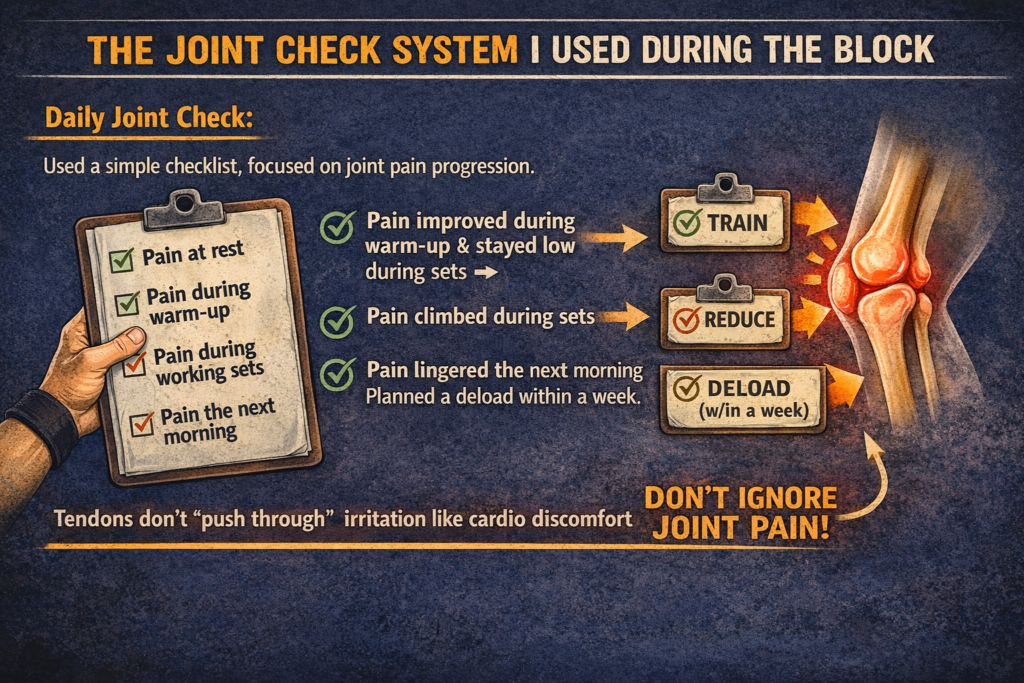
I used a simple daily check.
Pain at rest.
Pain during warm-up.
Pain during working sets.
Pain the next morning.
If pain improved during warm-up and stayed low during sets, I usually trained normally.
If pain climbed during sets, I reduced volume that day.
If pain lingered into the next morning more than usual, I planned a deload within a week.
This kept me from doing the classic mistake.
That mistake is assuming you can “push through” tendon irritation like it’s cardio discomfort.
Tendons don’t always respond well to motivational speeches.
The uncomfortable truth: form and exercise fit still matter more
My biggest “joint protection” improvements came from these changes, not deload timing.
Fixing pressing angles that aggravated shoulders.
Using grips that made elbows happier.
Reducing deep fatigue sets that made technique fall apart.
Balancing volume between pushing and pulling.
Adding smarter warm-ups for the specific tissues that complained.
Deloads helped a lot.
Those changes helped more.
Deloads made those changes easier to feel and implement, because I wasn’t always training in a fog of fatigue.
How to decide if you should deload every 4 weeks
Here’s the simplest rule I can honestly defend.
If you train hard, repeat the same main lifts, and your joints trend worse by week 3, a 4-week deload cycle is probably a good idea.
If you train with good autoregulation, vary movements, and your joints stay calm, you can deload less frequently.
If you have recurring tendon issues, a predictable deload schedule can prevent flare-ups better than waiting for warning signs.
If motivation dies during forced deload weeks, use a flexible deload system instead.
Consistency beats perfection.
A plan you actually follow protects joints more than a perfect plan you resent.
A realistic 4-week plan you can steal
Week 1: Build.
Week 2: Build.
Week 3: Push, but avoid turning everything into a near-death experience.
Week 4: Deload.
During week 4, do this.
Keep frequency the same.
Cut sets by roughly half.
Keep technique crisp.
Keep reps away from failure.
Swap movements that irritate joints.
Leave the gym feeling better than when you walked in.
Then return to week 1 and build again.
This plan is boring in the best way.
Boring is underrated when your elbows are trying to send you legal notices.
What if you only care about “joint health” and not performance
Deloads can still be worth it.
A deload is a stress management strategy, not just a strength strategy.
If training is part of your life for the long run, joints are the long run.
The goal is not to lift hard for 12 weeks.
The goal is to lift for years without constantly negotiating with pain.
Deloading every 4 weeks can be a simple, practical way to keep that negotiation short.
Final Thoughts
Deloading every 4 weeks can reduce joint irritation because it interrupts cumulative stress.
Deloading every 4 weeks is not a substitute for smart technique, smart exercise choices, and smart loading.
A deload works best when you reduce volume meaningfully and avoid the specific movements that aggravate your joints.
A flexible deload can work just as well if you’re honest about the signals.
My own results were clear enough that I still use deloads regularly.
Sometimes fixed.
Sometimes flexible.
Almost never never.
If your joints have been quietly complaining, try a 4-week deload cycle for two or three blocks.
Track discomfort like an adult scientist instead of an optimistic superhero.
Notice what actually changes.
Keep what works.
Drop what doesn’t.
That’s not guru advice.
That’s just respecting the fact that your joints are part of the system, not an accessory.