There’s a running joke in home gym forums that once you buy a cable machine, you’ve officially “made it.”
You’ve graduated from resistance bands and adjustable dumbbells to the real deal.
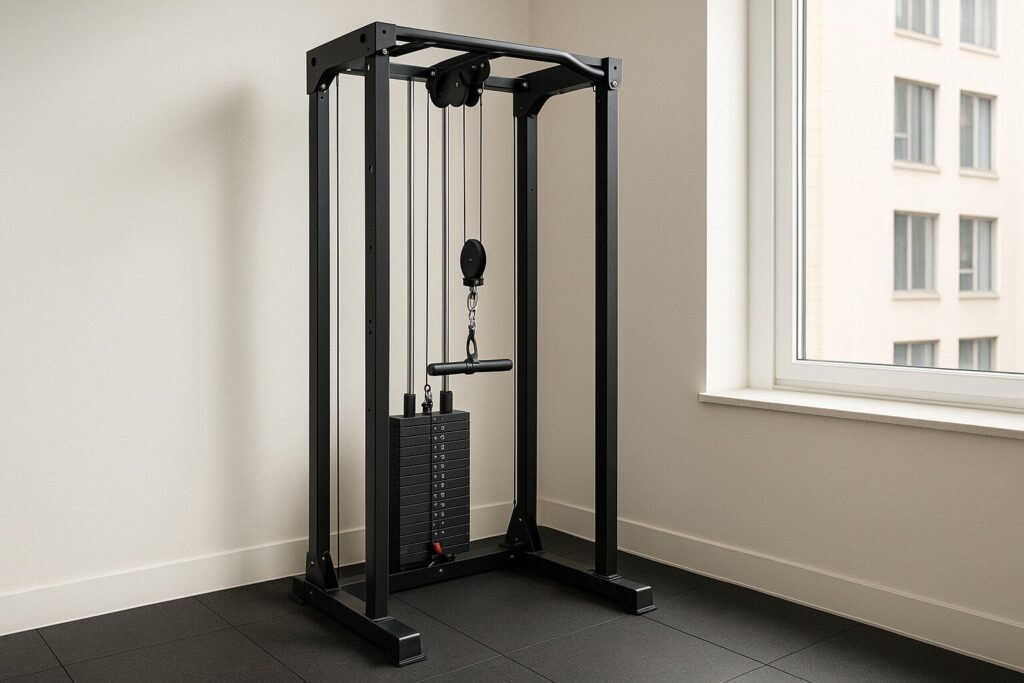
But then you see that sleek little compact cable tower sitting in someone’s garage and think—wait, can that thing actually do what the big commercial pulley machines do at the gym?
You know, the ones that look like they belong in a spaceship control room, with chrome levers and 20 weight stacks?
Alright, here’s the real story behind it.
The Garage Setup vs. the Gym Tower
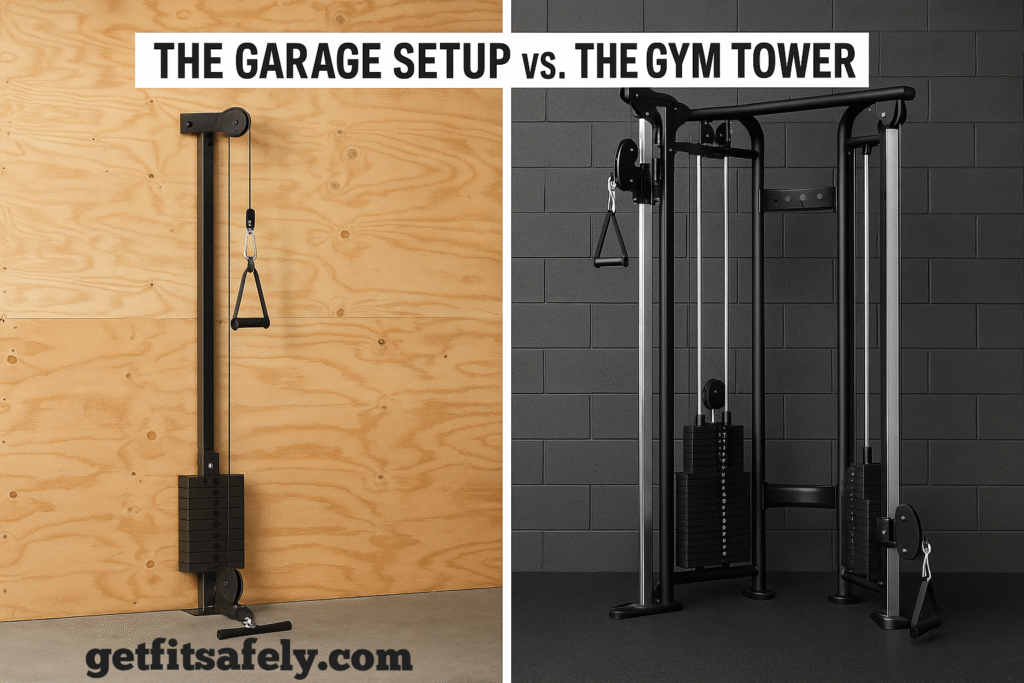
If you’ve ever trained at a gym, you know the cable system is the MVP of versatility.
You can hit your triceps, lats, chest, glutes, and even core—all without ever walking away from it.
The commercial pulley machines have a huge weight stack, a smooth pulley ratio (usually 2:1), and industrial-grade bearings that make the resistance feel buttery and consistent.
It’s like driving a Tesla after years in a used Corolla—same function, different ride.
But when you look closer, that buttery smooth feeling doesn’t come from magic.
It’s from physics. Big pulleys reduce friction.
Longer cables allow a full stretch and a more natural line of pull.
Heavy steel frames absorb movement instead of wobbling.
All those things combine to make every rep feel predictable and controlled.
Now, most compact cable machines you see online look amazing for their size.
They’re tall, slim, wall-mounted, and claim to “replace your entire gym.”
And while that sounds great, here’s the truth: physics doesn’t care about marketing.
When you reduce the pulley size, the cable length, and the anchor range, you also reduce motion quality and mechanical feel.
That’s not necessarily bad—it just changes what you get out of the movement.
You’ll feel more direct tension, but sometimes less fluid motion.
You’ll hit the same muscles, but the resistance curve may not match what you’re used to at the gym.
How Close It Actually Gets
Let’s be fair: the newer compact systems have come a long way.
Brands like Tonal, Mikolo, and Inspire have improved resistance smoothness, range of motion, and even load accuracy.
Some use dual pulleys to mimic gym-style movement patterns, and the adjustable height tracks allow for exercises like:
- Chest flyes
- Face pulls
- Cable squats
- Overhead triceps extensions
- Seated rows
So yeah, the movement variety is there.
What’s missing is that effortless glide and pure tension consistency that you only feel on heavy-duty gym pulleys.
You notice it most when doing isolation work—rear delt flyes, cable crossovers, triceps pushdowns.
On a commercial machine, the resistance follows you smoothly through the motion.
On some home units, the resistance peaks halfway and fades as you reach the end of the movement.
It’s not the end of the world—you can still get results—but it does mean you’ll have to adjust your tempo and maybe your expectations.
Resistance and Ratio
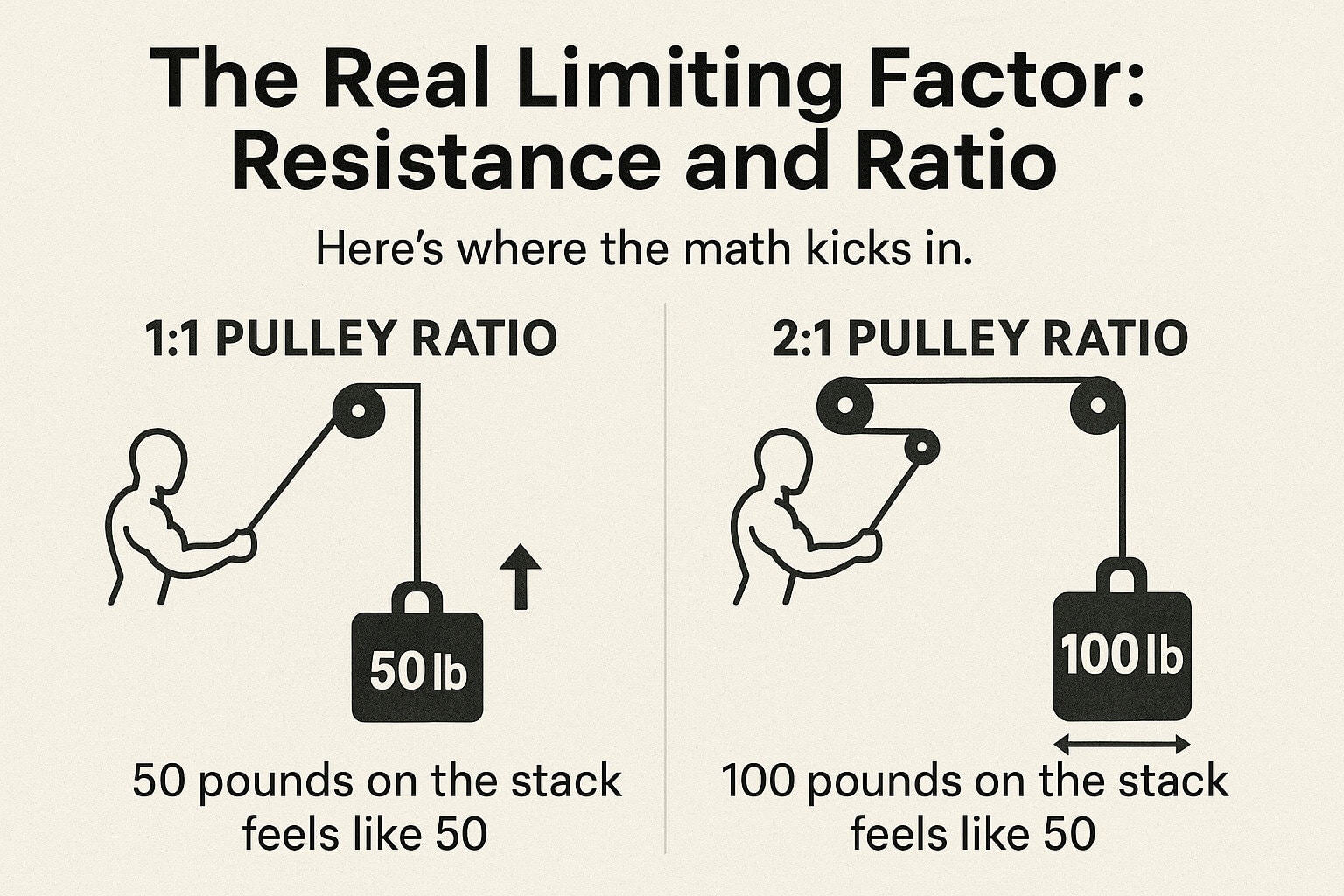
Here’s where the math kicks in.
Most compact systems use a 1:1 pulley ratio.
That means if you set 50 pounds, you’re actually pulling 50 pounds.
Commercial pulleys, however, often use a 2:1 ratio.
That means 100 pounds on the stack feels like 50, but the cable travels twice as far.
That extra cable length gives you smoother control, a more gradual resistance curve, and the ability to generate more speed without losing tension.
Compact cables often trade that for simplicity.
You get shorter travel and rawer resistance.
It’s like having the same horsepower but on a tighter racetrack—you hit full tension fast, but you also run out of track just as quickly.
For movements like standing cable rows, woodchops, or pulldowns, that shorter travel can slightly limit your range of motion.
But here’s the flip side: that direct feel can make compound work more satisfying.
When you’re doing cable presses, lateral raises, or curls, the instant feedback helps with stability and control.
If you’re a bodybuilder chasing slow eccentrics and time under tension, you’ll need to adapt your rep tempo.
For power athletes or circuit-style training, that snap can actually feel great.
The trick is knowing your pulley ratio and programming around it.
A compact machine isn’t worse—it’s just calibrated differently.
When Compact Machines Actually Win
Compact cable machines dominate in real-world practicality.
You don’t wait for machines.
You don’t wipe someone else’s sweat off the handle.
You don’t fight over who gets the dual pulley first.
And they shine in three key areas:
1. Core and rotation work. Pallof presses, woodchops, and anti-rotation holds feel rock solid. Because the pulleys are closer together, the resistance line stays tight—perfect for core control and stability.
2. Home consistency. You can train every day without driving anywhere. For busy people, that’s gold.
3. Functional training. If you mix calisthenics, mobility, and strength, compact cables let you add resistance without overloading joints.
And honestly, the biggest win? You actually use it.
Unlike that dusty elliptical in the corner, a cable machine begs to be used.
The variety keeps training fresh.
You can warm up with face pulls, finish with ab crunches, or superset arms without changing equipment.
Many people report training more often once they install one—because accessibility beats perfection every single time.
If you treat it like your main station, you’ll easily get 90% of what a full gym pulley offers—and for most lifters, that 90% covers everything they actually need.
The Setup Secrets Most People Ignore
One underrated factor in home cable setups is mounting stability.
If your wall mount flexes or your rack attachment wobbles, the entire feel of the exercise changes.
You lose control, the tension shifts, and your form starts to drift.
The fix?
Anchor it like it matters.
Use concrete bolts or a heavy-duty rack mount.
Check the torque every few weeks.
And don’t skip proper cable lubrication.
A dry cable adds drag, which makes resistance inconsistent.
A five-minute maintenance routine every month can make a cheap machine feel twice as smooth.
Another overlooked trick: cable angle.
Step forward or backward slightly during exercises to adjust how tension loads your muscles.
A small change in foot position can completely change how a movement feels—especially with limited cable travel.
What I Didn’t Expect from a Compact Setup
When I first switched to a compact setup
during lockdown, I thought I’d hate it.
I missed the clunk of weight stacks, the cable hiss, the sound of plates rattling at 6 AM.
But something funny happened—I started training more consistently.
I didn’t need to drive anywhere or wait for the cable station to free up.
And within a few months, my pulling strength actually went up because I was sticking to my plan every single day.
I started pairing my cable workouts with short bodyweight circuits—rows, presses, face pulls, curls, crunches—and the variety made training feel fun again.
That’s when I realized the best equipment isn’t the one that looks impressive. It’s the one that gets used.
And when you remove friction—literally and figuratively—you start to realize how much energy you used to waste just getting to the gym.
Buying Guide: What to Look For in a Compact Cable Machine
Pulley size matters.
Larger pulleys mean smoother resistance and less wear on the cable.
Small pulleys save space but add friction.
Cable quality is key.
Look for coated steel or aircraft-grade braided wire—cheap nylon cables wear fast and stretch over time.
Range of motion is everything.
The longer the cable travel, the more natural your movement will feel.
Aim for at least 80–90 inches per side if possible.
Check the mounting system.
Wall mounts are solid if you own your space.
Rack-mounted options work great if you already have a power cage.
Weight capacity tells part of the story, but don’t obsess over numbers.
A smooth 80 pounds feels better than a jerky 120.
And don’t forget accessories.
A good set of handles, ropes, and bars adds way more versatility than any extra ten pounds of resistance.
Programming Tips for a Cable-Focused Routine
Week 1–2: Focus on form. Keep reps between 8–12 and slow down your eccentrics.
Week 3–4: Add volume. Superset antagonistic muscles—push and pull, flex and extend.
Week 5–6: Increase density. Shorter rest, higher frequency, more variety.
Sample workout:
- Cable rows 4×10
- Standing chest fly 4×12
- Face pulls 3×15
- Overhead triceps press 3×12
- Cable curls 3×12
- Pallof press 3x30s per side
Thirty minutes. No waiting. Full-body stimulus.
Fixes Every Home Cable Owner Should Know
Hear squeaks or resistance spikes?
The pulley bearings might be dry.
A quick silicone spray can make a massive difference.
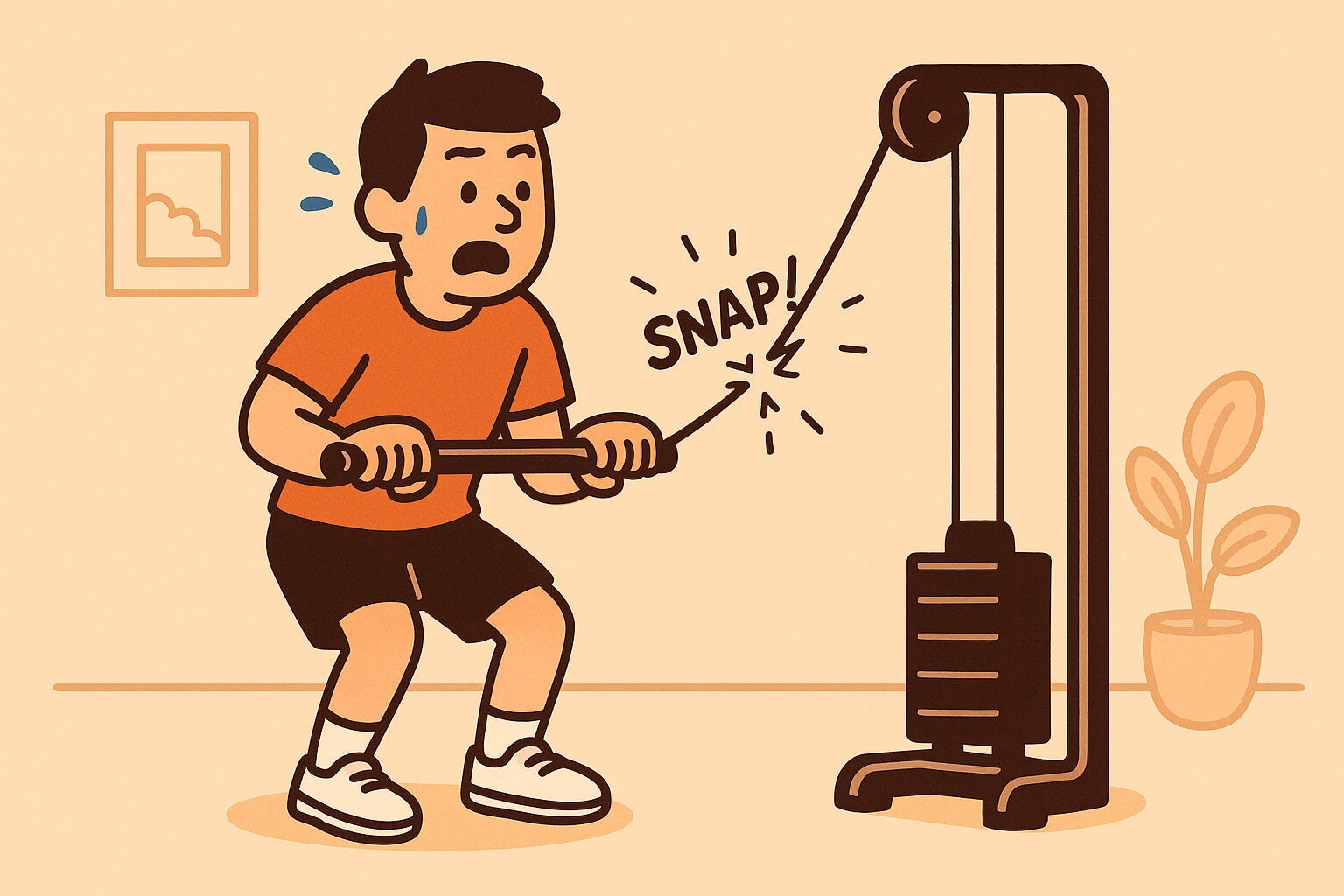
Cable starting to fray?
Stop immediately and replace it.
A broken cable can whip dangerously under load.
Machine wobbling?
Re-check your mounts.
Even a few millimeters of slack changes your exercise path.
Keep a microfiber cloth nearby and wipe cables after sessions—it prevents buildup that increases friction over time.
It’s not glamorous, but maintenance is what separates a $400 toy from a machine that lasts a decade.
Choosing the Right Model for You
If you want smart tracking and digital feedback, Tonal and Vitruvian are incredible but pricey.
If you prefer plate-loaded realism and heavy resistance, look at the REP FT-3000 or Titan dual pulley.
If portability matters most, the Ancore Trainer or A90 cable kit packs serious versatility into a backpack.
It’s not about brand loyalty—it’s about matching the tool to your lifestyle.
Not a Tonal, but perfect to start and save big — Buy on Amazon
Can You Really Build Muscle with It Alone?
Absolutely.
Resistance is resistance.
Progressive overload, volume, and consistency are what drive growth—not the size of your equipment.
If you train with intent, hit all major movement patterns, and eat for your goals, you’ll build muscle with a compact cable machine just fine.
Sure, you might miss the clatter of plates or the gym mirror pump lighting, but your muscles don’t care where the tension comes from—they just respond to it.
Final Thoughts
A compact cable machine won’t perfectly replicate the feel of a gym pulley system—but it can absolutely replace its role in your training life.
If you care about convenience, flexibility, and consistent progress, go for it.
If you’re obsessed with flawless cable tension for bodybuilding-level isolation, the gym still wins.
Either way, what really counts isn’t the pulley—it’s the person holding the handle.