
There’s a moment every lifter knows too well
You’re standing in front of the mirror after months of consistent gym sessions.
You’ve pushed every rep, tracked your protein, and even forced down chicken and rice like it’s a religion… yet you look exactly the same.
The bar feels heavier, but your shirt doesn’t.
That’s when it hits you — maybe the gym isn’t broken. Maybe your plan is.
Building muscle isn’t just about showing up
Most people think growth is a simple formula: show up, lift heavy, eat big.
But that’s like saying driving faster gets you to your destination — sure, if you’re on the right road.
If you’re not, you just burn fuel.
Muscle growth follows the same logic.
If your training lacks direction, even the hardest sessions won’t leave a mark.
Progress doesn’t reward effort alone.
It rewards efficient effort.
And that’s what separates the guys who grow from the ones who just grind.
You can have perfect attendance at the gym and still make zero progress if your body isn’t getting the right signal to grow.
That signal is mechanical tension — the physical stress that forces your muscle fibers to adapt and thicken.
The key is applying that tension consistently, not randomly, and pairing it with recovery strong enough to handle the adaptation that follows.
The gap between training hard and training right

I’ve seen guys load up the bench with ego plates, then wonder why their chest never changes shape.
And others who go light forever, terrified to push close to failure.
Both camps hit the same wall — they confuse effort with stimulus.
Your body doesn’t care how tired you feel.
It only cares if the muscle was challenged enough to adapt.
That’s why understanding progressive overload matters.
Not just lifting more weight every week (that’s a myth), but increasing total tension over time — through load, reps, control, or even better execution.
It’s not sexy.
But it works when the hype fades.
I still remember benching five days a week, convinced I was unstoppable.
Until I realized I’d built a routine around fatigue, not progress.
Then I changed the approach:
Three sets at 85% 1RM, two back-off sets at 70%, with full control and a pause on each rep.
That’s when my chest actually started to grow.
You don’t need a new exercise.
You need a reason behind each rep.
Why your program might be sabotaging your gains
If your workouts look like a TikTok compilation of random supersets, that’s your first red flag.
Muscles don’t grow from chaos — they grow from structure.
You don’t need 15 variations of curls to build your biceps.
You need consistent tension, the right frequency, and enough recovery between sessions to actually adapt.
Your muscles grow when you’re resting, not when you’re flexing for Instagram.
And if you’re hitting the same weights for months, that’s not “maintaining form.”
That’s stagnation in disguise.
Try sticking to a single program for at least six weeks before judging it.
Track your numbers.
Film your lifts once a week.
See if your execution, control, or bar speed improves.
If nothing’s changing, neither are you.
Training volume and recovery: the love-hate relationship

Here’s the paradox:
More volume gets you more gains… until it doesn’t.
Past a certain point, your recovery becomes the bottleneck.
If you’re sore for five days straight, you’re not adapting — you’re surviving.
The sweet spot?
Enough volume to trigger growth, not enough to ruin your next workout.
For most lifters, 10 to 20 sets per muscle group per week is the magic zone.
A 2022 review found that around 10 sets per week per muscle group tends to maximize hypertrophy — but that’s assuming good sleep, proper nutrition, and stable form.
Your body isn’t a machine.
It’s an ecosystem.
If one part breaks — recovery, sleep, nutrition — the whole thing slows down.
A simple rule: if your lifts feel heavier but your energy feels lower, you’re probably doing too much.
Nutrition that actually supports growth

You can’t out-train an empty plate.
Eating “a lot” doesn’t mean eating right.
If you’re slamming calories but never tracking protein or timing meals, you’re throwing ingredients into a blender without checking if it’s even plugged in.
Muscle growth thrives on consistency — not perfection, not extremes.
A clean surplus of 200–300 calories above maintenance is enough to build muscle without turning into a marshmallow.
And if you’re training hard, aim for about 1.6–2.2 grams of protein per kilogram of body weight per day.
More isn’t always better — what matters is absorption and distribution throughout the day.
Split your meals evenly, hydrate like it’s part of your workout, and don’t skip carbs before you lift — they fuel intensity.
Muscles don’t grow off vibes.
They grow off glycogen and amino acids.
Why your big lifts matter more than you think
If your workouts revolve around cable machines and isolation sets, you’re missing the heavy hitters.
The squat, bench press, deadlift, and overhead press aren’t just “compound exercises.”
They’re the backbone of strength and muscle synergy.
When you get stronger at them — properly stronger, with full control and no ego — everything else grows faster.
Compound lifts recruit more muscle fibers, improve hormonal response, and increase overall workload capacity.
Think of them as your training’s “central nervous system warmup” — the main engine that powers your progress.
And here’s the secret: the stronger your squat, the easier your leg press feels.
The stronger your bench, the more your triceps and shoulders can handle isolation work later.
Everything is connected.
Mind-muscle connection or mechanical tension?

Let’s be real — both matter.
That “feeling” of contraction is how you make every rep count.
But without real tension, you’re just flexing in slow motion.
The key is merging control with load.
Slow down your eccentric, pause at the hardest point, and then explode — no momentum.
That’s what makes your muscle fibers actually wake up and adapt.
I like to think of it this way:
The mind-muscle connection is your steering wheel.
Mechanical tension is your engine.
Without both, you’re not going anywhere.
Sleep: the anabolic drug no one talks about
You can take all the pre-workouts in the world, but if you’re sleeping five hours a night, you’re short-circuiting your own progress.
Growth hormone, testosterone, tissue repair — they all peak while you’re asleep.
You wouldn’t unplug your phone at 40% battery and expect it to last all day, right?
So why do that to your body?
If you’re training hard, aim for 7–9 hours of sleep consistently.
Your recovery starts when the lights go off, not when you rack the bar.
One of my training partners went from stalling at a 225 bench for months to breaking 245 in three weeks — all because he started prioritizing sleep and stopped scrolling past midnight.
That’s not a supplement.
That’s science you can feel.
The gym isn’t broken — your balance is
Most lifters don’t fail because they’re lazy.
They fail because they chase everything except balance.
Too much volume, not enough recovery.
Too many exercises, not enough progression.
Too much hype, not enough patience.
Growth happens in the quiet moments.
In the meals, in the recovery, in the small adjustments that don’t get likes online.
Balance means alignment — training, nutrition, recovery, and mindset all moving in the same direction.
Miss one, and the others fall apart.
The gym gives back what you put in — but only if the rest of your life is set up to handle it.
Accessory work that supports your main lifts, head to toe
You covered the main lifts — now zoom in.
Chest: Don’t stop at heavy bench work. Use accessory movements like dumbbell presses, cable flyes, and slow eccentrics to improve control and joint tolerance.
Arms: Don’t just curl for volume.
Use triceps pushdowns to reinforce bench lockout strength.
Add overhead triceps extensions to load the long head under stretch.
Include hammer curls to build brachialis, which gives your arm that “thick” look.
Shoulders: Overhead press builds your delts, but don’t stop there.
Add lateral raises for width, plus rear-delt flies and face pulls.
They keep your shoulder joint stable and pain-free.
Back: Pull-ups and rows are your bread and butter.
Add straight-arm pulldowns and lat-focused pullover variations to reinforce lat engagement.
Chest-supported rows and slow eccentrics improve control and reduce cheating.
A stronger back = safer lifts = bigger chest.
Legs: Squats are great, but they’re not the whole picture.
Single-leg work like Bulgarian split squats and lunges fixes asymmetries.
Hamstring curls, RDLs, and calf raises improve stability and force transfer.
Every muscle deserves its spotlight, but never in isolation from the system.
Gear, environment, and gym setup that actually help growth
The gym atmosphere matters more than people admit.
Train around lifters stronger than you — progress rubs off.
Set small goals every session: better bar speed, cleaner form, shorter rest.
Equipment can change the game.
Chains, resistance bands, safety pins — they add variety without losing structure.
And your recovery environment?
Foam rolling, stretching, or even contrast showers after lifting can help restore movement quality.
You don’t need fancy tools.
You just need consistency in how you use them.
Programming through life changes: work, travel, stress, age
No one trains in a vacuum.
Life throws curveballs — stress, travel, sleep loss.
When work gets crazy, reduce volume by 25% but keep intensity.
When traveling, switch to resistance bands or bodyweight circuits.
If you’re over 35, prioritize joint health and mobility before every lift.
And if you’re injured?
Don’t quit — adapt.
Train what you can safely, and treat rehab like another workout.
Consistency beats perfection every single time.
The classic split that actually works
Chest & Triceps / Legs & Shoulders / Back & Biceps (+ Core)
Old-school splits aren’t the problem.
Poor structure is.
This classic split works when every muscle group
—including the core—
is trained deliberately,
with enough volume to grow
and enough clarity to avoid confusion.
This is a complete hypertrophy-focused system,
not a random exercise list.
Day 1 – Chest & Triceps
Horizontal pushing and arm lockout strength
Chest
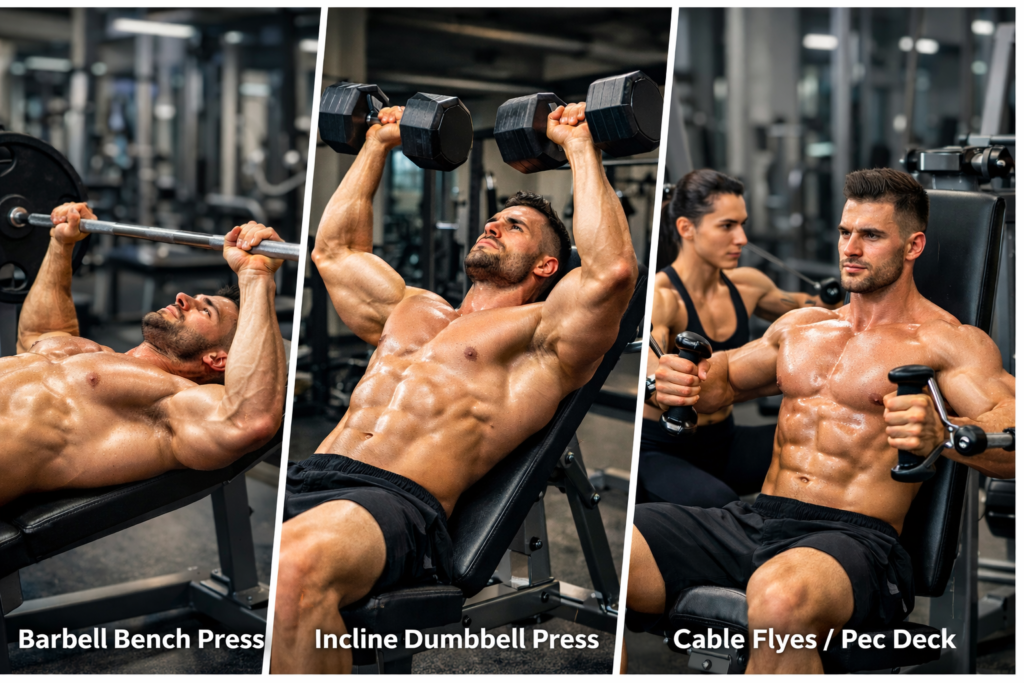
1. Barbell Bench Press
Target muscles:
- Pectoralis major
- Anterior deltoids
- Triceps (secondary)
Execution:
-
Lie on the bench, eyes under the bar, feet flat and stable on the floor.
-
Pull your shoulder blades together and lower the bar slowly to mid-chest.
-
Push the bar up while keeping your back tight and feet planted.
Sets & reps:
4 × 5–6
Progressions:
- Add 2.5–5 lb once all reps are clean
- Increase pause duration
- Improve bar speed
Variations:
- Dumbbell bench press: press dumbbells independently to allow a deeper stretch and more shoulder freedom.
- Machine chest press: follow a fixed path and focus on constant chest tension.
2. Incline Dumbbell Press
Target muscles:
- Upper chest
- Front delts
- Triceps (secondary)
Execution:
-
Set the bench to a low incline and sit back with dumbbells at chest level.
-
Lower the dumbbells slowly until you feel a stretch in the chest.
-
Press them up under control without fully locking out.
Sets & reps:
3 × 8–10
Variations:
- Incline barbell press: lower the bar to the upper chest under full control.
- Low-incline machine press: press through the handles without aggressive lockout.
3. Cable Flyes or Pec Deck
Target muscles:
- Chest (shortened range)
Execution – Cable Flyes:
- Step forward to create tension on the cables before the movement begins.
- Open the arms along a wide arc until the chest is fully stretched.
- Bring the hands together by squeezing the chest, not the shoulders.
Execution – Pec Deck:
- Sit firmly with chest up and elbows aligned to the pads.
- Open the arms slowly until a controlled chest stretch is reached.
- Close the pads by contracting the chest without pushing the shoulders forward.
Sets & reps:
3 × 12–15
Triceps
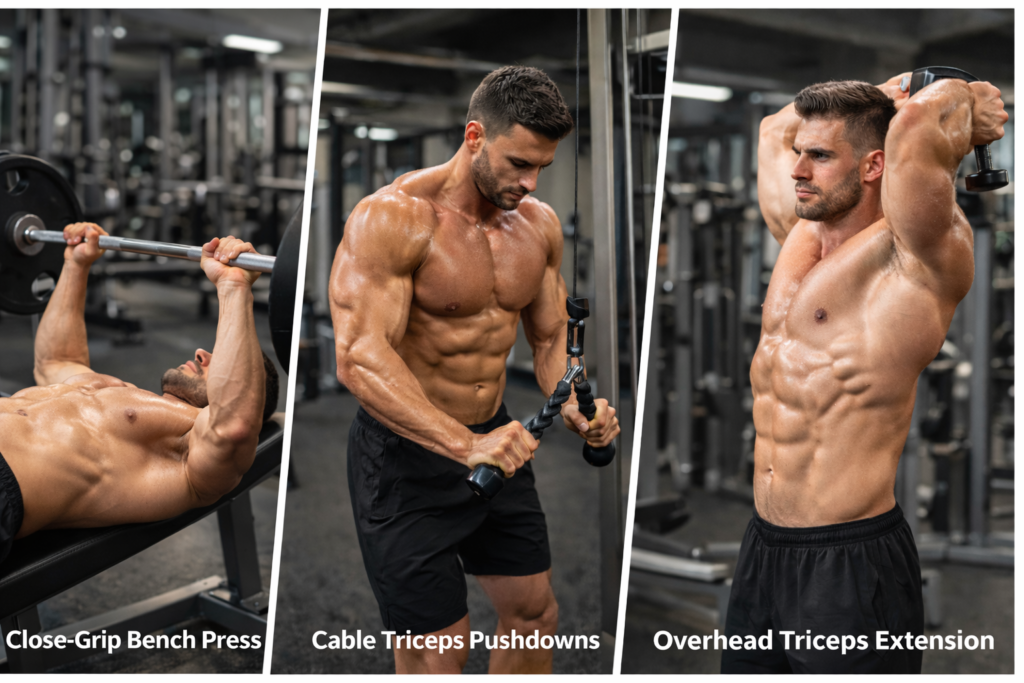
4. Close-Grip Bench Press or Dips
Target muscles:
- Triceps (long and lateral heads)
- Chest (secondary)
Execution – Close-Grip Bench Press:
- Grip the bar slightly inside shoulder width and keep the elbows close to the torso.
- Lower the bar under control until it touches the lower chest.
- Press up by extending the elbows, focusing on triceps drive.
Execution – Dips:
- Support the body on parallel bars with a slight forward lean.
- Lower yourself until the elbows reach a deep but controlled bend.
- Push back up by extending the elbows, keeping tension on the triceps.
Sets & reps:
3 × 6–8
Variations:
- Weighted dips: slight forward lean, controlled descent, strong triceps-driven press.
- Smith close-grip press: press along the rails while keeping elbows tucked.
5. Cable Triceps Pushdowns
Target muscles:
- Triceps lateral head
Execution:
-
Stand facing the cable with elbows glued to your sides.
-
Push the handle down until arms are fully straight.
-
Return slowly without moving your shoulders.
Sets & reps:
3 × 10–12
6. Overhead Triceps Extension
Target muscles:
-
Hold the weight overhead with elbows pointing forward.
-
Lower the weight behind your head slowly.
-
Extend the arms back up without arching the lower back.
Execution:
- Full stretch overhead
- Controlled extension
Sets & reps:
2–3 × 12
Day 2 – Legs, Shoulders & Core
Lower-body strength, shoulder stability, trunk control
Legs – Quadriceps & Glutes
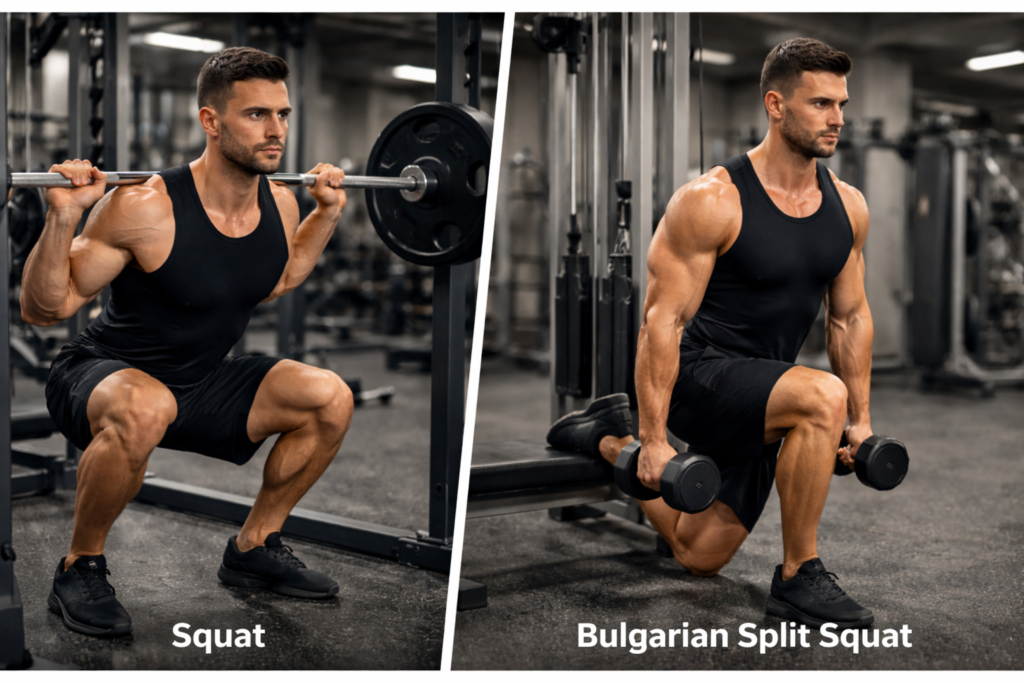
1. Squat or Leg Press
Target muscles:
- Quadriceps
- Glutes
- Core stabilizers
Execution – Squat:
- Stand with the bar balanced over mid-foot and brace the core before descending.
- Lower the hips while keeping the chest up and knees tracking forward.
- Drive up by pushing through the floor, maintaining full-body tension.
Execution – Leg Press:
- Sit with the lower back firmly against the pad and feet placed on the platform.
- Lower the sled under control until the knees bend deeply without losing position.
- Press the platform away by extending hips and knees, keeping tension on the quads and glutes.
Sets & reps:
4 × 5–8
Variations:
- Hack squat: back against the pad, drive through mid-foot.
- Safety bar squat: stay upright and reduce shoulder strain.
2. Bulgarian Split Squat
Target muscles:
- Quads
- Glutes
Execution:
-
Place your back foot on a bench and front foot flat on the floor.
-
Lower your body slowly on the front leg.
-
Push back up through the front foot without bouncing.
Sets & reps:
3 × 8 per leg
Legs – Hamstrings
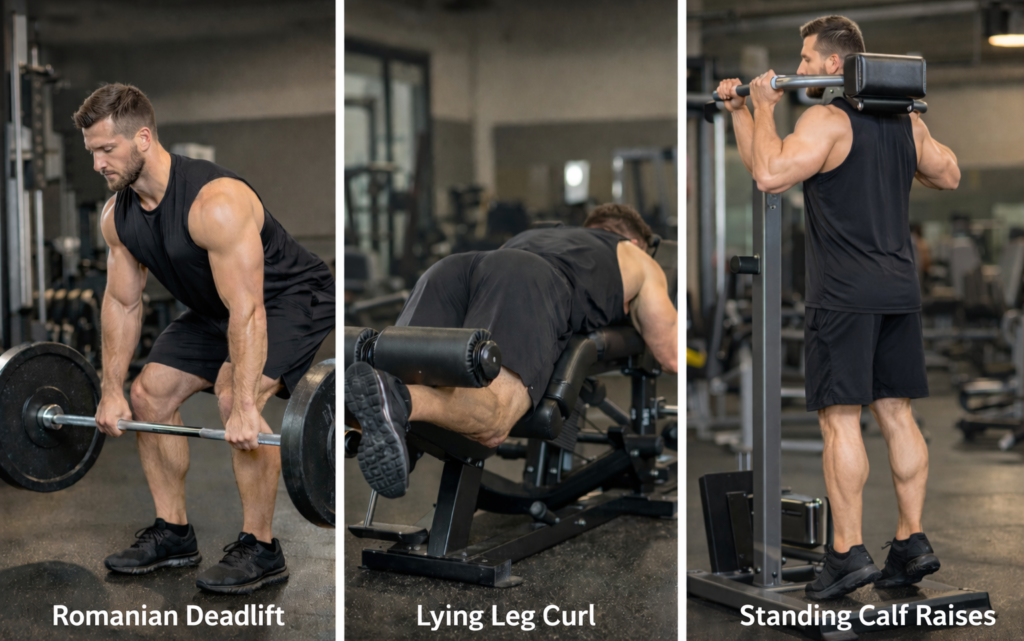
3. Romanian Deadlift
Target muscles:
- Hamstrings
- Glutes
- Lower back (isometric)
Execution:
-
Stand tall holding the bar close to your thighs.
-
Push your hips back while keeping your back flat.
-
Stand back up by driving your hips forward.
Sets & reps:
3 × 6–8
4. Leg Curl
Target muscles:
- Hamstrings
Execution:
-
Sit or lie in the machine with knees aligned to the pivot.
-
Curl the weight by bending your knees.
-
Lower slowly to keep tension on the hamstrings.
Sets & reps:
3 × 10–12
Calves
5. Standing or Seated Calf Raises
Target muscles:
- Gastrocnemius
- Soleus
Execution – Standing Calf Raises:
- Stand tall with weight balanced over the forefoot and heels free to move.
- Lower the heels slowly to feel a deep stretch in the calves.
- Rise up by pushing through the balls of the feet and fully contracting the calves.
Execution – Seated Calf Raises:
- Sit with knees bent and feet flat on the platform or blocks.
- Lower the heels under control until the calves are fully stretched.
- Lift the heels by driving through the forefoot, focusing on calf contraction.
Sets & reps:
4 × 10–15
Shoulders
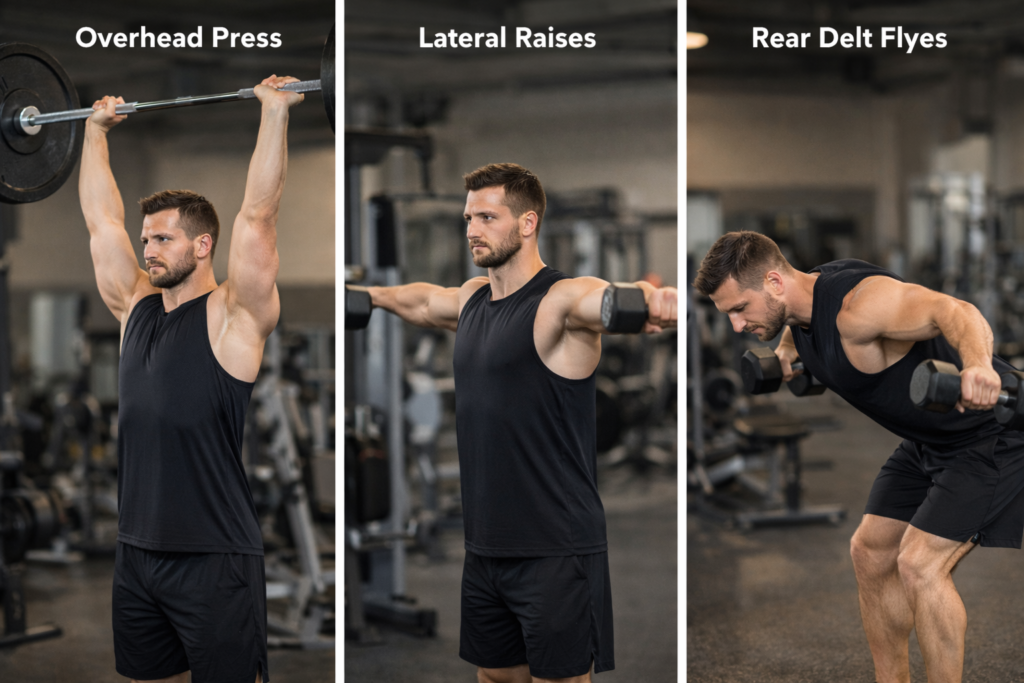
6. Overhead Press
Target muscles:
- Deltoids
- Triceps
- Upper chest
Execution:
-
Start with the bar at shoulder height and core tight.
-
Press the bar straight overhead.
-
Lower it back down slowly to the shoulders.
Sets & reps:
3 × 5–8
Variations:
- Seated dumbbell press: press independently for more shoulder stability.
- Machine shoulder press: smooth, controlled reps.
7. Lateral Raises
Target muscles:
- Medial delts
Execution:
-
Hold dumbbells at your sides with elbows slightly bent.
-
Raise arms out to the sides until shoulder height.
-
Lower slowly without swinging.
Sets & reps:
4 × 12–15
8. Rear Delt Flyes or Face Pulls
Target muscles:
- Rear delts
- Upper back
- Rotator cuff
Execution – Rear Delt Flyes:
- Hinge at the hips with the torso inclined and arms hanging under the shoulders.
- Open the arms outward while keeping a slight bend in the elbows.
- Squeeze the rear delts at the top without using momentum.
Execution – Face Pulls:
- Set the cable at upper-chest or face height and grip the rope with thumbs up.
- Pull the rope toward the face while driving the elbows outward.
- Finish by squeezing the rear delts and upper back, not the arms.
Sets & reps:
3 × 12–15
Core
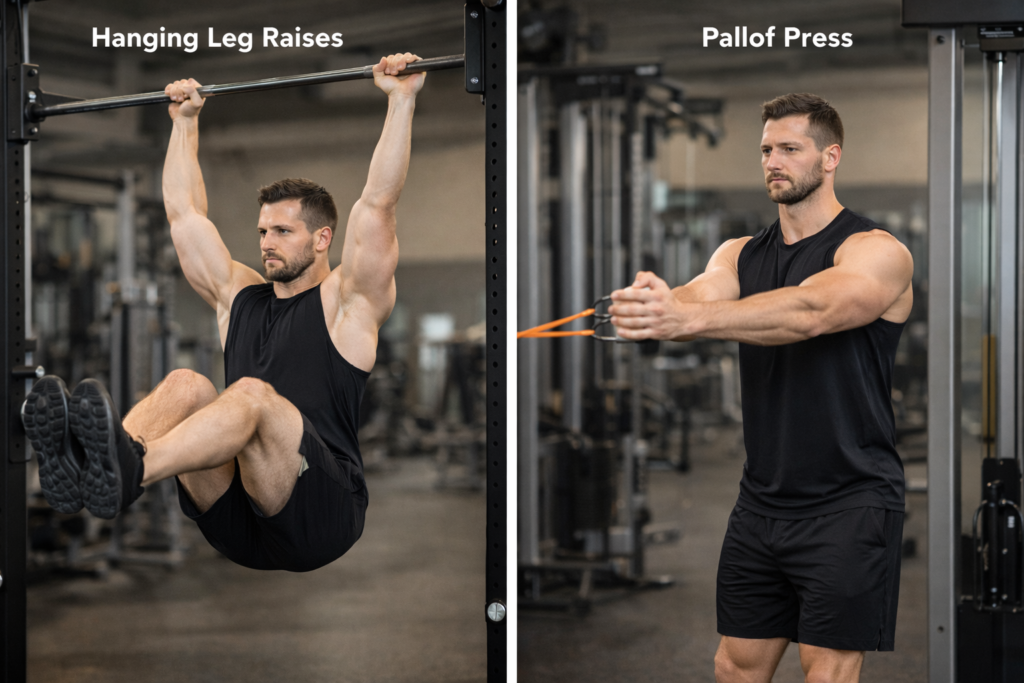
9. Hanging Leg Raises or Captain’s Chair Raises
Target muscles:
- Rectus abdominis
- Hip flexors
Execution – Hanging Leg Raises:
- Hang from the bar with shoulders active and core engaged.
- Raise the legs by curling the pelvis upward rather than swinging.
- Lower the legs slowly while maintaining control and tension.
Execution – Captain’s Chair Raises:
- Support the body on the pads with the back stable and arms pressing down.
- Lift the knees or legs by tilting the pelvis upward.
- Lower under control, keeping constant tension on the abs.
Sets & reps:
3 × 8–12
10. Pallof Press or Weighted Plank
Target muscles:
- Obliques
- Deep stabilizers
Execution – Pallof Press:
- Stand or kneel perpendicular to the cable with the core fully braced.
- Press the handle straight out in front of the chest without rotating.
- Hold briefly, then return under control while resisting rotation.
Execution – Weighted Plank:
- Set up in a strong plank position with the spine neutral.
- Place external load on the upper back while maintaining full-body tension.
- Hold the position without sagging or rotating.
Sets:
2–3 controlled sets
Day 3 – Back, Biceps & Core
Pulling strength, arm size, trunk stability
Back
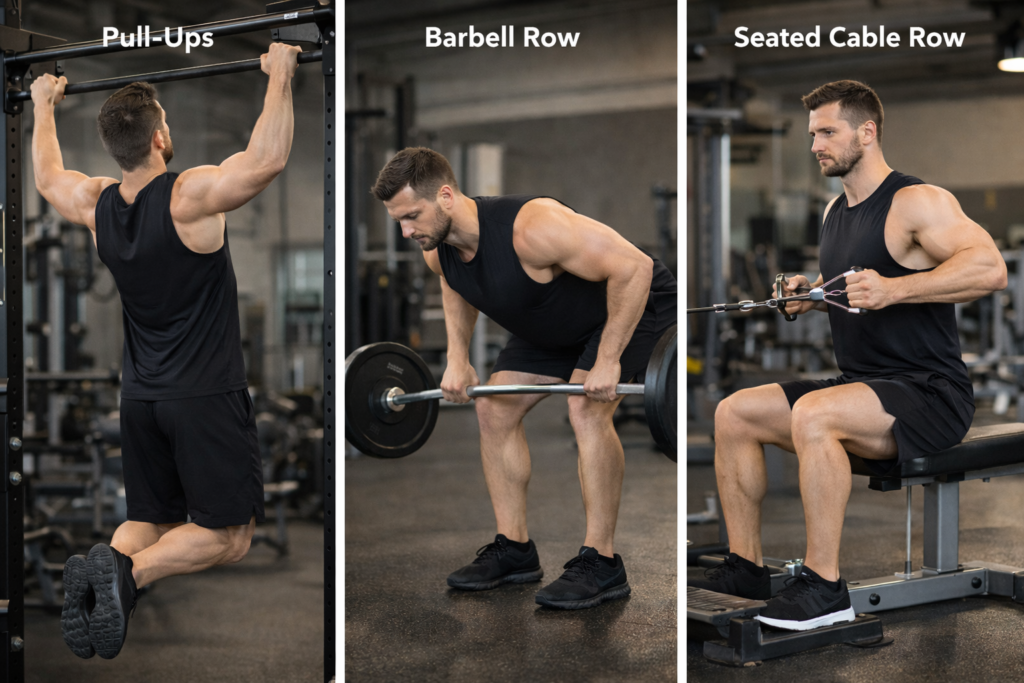
1. Pull-Ups or Lat Pulldown
Target muscles:
- Lats
- Upper back
- Biceps (secondary)
Execution – Pull-Ups:
- Hang from the bar with shoulders active and chest tall.
- Pull the body upward by driving the elbows down and back.
- Lower under control until the arms are fully extended.
Execution – Lat Pulldown:
- Sit firmly with thighs secured and chest slightly lifted.
- Pull the bar toward the upper chest by leading with the elbows.
- Control the return while maintaining tension on the lats.
Sets & reps:
4 × 6–10
2. Barbell or Chest-Supported Row
Target muscles:
- Mid-back
- Lats
- Rear delts
Execution – Barbell Row:
- Hinge at the hips with the torso inclined and the bar hanging below the shoulders.
- Pull the bar toward the lower ribs by driving the elbows back.
- Lower the bar under control while keeping the torso stable.
Execution – Chest-Supported Row:
- Set the bench so the chest is fully supported and the spine stays neutral.
- Pull the weights by leading with the elbows and squeezing the upper back.
- Lower slowly while maintaining constant tension.
Sets & reps:
4 × 6–8
3. Seated Cable Row
Target muscles:
- Back thickness
- Scapular control
Execution:
-
Sit upright with feet on the platform and arms straight.
-
Pull the handle toward your waist.
-
Slowly extend the arms back forward.
Sets & reps:
3 × 10–12
Biceps
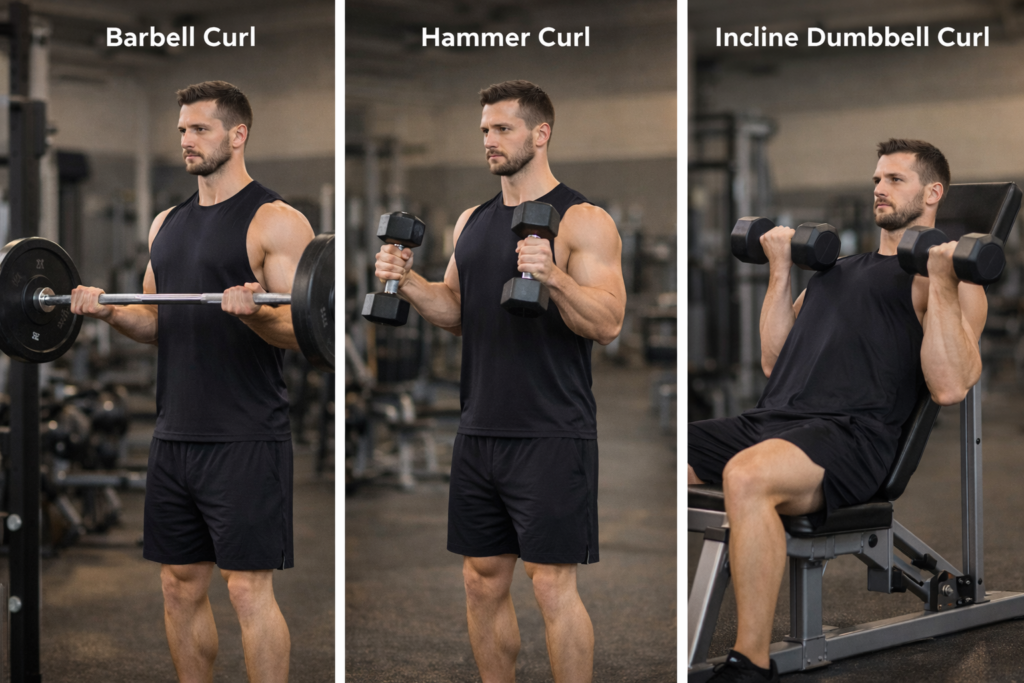
4. Barbell Curl
Target muscles:
- Biceps brachii
Execution:
-
Stand tall holding the bar at shoulder width.
-
Curl the bar up without moving your torso.
-
Lower the bar slowly.
Sets & reps:
3 × 8–10
5. Hammer Curl
Target muscles:
- Brachialis
- Forearms
Execution:
-
Hold dumbbells with palms facing each other.
-
Curl the weights up keeping elbows still.
-
Lower slowly under control.
Sets & reps:
3 × 10–12
6. Incline Dumbbell Curl or Cable Curl
Target muscles:
- Biceps long head
Execution – Incline Dumbbell Curl:
- Sit back on an incline bench with arms hanging behind the torso.
- Curl the dumbbells up while keeping the elbows slightly back.
- Lower slowly to maintain tension through the stretched position.
Execution – Cable Curl:
- Stand upright with the cable set low and arms extended.
- Curl the handle while keeping the elbows fixed at the sides.
- Control the return to maintain constant tension on the biceps.
Sets & reps:
2–3 × 12
Core
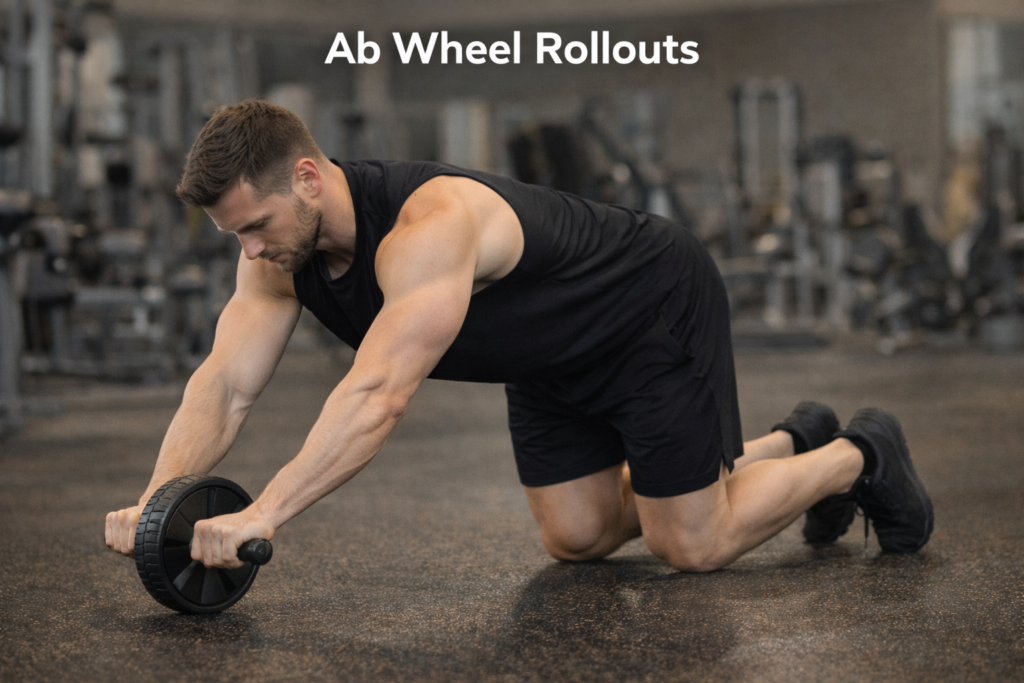
7. Ab Wheel Rollouts or Barbell Rollouts
Target muscles:
- Anterior core
- Deep stabilizers
Execution – Ab Wheel Rollouts:
- Start on the knees with the wheel positioned under the shoulders.
- Roll the wheel forward by extending the hips and shoulders while bracing the core.
- Pull back to the start by contracting the abs, not the lower back.
Execution – Barbell Rollouts:
- Load a barbell with plates that can roll smoothly.
- Roll the bar forward while maintaining a neutral spine and tight core.
- Reverse the movement by pulling the bar back with abdominal control.
Sets & reps:
3 × 6–10
|
WHY THIS SPLIT IS TRULY COMPLETE
|
Mindset and habit formation behind consistent growth
Muscle is built by habits, not hacks.
The best lifters don’t have perfect genetics — they have routines that stick.
Keep a workout journal.
Write your numbers, energy levels, even your mood.
That data becomes your personal coach.
Celebrate micro-wins:
An extra rep, smoother form, less fatigue.
Progress is progress — even when the mirror’s silent.
Tracking progress like a pro (beyond the scale)
The scale lies.
Muscle is denser than fat, so if your weight stays the same but your body looks sharper, that’s progress.
Track your circumference measurements, not just weight.
Measure your arms, legs, and chest every 3–4 weeks.
Watch your strength metrics: 5RM, bar speed, time under tension.
If they’re improving, your muscles are too.
Recovery markers matter just as much — sleep quality, mood, soreness.
If all those are trending up, your program’s working.
Final takeaway
If you want to build real strength and size, stop treating training like punishment and start treating it like practice.
Pay attention to what your body responds to.
Respect recovery as much as intensity.
Lift with purpose, not impulse.
Because the gym will always give back what you put in — just not always in the way you expect.
Stay consistent, stay patient, and yeah — stop overcomplicating what’s meant to be simple: show up, execute well, recover better, repeat.
That’s the real secret to growth that lasts.