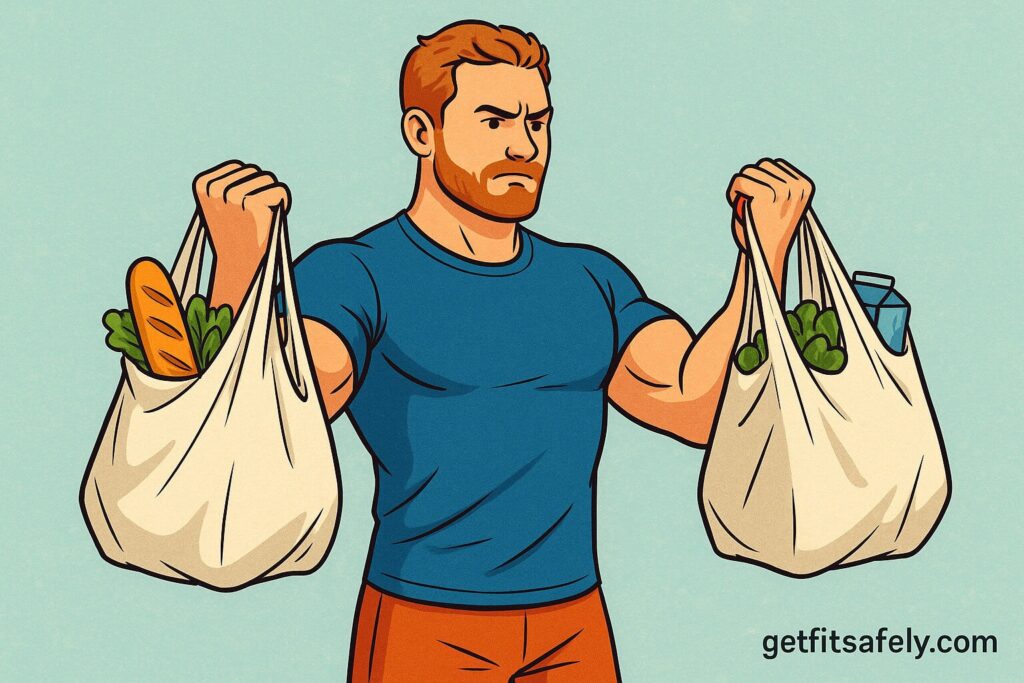
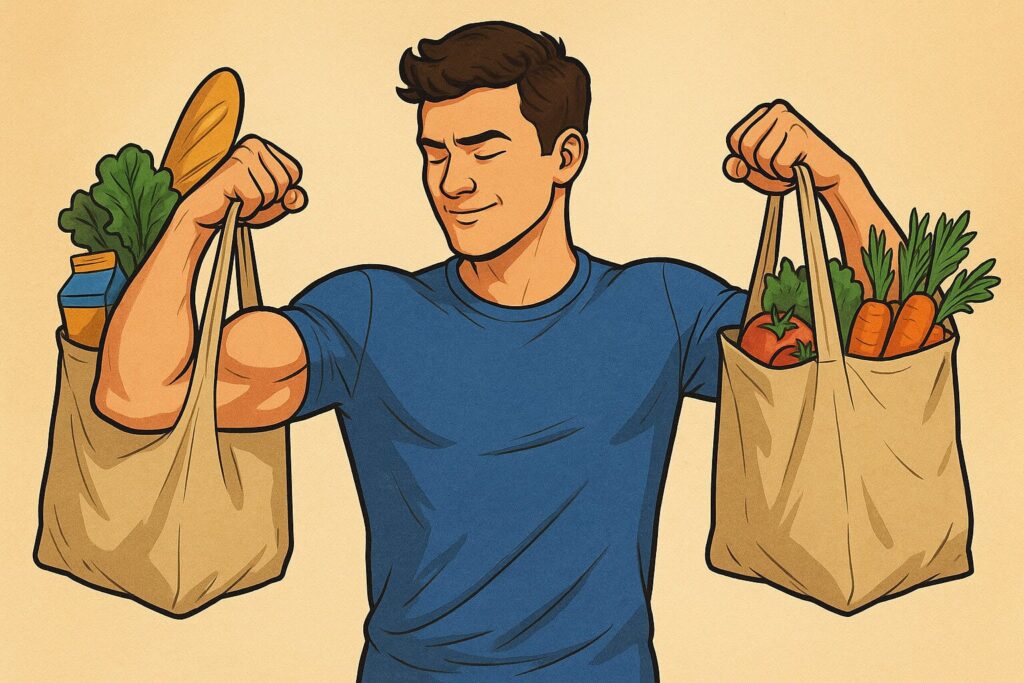
Walking out of the store with two grocery bags that felt like they were filled with wet cement is an experience many people know too well.
The left arm starts shaking like a chihuahua in a snowstorm.
The right arm pretends everything is fine, as if its reputation depends on it.
By the time the car comes into view, the biceps are so pumped they could pass for the result of a superset with a pair of 40s.
And that’s exactly when the real question hits:
Are grocery-bag curls actually contributing to muscle growth, or are they just giving a ‘desperation pump’?”
Understanding Biceps Curls with Grocery Bags Without Overthinking
The funny thing is this.
Every time someone asks whether “non-gym” objects can build muscle, the answer is almost always the same: it depends on how you use them.
Grocery bags aren’t magical.
They’re not secretly dumbbells in disguise.
But they are external resistance, and your muscles don’t care whether that resistance is shaped like a kettlebell or a lumpy plastic bag filled with apples, detergent, and an unnecessary number of protein bars.
If the load challenges the muscle, the muscle reacts.
If the load is too light, your body treats it like a warm-up stroll.
Simple as that.
How Heavy Grocery Bags Actually Hit the Biceps
Here’s where things get interesting.
When you’re carrying a heavy bag from the store to your car, you’re basically holding an isometric contraction.
Your forearms are gripping for dear life.
Your biceps are quietly negotiating their survival.
And your shoulder stabilizers are sending emails to HR.
But when you actually curl the bag — yes, right there in the parking lot like the proud gremlin that you are — you turn it into a dynamic movement.
A legit curl.
A real elbow-flexion exercise.
Muscles activated?
Biceps brachii, brachialis, brachioradialis.
Same ones as a dumbbell curl.
The issue isn’t “does it work?”
It’s “can you load it enough to make it worth your time?”
Do Overloaded Grocery Bags Provide Enough Stimulus to Build Muscle?
Let’s put this in practical terms.
If your bag weighs 8–12 pounds, that’s not terrible if you’re a beginner.
If your bag weighs 20+ pounds and has handles made of plastic so thin they could slice through reality itself, then congratulations — you’ve basically created a budget adjustable dumbbell with built-in danger.
Muscle adapts to tension.
If the tension is significant enough, adaptation happens.
But here’s the catch.
You can only get so far with awkward weight.
The load distribution is weird.
The handles dig into your fingers like they’re collecting rent.
And because the bags swing unpredictably, you spend half the rep fighting gravity in ways that don’t always target the actual biceps.
It’s still work, just not optimized work.
Why Grocery-Bag Curls Set Your Grip on Fire
Nobody talks about this part, but they should.
These makeshift curls will absolutely torch your grip.
Way more than dumbbells will.
Your fingers are fighting friction.
Your forearms are locking up like you typed a 12-page essay without breaks.
For people who struggle with weak grip in pull-ups, rows, or farmer carries, grocery-bag curls are weirdly effective.
It’s like a secret forearm workout disguised as a trip to the supermarket.
Why Grocery-Bag Curls Hit Different from Standard Dumbbell Curls
Because the load hangs from a flexible handle, your biceps get forced into stabilization they don’t normally experience.
It’s messy tension.
Not as efficient as textbook curls.
But strain is strain, and muscles respond to strain the way teenagers respond to drama — dramatically, and with noticeable changes.
Just not always the changes you want.
If you want clean, progressive overload, grocery bags won’t give you the consistency you need.
One day your bag is full of eggs and pasta.
The next day it’s just spinach and regret.
Hard to measure progress when the weight changes every grocery run.
Technique Tips to Make Grocery-Bag Curls Less Chaotic
If you’re going to do this, do it smart.
I’ve seen people curl grocery bags with technique that looked like they were trying to shake water off a coat sleeve.
So here’s how to make it at least somewhat respectable:
- Keep your elbows pinned to your sides instead of letting them drift forward.
- Curl slowly to reduce the swinging of the bag.
- Pause for a micro-second at the top to feel the contraction.
- Lower the bag with control — no free-falling noodles.
- Keep your wrist neutral to avoid unnecessary forearm strain.
Do this, and suddenly you’re not “just curling a bag.”
You’re doing an off-brand resistance exercise that still has some structure.
Can Grocery-Bag Curls Truly Build Muscle Over Time?
Here’s where honesty kicks in.
If you’re serious about building biceps that pop out of your T-shirt sleeves like they’re trying to escape, overloaded grocery bags are not the promised land.
They can help in a pinch.
They can maintain muscle if you’re traveling or stuck without equipment.
They can add a fun novelty burn that makes you feel alive.
But they’re not going to replace structured training with progressive overload.
Muscle needs consistent tension increases.
Bags don’t scale cleanly.
Workouts need predictability.
Bags scale unpredictably, like guessing the weather by sniffing the air.
How to Actually Turn Grocery-Bag Biceps Curls Into Something Useful
Before we wrap this up, let’s add something practical.
Because it’s fun to joke about curling bags in the parking lot, but a lot of people actually want to know how to make it count.
So here’s the simple, no-nonsense, “I just walked out of the store and want to turn this into a mini-arm workout” guide.
No complicated formulas.
No math.
Just real-world stuff that fits into the part of your day where you’re balancing a rotisserie chicken on your forearm.
The Weight That Actually Does Something
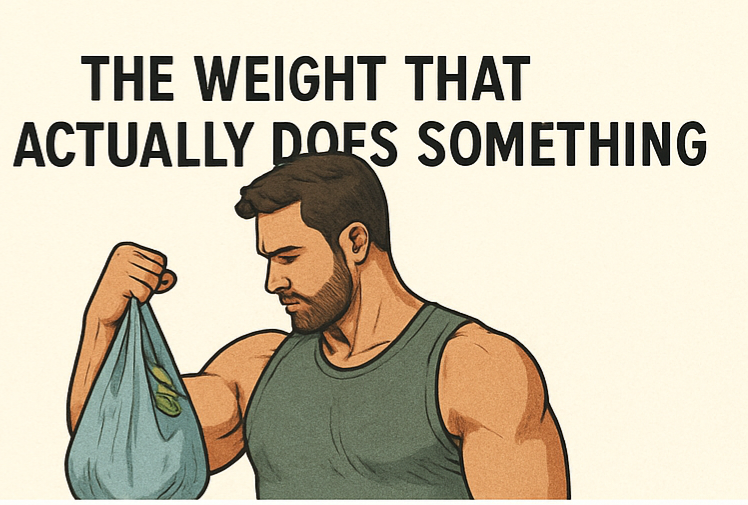
If the bag feels like nothing, your biceps will agree.
You want each bag to land somewhere around this sweet spot:
- Beginners: 8–12 pounds per bag
- Intermediate lifters: 12–20+ pounds
- Strong folks: load the bag until the handles feel like they’re negotiating their employment contract
If you can curl the bag without thinking about it, it’s too light.
If your elbow feels like it’s reconsidering its life choices, it’s too heavy.
Somewhere in the middle lies the perfect grocery curl.
How Many Reps Actually Make It a Workout
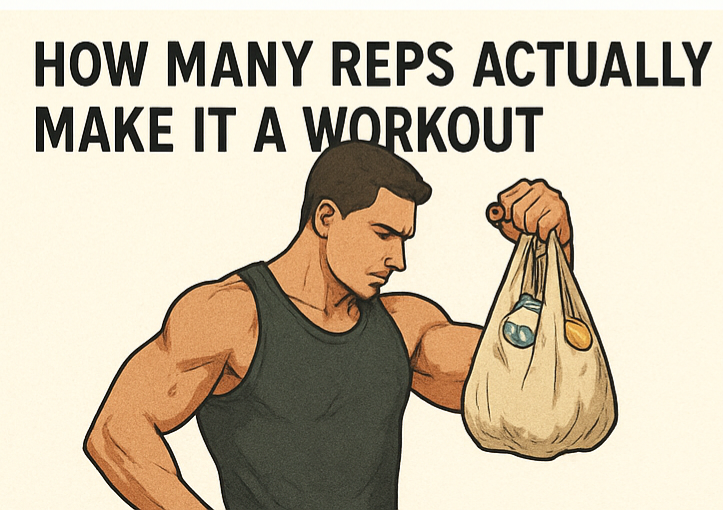
Think of this as a quick-hit “micro session.”
You’re not trying to break records — you’re trying to create tension.
Try something like:
- 12–20 reps per arm
- 2–3 rounds
- Rest about 20–30 seconds between rounds
You’ll get a solid pump without looking like you’re filming a Rocky montage in aisle 4.
A Simple Way to Remove the Awkward Swing
Grocery bags swing like they’re trying to escape your grip, so here’s the cleanup trick.
Grab the handles together in one fist, choke up on them, and pull the weight closer to your wrist.
This reduces the pendulum effect and gives you something more like a dumbbell… just a dumbbell shaped like spaghetti boxes and oat milk.
A Little Parking-Lot Biceps Finisher
If you want a tiny routine you can sneak in before loading the trunk, try this:
- 10 curls per arm
- 10 hammer curls (just rotate your wrist)
- 10 half-reps from the bottom
- 10 half-reps from the top
The burn is almost disrespectful.
And it works.
Other Quick Exercises You Can Do With the Bags (Without Overdoing It)
You don’t need to turn your grocery run into a CrossFit class, but a couple of extra moves can actually help:
- Farmer Carry Hold: lock your elbows, stand tall, squeeze everything
- Single-Arm Row: hinge, pull the bag to your hip, keep it controlled
- Reverse Curl: same bag, different forearm emphasis
Again — bonus reps, not full workouts.
But extremely useful when life gets in the way.
How to Progress Without Doing Calculus on Your Groceries
Progression doesn’t need to be complicated.
Here’s how to make it happen naturally:
- Use more items in the bag
- Slow the reps down
- Add a 2–3 second hold at the top
- Try one extra round compared to last time
Tiny changes = real tension = real adaptation.
RELATED:》》》 Do Towel Curls Actually Boost Bicep Growth or Are They Just Pretend Gains?
Conclusion
At the end of the day, you can absolutely hit your biceps with overloaded grocery bags.
You can get a real pump.
You can maintain muscle.
You can even build a bit if the weight is challenging and you use decent form.
But think of it as “fitness improv,” not a full routine.
Use it to stay active.
If life hands you heavy grocery bags, curl them.
If you want real progress, get structured training involved too.