Ten pull-ups.
It’s the number that shows up again and again when people talk about upper-body strength.
Strange, because in every gym there’s always someone doing three reps and someone else casually hitting twenty-five.
And yet, after watching hundreds of sessions around pull-up bars, that number keeps appearing over and over again.
The interesting part isn’t the number itself.
The interesting part is what happens in the body when someone reaches that level, and how pull-up strength actually develops over time.
When a Pull-Up Actually Counts as a Full Rep
Before talking about numbers, there’s one detail that changes the entire conversation.
What exactly counts as one real pull-up?
Around most pull-up bars, people count repetitions in very different ways.
Some start the movement with their arms already bent.
Some swing their legs to help themselves up.
Others lower only halfway before starting the next repetition.
All of those variations make the final number look bigger than it actually is.
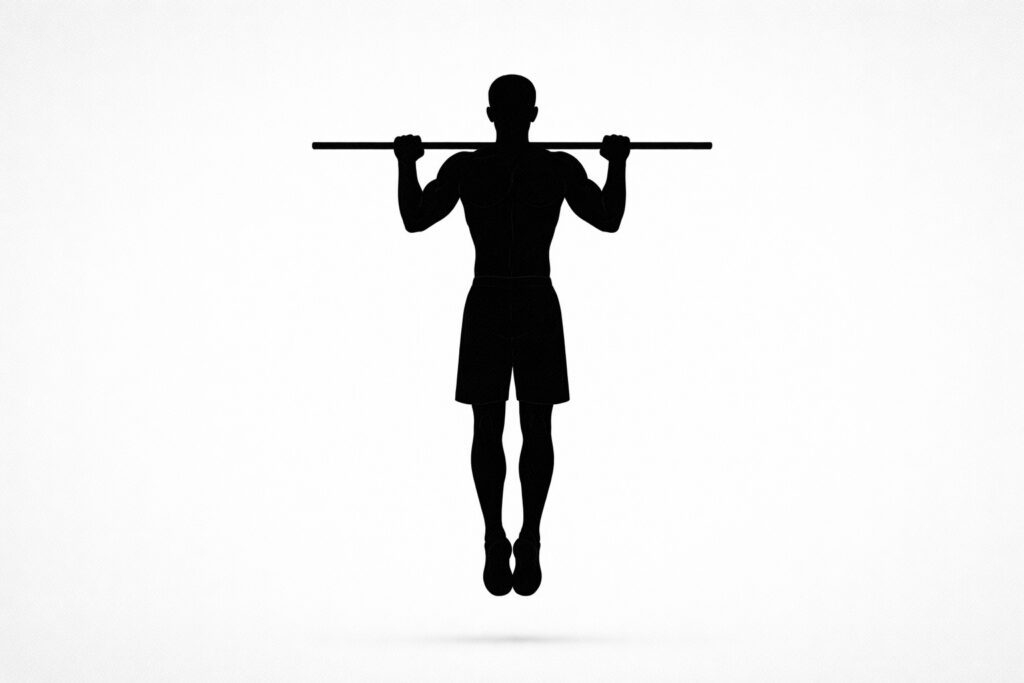
A full pull-up repetition follows a simple sequence.
The movement begins with the arms completely straight, hanging under the bar.
The shoulders stretch upward for a brief moment while the body hangs freely.
From there the elbows pull down toward the ribs and the chest moves toward the bar.
The repetition is considered complete when the chin clearly rises above the bar.
Then the body lowers again until the arms return to a fully extended position.
Only when the arms are straight again does the next repetition begin.
That’s why two people can both say they can do ten pull-ups while the effort involved may be completely different.
Pull-Ups Reveal More About Upper-Body Strength Than Many Exercises
Many exercises allow little shortcuts.
A bench press can bounce slightly off the chest.
A machine row can use momentum.
Even dumbbells can swing a bit.
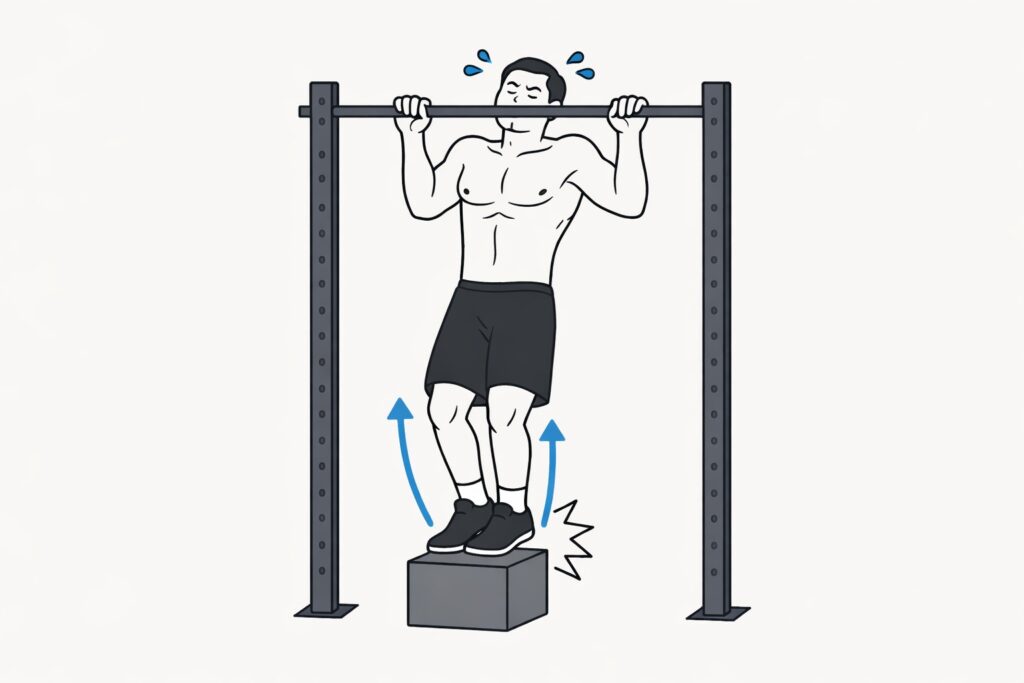
Pull-ups are less forgiving.
The bar stays still.
Your body must move through the entire range.
Either the chin clears the bar or it doesn’t.
This makes pull-ups one of the most honest upper-body strength indicators.
There’s also another factor.
Pull-ups require relative strength, which means strength compared to body weight.
If someone weighs 80 kg (176 lb), every repetition means lifting those 80 kg.
Imagine performing a deadlift with your own body weight over and over again using only your upper body.
That’s essentially what a pull-up is.
The First Numbers Most People Reach
When someone starts practicing pull-ups regularly, the first noticeable milestone tends to appear around 3 to 5 clean repetitions.
This usually happens after several weeks or a few months of consistent practice.
A typical early set might feel like this.
Rep 1 — smooth and confident.
Rep 2 — still comfortable.
Rep 3 — breathing becomes noticeable.
Rep 4 — the elbows slow near the top.
Rep 5 — chin barely clears the bar.
After dropping down, the forearms feel warm and the hands shake slightly.
That moment often surprises beginners.
Five pull-ups might not sound like much.
But performing them with full range already requires coordination between several muscle groups.
The Muscles That Make Pull-Ups Work
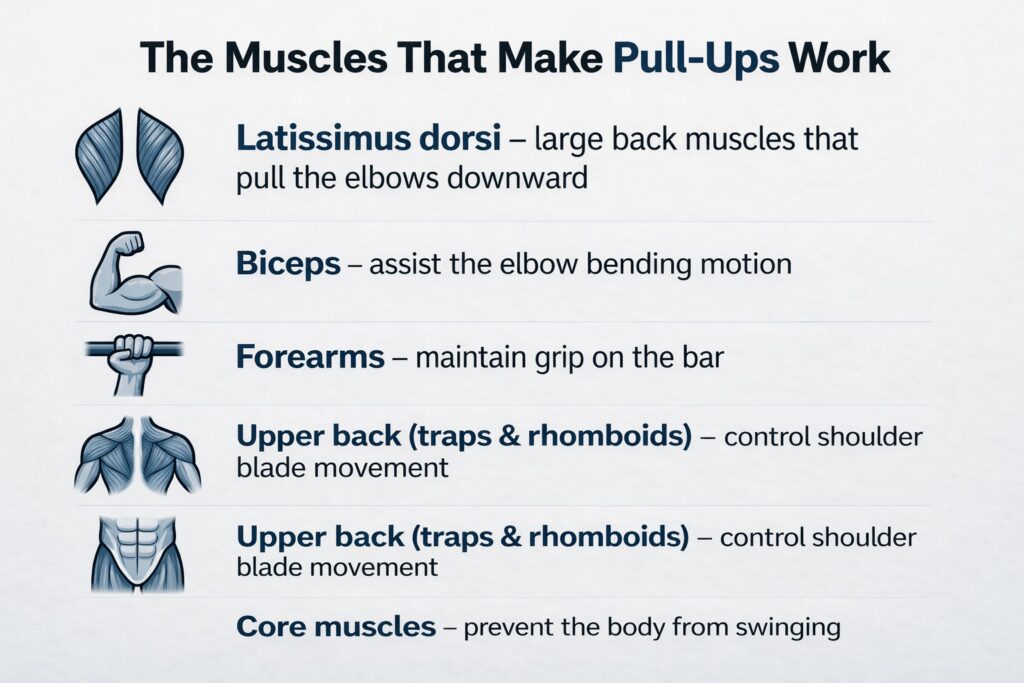
A pull-up might look like a simple arm movement.
In reality, several muscles cooperate during every repetition.
The primary contributors include:
- Latissimus dorsi — large back muscles that pull the elbows downward
- Biceps — assist the elbow bending motion
- Forearms — maintain grip on the bar
- Rear shoulders — stabilize the shoulder joint
- Upper back muscles — control shoulder blade movement
- Core muscles — prevent the body from swinging
When these muscles work together efficiently, the movement feels smooth.
When one of them fatigues earlier than the others, the repetition slows down.
For many people the first limiting factor isn’t the back.
It’s the grip.
When Grip Strength Starts Talking
One of the earliest sensations during pull-up sets appears in the forearms.
The fingers squeeze the bar constantly.
After several repetitions the muscles around the forearm begin to burn.
During a typical set of 8–10 pull-ups, the sequence often feels like this.
The first few reps feel powerful.
Around rep six the forearms begin to heat up.
Around rep eight the fingers tighten harder around the bar.
By rep ten the hands start feeling slippery.
Even if the back still has strength left, the grip may decide when the set ends.
That’s why many people who train pull-ups also spend time simply hanging from the bar.
A basic routine might look like this.
- Dead hang — 25 seconds
- Rest for around a minute
- Repeat 4 rounds
After a few weeks, the hands become noticeably stronger.
The Moment Someone Reaches 15 Pull-Ups
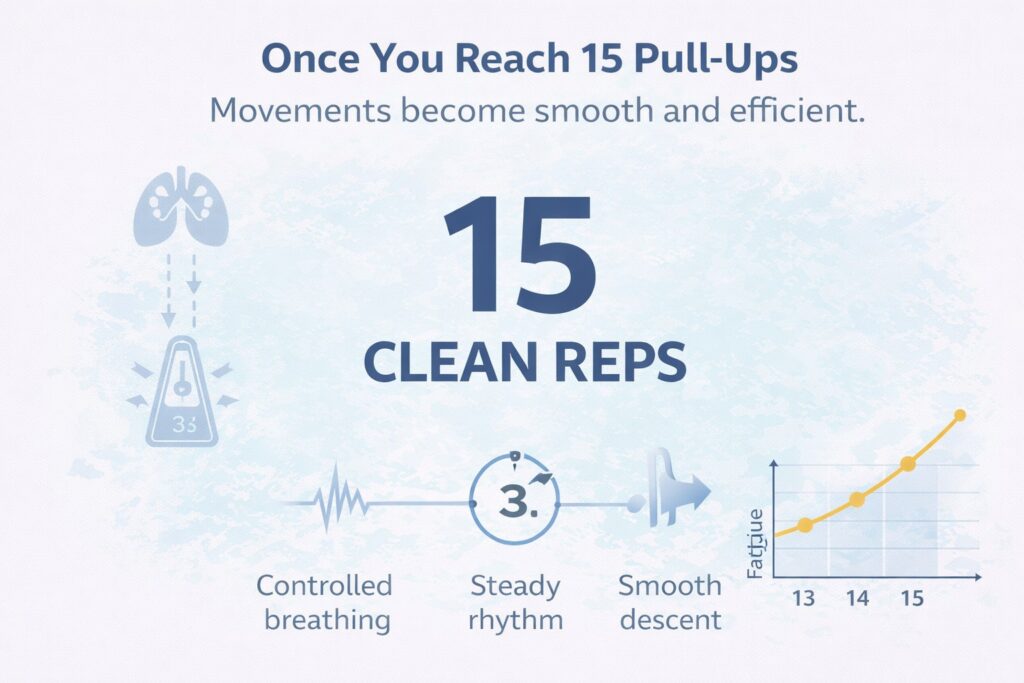
Once someone reaches 15 clean pull-ups, the movement starts becoming very efficient.
The rhythm becomes predictable.
Instead of explosive pulling, the repetitions become economical.
Watching someone perform fifteen strict reps often looks almost effortless.
Each repetition lasts about 3 seconds.
Breathing settles into a pattern.
Lower down — inhale.
Pull up — exhale.
Fatigue arrives gradually rather than suddenly.
Rep thirteen slows slightly.
Rep fourteen requires more elbow drive.
Rep fifteen finishes with a steady descent.
When Someone Reaches Twenty Pull-Ups
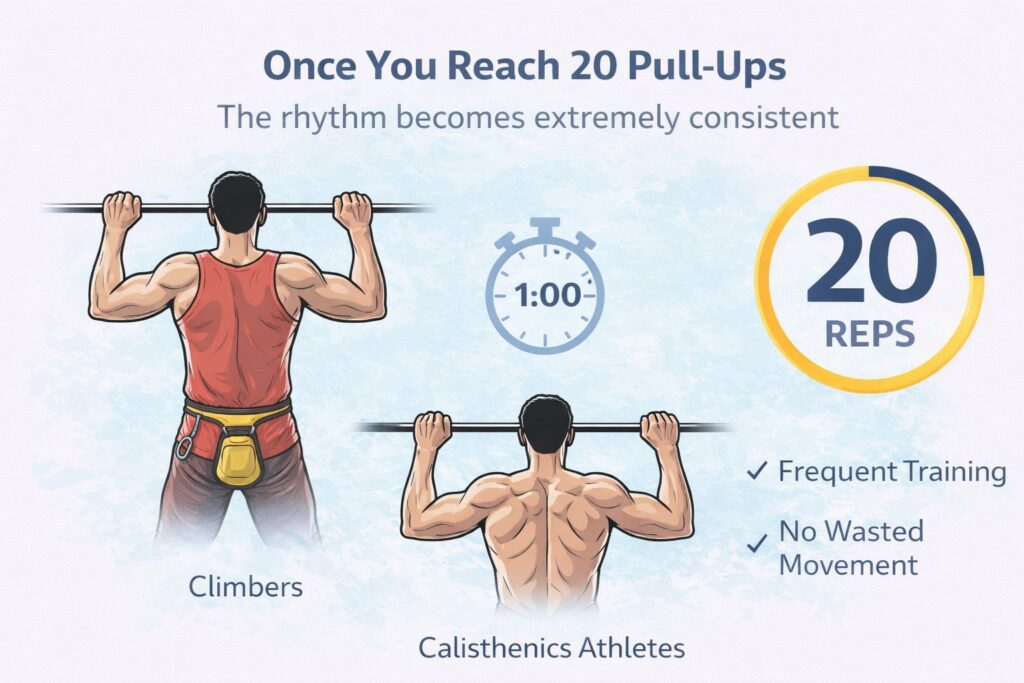
The number 20 pull-ups has a special reputation in bodyweight training.
Most people who reach twenty pull-ups train pulling movements frequently.
Climbers are a great example.
Their grip endurance allows them to hold bars for long periods.
Calisthenics athletes also often reach this level.
A twenty-rep set often takes about one minute.
The rhythm becomes extremely consistent.
No wasted movement.
Just smooth repetitions.
How Different Athletes Perform Pull-Ups
Watching pull-up bars in different environments reveals interesting patterns.
Climbers

Climbers often perform 15–20 repetitions.
Their grip endurance is exceptional.
The pulling rhythm is steady and controlled.
Gym strength athletes
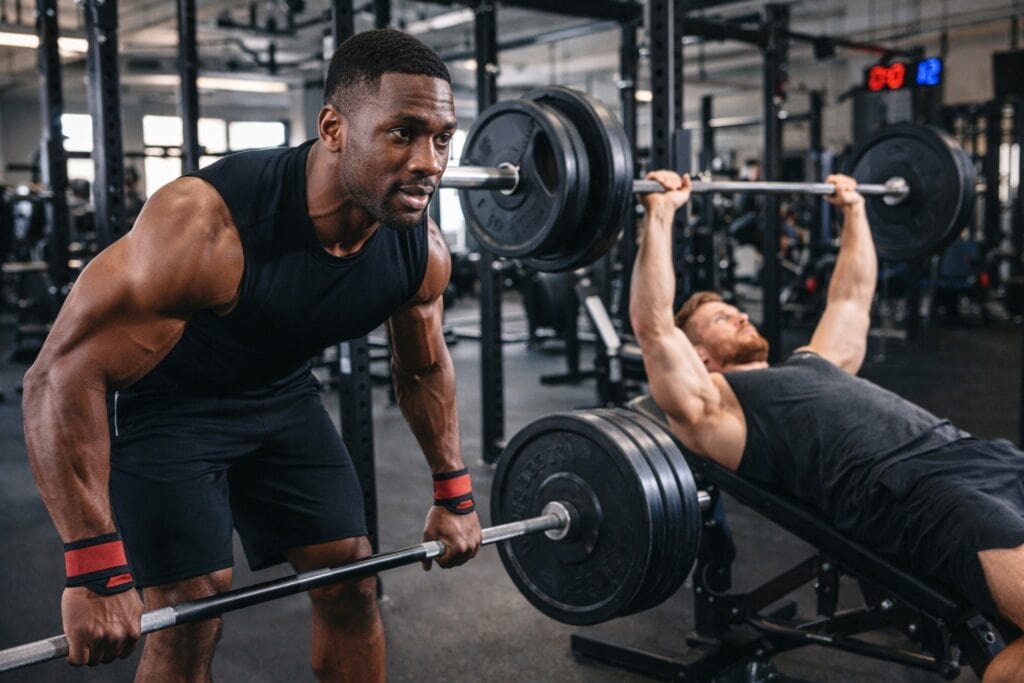
Lifters sometimes perform 6–10 powerful reps.
The movement is explosive but endurance fades earlier.
Calisthenics practitioners
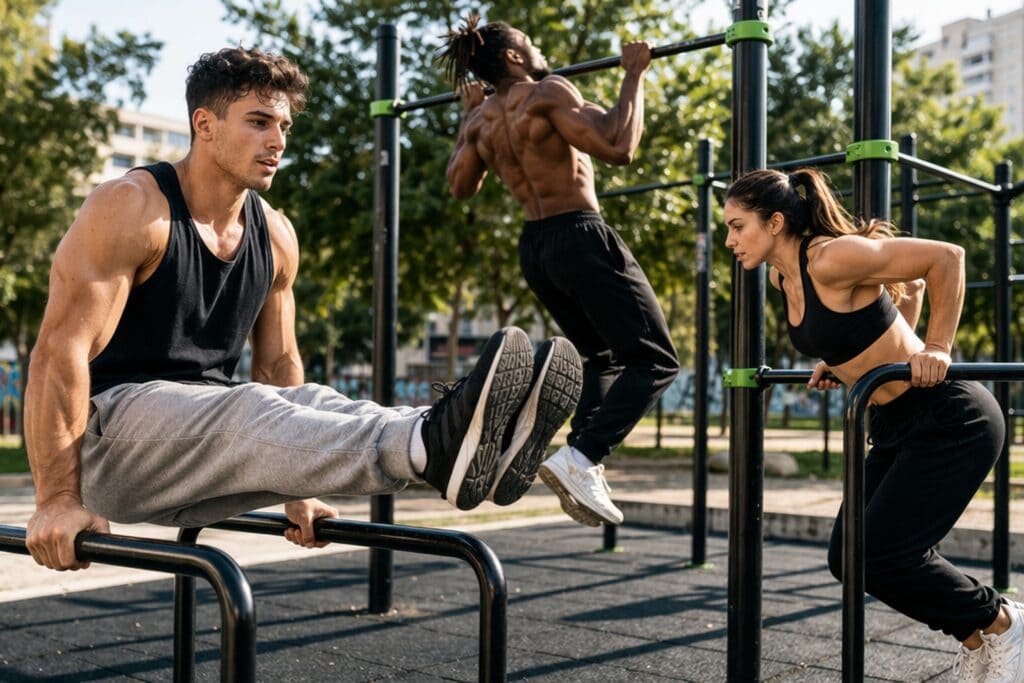
People focused on bodyweight training often perform 12–18 clean reps.
Their technique tends to look extremely smooth.
Body Weight Changes Pull-Up Numbers More Than People Expect
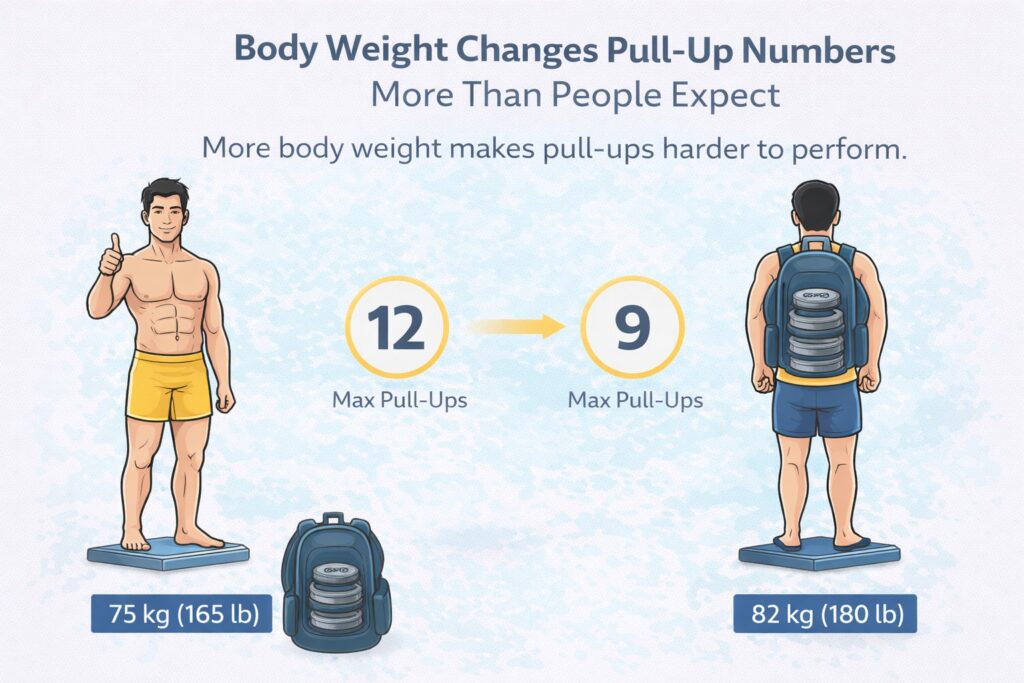
Pull-ups measure relative strength, so body weight plays a big role.
A lighter athlete often performs more repetitions simply because there’s less mass to move.
For example.
At 75 kg (165 lb) my maximum pull-ups hover around 12–13 reps.
After gaining weight up to 82 kg (180 lb), the number drops closer to 9 or 10.
Nothing about my back strength suddenly disappeared.
But every repetition now requires lifting 7 extra kilograms.
Imagine wearing a backpack with weight plates during every pull-up.
That’s essentially what weight gain does to the exercise.
Building Stronger Pull-Ups with a Short Series of Sets
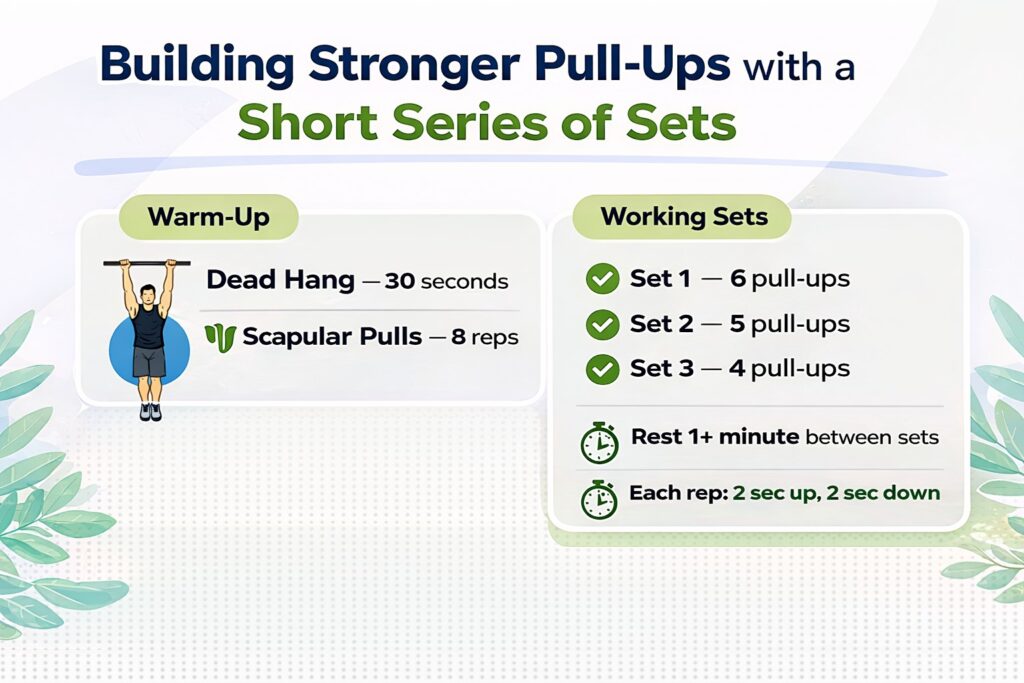
One routine that gradually improves pull-up numbers is surprisingly simple.
Here’s a session that lasts about 12–15 minutes.
First the warm-up.
- Dead hang — 30 seconds
- Scapular pulls — 8 repetitions
Scapular pulls are small shoulder blade movements where the arms stay straight and the shoulders lift and lower slightly.
They activate the upper back before full pull-ups.
Then the working sets begin.
Set 1 — 6 pull-ups
Set 2 — 5 pull-ups
Set 3 — 4 pull-ups
Set 4 — 4 pull-ups
Rest as needed between sets. A little over a minute usually works well.
Each repetition takes about 4 seconds.
Two seconds up.
Two seconds down.
Repeating sessions like this two or three times per week gradually increases the number of comfortable repetitions.
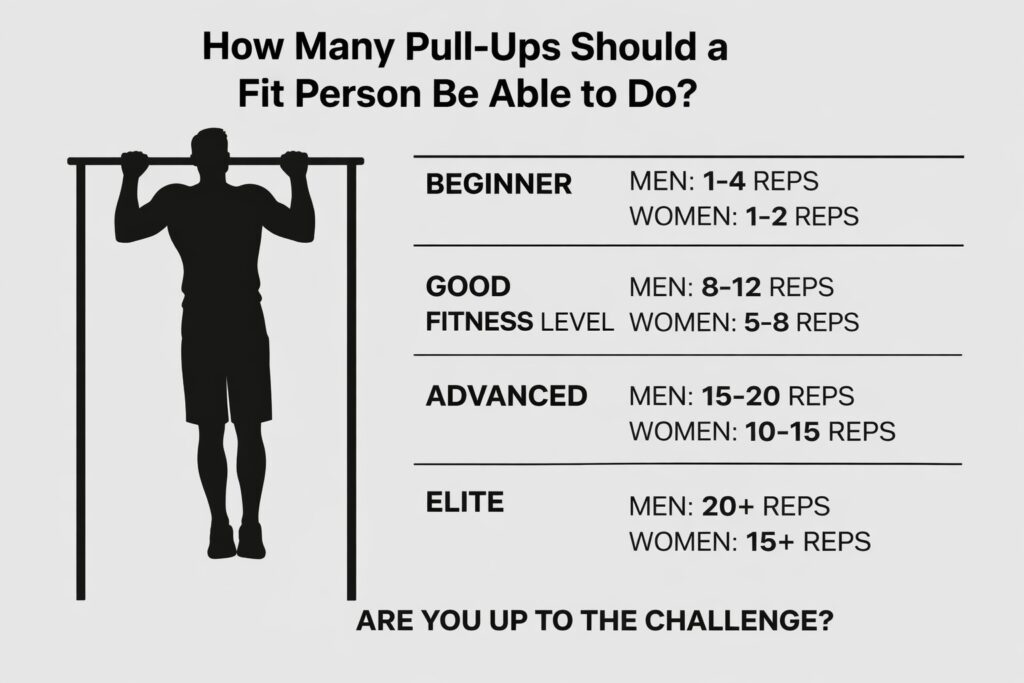
Typical Pull-Up Strength Levels
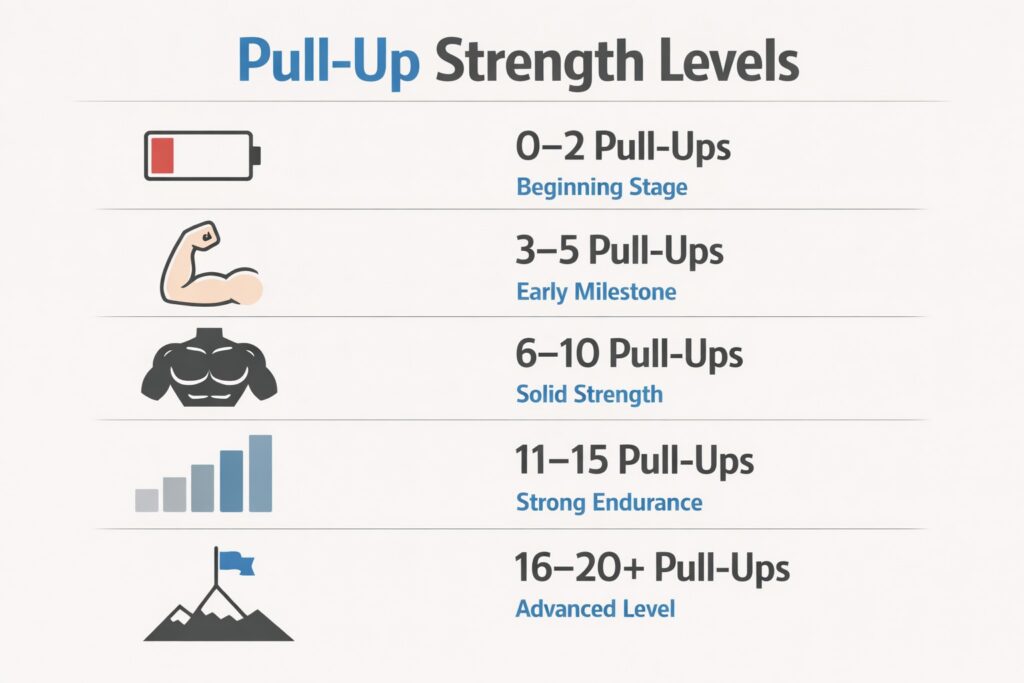
After years of observing pull-up bars, these ranges appear frequently.
0–2 pull-ups
Beginning stage.
Grip and coordination still developing.
3–5 pull-ups
Early strength milestone.
Back muscles beginning to work efficiently.
6–10 pull-ups
Solid upper-body strength.
Common among people who train regularly.
11–15 pull-ups
Strong pulling endurance.
Often seen in dedicated bodyweight training.
16–20+ pull-ups
Advanced level.
Usually reached through years of consistent practice.
Final Thoughts
Pull-ups are one of the simplest strength measurements available.
After watching countless sessions at parks, gyms, and climbing facilities, the same strength patterns tend to appear again and again.
The early stage usually begins with only a few repetitions, when grip strength and coordination are still learning to work together.
Then comes the first real milestone, when the back muscles finally start pulling with purpose and the movement feels less like a struggle.
With consistent training, the exercise gradually turns into a reliable indicator of solid upper-body strength.
At higher levels, the difference becomes less about raw strength and more about endurance, rhythm, and efficiency.
Eventually the movement looks almost effortless, with smooth repetitions and complete control.
The number itself isn’t the most interesting part.
What matters more is how the body gradually learns to pull upward with stronger grip, better coordination, and cleaner technique.
Over time, the movement simply becomes stronger, smoother, and more controlled.
FAQs
Do longer arms make pull-ups harder?
Yes, longer arms increase the range of motion and mechanical leverage during the movement. That means more work per rep, which is why taller athletes often find pull-ups more demanding.
Is doing ten pull-ups more about strength or technique?
Both matter. Strength in the back and arms is essential, but good technique—like proper scapular control and body tension—can make each rep significantly more efficient.
Why do pull-ups suddenly get easier after the first few months of training?
Early improvements often come from better coordination and nervous system adaptation. The body learns how to recruit the right muscles at the right time, making each rep feel smoother.
Can someone be very strong but still struggle with pull-ups?
Yes. Lifters with strong pushing muscles or heavy lower bodies sometimes struggle because pull-ups depend heavily on relative strength and pulling mechanics.
Do the same pull-up rep standards apply to women?
Not exactly. Women generally have less upper-body muscle mass than men, so the average number of pull-ups tends to be lower. A simplified strength scale for strict pull-ups in women often looks like this:
- Beginner: 0–2 pull-ups
- Intermediate: 5–8 pull-ups
- Advanced: 10–15 pull-ups
- Elite: 15+ pull-ups