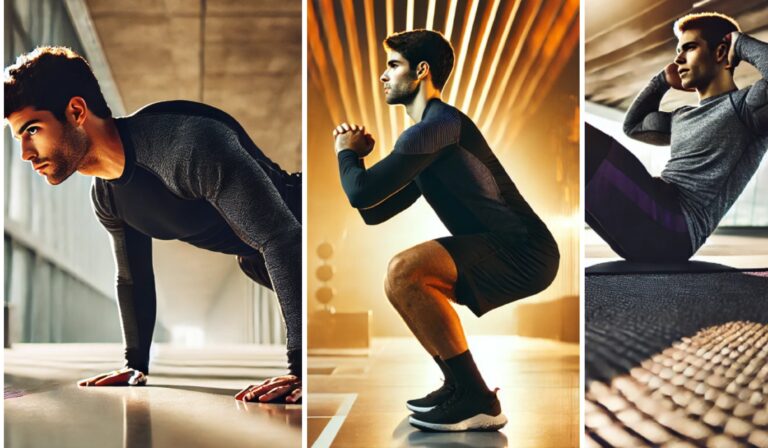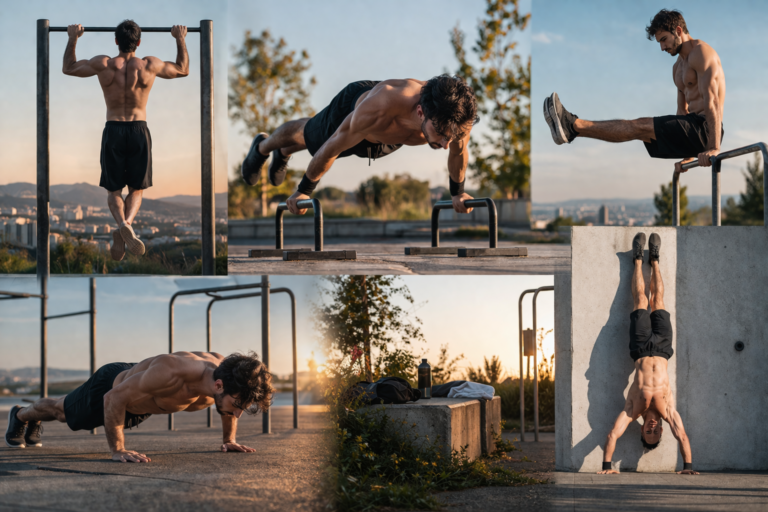
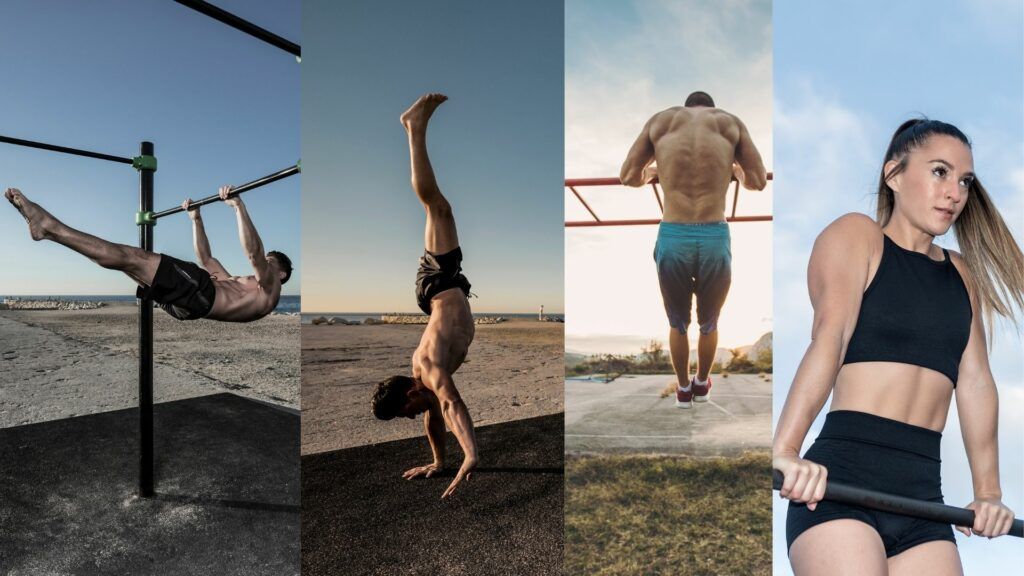
Calisthenics progressions are not a detail.
They are the system that decides whether your training keeps moving forward or quietly circles the same level for months.
Most people don’t stall because they lack effort.
They stall because the steps between levels are unclear, mismatched, or poorly timed.
This guide breaks down how progressions actually work in calisthenics, how to choose the right ones, and how to apply them in real training without guessing, rushing, or burning out joints.
What a calisthenics progression really is

A calisthenics progression is not just an easier or harder variation.
It’s a controlled change in difficulty that modifies at least one of these variables:
- Leverage
- Range of motion
- Load
- Tempo
- Stability
Good progressions change one variable at a time, or at least keep the others stable enough that the body can adapt.
Bad progressions change too many things at once.
That’s when skills feel impossible and stalls appear “out of nowhere.”
Why calisthenics needs progressions more than weights
With barbells or machines, progression is usually external.
The movement stays the same.
You add weight.
In calisthenics, progression is internal.
Your body position changes.
Joint angles shift.
Balance and coordination demands increase.
That means two movements that look similar on video can feel completely different to your nervous system and connective tissue.
This is why repeating the same reps endlessly often stops working in bodyweight training.
At some point, the system needs a new mechanical challenge, not just more effort.
What makes a progression step effective
A good progression step checks several boxes.
It is harder than the previous step, but not dramatically so.
It allows multiple clean reps or controlled holds.
It targets the same muscles and positions required later.
If a step can only be survived for one ugly rep, it’s probably not a training step.
It’s a test.
Main types of calisthenics progressions (with real examples)

Most effective programs combine several progression types instead of relying on just one.
Leverage-based progressions
These modify how much of your bodyweight is being lifted.
Examples:
- Front lever: tuck → advanced tuck → one-leg → straddle → full
- Planche: frog → tuck → advanced tuck → straddle → full
Leverage progressions are powerful but demanding.
They should be approached slowly and paired with builder work.
Stalling here often means the lever jump is too large, not that you’re “not strong enough.”
Range-of-motion progressions
These expand how much of the movement you control.
Examples:
- Push-ups: partial → full → deficit
- Dips: shallow → parallel → deep controlled
- Squats: box → full depth → paused bottom
These are excellent when joints feel sensitive, because they build strength where control is missing.
Many people stall simply because they never strengthen the hardest range.
Tempo-based progressions
These increase difficulty without changing the movement itself.
Examples:
- 2-second eccentric → 5-second eccentric
- Paused reps at the bottom or top
- Isometric holds at sticking points
Tempo work is especially useful when joints need time to adapt.
It increases tension without sudden spikes in stress.
Load-based progressions
These add external resistance to familiar patterns.
Examples:
- Weighted pull-ups
- Weighted dips
- Backpack-loaded push-ups
This is one of the most reliable ways to build raw strength that later transfers to harder bodyweight skills.
Many “advanced” calisthenics athletes stall simply because they avoid load entirely.
Stability-based progressions
These reduce external support.
Examples:
- Rings instead of bars
- Single-leg squats
- Single-arm variations with assistance
Stability progressions increase joint demand quickly.
They work best when introduced gradually and not as the only progression method.
How to choose the right progression level

The right progression is not the hardest
one you can attempt on a good day.
It is the hardest one you can train consistently.
Ask three questions:
- Can I perform clean sets repeatedly
- Can I recover in 48–72 hours
- Can I improve one measurable variable within a few weeks
If the answer is no, the step is too aggressive.
How long to stay on a progression
There is no universal timeline.
Instead, look at performance trends.
Stay on a progression if:
- Total reps increase
- Hold time increases
- Control improves under fatigue
Change something if nothing improves for 4–6 weeks.
Changing does not always mean moving to a harder step.
It may mean:
- Adding volume
- Slowing tempo
- Increasing rest
- Reducing overall fatigue
Progressions move when the stimulus changes, not when impatience increases.
How to structure progressions inside a workout

One of the most effective structures is a two-lane approach.
A skill lane and a building lane.
Example: pull-up progressions
Skill lane:
- 6–10 sets of the current progression
- Low reps, clean form, no grinding
Building lane:
- Weighted pull-ups
- Slow eccentrics
- Top-position isometrics
This keeps technique sharp while strength increases quietly.
Example: push progressions
Skill lane:
- Planche lean holds or handstand line drills
Building lane:
- Dips
- Deficit push-ups
- Tempo pike push-ups
The skill stops feeling fragile because the support strength is growing.
Example: leg progressions
Skill lane:
- Assisted pistol squats or controlled box pistols
Building lane:
- Split squats
- Step-ups
- Tempo goblet squats
Most single-leg stalls are actually hip and knee strength issues, not balance problems.
How to sanity-check a progression before committing
Before settling on a progression, it helps to pause for a moment and look at it from a practical angle, not an emotional one.
A good progression should feel challenging, but also manageable over time.
Ask yourself these questions:
- Is this step close enough to my current level that I can train it regularly, not just test it once?
- Does it actually train the positions and joint angles I’ll need later, or is it just “hard” in a generic way?
- Can I track progress in a clear way, such as reps, hold time, or control, instead of guessing?
- Can I recover from it without persistent joint irritation or fatigue carrying over into the next sessions?
If most of these answers are yes, the progression is probably well chosen.
It doesn’t need to feel dramatic.
It needs to feel repeatable, controllable, and slightly more demanding than what came before.
Complete Calisthenics Progressions by Exercise

This section works as a reference map.
Not every athlete needs to use every step, but seeing the full structure helps you understand how difficulty is usually layered in calisthenics training.
Progressions are listed from easier to harder, using common and widely accepted variations.
Push-Up Progressions

- Wall push-ups – Push your body away from a wall while keeping it straight.
- Incline push-ups (bench or bar) – Push from an elevated surface to reduce bodyweight load.
- Knee push-ups – Perform push-ups with knees on the ground for support.
- Standard push-ups – Push the floor away with a straight body line.
- Close-grip push-ups – Push with hands closer to emphasize arms and chest.
- Decline push-ups – Place feet higher to increase shoulder and chest load.
- Tempo push-ups – Lower and push up slowly to increase control.
- Deficit push-ups – Push deeper than floor level using raised hands.
- Ring push-ups – Push while stabilizing the rings.
- Archer push-ups – Shift more weight to one arm while pushing.
- Pseudo-planche push-ups – Lean shoulders forward while pushing.
- One-arm push-up (assisted → full) – Push using mostly one arm.
Dip Progressions

- Bench dips (short range) – Lower and raise body using a bench behind you.
- Parallel bar support hold – Hold your body locked above the bars.
- Assisted dips – Dip with help from bands or feet.
- Partial range dips – Dip only through part of the movement.
- Full depth dips – Lower shoulders below elbows, then press up.
- Tempo dips – Perform dips slowly and under control.
- Ring dips – Dip while stabilizing rings.
- Weighted dips – Dip with added external weight.
- Straight bar dips – Dip on top of a single bar after pulling over it.
- Korean dips – Dip behind the bar with shoulders moving back.
Pull-Up Progressions

- Hanging scapular shrugs – Move shoulders up and down while hanging.
- Assisted pull-ups – Pull with help from bands or feet.
- Negative pull-ups – Lower yourself slowly from the top position.
- Band-assisted pull-ups – Use bands to reduce bodyweight.
- Full pull-ups – Pull chin over the bar with control.
- Chest-to-bar pull-ups – Pull chest to the bar for extra range.
- Tempo pull-ups – Pull and lower slowly.
- Weighted pull-ups – Pull with extra weight attached.
- Archer pull-ups – Shift more load to one arm while pulling.
- Mixed-grip pull-ups – Pull using one overhand and one underhand grip.
- One-arm pull-up (assisted → eccentric → full) – Pull mainly with one arm.
Chin-Up Progressions

- Assisted chin-ups – Chin-ups with external assistance.
- Full chin-ups – Pull up with palms facing you.
- Close-grip chin-ups – Pull with hands closer together.
- Tempo chin-ups – Slow and controlled chin-ups.
- Weighted chin-ups – Chin-ups with added weight.
- Archer chin-ups – Shift body toward one arm.
- One-arm chin-up progressions – Gradually reduce assistance to one arm.
Row Progressions
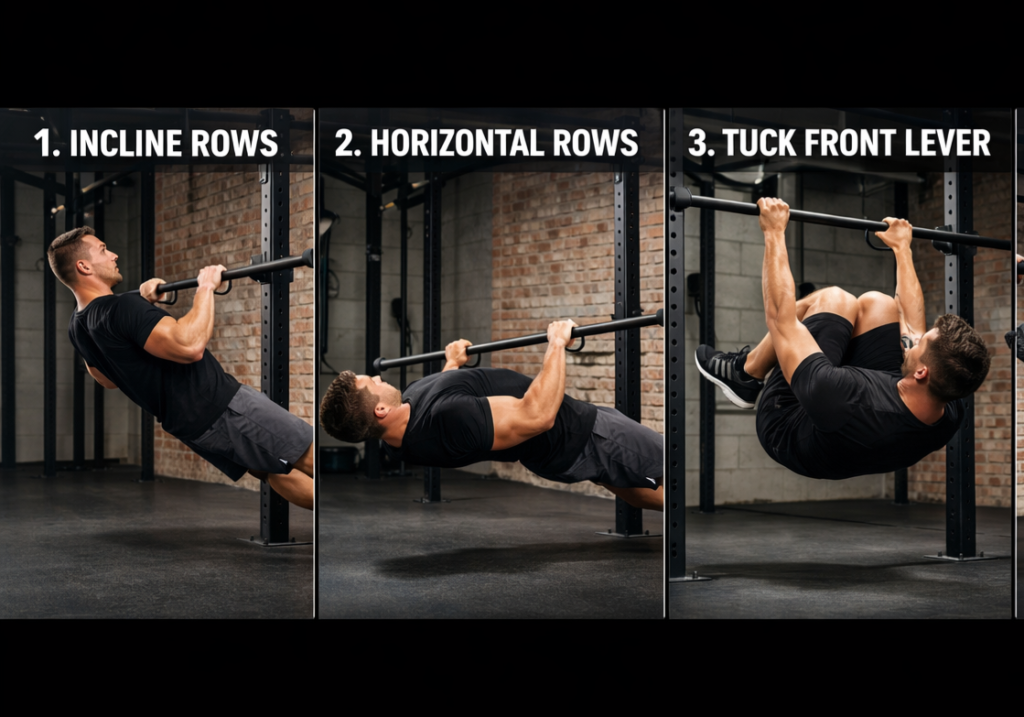
- Incline rows (rings or bar) – Pull chest toward bar with feet on ground.
- Horizontal rows – Pull body horizontally under the bar.
- Feet-elevated rows – Raise feet to increase difficulty.
- Tempo rows – Row slowly with control.
- Archer rows – Pull more with one arm at a time.
- One-arm assisted rows – Row mainly with one arm.
- Front-lever row variations – Row while holding lever body position.
Squat Progressions

- Box squats – Sit on a box and stand up.
- Assisted squats – Squat while holding support.
- Full bodyweight squats – Squat down and stand up freely.
- Tempo squats – Squat slowly.
- Pause squats – Pause at the bottom before standing.
- Split squats – Squat with one leg forward and one back.
- Bulgarian split squats – Rear foot elevated split squat.
- Assisted pistol squats – Single-leg squat with assistance.
- Box pistols – Single-leg squat to a box.
- Full pistol squats – Full single-leg squat.
- Shrimp squats – Single-leg squat with rear knee lowering.
- Skater squats – Single-leg squat with rear leg hovering.
Lunge and Step Progressions

- Reverse lunges – Step backward into a lunge.
- Forward lunges – Step forward into a lunge.
- Walking lunges – Move forward step by step.
- Deficit lunges – Lunge from an elevated surface.
- Step-ups – Step onto a box and stand tall.
- High step-ups – Step onto a higher platform.
- Explosive lunges – Jump between lunge positions.
Hip Hinge Progressions

- Glute bridges – Lift hips from the floor.
- Single-leg glute bridges – Lift hips using one leg.
- Hip thrusts – Lift hips with upper back elevated.
- Hamstring walkouts – Walk heels away while holding hips up.
- Nordic curl eccentrics – Lower forward using hamstrings.
- Full Nordic curls – Lower and pull back up with hamstrings.
Calf Progressions
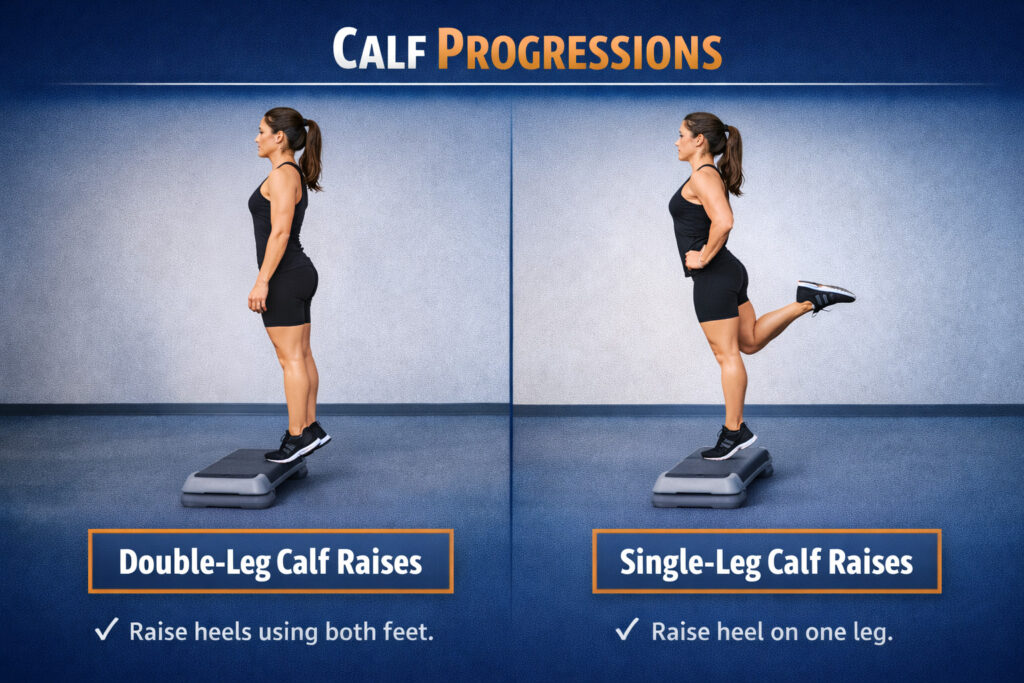
- Double-leg calf raises – Raise heels using both feet.
- Tempo calf raises – Raise and lower heels slowly.
- Single-leg calf raises – Raise heel on one leg.
- Deficit calf raises – Lower heel below foot level.
- Loaded calf raises – Perform calf raises with weight.
Hanging Core Progressions
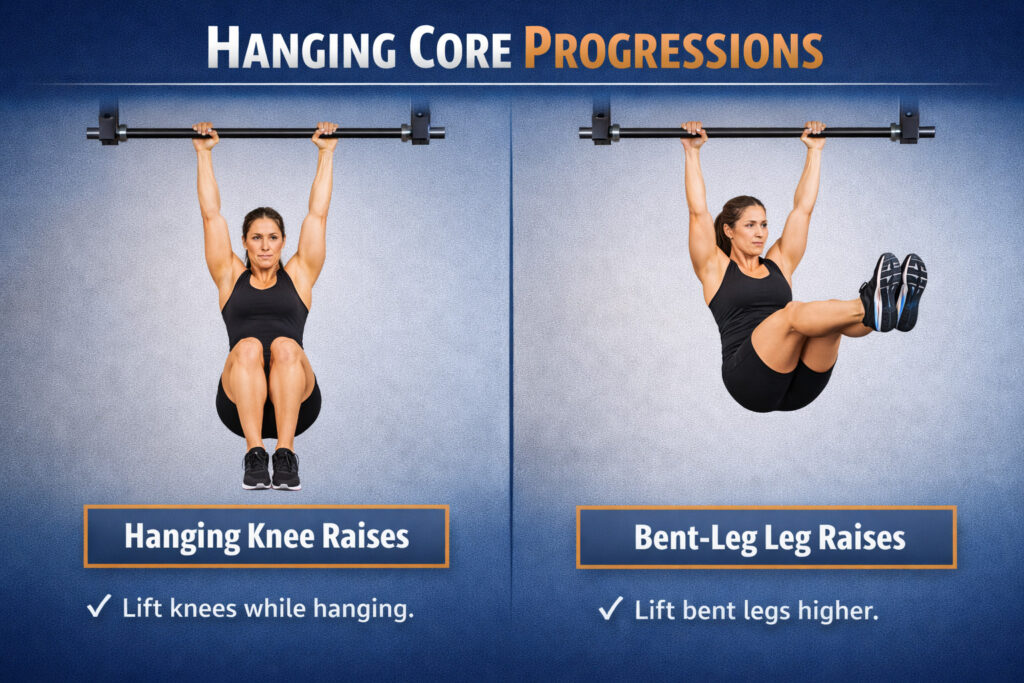
- Hanging knee raises – Lift knees while hanging.
- Bent-leg leg raises – Lift bent legs higher.
- Straight-leg leg raises – Lift straight legs upward.
- Toes-to-bar – Lift toes to touch the bar.
- Tempo leg raises – Lift and lower legs slowly.
- L-sit raises – Raise legs into L position while hanging.
- Windshield wipers – Rotate legs side to side while hanging.
Floor Core Progressions

- Plank – Hold a straight body on elbows or hands.
- Side plank – Hold body sideways on one arm.
- Dead bug – Move opposite limbs while keeping back flat.
- Hollow body hold – Hold curved body position on floor.
- Hollow rocks – Rock back and forth in hollow position.
- V-ups – Lift arms and legs together.
- Dragon flag (eccentric → full) – Lower and lift body with core tension.
L-Sit Progressions

- Tuck sit – Hold bent legs off the floor.
- One-leg L-sit – Hold one leg straight.
- Full L-sit – Hold both legs straight in front.
- L-sit to tuck transitions – Move between L and tuck.
- L-sit to V-sit – Lift legs higher from L-sit.
Front Lever Progressions

- Scapular retractions – Pull shoulders down while hanging.
- Tuck front lever – Hold tucked body horizontal.
- Advanced tuck front lever – Extend hips slightly.
- One-leg front lever – Extend one leg.
- Straddle front lever – Hold legs spread.
- Full front lever – Hold straight body horizontal.
- Front lever pulls and raises – Pull or lift while holding lever.
Back Lever Progressions
- Skin-the-cat – Rotate through shoulders on rings or bar.
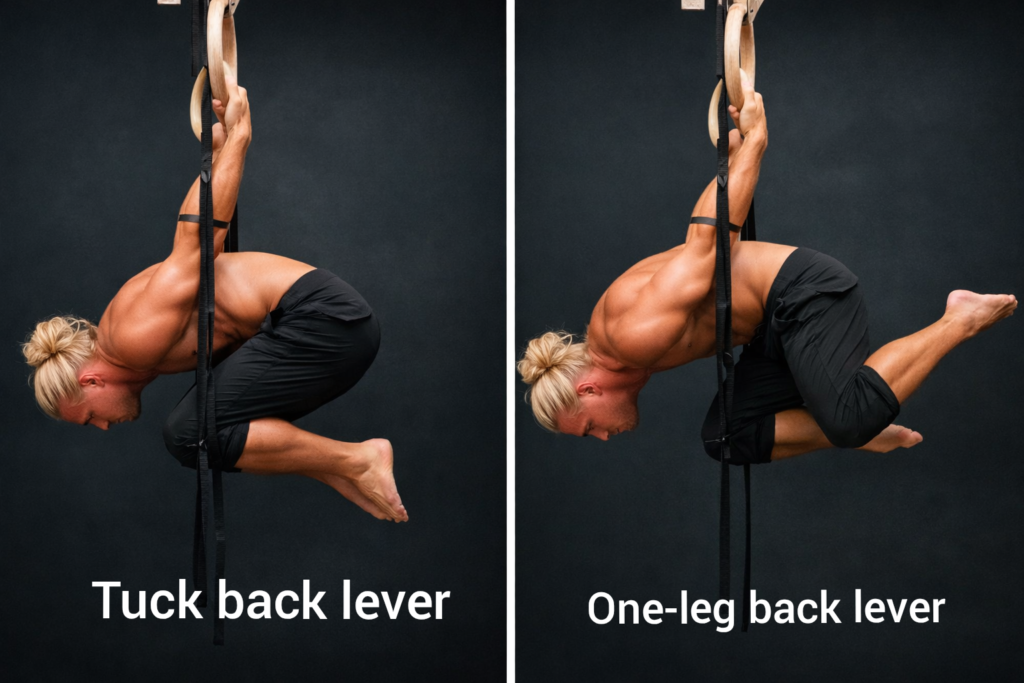
- Tuck back lever – Hold tucked body face down.
- Advanced tuck back lever – Open hips slightly.
- One-leg back lever – Extend one leg.
- Straddle back lever – Hold legs spread.
- Full back lever – Hold straight body horizontal.
Planche Progressions

- Planche leans – Lean shoulders forward over hands.
- Frog stand – Balance on hands with knees on arms.
- Tuck planche – Hold body off ground in tuck.
- Advanced tuck planche – Open hips slightly.
- Straddle planche – Hold legs spread.
- Full planche – Hold straight body parallel to floor.
- Planche push-ups – Push while holding planche position.
Handstand Progressions
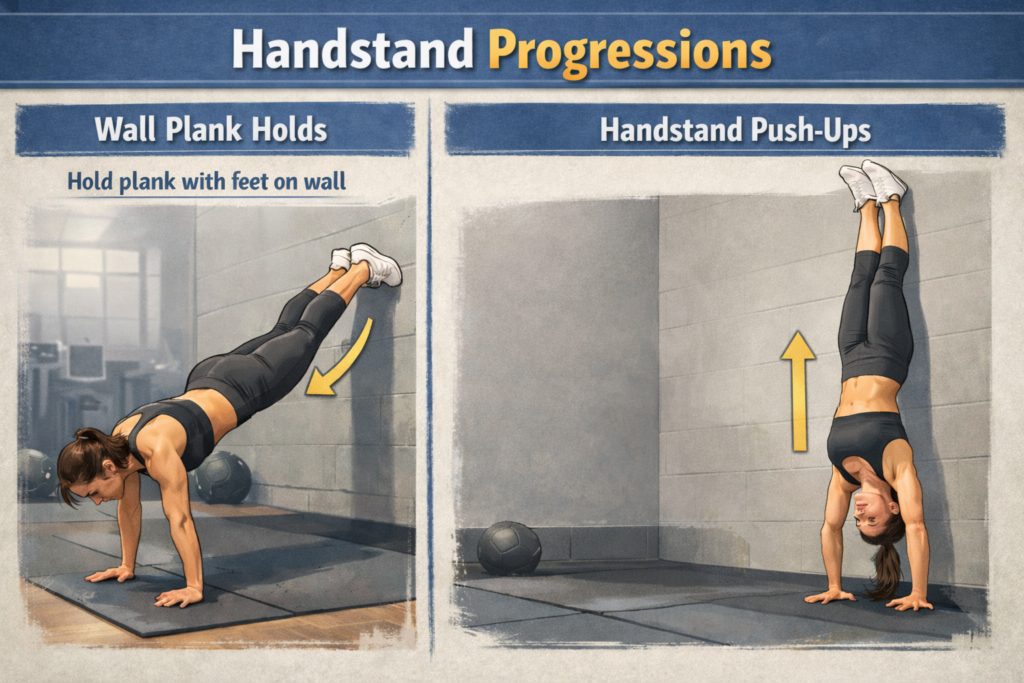
- Wall plank holds – Hold plank with feet on wall.
- Pike holds – Hold inverted pike position.
- Elevated pike holds – Pike with feet raised.
- Wall handstand (chest-to-wall) – Hold handstand facing wall.
- Wall handstand shoulder taps – Shift weight between hands.
- Freestanding handstand kick-ups – Kick up to balance.
- Freestanding handstand holds – Hold balance without support.
- Handstand push-ups (partial → full) – Press body upside down.
Muscle-Up Progressions
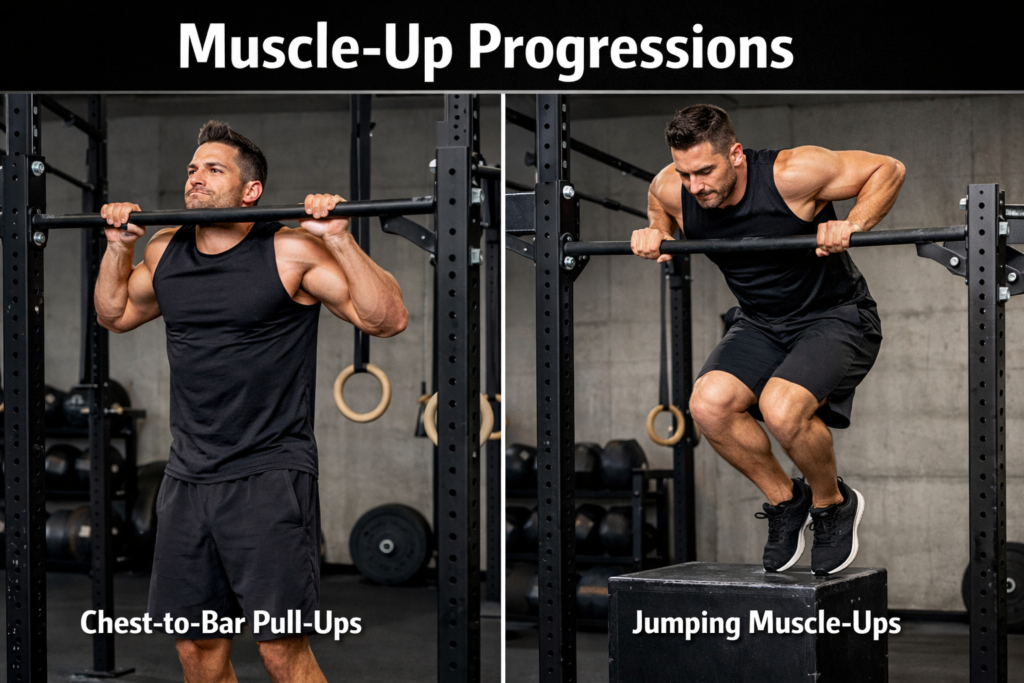
- False grip hangs – Hang using false grip.
- Chest-to-bar pull-ups – Pull chest high to bar.
- Straight bar dips – Dip above bar.
- Transition drills (banded or low bar) – Practice pull-to-dip transition.
- Jumping muscle-ups – Use jump to assist transition.
- Strict bar muscle-up – Pull and press without momentum.
- Ring muscle-up – Muscle-up on rings.
Ring-Specific Progressions
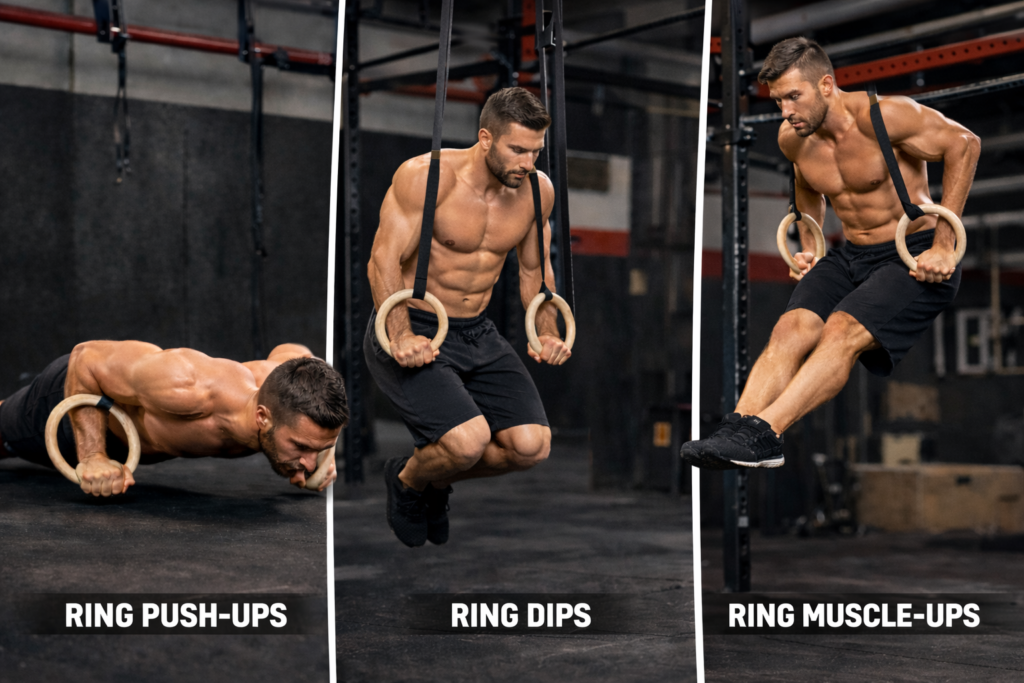
- Ring support holds – Hold body steady on rings.
- Ring rows – Pull chest to rings.
- Ring push-ups – Push while stabilizing rings.
- Ring dips – Dip on unstable rings.
- Ring L-sits – Hold L-sit on rings.
- Ring muscle-ups – Muscle-up performed on rings.
Explosive and Power Progressions
- Explosive push-ups – Push hard enough to leave the ground.
- Clap push-ups – Add a clap in the air.
- Jump squats – Squat and jump upward.
- Explosive pull-ups – Pull fast and high.
- High pull-ups – Pull chest well above bar.
- Muscle-up transitions – Fast pull-to-dip movements.
For a broader view on training methods, programming ideas, and related exercises, see the calisthenics and bodyweight sections
Final thoughts
Calisthenics progressions are not about rushing to advanced skills.
They are about building strength in a way that compounds over time.
Small steps are not a compromise.
They are the reason advanced movements eventually feel normal.
When progressions are structured well, progress stops feeling random.
It becomes predictable.
And predictable progress is what keeps calisthenics sustainable for the long term.
FAQs
Does proper breathing improve performance in progressions?
Breathing is a crucial element for improving performance in calisthenics progressions. During the execution of complex and advanced movements, the body requires more oxygen to fuel the muscles and provide energy.
Can I quickly move on to more advanced exercises if I feel strong?
Even if you feel strong, increasing the difficulty too quickly can lead to overtraining or injuries. It’s essential to give your body time to adapt.
How important is mobility in calisthenics?
Mobility is crucial. Focusing solely on strength without developing good mobility can lead to a limited range of motion and potential muscle imbalances.
Can I combine calisthenics with other forms of training?
Absolutely. Incorporating calisthenics with other training methods, like weightlifting or cardio, can provide a well-rounded fitness routine and optimize results.