Someone once told me — completely serious — ‘Dips are all you need for massive triceps.’
I looked at him like he’d just told me microwaving chicken makes it anabolic.
Because dips feel too simple.
Too accessible.
Too… unglamorous.
And yet, every time I hit a phase where my triceps start looking like sad noodles, dips are the movement that drags me back to life.
But are bodyweight dips alone really enough?
Let’s dig in — without turning this into some stiff scientific monologue you’d read in a biomechanics textbook.
Just you, me, and the uncomfortable truth about your arms.
Understanding Bodyweight Dips for Triceps Growth
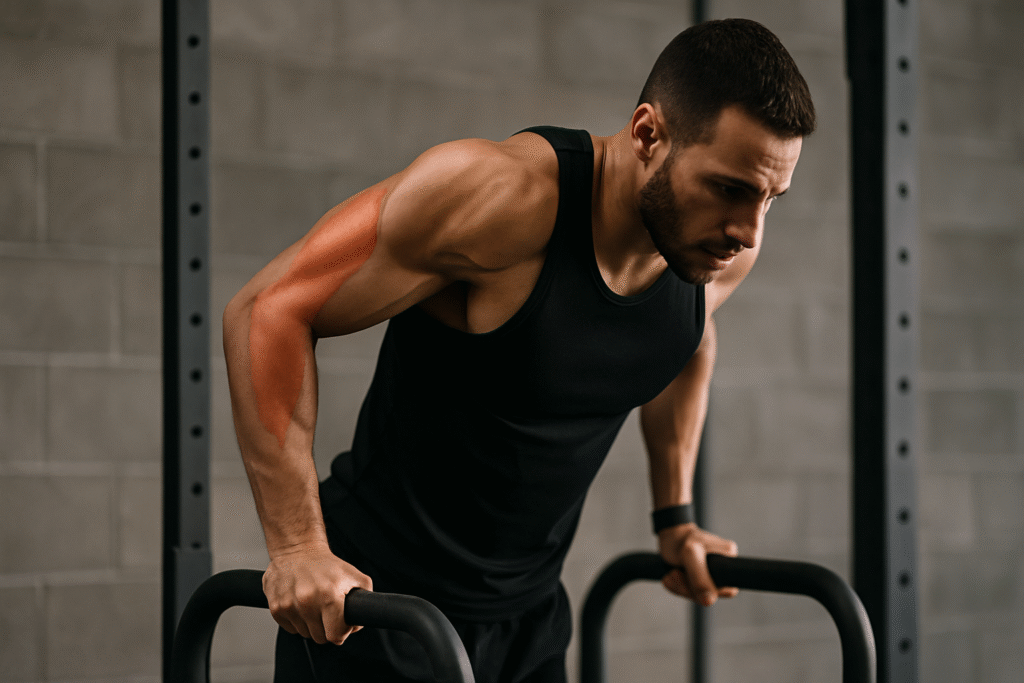
Bodyweight dips look innocent.
You lower yourself between two bars.
You push back up.
Easy… in theory.
But the moment you hit that bottom position and feel your chest widen like an old wooden door in winter, you realize there’s nothing “light” about this movement.
And for the triceps?
It’s like someone plugged your arms into a toaster.
Because dips overload the long head of the triceps — the part that gives the arm that meaty, 3D back-of-the-arm shape when flexed.
Most people never train this region well because they stick to pushdowns that work the lateral head more.
But dips force the long head to wake up and actually do its job.
And since the long head crosses the shoulder joint, dips hit it in a way that most cable machines never manage.
So yes, dips have a built-in anatomical advantage.
But is anatomical advantage enough to build big triceps by itself?
How Far Bodyweight Dips Can Really Take Your Triceps Gains
There’s something magical about the first months of dipping.
You go from shaking like a baby deer on ice…
…to suddenly repping out sets like you’re auditioning for a calisthenics montage on YouTube.
And your triceps respond fast.
Why?
Because dips naturally combine:
- High mechanical tension
- A long range of motion
- Multi-joint engagement
- Progressive overload through body positioning
But here’s the catch:
Your bodyweight is both your best friend and your biggest ceiling.
At some point, you stop getting heavier.
Or you stop getting stronger at the same rate.
That’s when dips alone might plateau your triceps growth.
Not because dips aren’t good.
But because muscles grow in response to increasing challenge — and your bodyweight doesn’t increase weekly unless your diet is chaos.
Still, plenty of people build very solid arms with just dips.
As long as they know how to use them intentionally.
Why Some People Don’t Grow from Bodyweight Dips
If dips were universally magical, everyone at the park would have arms like Greek statues.
But here’s why some lifters don’t grow:
- You go too fast.
- You cut the range short.
- You flare your elbows like you’re trying to take flight.
- You let the chest take over because you’re afraid of sinking into the bottom.
- Or you avoid going close to lockout because you heard on TikTok that locking out is “bad for elbows.”
Look, I get it.
The bottom position is intimidating.
The top position burns.
And dips punish sloppy reps instantly.
But if you want triceps growth, your elbows need to work through those uncomfortable ranges — safely, yes, but not half-heartedly.
Many people simply “do dips.”
Very few train them.
How to Make Bodyweight Dips More Effective for Triceps
This is where dips either turn into a secret weapon… or a background filler exercise you pretend to do for warm-ups.
Here’s how to turn them into a triceps-focused monster:
- Tilt your torso just slightly forward — not chest-day forward, just a soft lean.
- Let your elbows stay closer to your ribs rather than flaring wide.
- Lower with control, like you’re easing your body onto a couch you don’t own.
- Go deep enough to feel the stretch but not so far your shoulders send you hate mail.
- Pause for half a second at the bottom.
- Drive up explosively but finish the rep by straightening the arm fully.
That lockout is where the triceps shine.
And if your shoulders complain?
Parallel bars are friendlier than rings.
And straight bars are surprisingly brutal but great for pure arm drive.
Progressive Overload Without Weights in Bodyweight Dips
One of the most underrated things about dips is how many ways you can make them harder without touching a single plate.
You can slow the eccentric.
You can add a pause.
You can increase your reps.
You can increase your sets.
You can change the bar width.
You can elevate your feet behind you.
You can use a slight hollow-body shape to restrict chest assistance.
You can add isometric holds at the top or bottom.
And suddenly you’re sweating like you’re in a Florida gym in July.
Don’t underestimate how much harder a “simple” tweak can make a dip session.
Even without weights, dips can humble almost anyone when programmed creatively.
Where Bodyweight Dips Fit in a Balanced Triceps Training Plan
This is where lifters usually get confused.
Some people treat dips like they’re the only thing that matters.
Others treat them like optional seasoning.
The truth?
Dips are a main course.
But not the whole buffet.
If you want maximum triceps development, you still need movements that isolate certain functions dips don’t emphasize as much — like elbow-extension isolation with cables or dumbbells.
But here’s the twist:
If you’re training at home, or doing calisthenics, or you just prefer simplicity?
Dips can absolutely be your primary triceps movement.
You’ll grow.
You’ll get stronger.
And your shirts will fit tighter in all the right places.
Just sprinkle in some pushup variations or close-grip work, and you’re golden.
Why Bodyweight Dips Feel Emotionally Different Than Other Triceps Exercises
This might sound dramatic, but dips hit you in a different emotional zone.
They feel like a rite of passage.
Like joining a club where everyone knows the same shared suffering.
You’re not just pushing weight.
You’re lifting yourself.
And there’s something strangely grounding about that.
Dips give you that “earned it” sensation — the kind you don’t always get from a cable stack with shiny attachments.
It’s raw.
It’s simple.
It’s primal in that quiet, humbling way that only bodyweight strength gives you.
And maybe that’s why people swear by dips more than they swear by any other triceps exercise.
So… Are Bodyweight Dips Sufficient for Triceps Gains?
Short answer?
Yes — for a long time, and for a lot of people.
You can build big, strong, visually impressive triceps with dips as your foundation.
But if you reach a plateau?
If your reps stall?
If your arms stop growing?
It just means you’ve outgrown “bodyweight only” and might benefit from weighted dips or accessory work.
Not that dips are suddenly useless.
They remain one of the most bang-for-your-buck movements you can do for triceps — in the gym, at home, at the park, wherever.
How Many Bodyweight Dips You Actually Need for Triceps Gains
At some point you finish reading about dips and think,
“Okay, but… how many do I actually do?”
Totally fair question.
And honestly, it’s the part nobody says out loud because everyone assumes “you’ll figure it out.”
So here’s the truth that would’ve saved me months of trial and error:
If you’re a beginner, your triceps don’t need a heroic amount of work.
They just need consistency.
Think something like:
Beginners: 3×5–8 clean reps, twice a week.
Intermediates: 4×8–15, once or twice a week depending on recovery.
Advanced lifters: 5×10–20, or weighted dips if you hit those reps with room to spare.
The pattern is simple:
You push.
You recover.
Your triceps grow.
And then you repeat.
Volume matters, yes — but only if you can keep the reps clean enough that your elbows don’t stage a rebellion halfway through the set.
If you track just one thing?
Track whether you’re getting one more good rep every week.
A Simple Progression if You Can’t Do Full Bodyweight Dips Yet
A ton of people struggle with dips and feel ashamed to admit it.
But dips aren’t a “beginner-friendly” movement.
They demand shoulder stability, scapular control, and enough triceps strength to not fall through the bars like a sack of laundry.
So if full dips aren’t there yet, try this smooth progression:
Start with negative dips — lowering yourself as slowly as you can.
Then add bottom-position holds for 5–10 seconds.
Practice bench dips with your feet further out to remove some assistance.
Move to assisted band dips to get the full motion safely.
Finally, transition to full parallel-bar dips once the movement feels stable instead of chaotic.
A Bodyweight-Only Triceps Routine to Use Right Away
Sometimes you just want someone to say,
“Here, do this,”
so you’re not stuck overthinking which exercises go where.
So here’s a simple, no-equipment (except bars) triceps session you can run 1–2 times a week:
Strict Dips — 4×8–12
Focus on range, control, and locking out.
Diamond Pushups — 3×10–15
Feel that tight squeeze in the triceps on every rep.
Close-Stance Pike Pushups — 3×6–10
A sneaky triceps burner disguised as a shoulder movement.
Top-Position Isometric Holds — 20–30 seconds
Flex the triceps like you’re trying to dent the air.
This combo hits every portion of the triceps without relying on cables or dumbbells, and it slots perfectly into calisthenics or minimalist training.
Shoulder-Friendly Tips and Alternatives If Dips Hurt
Dips are incredible, yes — but only if your shoulders aren’t screaming louder than your music.
If dips feel sketchy, here’s how to make the movement kinder on your joints:
Don’t go excessively deep if your shoulder mobility isn’t ready.
Use parallel bars, which are more forgiving than rings.
Try straight-bar dips, which naturally keep elbows tighter and reduce awkward angles.
Experiment with a smaller ROM until strength catches up.
Lean slightly forward, which decreases pure shoulder stress.
And if dips just aren’t happening today?
You still have great options:
- Bench dips with feet elevated
- Close-grip pushups
- Decline close-grip pushups
- Band pushdowns (if you have a band lying around)
You’re not “cheating the process” — you’re letting your joints survive long enough to actually build muscle.
Final Thoughts
If there’s one thing I’ve learned after years of training, restarting, plateauing, and reinventing my workouts…
…it’s that simple exercises aren’t simple when done with intention.
Dips included.
So if dips are part of your training right now?
Lean into them.
Refine the form.
Progress them.
Give them time to work their magic.
And if they’re not in your routine yet?
Maybe today is the day to start building those arms with nothing but your own body, a pair of bars, and the willingness to feel that burn.