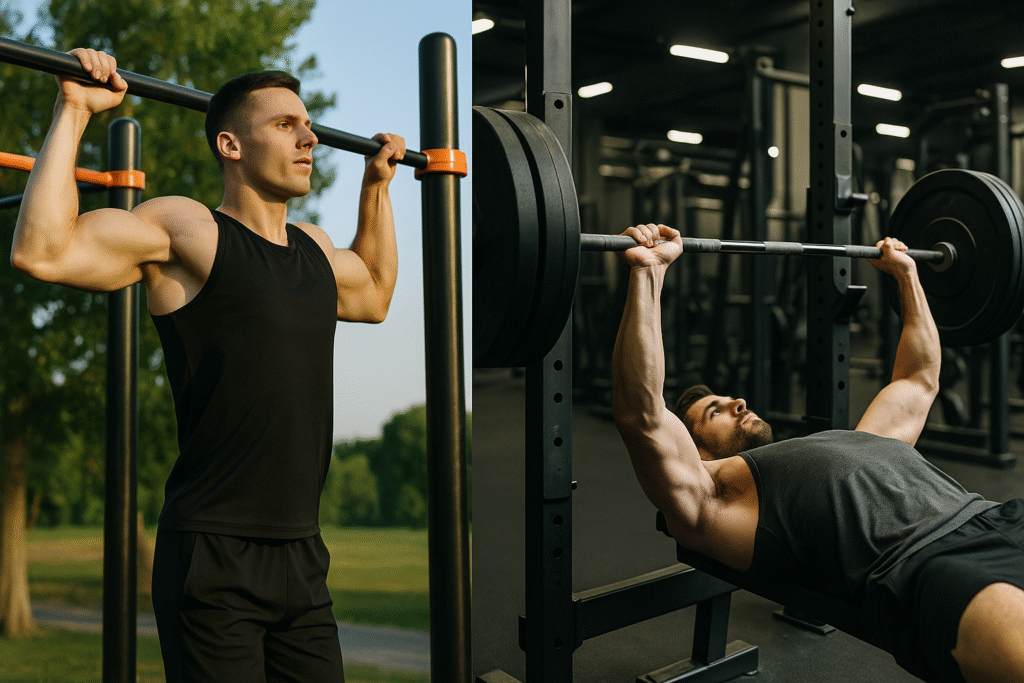
Sometimes a workout starts with nothing more than a park, a little space, and whatever equipment happens to be around.
Maybe a bar.
Maybe two benches sitting in the shade.
And suddenly those two benches become the setup for a quick set of dips.
The setup is simple.
Almost minimal.
Yet the exercise is the same one that, in a gym, would require a shiny, expensive machine.
That contrast brings up an obvious question.
“Wait… is a gym really necessary for all this?”
Is the gym still the mandatory stop for building strength?
Or can calisthenics handle the job just as well with far less equipment?
If that question sounds familiar, the timing is perfect.
It’s time to break things down.
What Calisthenics Actually Gives You
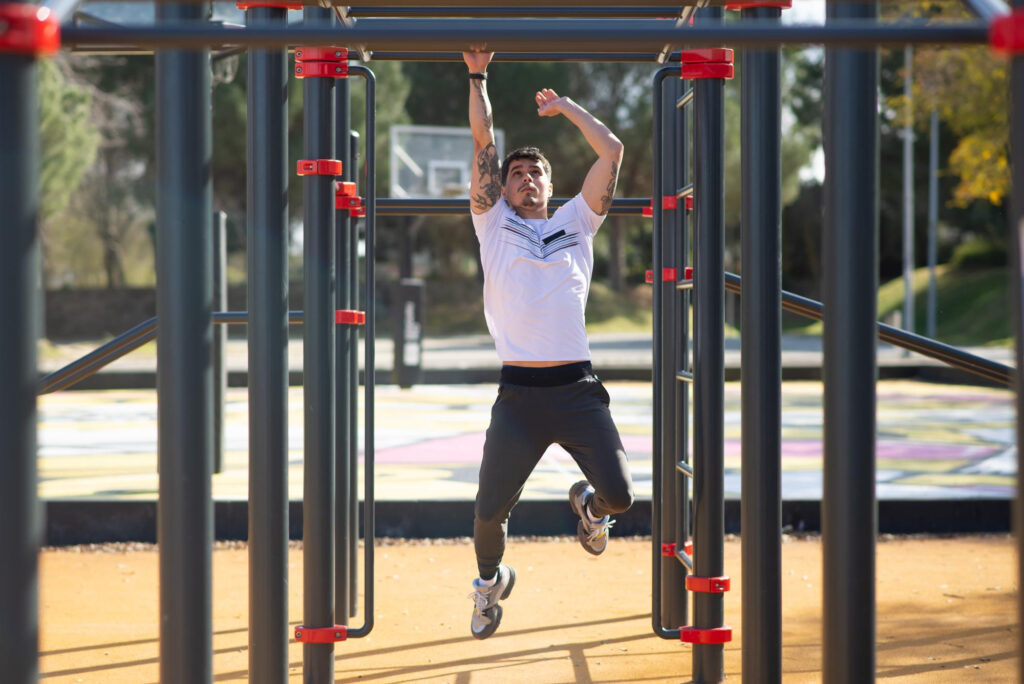
Calisthenics has this charm that sneaks up on you.
You start with push-ups because you don’t want to drive to the gym at 7 a.m.
Then suddenly the routine shifts.
And Google is open.
And the search bar says: “why does my scapula click during wall handstands.”
Plans start changing too.
Vacations get organized around parks.
And those parks get judged by one thing only.
“Do they have good pull-up bars?”
Bodyweight training builds something deeper than muscle.
It gives you control.
It gives you awareness.
It builds a kind of strength that actually matters.
Strength that shows up in everyday life.
Like carrying all the groceries in one arm while opening the door with the other.
The kind of strength that feels practical.
Not just another plate added to a machine.
And the progression is addictive.
Each rep feels like a small high-five from your body saying, “See? We can do more than we thought.”
Where Calisthenics Wins Without a Gym
You can train anywhere.
Living room, park bench, airport terminal if you’re chaotic enough.
You use your own body as resistance, which means your joints learn to handle forces naturally instead of fighting awkward machine angles.
You also build a ridiculous amount of stability.
Every push-up variation forces your core, hips, and shoulders to coordinate like a squad trying to move a couch up narrow stairs.
You develop strength that transfers beautifully to sports, manual jobs, martial arts, even posture.
Plus, skill work — handstands, levers, muscle-ups — keeps the dopamine high.
There’s always a next level.
And yes, the bragging rights do taste a little sweeter when you didn’t need a building full of plates to get there.
Calisthenics Has Limits Too
I know, I know.
We love bodyweight training.
It’s efficient.
It’s empowering.
And it makes you feel athletic even on days when you’re one spilled coffee away from losing your sanity.
But let’s be real.
Your legs might hit a wall if you never add load.
Pistol squats are amazing, sure.
But they don’t replace progressive loading forever.
Your pulling strength might stall if you only rely on gravity.
Weighted pull-ups exist for a reason.
Your upper body might stop growing as fast as it could because progressive overload becomes harder to quantify with “slower tempo” or “more explosive.”
And some muscle groups — especially the posterior chain — respond incredibly well to external load.
Try mimicking the force of a Romanian deadlift with just your bodyweight.
It’s like trying to recreate a thunderstorm with a spray bottle.
The Honest Middle Ground: You Don’t Need the Gym, But It Helps Like Crazy
Let me put it this way.
You can absolutely get strong, lean, athletic, coordinated, and mobile with calisthenics alone.
You can build a great physique.
You can master advanced skills.
You can progress for years without stepping foot into a gym.
But the gym gives you tools.
Not obligations — tools.
You don’t need tools to cook dinner either.
But a well-sharpened knife makes life easier.
Mix the two and your training unlocks a different gear.
You get the raw, functional strength of bodyweight work.
You get the clean, trackable overload of weights.
And your joints thank you because you’re training through more movement patterns instead of the same pushing and pulling angles.
When You Don’t Need the Gym at All
There are phases where calisthenics is basically king:
You want to improve movement control.
You’re learning handstands, levers, planche entries, or bar flow.
You want athletic-looking muscle definition without chasing max loads.
You prefer training outdoors.
You need something low-cost or apartment-friendly.
You dislike gym crowds and that one dude who slams dumbbells like he’s trying to wake the ancestors.
When the Gym Becomes the Upgrade You Need
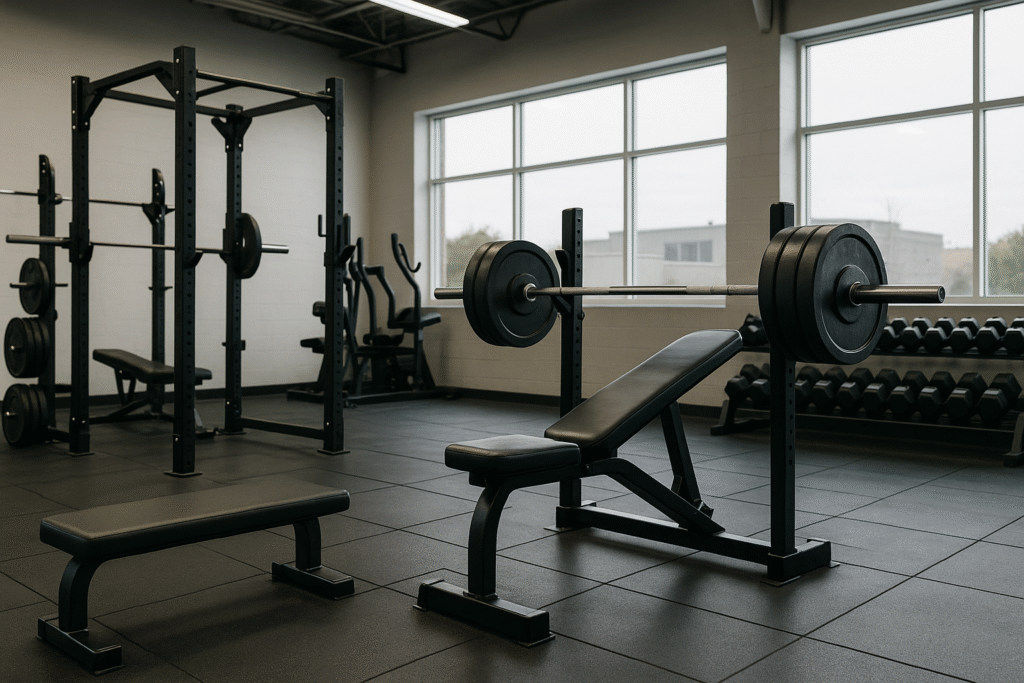
Sometimes your body asks for more load than your limbs can deliver on their own:
You want thicker legs — not just toned, but “someone squats” legs.
Your pulling strength stalls because you’re maxing out what gravity can challenge.
You want to isolate weak links without skill-based movements getting in the way.
You need controlled progression for injury prevention.
You don’t feel the burn in certain muscles anymore unless you add weight.
Why People Burn Out Mixing the Two
When the excitement kicks in, people go too hard.
They do bar muscle-ups at the park in the morning.
Then they hit heavy rows and deficit deadlifts in the evening.
The next day they wonder why their elbows feel like glassware and their back refuses to negotiate.
The trick isn’t adding more.
It’s adding smarter.
Use the gym to support your calisthenics, not to fight it.
Use calisthenics to polish your gym strength, not to sabotage your recovery.
A Different Angle: The Confidence Factor
One thing people rarely talk about:
Calisthenics changes your relationship with your body in a way weights don’t always match.
You feel capable.
Balanced.
Connected.
You realize strength isn’t just about numbers but about controlling your weight through space.
And that confidence bleeds into everything — walking taller, moving smoother, looking more athletic without flexing.
Some people crave that feeling more than a bigger bench or deadlift PR.
For others, the iron gives them the same emotional boost.
There’s no wrong choice.
Just different flavors of the same experience.
How to Combine Calisthenics and Gym
You don’t need a complex program.
Just a simple structure that gives your body both worlds.
Try something like this:
Calisthenics days → skills, push, pull, core, sprinting, mobility.
Gym days → progressive overload, legs, back thickness, loaded carries.
Leave space to recover.
Don’t turn every week into a glucose-powered warzone.
And alternate intensity — don’t max everything at once.
Your nervous system won’t send you a postcard.
The Real Question: What’s the Goal Behind the Question?
Whenever someone asks, “Do I need the gym?” what they’re really asking is:
“Will I miss out on gains if I don’t go?”
And the truth is more comforting than dramatic.
You won’t miss out.
You’ll just develop in a different direction.
Calisthenics alone → athletic, lean, coordinated, functional, expressive strength.
Gym alone → hypertrophy, raw force, isolated growth, predictable progression.
Mix of both → the best of both worlds without burning out.