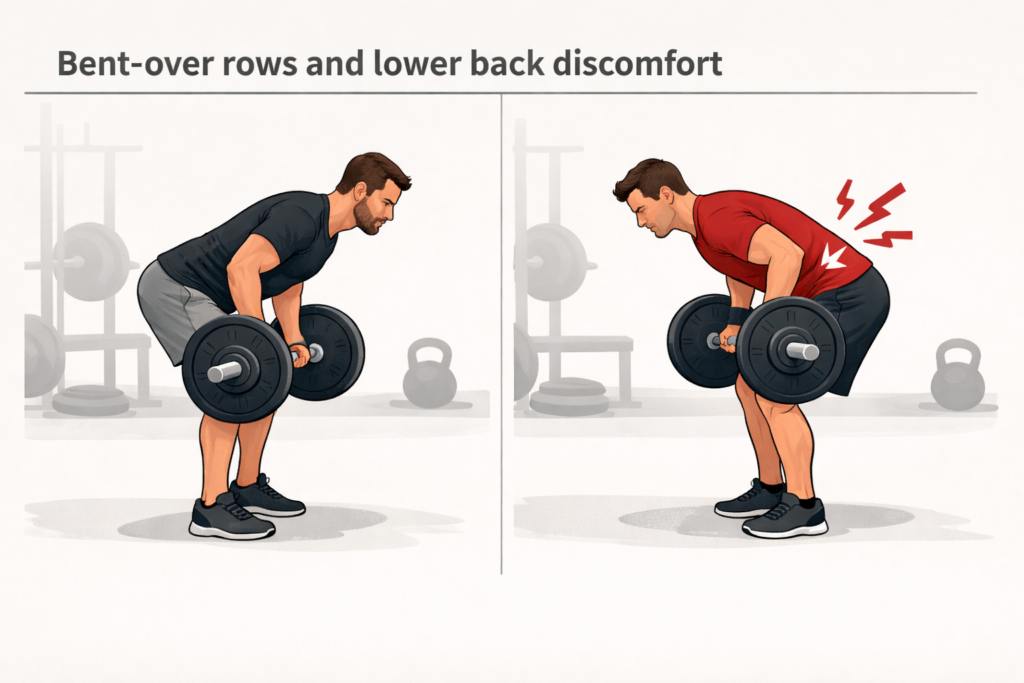
Bent-over rows are one of those exercises that look straightforward.
Pick weight up.
Lean forward.
Row it.
Become a strong, heroic rectangle.
And then… the lower back starts complaining like it just got asked to run a marathon in dress shoes.
If that sounds familiar, this is for you.
I’m going to explain what’s actually happening in simple, clear language, and I’ll walk you through the small adjustments and comparisons I made on my own body to understand why my lower back kept getting irritated.
No timelines.
No staged programs.
Just real-world troubleshooting based on what actually changed how the movement felt.
- Core bracing isn’t solid under load
- The hip hinge angle exceeds current control
- The weight drifts too far from the body
- Brace harder and hinge from the hips with a neutral spine
- Keep the load close and reduce weight when control drops
- Slow the reps or switch to supported row variations
What a Bent-Over Row Really Is (And Why Your Lower Back Is Involved Even If You Don’t Want It To Be)

A bent-over row is a pulling exercise where you hinge your hips, lean your torso forward, and pull a weight toward your body.
The weight can be a barbell (a long bar you load with plates), dumbbells (one in each hand), or a cable attachment.
The main goal is to train the upper back muscles that pull your arms behind you, especially the lats (the wide “wing” muscles), rhomboids (between the shoulder blades), and mid traps (upper back stabilizers).
But here’s the catch that beginners don’t get told clearly enough.
A bent-over row is not only a “back exercise.”
It’s also a long isometric hold for your lower back, glutes, and hamstrings.
Isometric means your muscles are working hard without visibly moving, like when you hold a heavy grocery bag and your arm is shaking but not bending.
In a row, your upper back is moving the weight.
Your lower back is acting like the steel beams of a building, keeping the whole structure from folding in half.
If those beams get overloaded, stressed, or positioned badly, discomfort shows up fast.
“Discomfort” vs “Pain”: The Quick Reality Check Before Blaming the Exercise
Before we go deeper, this matters.
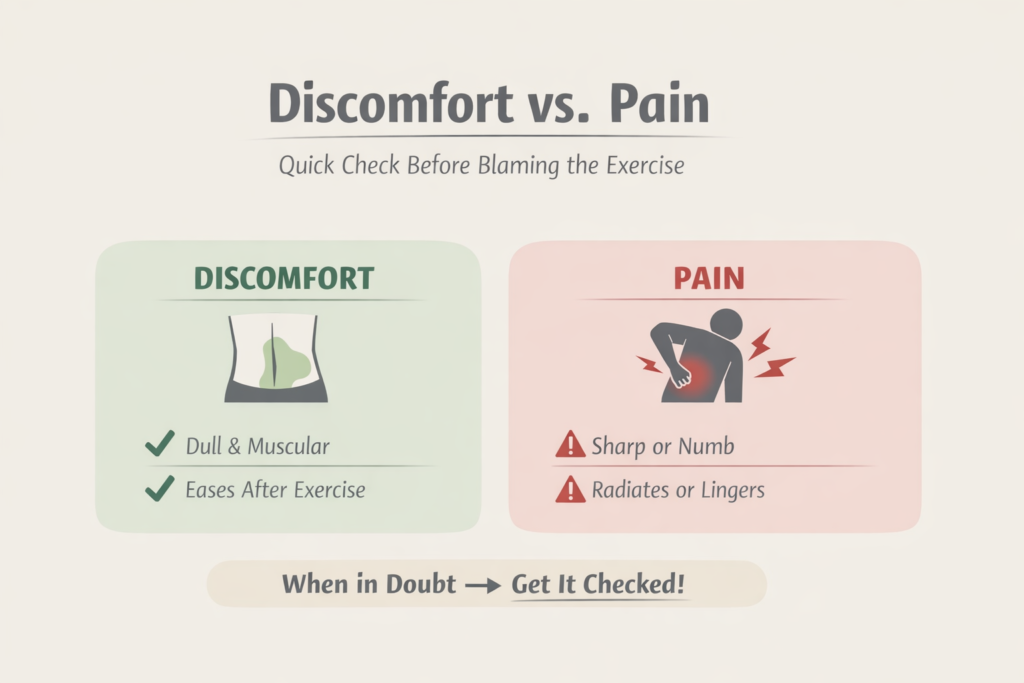
Some sensations are normal training fatigue.
Some are your body tapping the “stop” sign.
A common normal feeling after bent-over rows is a dull, tired pump in the muscles along your lower spine, kind of like you “held a hinge position for a long time.”
That usually feels symmetrical, muscular, and improves quickly after the set ends.
The more concerning stuff tends to feel sharp, pinchy, one-sided, or like something is catching when you move.
If discomfort shoots down the leg, causes numbness or tingling, or lingers and worsens over days, that’s not a “form tweak” situation anymore.
That’s a “get assessed by a medical professional” situation.
No ego points are awarded for ignoring nerve symptoms.
Your spine doesn’t care how motivated you are.
The Main Reasons Bent-Over Rows Irritate the Lower Back
Lower-back discomfort during rows usually comes from one (or several) of these buckets.
The good news is that most of them are fixable once you know which bucket you’re in.
And the annoying news is that they can stack like bad internet tabs: one issue open leads to five more running in the background.
Bucket #1: The Hinge Position Isn’t a “Hip Hinge” Yet
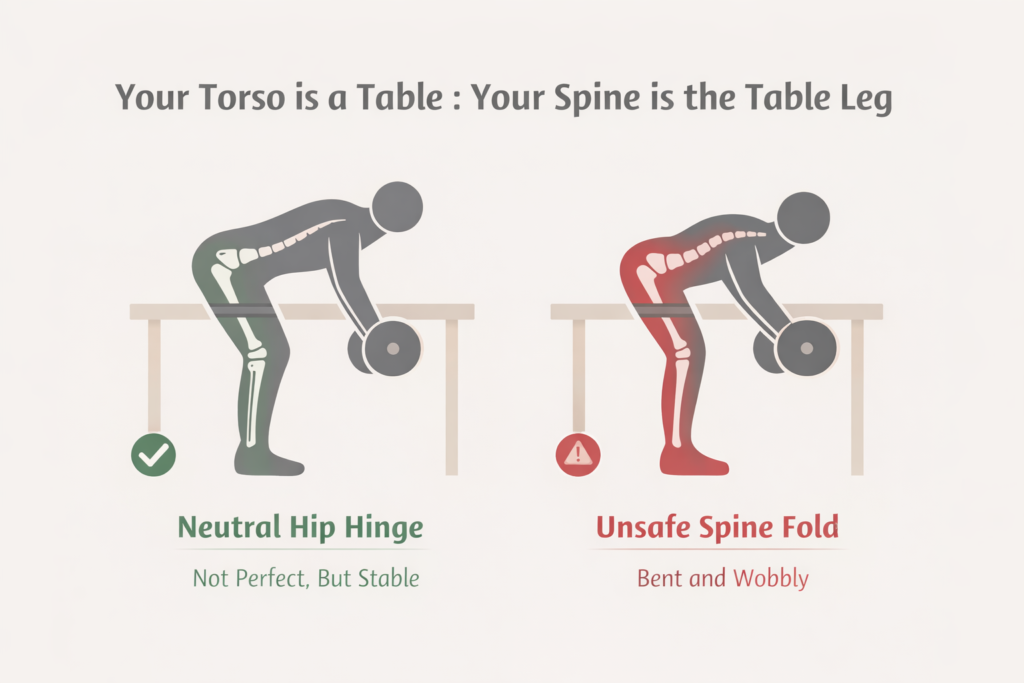
A hip hinge is the movement pattern where you push your hips back while keeping your spine relatively neutral.
Neutral spine means the natural gentle curve in your lower back stays, without rounding into a “C” shape or over-arching aggressively.
In a clean hinge, the movement happens mostly at the hips, not by curling your spine forward.
A lot of people think they’re hinging, but they’re actually doing a partial spine fold.
That turns rows into a repeated stress test for the tissues of the lower back.
The simplest mental image I use is this.
Imagine your torso is a table, and your spine is the table leg.
If the leg is straight and solid, the table can hold weight.
If the leg is bent and wobbly, the table starts to sag, and everything feels sketchy.
Rows punish a wobbly “table leg” pretty quickly.
Bucket #2: Your Lower Back Is Doing the Job Your Bracing Should Be Doing
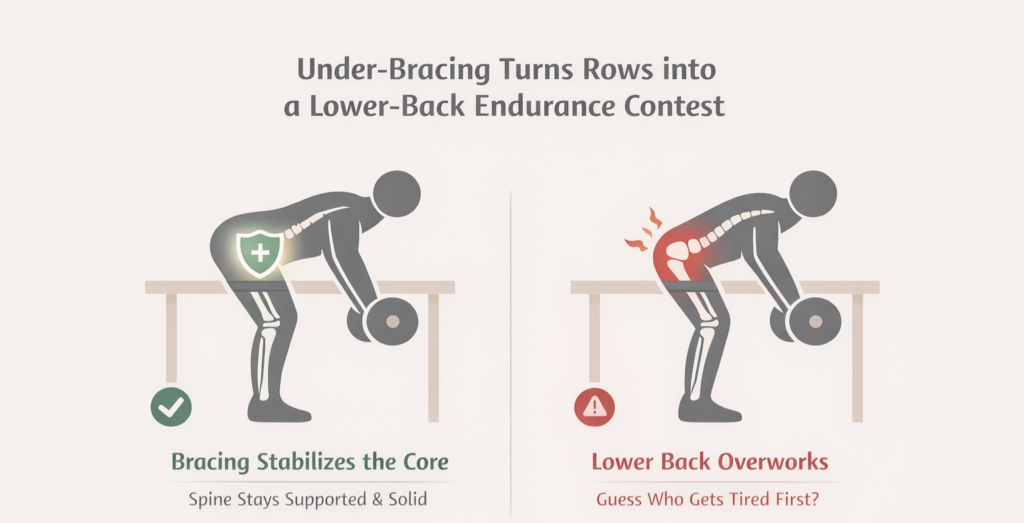
Bracing is the act of creating pressure and stiffness through your trunk so your spine stays stable under load.
It’s not just “tighten your abs.”
It’s more like you’re preparing to take a playful punch to the belly, while still being able to breathe and move.
When bracing is weak or inconsistent, the lower back often tries to compensate by tightening and overworking.
That can feel like tension, cramping, or an uncomfortable burn that shows up way before your upper back is even tired.
In other words, your row turns into a lower-back endurance contest.
Your lats are basically spectators at that point.
Bucket #3: The Weight Is Pulling You Into a Bad Position (Even If Your Form Looks “Okay” at First)
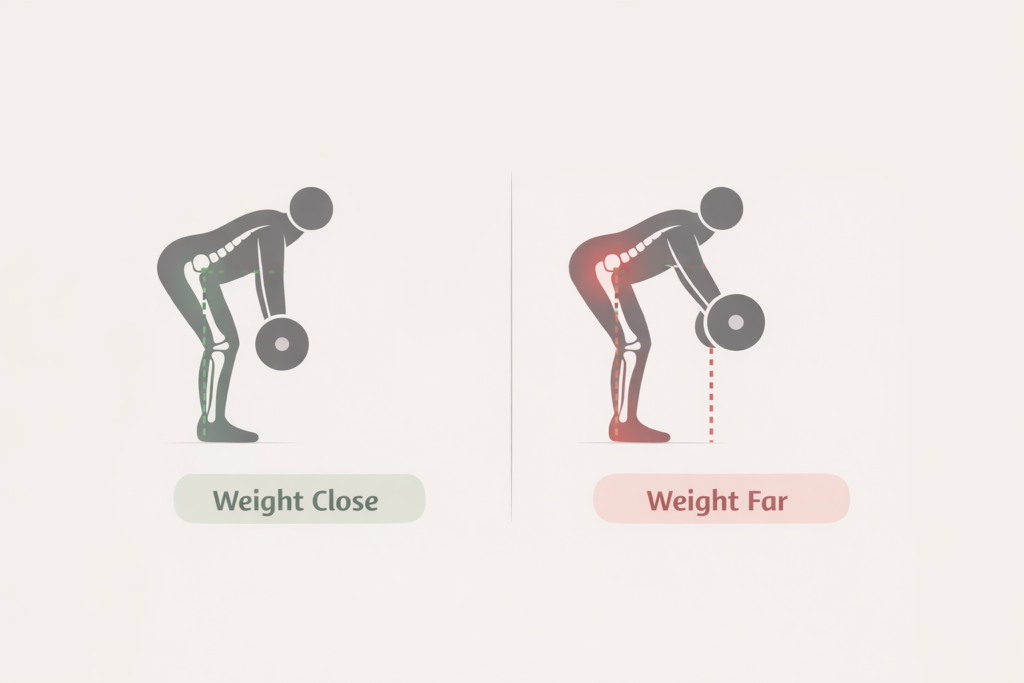
This one surprised me when I tested it.
I thought my setup looked fine.
Then I noticed something: the heavier I went, the more the bar subtly dragged my shoulders forward and my torso more upright.
That tiny shift changed leverage a lot.
It made my lower back fight harder to stop my torso from collapsing, especially at the bottom when the arms are extended and the weight is farthest from the body.
Think of holding a heavy suitcase.
If the suitcase is tight against your leg, it’s manageable.
If you hold it with a straight arm away from your body, it suddenly feels like it weighs double.
That’s leverage.
Rows are leverage-heavy.
If the weight drifts away from your center of mass, your lower back pays the tax.
Bucket #4: The Row Is Quietly Turning Into a “Cheat Curl + Back Extension Combo”
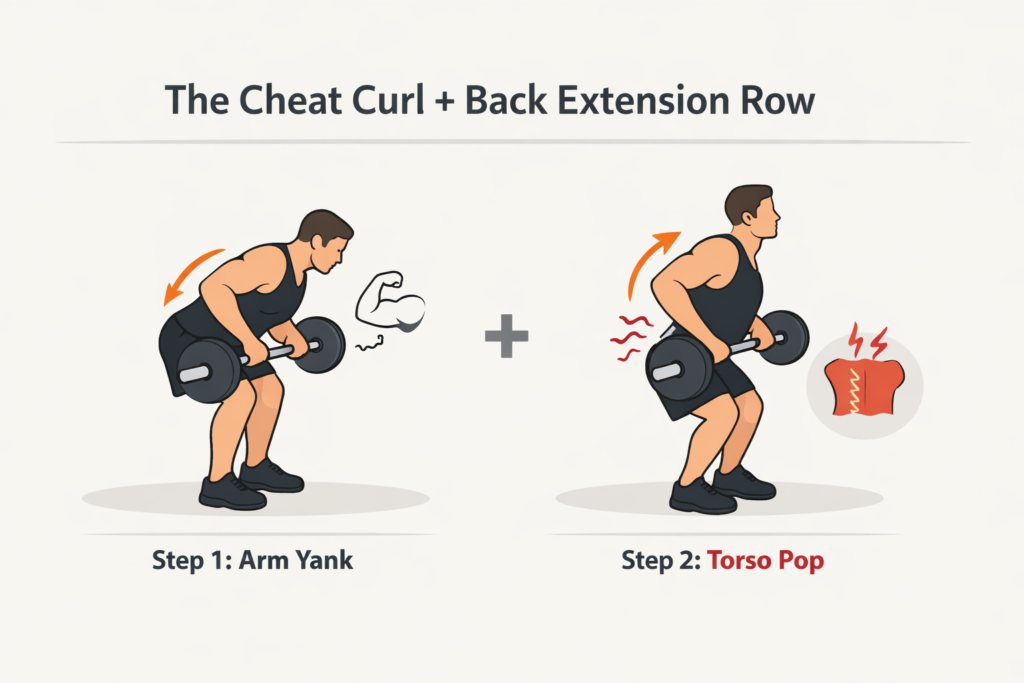
There’s a version of the row that many people accidentally do.
They start the pull by yanking the weight with the arms, then “finish” by extending the torso up slightly.
It’s not always dramatic.
It can be a small torso pop that barely shows, but your lower back feels it.
That repeated little extension can irritate the joints and tissues in the lumbar spine, especially if you already have a tendency to over-arch.
It’s like doing mini-reps of a movement you didn’t program.
Your body is basically freelancing.
And your lower back is the employee who didn’t agree to overtime.
Bucket #5: Mobility Isn’t “Bad,” But Your Current Mobility Might Not Match the Row Angle You’re Using
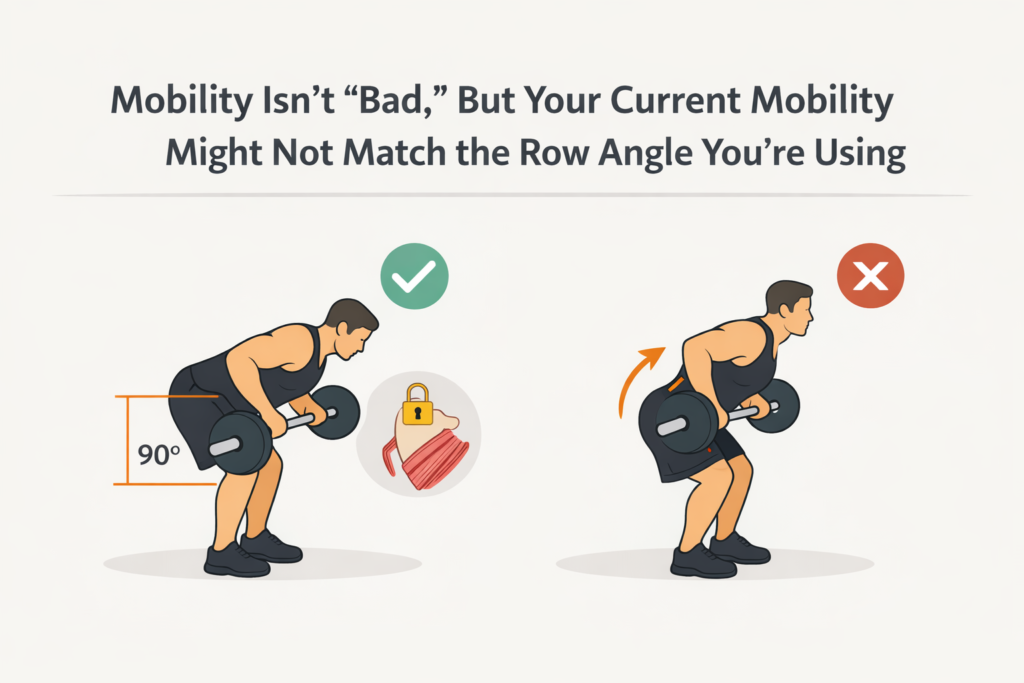
Mobility is how far a joint can move actively and comfortably.
In rows, the biggest mobility players are hips and hamstrings.
If your hamstrings are tight, your hips may stop hinging earlier.
Then the only way to lean forward more is to round the lower back.
That doesn’t mean tight hamstrings are “evil.”
It just means your chosen torso angle might be asking for range you don’t currently own.
A common misunderstanding is thinking you must row with your torso nearly parallel to the floor for it to “count.”
That’s like thinking a laptop only works if the screen is at exactly 90 degrees.
Different hinges and angles can still be valid.
They just change what gets loaded and how.
How I Narrowed Down What Was Really Irritating My Lower Back
I’m going to share these exactly as I did them, because this was the part that actually gave me clarity.
The goal wasn’t to find “perfect form.”
The goal was to identify what variable made the discomfort better or worse.
That’s how you isolate the real cause.
Like debugging a program without rewriting the whole operating system.
1#I Swapped the Exercise Without Changing the Muscles I Was Trying to Train
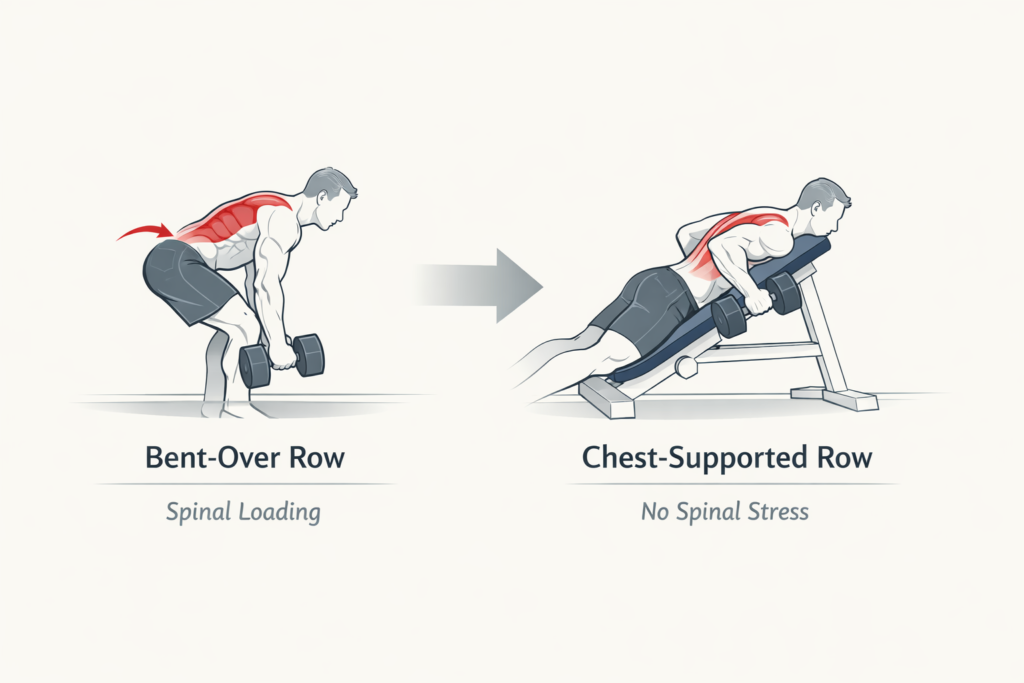
First, I replaced the bent-over row with a chest-supported row.
A chest-supported row is a row where your chest rests on an incline bench (a bench with a back support angled up), and you row dumbbells or a machine handle.
This setup removes most of the hinge demand, because the bench supports your torso.
When I did this, my lower back discomfort basically disappeared immediately.
That told me something important.
My upper back was fine doing rows.
The hinge and trunk stability were the weak link under load.
This test is powerful because it doesn’t rely on “feeling” or guessing.
It’s a simple swap that changes one big variable: spinal loading.
2# I Kept Bent-Over Rows, But Reduced the Range Where the Weight Was Farthest Away
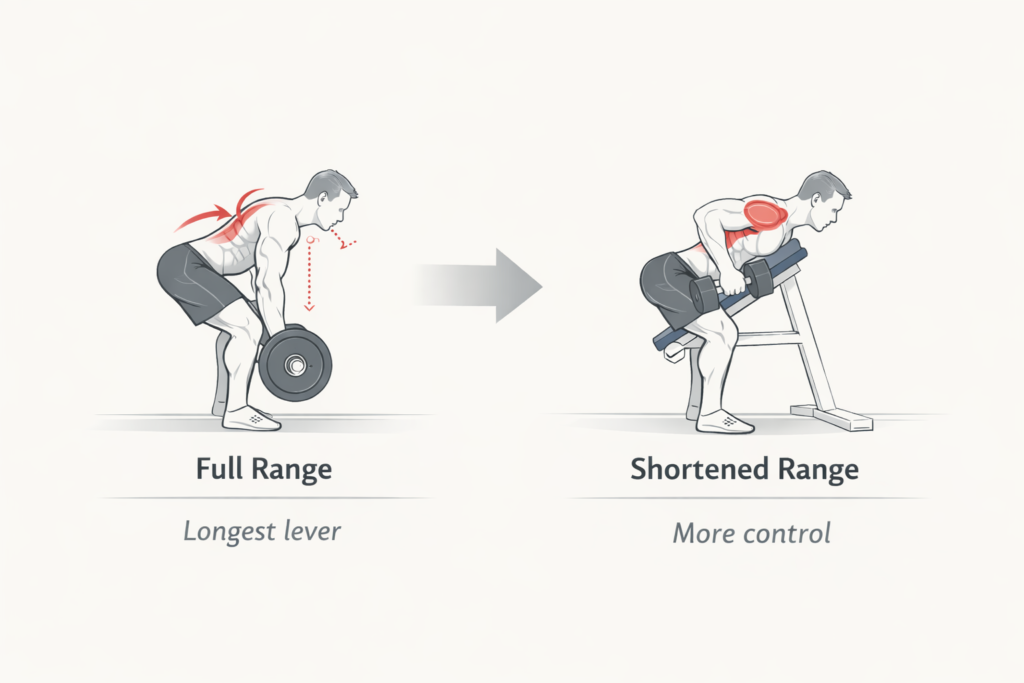
Next, I did the same rows but used a different start position.
Instead of letting the bar hang fully at the bottom with relaxed shoulders, I stayed a little more “packed.”
Packed means the shoulders are set slightly back and down, not shrugged or hanging.
I also stopped the descent just a bit earlier, without losing control.
Discomfort decreased.
That pointed toward leverage and bottom-position strain being a major trigger.
It wasn’t that the exercise was inherently “bad.”
It was that the longest lever position was asking too much from my current bracing and hinge stamina.
3# I Changed My Torso Angle on Purpose (And Watched What My Lower Back Said)
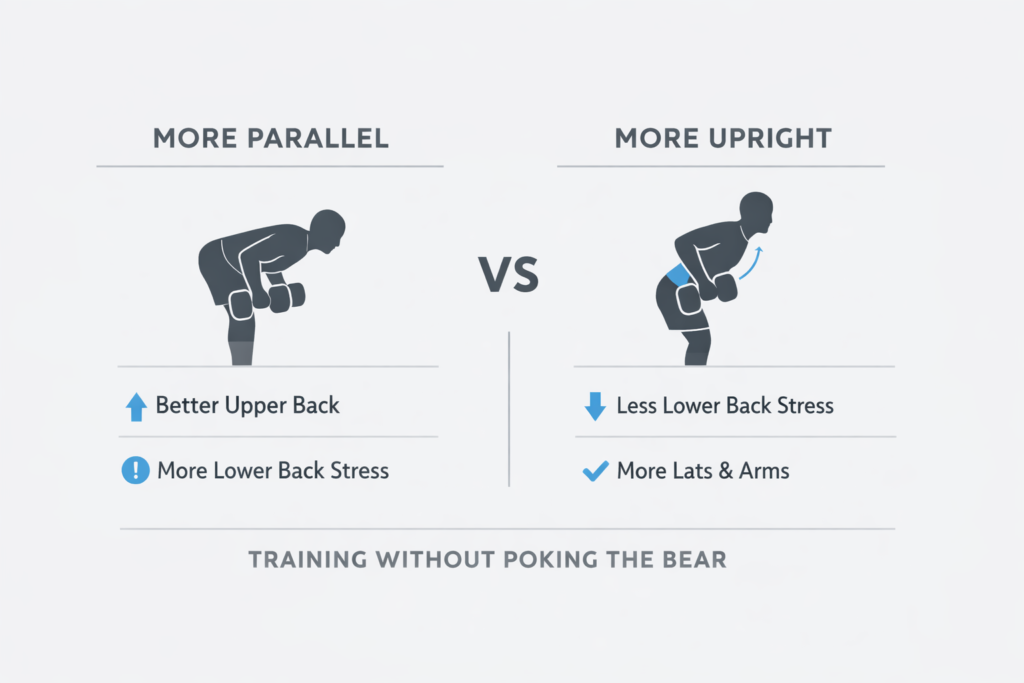
I tried two torso angles.
One was very bent over, close to parallel with the floor.
The other was more upright, around a 30–45 degree lean.
Here’s what happened.
More parallel gave me better upper-back “feel,” but it also made my lower back light up sooner.
More upright reduced lower-back stress, but it shifted the row slightly toward lats and arms.
That was a tradeoff I was happy to make temporarily, because the goal wasn’t to impress anyone with how horizontal I could be.
The goal was to train consistently without poking the bear.
4# I Slowed the Reps Down and Removed Momentum
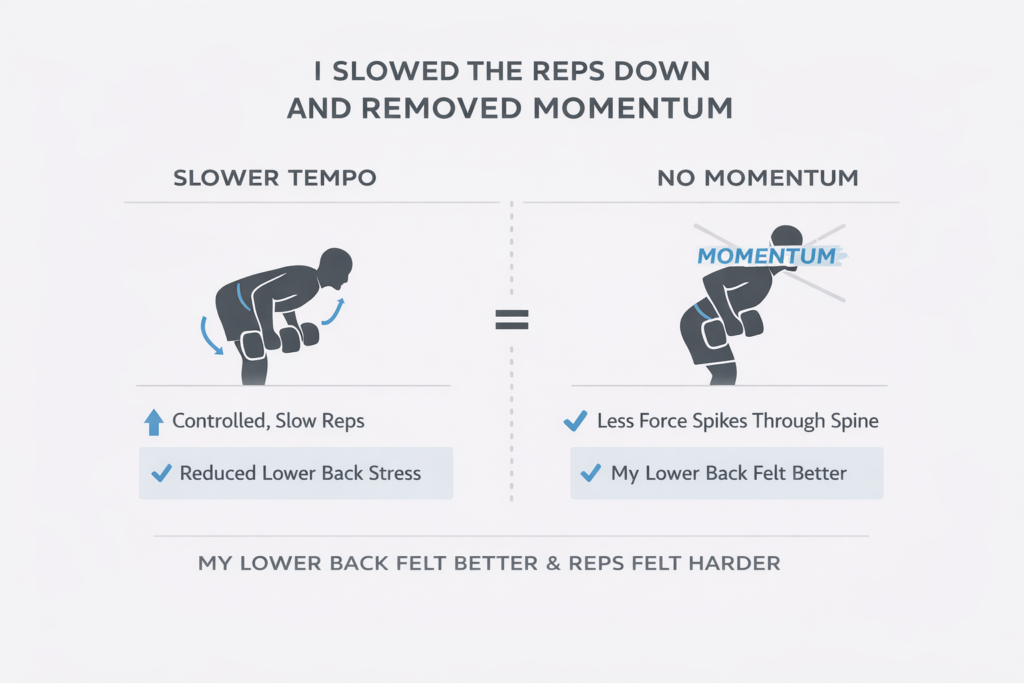
This was the most humbling test.
I reduced weight and rowed with a slower tempo.
Tempo just means the speed of the rep, especially the lowering phase.
I made the lowering controlled, like I was lowering a fragile package, not dropping a sack of potatoes.
The lower back discomfort reduced again, even with a similar total effort.
That told me I was probably using small amounts of momentum before.
Not dramatic swinging.
Just enough to create tiny force spikes through the hinge position.
Spines tend to dislike surprise spikes.
They prefer boring, predictable forces.
Yes, this makes training less exciting.
But so does being annoyed all week because you “rowed like an action hero.”
5# I Changed the Implement: Dumbbells vs Barbell vs Cable
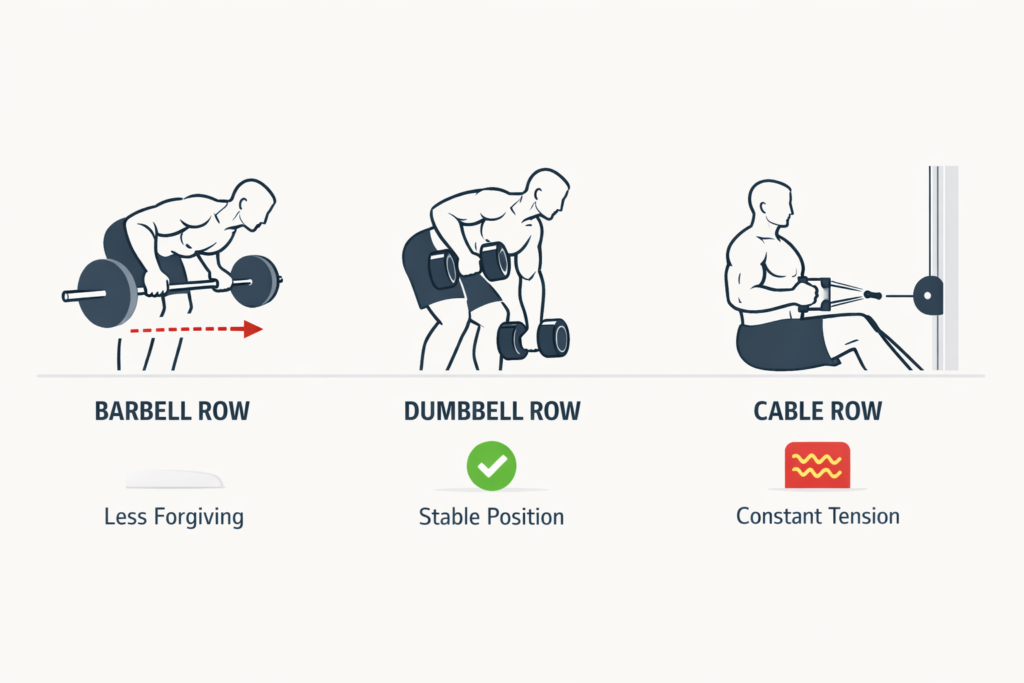
A barbell row fixes your hands in one position and keeps the load in a straight vertical line.
Dumbbell rows allow your hands to rotate slightly, and you can tuck the weights closer to your body.
Cable rows create more constant tension but can also allow a more upright torso depending on setup.
When I used dumbbells with a slightly more upright hinge, my lower back felt better.
The ability to keep the weights close and adjust my arm path made the position more stable.
When I used a barbell heavy, the bottom position felt harsher, because the bar wanted to drift forward if my lats didn’t keep it close.
This doesn’t mean barbells are bad.
It just means they are less forgiving when your bracing and lat control are not locked in yet.
What Helped the Most: The “Tripod Row” Setup I Ended Up Using
After those tests, I kept rows in my training, but I earned them back with a setup that reduced lower-back irritation.
Here’s the version that worked best for me.
Feet about hip-width apart, toes slightly turned out if needed for comfort.
Soft knees, not locked.
Hips pushed back like closing a car door with your butt while holding groceries.
Torso leaned forward to a position I could hold without shaking.
Core braced like I’m preparing for a cough, not like I’m doing a bodybuilding pose.
Then I rowed by driving elbows back and pulling the weight toward the lower ribs or upper waist area, depending on the tool.
The key was keeping the weight close to my body the whole time, like sliding it along an invisible track.
If the weight drifts forward, my lower back instantly notices and files a complaint.
How to Tell If Your Lower Back Is Just Getting Stronger vs Getting Irritated
This distinction matters because you don’t want to quit an exercise just because you feel muscles working.
At the same time, you don’t want to “tough it out” through irritation.
Here’s what I used as a practical filter.
If the sensation felt like symmetrical muscular fatigue and faded quickly after sets, I treated it like training.
If the sensation felt sharp, localized, or got worse across sets even when I reduced weight and cleaned up the rep, I treated it like irritation.
Also, if the discomfort changed how I moved later that day, like bending over to pick something up felt sketchy, I backed off.
A good row session should not make you scared of tying your shoes.
That’s a very low bar for success, but it’s a helpful one.
Row Variations That Usually Feel Friendlier on the Lower Back (Without “Giving Up” on Back Training)
If bent-over rows consistently irritate your lower back, it doesn’t mean you can’t train your back.
It means you need a version that matches your current trunk capacity.
Chest-supported rows are the obvious one, because the bench supports your torso.
One-arm dumbbell rows with a hand on a bench also reduce spinal demand, because you have external support and can brace better.
Seated cable rows let you stay more upright and can be easier to control, especially if you focus on steady reps and not leaning back like you’re starting a lawnmower.
Machines can also be useful, not because machines are magical, but because they often reduce the hinge requirement and let you build rowing strength without your lower back being the limiting factor.
That’s not cheating.
That’s smart training.
Your ego can still come to the gym, but it doesn’t need a membership.
When It’s Not the Row: The Problem Starts Before You Even Touch the Bar
Sometimes the row is just the exercise where your lower back finally speaks up, but the real issue started earlier.
If I did heavy deadlifts or heavy squats close to rows, my lower back tolerance was lower.
That makes sense because those lifts also load the spinal erectors and require bracing.
Sleep and general fatigue mattered too.
When I was run down, my bracing was sloppier, and sloppier bracing made rows feel worse.
Warm-up quality also changed everything.
If I rushed and jumped into rows cold, the hinge felt stiff and my back complained sooner.
When I warmed up with a few hinge drills and lighter sets, rows felt smoother and more stable.
Not because warm-ups are magical rituals.
Because your nervous system and muscles were actually ready to coordinate.
When It’s No Longer Just a Technique Issue
A few signs are worth repeating clearly, because being realistic is part of being smart.
Pain that travels down the leg.
Numbness, tingling, or weakness.
Pain that worsens over time despite reducing load and improving control.
Pain that is sharp with bending, coughing, or sneezing.
Any loss of bladder or bowel control is an emergency, not a “form cue” situation.
If any of those show up, the right move is to get evaluated by a qualified healthcare professional.
That’s not being dramatic.
That’s protecting your future training.
RELATED:>>> Barbell Rows vs Dumbbell Row
Conclusion
Bent-over rows aren’t automatically “bad for the lower back.”
They’re just honest.
They expose whether your hinge position, bracing, and leverage control are ready for the load you’re using.
When I stopped treating the row like a pure upper-back exercise and started respecting the fact that it’s also a trunk stability challenge, the discomfort stopped being mysterious.
It became measurable.
And once it’s measurable, it’s fixable.
Keep the goal simple.
Train the back, build the hinge, and pick the row variation that lets you progress without starting a drama series in your lumbar spine.
You can use these cues to compare your own setup—barbell or dumbbells, torso angle, rep control, and where the discomfort shows up—and see which adjustment makes the biggest difference.