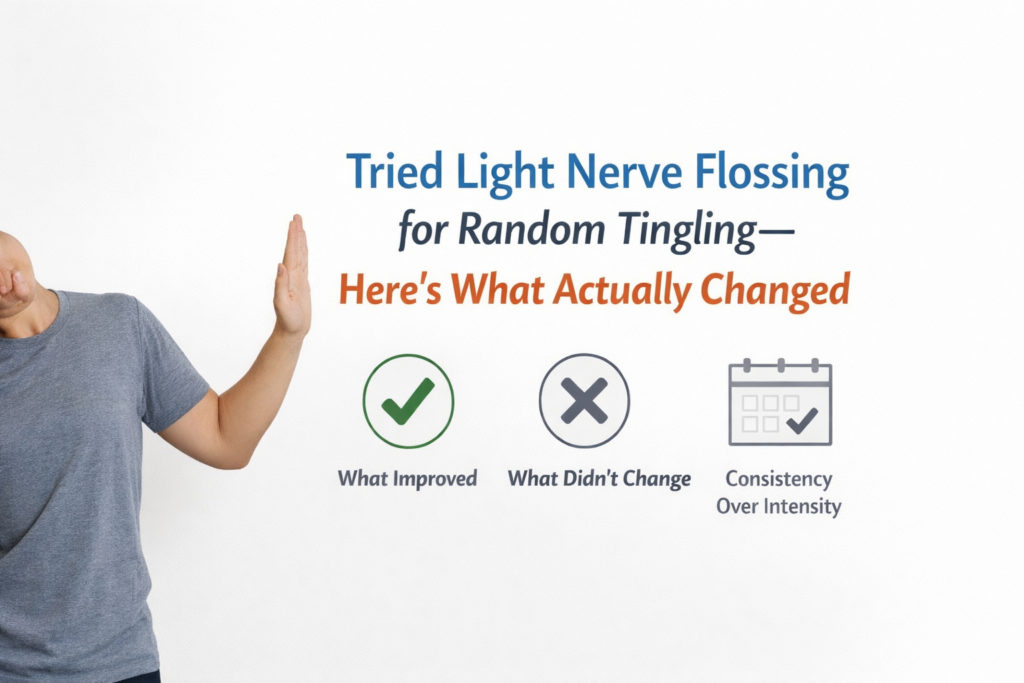
Random tingling is one of those symptoms that feels both “probably nothing” and “what if it’s everything” at the same time.
In my case it wasn’t dramatic pain.
It was that annoying, unpredictable electric-lite buzzing that would show up in an arm/hand (and sometimes feel like it had a mind of its own), then disappear before I could even explain it properly to myself.
So I did what any reasonable person does in 2026: I tried to be systematic, I tested things, and I tried a gentle nerve flossing routine without turning it into a weird spiritual identity.
This is my real experience, with the exact checks I used, what changed, what didn’t, and what I’d do differently if I could rewind.
And yes, I’ll explain everything like the reader has never heard the words “nerve flossing” in their life, because honestly… most people haven’t.
| A Personal Look at Light Nerve Flossing (Not Medical Advice) |
|---|
| This is not medical advice. I’m not a physical therapist, not a clinician, and not someone who treats nerve issues for a living. What follows is simply what I did, how I approached it, and what seemed to work for me while closely monitoring how my body reacted. Consider this a cautious personal experiment, not a protocol to follow. |
| Setup & baseline |
| Start with a baseline first. Pick two repeatable checks: a position trigger test and a sensation map. Without that, progress cannot be evaluated. |
| Movement guidelines |
| Keep range extremely mild. Aim for gentle tension, not stretch. If symptoms appear strongly, reduce range until they are minimal or absent. No end-range holds. No aggressive stretching. |
| Volume & frequency |
| Use small sets. 5–10 slow repetitions. One or two times per day. |
| Reassessment |
| Reassess after a few days, not after one session. Nerves can be sensitive. One good or bad session does not define a trend. Patterns matter. |
| When to stop and seek help |
| Stop and get checked if red flags appear. Worsening numbness, spreading symptoms, real weakness, dropping objects, severe pain, progressive changes, or symptoms that do not respond to position changes require professional evaluation. |
First, What “Random Tingling” Felt Like (And Why It Was Hard to Track)

For me, tingling wasn’t constant.
It showed up in short bursts, usually at rest, often when I’d been sitting a while or scrolling on my phone with my elbow bent like a shrimp.
Sometimes it felt like pins and needles in a couple of fingers, sometimes like a faint electrical shimmer in the forearm.
The worst part wasn’t the intensity.
The worst part was the randomness, because randomness makes your brain start writing horror movies with zero evidence.
Also, tingling is annoyingly vague.
The same “buzz” could be a nerve getting irritated, a position issue, a tight muscle compressing something, or even just your body being dramatic after a long day.
So before I touched nerve flossing, I needed a baseline and a way to measure change that wasn’t just “vibes.”
How I Made Sure Improvements Were Real, Not Imagined
What I learned very quickly is that sensations are great at telling stories, but terrible at keeping receipts.
A good day can make everything feel better.
A stressful day can make the same body feel broken.
So instead of asking myself “Do I feel better?”, I started asking a more boring but useful question: “Does this show up the same way every time?”
I paid attention to patterns, not moments.
If a position triggered tingling before, I wanted to see whether it still did under the same conditions.
Not once.
Not when I was well-rested and optimistic.
But repeatedly, across normal days.
I also stopped relying on how things felt in the moment.
Immediate relief is seductive, but it doesn’t always mean much.
What mattered more was what happened later:
- After sitting,
- After using my phone,
- After a long work block,
- After waking up the next morning.
Those delayed reactions told me far more than any short-lived “this feels nice” response.
I treated memory with suspicion.
Not because it’s useless, but because it edits reality for dramatic effect.
If something truly changed, it had to show up again without me looking for it.
That mindset shift alone filtered out a lot of noise and made the improvements—when they happened—feel far more believable.
What Nerve Flossing Actually Is (In Normal Human Language)
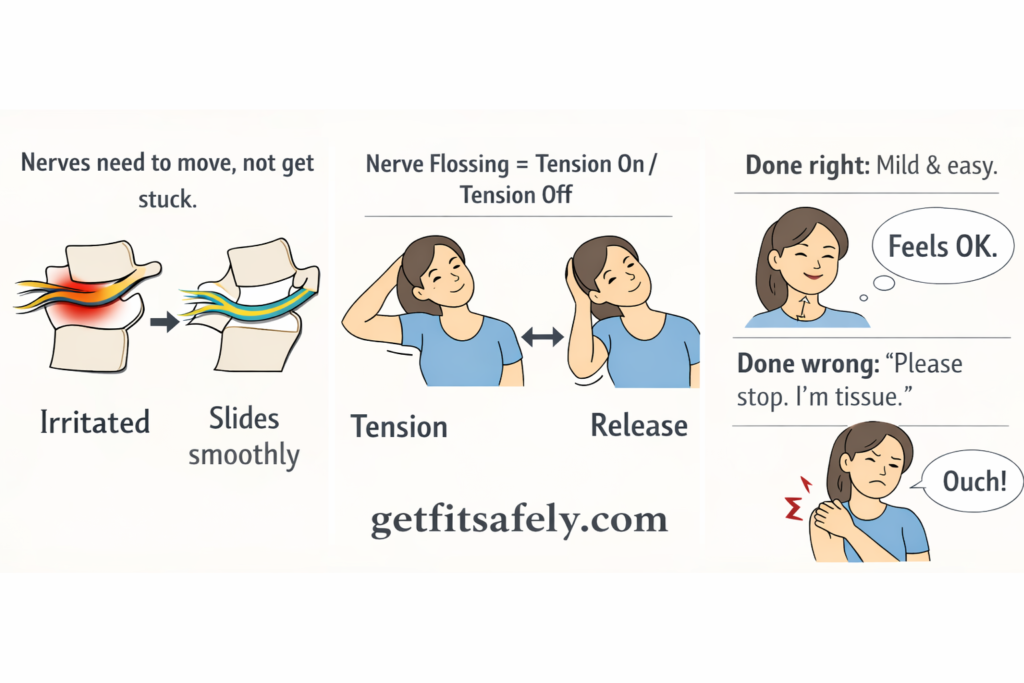
Nerves are not rigid wires.
They’re living tissue that needs to slide and move as your joints move, kind of like how a cable inside a sleeve needs to glide when the sleeve bends.
When a nerve is irritated, compressed, or just unhappy about the environment (tight tissues, swelling, sustained positions), its ability to “glide” can feel worse.
That can show up as tingling, numbness, burning, or weird sensations that don’t behave like muscle soreness.
Nerve flossing (also called nerve gliding) is a very gentle movement pattern that puts the nerve on a little stretch in one area while releasing it in another area.
So instead of yanking it like a bungee cord, you’re guiding it through a small range, trying to encourage normal sliding and reduce sensitivity.
If stretching is “pull and hold,” flossing is more like “tension on / tension off,” in a controlled rhythm.
Done right, it should feel mild and almost boring.
Done wrong, it can feel spicy in a way that screams, “Please stop, I am tissue.”
Why Some Symptoms Shouldn’t Be Self-Tested
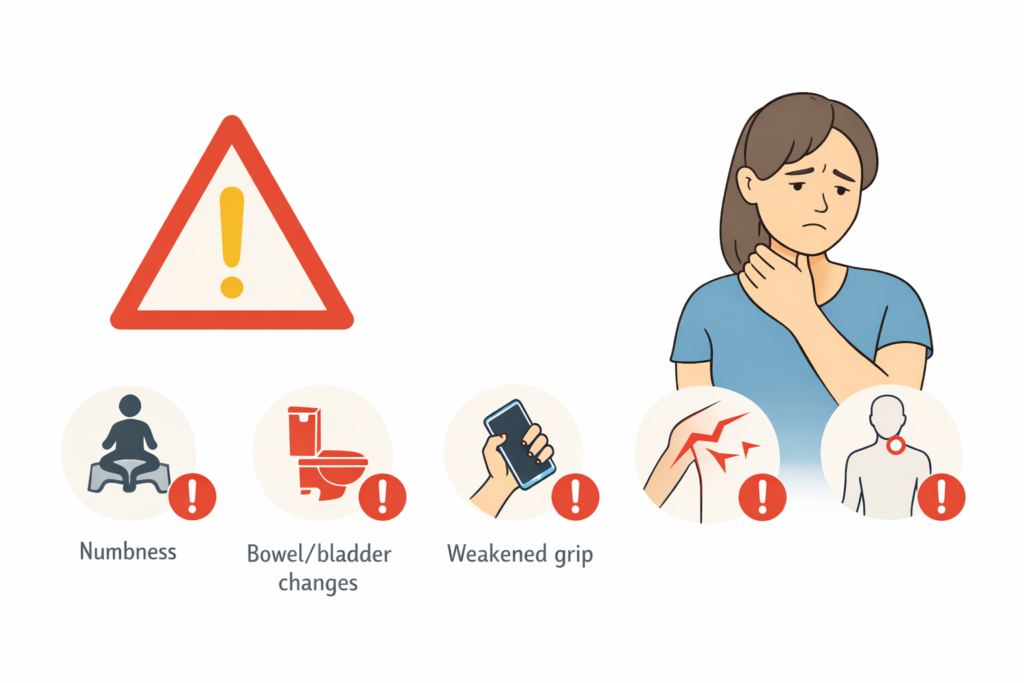
Tingling can be benign, but it can also be a sign of something that needs a professional.
So I used a simple rule: if symptoms were getting worse, spreading, becoming constant, or coming with real weakness, clumsiness, severe pain, or loss of function… I wasn’t going to “floss harder.”
Also, if there’s tingling plus major neck pain after trauma, bowel/bladder changes, numbness in a saddle area, or anything that feels urgent and scary, that’s not a blog–experiment situation.
That’s a “get checked” situation.
My case was mild, intermittent, and position-linked enough that a cautious self-test approach felt reasonable.
What I Checked Before Touching Any Technique
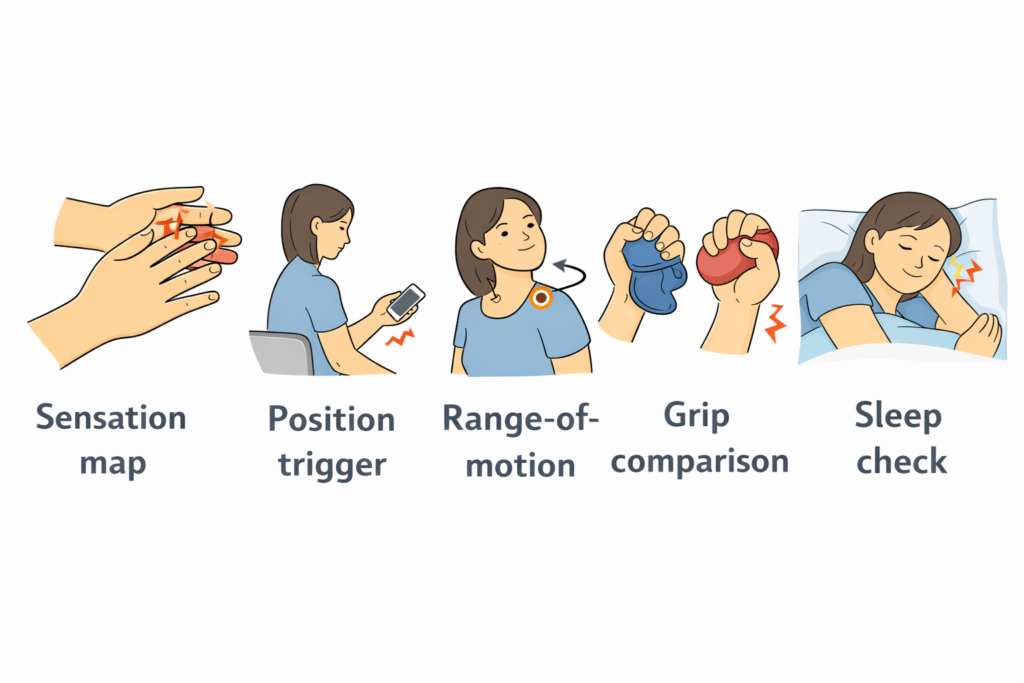
I didn’t rely on tools or measurements.
I relied on situations that already existed in my day.
Here are the exact checks I repeated, because without them I would’ve had no clue whether anything changed or I just got distracted by life.
1) Sensation map (simple but surprisingly useful).
I lightly brushed the pads of each finger and the palm with my other hand and noted if anything felt “different” side to side.
Not numb vs normal, but even “this one feels slightly duller” or “this one is more tingly.”
I also noted which fingers were involved because different nerve pathways often show up in different zones.
2) Position trigger check.
I held a couple of common “problem postures” for 60–90 seconds and watched what happened.
Things like elbow bent while holding the phone, shoulders rounded while sitting, wrist extended while typing, or neck forward while staring at a screen.
If tingling appeared, I noted the time it took to show up and how intense it felt.
3) Range-of-motion comfort check.
I did slow neck turns, shoulder circles, gentle wrist flexion/extension, and noted if any motion consistently “lit up” that electric feeling.
Not pain, just nerve-ish sensation changes.
4) Grip comparison (low-tech edition).
I squeezed a rolled towel or stress ball with each hand and noted if one side fatigued faster or felt clumsier.
This wasn’t a max strength test.
It was just “does this side feel normal and confident.”
5) Sleep and morning check.
I wrote down if I woke up with tingling and whether it disappeared quickly after moving around.
Because sleep positions can absolutely mess with nerves, and that’s an easy variable to overlook.
That was my dashboard.
Not perfect, but repeatable enough to detect patterns.
What I Suspected Was Going On (Without Pretending I’m a Diagnostician)
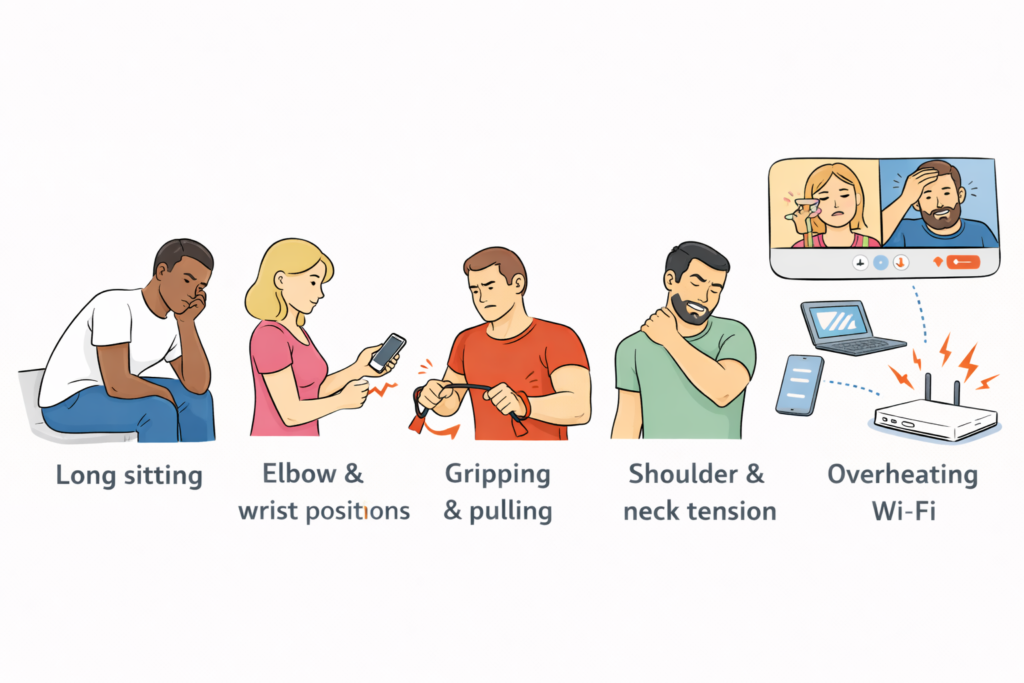
I didn’t assume a single cause.
I assumed a “stack.”
Long sitting.
A lot of elbow flexion and wrist positions (phone, keyboard, mouse).
Training that involved gripping and pulling.
And probably a bit of shoulder/neck tension that made the whole upper chain less forgiving.
That stack can create a scenario where a nerve becomes more sensitive, even if nothing is “damaged.”
Think of it like your Wi-Fi router.
Sometimes the router isn’t broken.
It’s just overheated, surrounded by interference, and one more device connects and suddenly your video call turns into a slideshow.
Your nervous system can behave similarly when it’s irritated.
Not broken.
Just less tolerant.
Why I Chose a Very Gentle Nerve Flossing Strategy
I deliberately chose “light” flossing because nerves don’t respond well to aggression.
Muscles sometimes tolerate “stretch harder.”
Nerves often respond to “stretch harder” with “tingle harder.”
So my rule was: mild sensation is okay, sharp or increasing symptoms are not.
And I treated the movement like brushing your teeth.
Gentle, consistent, not a powerlifting event.
Also, I limited volume.
I didn’t do 15 different flosses for every nerve in the body like I was collecting Pokémon.
I focused on the pattern that seemed most relevant to my symptoms and position triggers.
The Main Floss I Used (Step-by-Step, No Assumptions)
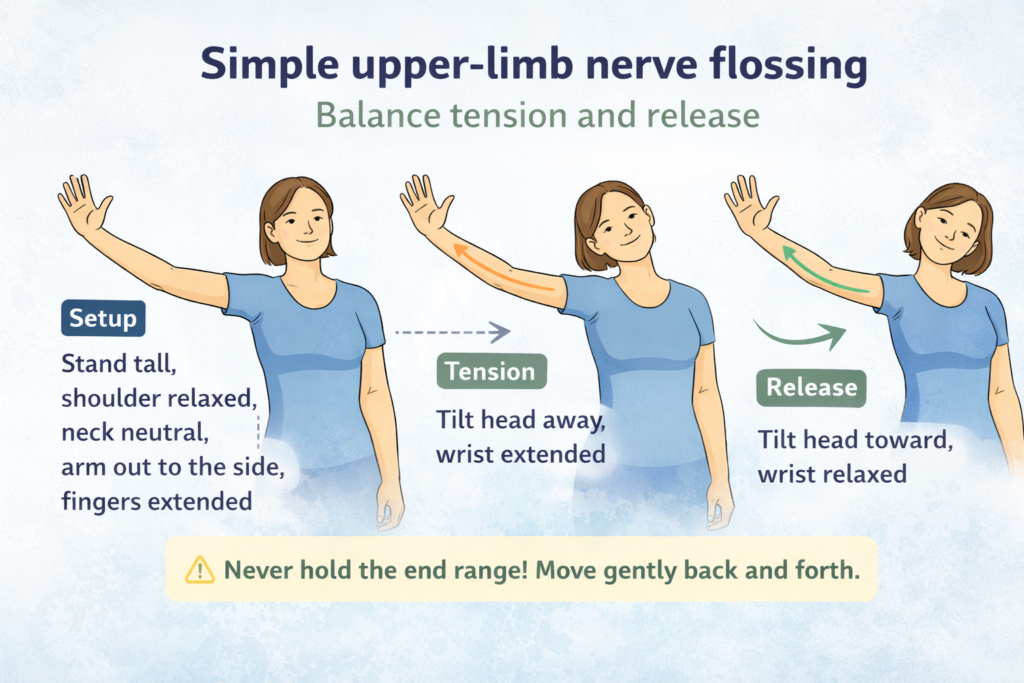
Because my tingling was mostly in the arm/hand zone, I used a very common upper-limb nerve glide pattern.
There are different versions depending on whether you’re targeting the median nerve, ulnar nerve, or radial nerve, but I didn’t try to “diagnose” which one with certainty.
Instead, I used the version that reproduced a mild familiar sensation without pain and that improved when I eased off.
Here’s the basic structure I used, explained as a movement concept:
Setup: stand tall or sit upright.
Shoulders relaxed, not shrugged.
Neck neutral, like you’re balancing a book on your head without trying too hard.
Action concept: you move two ends of the system in opposite directions.
One end increases tension while the other decreases it, then you swap.
So the nerve gets a glide rather than a sustained stretch.
The version I used most often looked like this:
- Arm out to the side at a comfortable angle (not forced).
- Wrist and fingers gently extended (like a “stop” sign) only as far as mild tension appears.
- Then I tilted my head slightly away or toward depending on which direction reduced symptoms.
- I moved slowly back and forth: wrist extension slightly more while head tilt reduced tension, then wrist relaxed slightly while head tilt increased tension.
The key detail: I never held the end range.
I treated it like a smooth pendulum.
If I felt a sharp zing, I reduced range immediately.
If symptoms increased after the set and stayed elevated, that was a “too much” signal.
This is one of those cases where “less impressive” is usually more effective.
How I Organized the Whole Process in Practice
I broke my experience down into phases based on what changed and what I noticed along the way.
That ended up mattering more than the calendar anyway.
Phase One: The “Can I Do This Without Making It Worse?” Stage
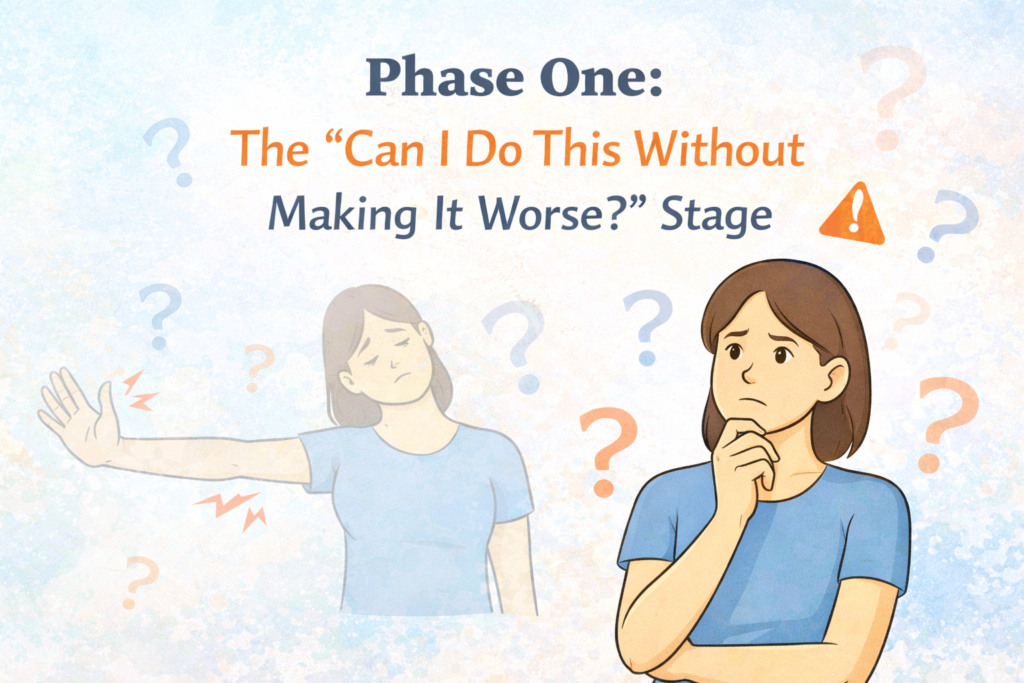
In the beginning, the goal was not improvement.
The goal was stability.
I did very small sets, like 5–8 slow reps, once or twice a day.
I chose times when symptoms were calm, not when I was already flared up and anxious.
I also retested my position triggers afterward.
Not immediately like a maniac, but later that day to see if my tolerance changed.
What I noticed early was subtle: a slight reduction in that “instant buzz” when I held my elbow bent for a long time.
Not gone.
Just delayed.
That “delayed onset” was my first sign that something was shifting.
And honestly, even that small delay felt like winning a tiny war.
Phase Two: The “Okay, Now It’s a Habit” Stage
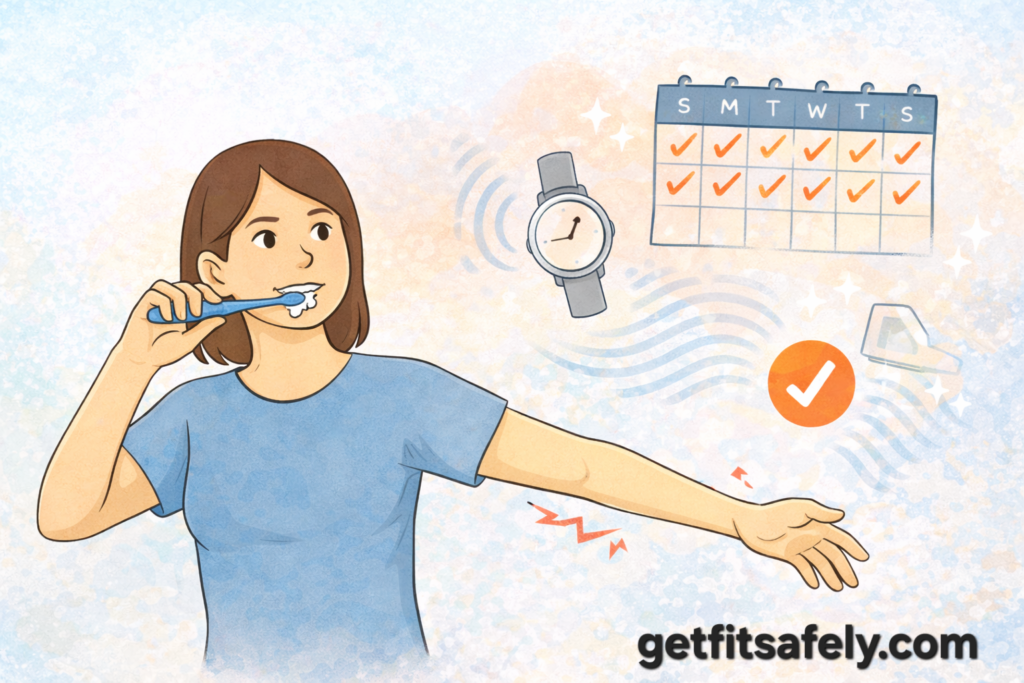
Once I saw that I wasn’t worsening symptoms, I kept the routine boring and consistent.
Same floss, same gentle range, same low volume.
I did it like brushing teeth: not because it felt magical, but because repetition can change tissue tolerance over time.
During this stage, the biggest change wasn’t that tingling disappeared.
The biggest change was that tingling became more predictable.
It showed up mostly when I sat too long or when my wrist/hand position got awkward.
And it resolved faster when I corrected the position.
That’s important because “random tingling” is scary.
“Predictable tingling” is manageable.
Predictable means you have levers you can pull.
Phase Three: The “Add Context, Not More Intensity” Stage
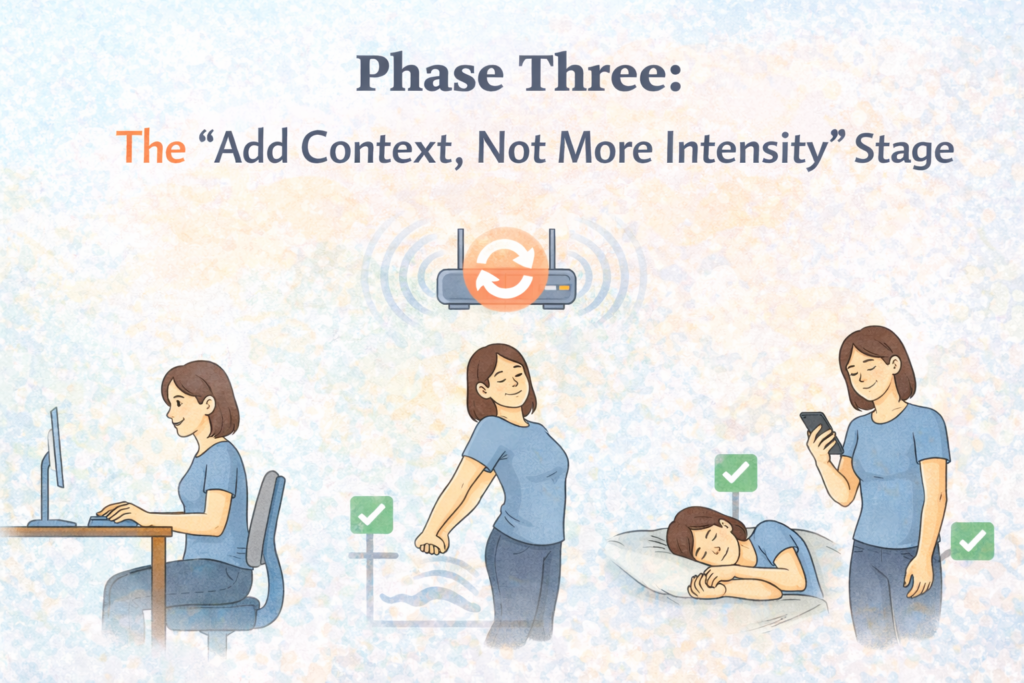
At this point I realized something slightly annoying.
Flossing wasn’t a superhero.
It was more like tech support.
Helpful, but it still wants you to restart the router and stop doing the thing that keeps breaking the connection.
So instead of adding more flossing, I added context changes that didn’t wreck my experiment.
I tweaked my desk posture slightly.
I took short movement breaks.
I reduced sustained elbow flexion during phone use.
And I paid attention to sleep position, especially whether my arm was tucked under my head like I was trying to become a human croissant.
This is the phase where improvement became more obvious.
Not dramatic, but real.
Less frequent tingling episodes.
Shorter duration when they happened.
And a noticeably calmer baseline in the morning.
What Truly Changed Once I Looked at the Details
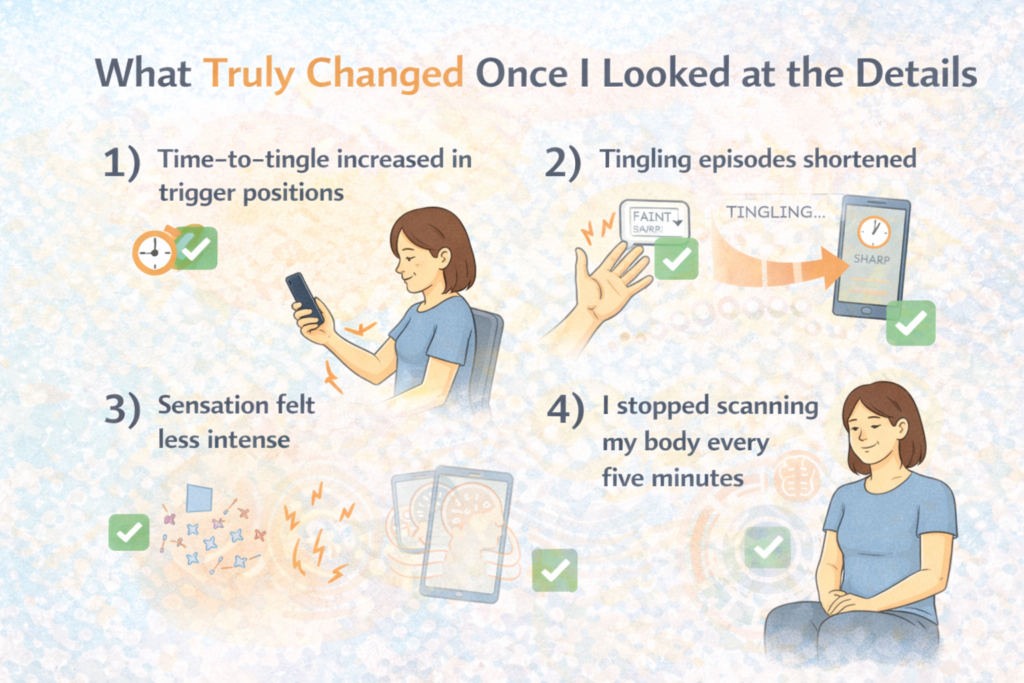
Here’s what improved in a way I could honestly defend.
1) Time-to-tingle increased in trigger positions.
When I did the elbow-bent phone posture test, tingling took longer to appear.
Sometimes it didn’t appear at all unless I really pushed the position.
2) Tingling episodes shortened.
When tingling did show up, it didn’t “stick” as long.
It was more like a notification that popped up and then cleared, not an app that froze my whole system.
3) The sensation felt less intense.
This one is hard to quantify, but it felt more like faint pins and needles instead of that sharper electrical edge.
4) I stopped scanning my body every five minutes.
This matters because constant monitoring makes symptoms feel louder.
Once I had a routine and data, I felt less helpless, and the symptom became less “center stage.”
That psychological shift is not fake.
Your nervous system absolutely reacts to stress, attention, and threat perception.
And yes, that’s annoying, because the brain loves being involved in everything.
The Limits I Ran Into (And Why They Matter)
Flossing didn’t make me feel instantly cured.
It didn’t erase tingling in 48 hours.
And it didn’t let me ignore the positions and habits that were clearly aggravating things.
Also, flossing did not replace strength work or movement quality.
If training or daily posture was part of the irritation stack, flossing was only one tool.
A helpful tool.
Not the entire toolbox.
If someone is looking for a single magical drill, nerves are not impressed by your optimism.
How Nerve Flossing Fit Into the Bigger Picture
The best part of this experiment wasn’t just symptom reduction.
It was learning what my body tolerated and what it didn’t.
Flossing gave me a way to nudge sensitivity down, but the real progress came when I also cleaned up the “irritation stack.”
Less sustained elbow flexion.
More micro-movement breaks.
More neutral wrist positions during work.
Less sleeping in positions that trap the arm.
It wasn’t glamorous.
But it was realistic.
And realistic is usually what actually works long-term.
RELATED:》》》 Does Deloading Every 4 Weeks Actually Protect Your Joints?
Final Take: What Actually Changed for Me (And Why I’d Do It Again)
Light nerve flossing didn’t feel dramatic.
It felt like maintenance.
It made tingling less frequent, less intense, and less sticky.
It made my triggers easier to control.
And it gave me a structured way to stop spiraling and start observing.
If someone is dealing with mild, position-linked tingling, I think gentle flossing can be a smart experiment.
Not as a cure-all.
As a low-risk tool to restore tolerance, especially when combined with better movement habits.
And if nothing changes after consistent, gentle attempts, that’s also valuable data.
Because then it’s time to stop guessing and get someone qualified to look at the full picture.
That’s not failure.
That’s just upgrading from “DIY troubleshooting” to “actual diagnostics,” which is exactly what a sane person does when the router keeps acting up.