A shoulder tweak shows up out of nowhere, usually during a perfectly normal lift, and suddenly even reaching for a water bottle feels like navigating a minefield.
That’s when most people hit Google.
And Google responds with a full-blown parade of medical authority:
Mayo Clinic, Cleveland Clinic, Verywell Health, pages full of anatomical diagrams that look like blueprints for a spaceship.
All you wanted was to know if a basic resistance band on a door could actually help.
Not a graduate-level lecture.
Yet in the middle of all that expert-level content, something interesting keeps showing up over and over:
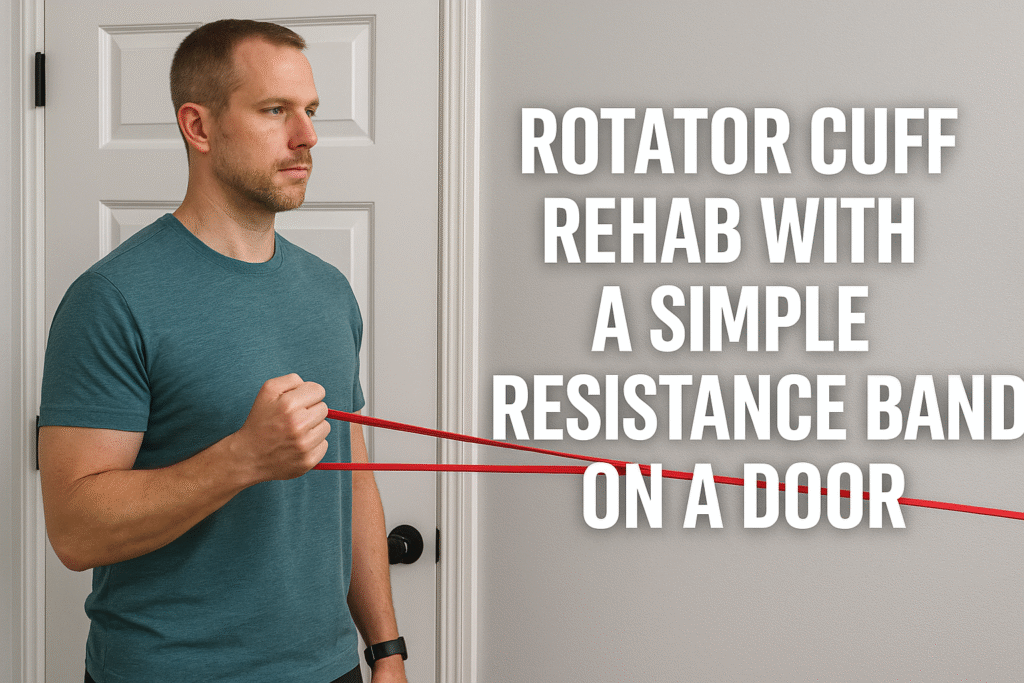
that tiny, unassuming resistance band anchored to a door.
Band-on-door rotator cuff work sounds too simple… until you try it
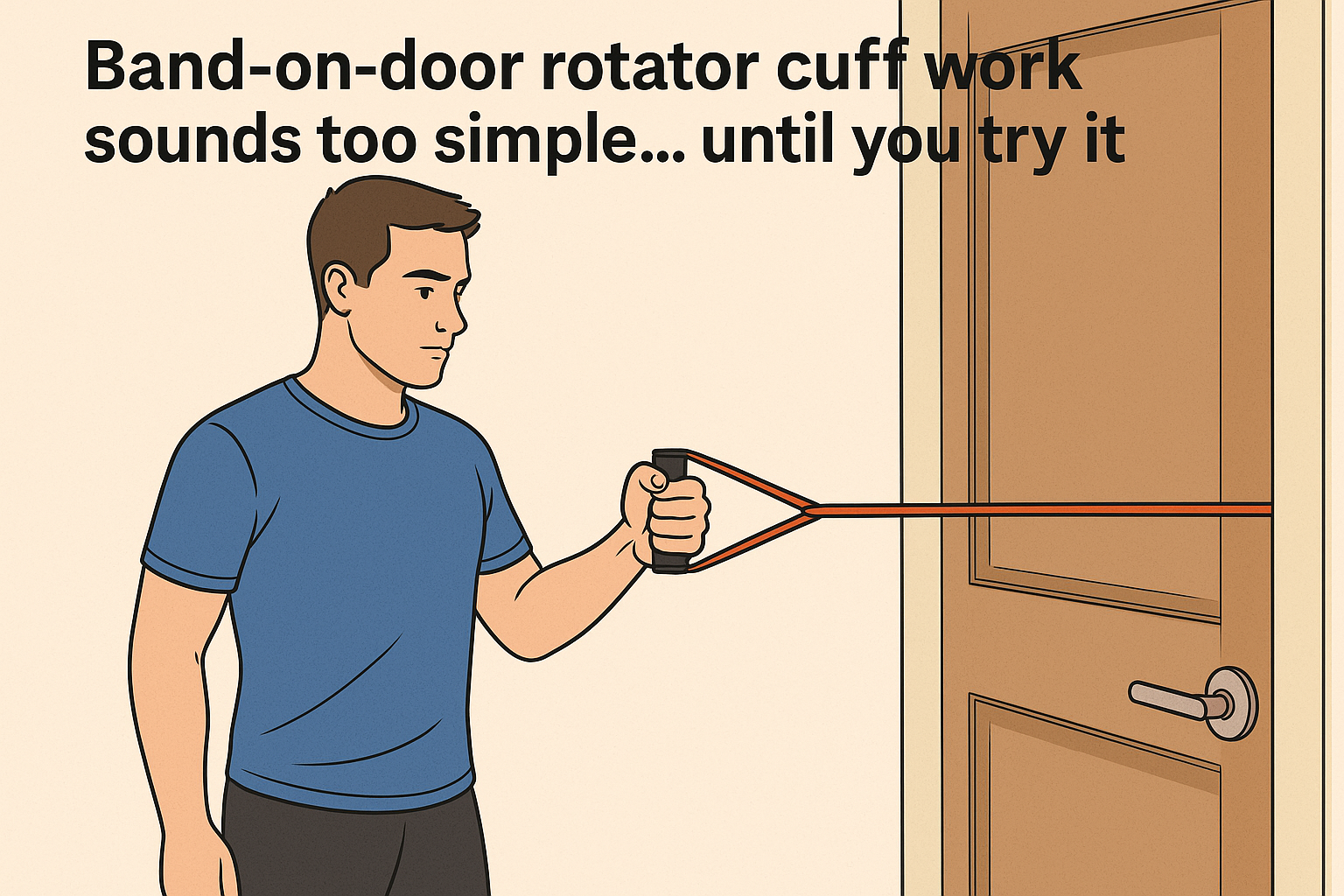
Once I dug a little deeper, I realized something funny.
The more complicated the shoulder problem looks on paper, the more useful the simplest tool becomes.
Rotator cuff stabilizers crave low-load, high-control movement, not ego lifts with bad form and false confidence.
And bands — especially when fixed to a door — deliver exactly that.
Predictable tension.
Clean angles.
Movements that don’t ask your shoulder to be brave… just coordinated.
I remember thinking, “Okay, fine, let’s see if this rubber noodle can actually do something.”
The surprise came fast.
My real turning point with band-based external rotations
The first session felt like learning a foreign language with my shoulder.
Everything was tiny and deliberate.
The band pulled one way, my arm resisted the other, and every micro-movement felt like it was smoothing out a messy wiring problem inside the joint.
I wasn’t pressing.
I wasn’t pulling.
I was retraining.
And the oddest part was how quickly things felt different — not stronger in a heroic way, but calmer, more predictable.
It reminded me of fixing the alignment on a door hinge.
Nothing dramatic happens, but suddenly it stops squeaking and opens like it was supposed to all along.
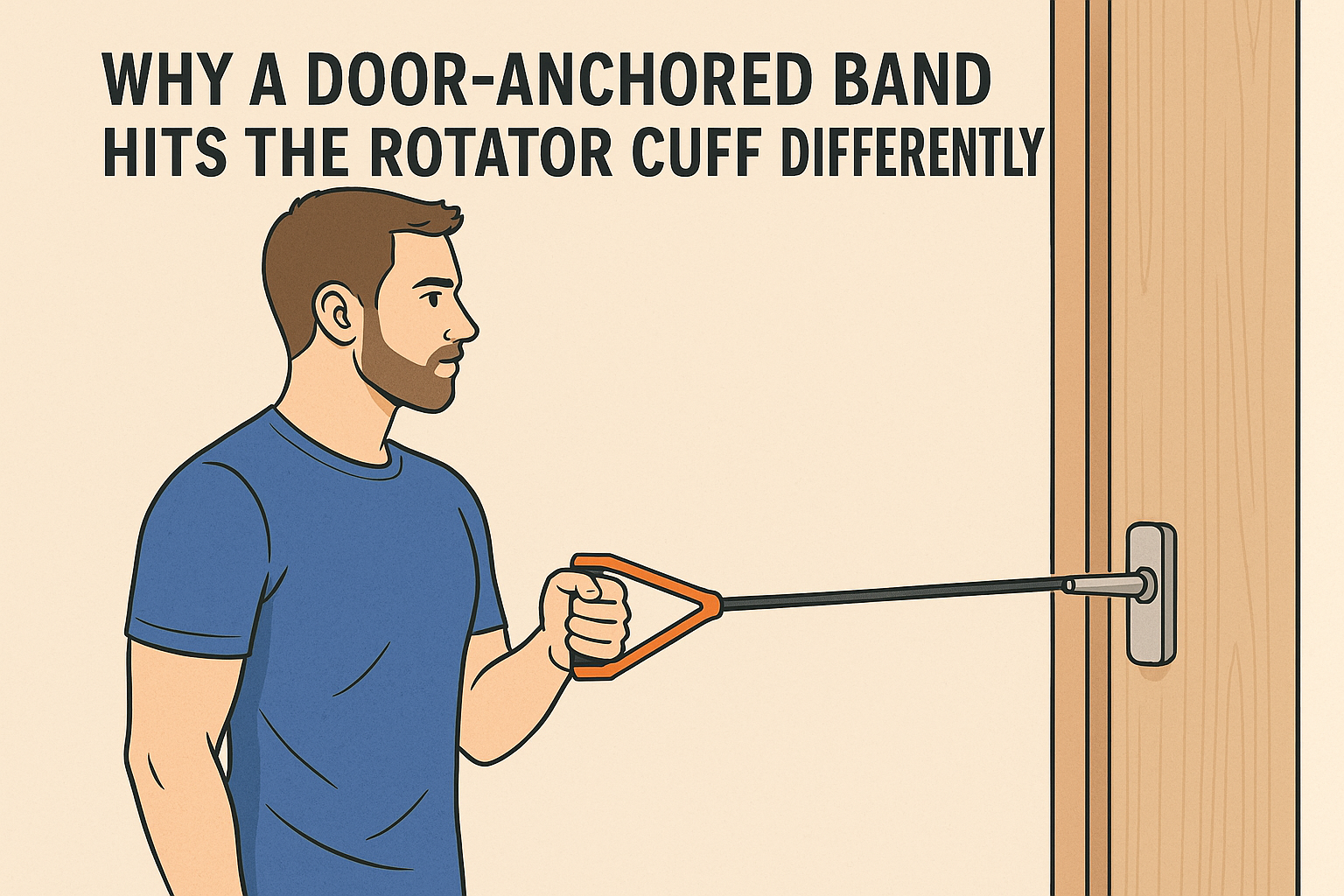
Why a door-anchored band hits the rotator cuff differently
The rotator cuff has a simple job:
keep the humeral head centered in the glenoid while everything else moves around it.
But when that system gets even slightly off, every lift becomes a negotiation.
Bands work because they create tension that your shoulder can manage without panicking.
No momentum.
No cheating.
No “oops, that was too heavy.”
Just pure control.
When you anchor the band to a door, you also gain structure:
- The height is consistent
- The range is contained
- The force curve is smooth
- Your torso can’t randomly twist to compensate
It makes the whole thing feel almost… civilized.
Like you’re finally giving your shoulder the environment it’s been begging for.
The go-to band-on-door movements that actually make a difference
These aren’t glamorous.
Nobody posts them on Instagram with inspirational captions.
But they work.
- External rotations at elbow height
Elbow against your side, forearm rotates outward slowly without twisting the torso. - Internal rotations using the same setup
Same position, but rotate the forearm inward toward your stomach, small range, slow control. - Low-angle isometric holds for 10–20 seconds
Pull the band just enough to feel light tension and hold the position without moving. - Scaption raises with slight band tension
Lift your arm 30–45° forward and sideways (in the “V” line), keeping the thumb up and motion smooth. - Face-pull style band pulls with strict form
Pull the band toward your face with elbows high, squeezing the upper back without shrugging.
None of these require heavy load.
In fact, going heavy is the fastest way to make your shoulder hate you again.
Funny thing?
The lighter the band I used, the better my shoulder responded.
Where shoulder band routines tend to fall apart
After talking with other lifters and messing up plenty myself, the common pitfalls became obvious:
They rotate from the torso instead of the shoulder.
They use resistance that belongs in a tug-of-war competition.
They blast through reps like they’re doing cardio.
They think “feeling nothing” means the exercise isn’t working, when in reality the cuff responds to precision, not fireworks.
I used to make all of these mistakes.
It wasn’t until I slowed down — painfully slow, almost awkwardly slow — that things clicked.
Where band-only rotator cuff rehab shines the most
Band work isn’t a cure for everything.
Let’s get that out of the way.
A partial tear, a structural issue, significant impingement — none of that gets magically erased with a band and a doorknob.
But most shoulder issues in lifters aren’t dramatic injuries.
They’re a cocktail of:
- Mild tendon irritation
- Overuse
- Poor scapular control
- Too much pressing compared to pulling
- Bad overhead mechanics
- Random tightness that never gets addressed
And for those?
Band work is gold.
It doesn’t fix the symptom — it fixes the behavior.
How my lifts changed after sticking with door-band rotations
This is the part that caught me off guard.
My overhead press stopped tilting forward.
My pull-ups felt smoother.
My dips stopped turning into a shoulder negotiation.
And for the first time in months, I didn’t need a 15-minute warm-up ritual to feel “safe.”
Rotator cuff work didn’t boost my numbers directly.
But it made every movement feel cleaner, which ended up improving performance indirectly in a huge way.
It was like tightening all the screws in a piece of furniture.
It still looks the same…
but suddenly it doesn’t wobble.
Why band-on-door rehab feels so different compared to dumbbell rehab
Dumbbells challenge the shoulder in a gravitational plane.
Bands challenge it in a tension plane.
That matters more than people think.
Gravity-based resistance is heaviest at the bottom.
Band resistance increases as you pull.
So your rotator cuff gets loaded where it can handle it, not where it’s vulnerable.
I didn’t appreciate that until I felt the difference rep after rep.
Bands almost “teach” your shoulder the movement rather than forcing it to survive the movement.
What to do if your shoulder gives you specific symptoms
Here’s the part lifters usually search for when the shoulder feels “off” and uncertainty kicks in.
If your shoulder feels sharp pain during daily movements
→ switch to ultra-light isometrics and stay well below discomfort.
Think of it as calming the area, not training it.
If it clicks or snaps without pain
→ prioritize slow, steady external rotations.
Clicks often mean lack of control, not catastrophe.
If overhead pressing feels unstable
→ reduce the angle for now and practice
band rotations in the mid-range.
Let the cuff rebuild coordination before asking for full arcs.
If the front of the shoulder feels tight after workouts
→ combine internal rotations with gentle band pulls to restore balance.
Simple. Logical. Shoulder-friendly.
If your shoulder pops or makes weird noises during lateral raises, that’s usually a sign of poor control, not doom.
If that happens to you, I’d recommend reading this related article for a clearer breakdown.
How often to use a resistance band for rotator cuff rehab
Here’s the frequency rule that changes everything:
5 minutes a day beats 25 minutes once a week.
The rotator cuff responds to repetition, not dramatic sessions.
In practical terms:
- 5–7 days per week is the sweet spot
- Low volume, high control
- Slow reps, clean angles
- Stop before irritation shows up
How long it actually takes to feel results
The timeline is way more encouraging than people expect.
After 5–7 days
→ the shoulder usually feels calmer and less reactive.
After 2–3 weeks
→ noticeable improvements in stability and smoothness.
After 4–6 weeks
→ better overhead mechanics and less hesitation under load.
After 8+ weeks
→ long-term changes that hold up in real training.
RELATED:》》》 Can You Really Get Gym-Level Strength Without Ever Leaving Your Living Room?
Conclusion
A band on a door isn’t a miracle.
It’s a conversation.
Every rep is your shoulder relearning how to stabilize, glide, and rotate.
It’s your joint learning to behave like a functional part of your body instead of a grumpy roommate
If you keep showing up and stay light with the load, the shoulder starts to settle down.
Pay attention to how it moves, and the progress builds in a steady, reliable way.
And suddenly the shoulder that once complained during warm-ups becomes the same shoulder you trust during heavy sets.
That’s the real win.