Some routines are born out of pure accident, others out of curiosity.
And then there are the ones that start because someone wakes up one day convinced that two exercises can carry an entire fitness journey.
No barbells.
No cables.
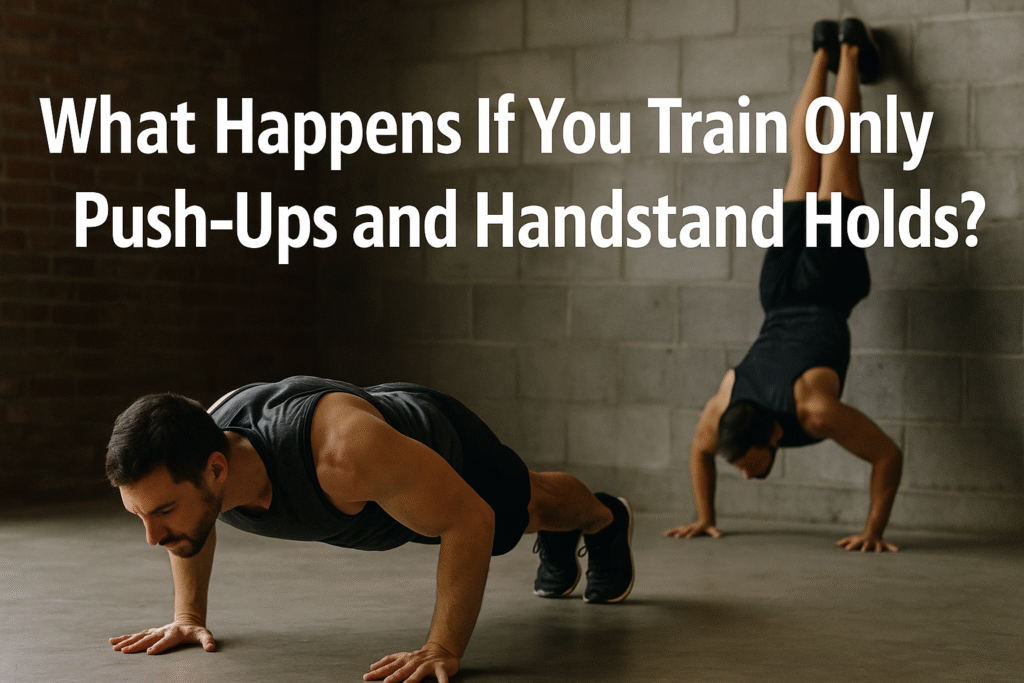
Just the floor, a wall, and the belief that push-ups and handstand holds are the minimalist power couple the world has been sleeping on.
At first glance, the whole thing feels almost poetic — like the kind of routine you’d expect from a superhero in training or a college student with no equipment and too much confidence.
And honestly, the simplicity is seductive.
Drop down, press up, flip upside down, repeat.
It looks clean on paper… until reality starts adding footnotes.
Push-Ups and Handstand Holds
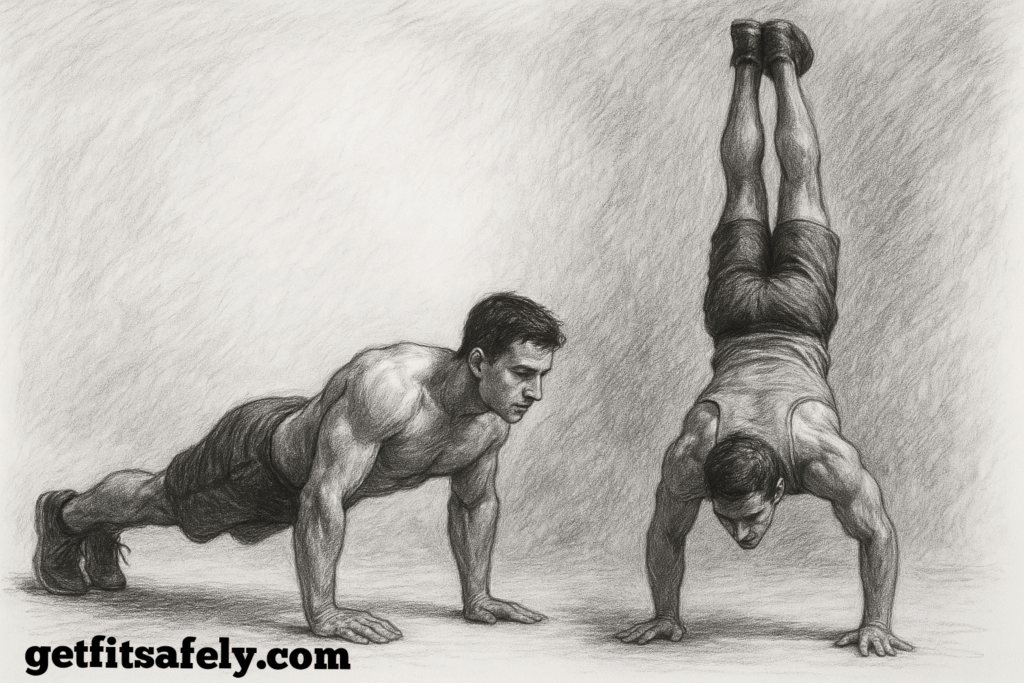
There’s something oddly satisfying about rolling out of bed, dropping to the floor, and knocking out reps like you’re auditioning for a superhero origin story.
Push-ups make you feel grounded and gritty.
Handstand holds make you feel like a circus acrobat pretending to be responsible.
Put them together and it feels like you cracked the secret code of “training smarter, not harder.”
But let’s talk about what actually happens to your body if these two become your entire gym.
Strength Gains You Absolutely Will See
If all you do is push-ups and handstand holds, you will get stronger in certain areas.
Your chest will adapt quickly.
Your triceps will become way more stubborn than you thought.
Your anterior delts will start carrying the emotional weight of your entire upper-body routine.
And your core — especially the deep stabilizers — will have no choice but to toughen up to keep you steady upside down.
There’s real value here.
No gatekeeping, no elitism — these movements work.
But that’s also where the story starts to get… interesting.
The Imbalance Problem

Training only two upper-body pushing patterns is like eating only two foods.
Sure, you can survive on eggs and rice… but your body will eventually file a complaint.
Push-ups and handstand holds are both push patterns.
Horizontal push + vertical push.
That’s it.
No pull.
No hinge.
No real lower-body strength stimulus.
If you only train these two:
- Your shoulders will roll forward over time.
- Your traps and front delts will dominate every movement.
- Your back muscles will become the quiet kid no one invites to the party.
- Your posture will slowly drift into “tired desk guy who forgot how to stand tall.”
And the craziest part?
You might not notice until you try to pick something up from the floor and your body answers, “Buddy… I don’t have the software for this.”
What About Muscle Size?
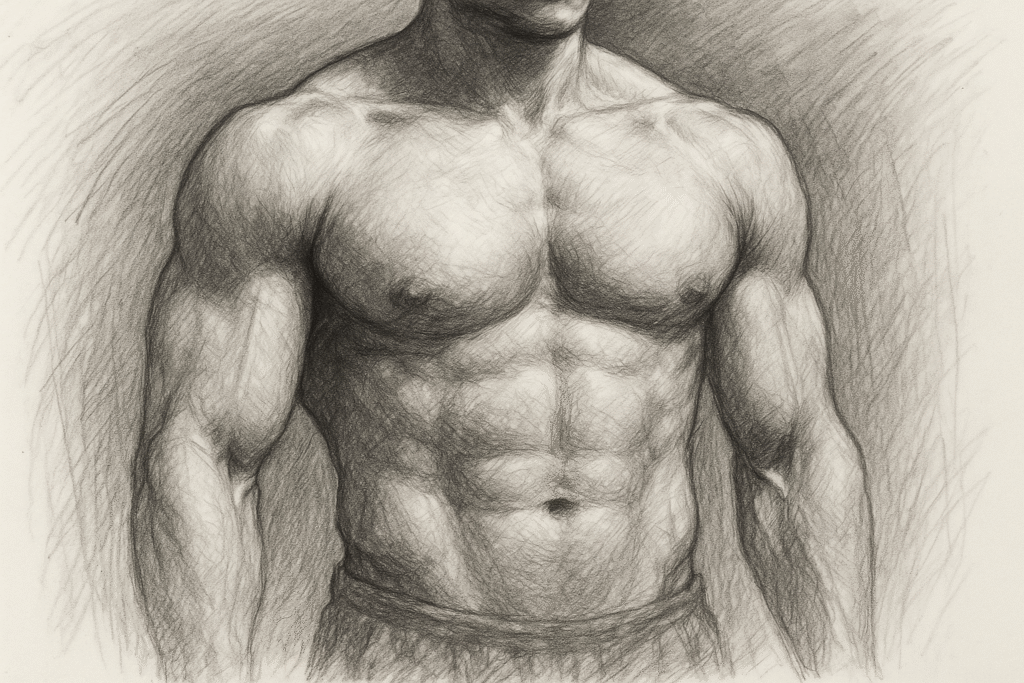
Push-ups can build muscle — especially high-tension variations.
Handstand holds give your shoulders a level of stability and control that dumbbells can’t replicate.
But hypertrophy loves variety.
Your chest, triceps, and shoulders need different angles, tempos, ranges of motion, and levels of resistance to grow long-term.
If all your reps look the same, your gains will eventually… also look the same.
Flat.
Predictable.
Plateaued.
Handstands: Amazing Skill, Limited Stimulus
Handstands are incredible for balance, proprioception, scapular control, and pure confidence.
But they don’t load your muscles progressively in a way that builds significant size or strength over time.
Holding a handstand for 60 seconds is impressive.
Holding it for 90 seconds is cool.
Holding it for 120 seconds doesn’t suddenly give you boulder shoulders.
It’s a skill, not a growth engine.
The Hidden Fatigue That Sneaks Up on You
If you only train push-ups and handstand holds, your shoulders live in a constant state of “overworked middle manager.”
They never really get rest.
Everything you do revolves around shoulder flexion, stabilization, or pressing mechanics.
So guess what fatigue pattern shows up?
Front-delt burnout.
And once the front delts tap out, the rest of the upper body suffers.
It’s like losing the drummer in a band — the music keeps going, but something sounds wrong.
How Your Body Changes After Weeks and Months of Only Push-Ups and Handstands
When you follow this two-exercise routine for a while, your progress becomes easy to read.
And that makes it much simpler to understand how your body adapts and gets stronger.
After 2 weeks, you feel sharper.
Your shoulders warm up quicker.
Your core stabilizes faster.
And your push-ups start looking smoother simply because the movement pattern becomes second nature.
After 4–6 weeks, you hit the “specialization phase.”
You get much better at these two moves… but at the cost of everything else.
Your pushing strength climbs, yet your pulling strength starts fading like an old photo.
Your posture becomes more dominated by the front side.
You also begin noticing more shoulder tightness, especially in the morning or after long sitting sessions.
After 10–12 weeks, reality sets in.
Your progress plateaus because you’re repeating the same angles and loading conditions.
Your back feels deconditioned.
Your range of motion overhead becomes slightly compromised.
And your shoulders hit the kind of fatigue that no caffeine shot can rescue.
This timeline isn’t meant to scare you.
It’s simply what happens when the body adapts to a narrow skillset.
You become excellent at two things and noticeably worse at the categories you’re not training.
How to Program Push-Ups and Handstand Holds Without Burning Out
Minimalist training doesn’t have to mean “unbalanced.”
With a bit of structure, these two exercises can be part of a clean, sustainable plan that doesn’t sabotage your long-term progress.
Here’s a simple way to do it without turning your routine into a spreadsheet.
Day Structure:
- Push-ups: 3–5 sets
- Handstand holds: 3–4 sets
- Light pulling pattern: 2–3 sets (band rows, doorway rows, towel rows)
- One leg movement: 2–3 sets (squats or lunges)
This keeps the minimalist vibe but prevents your body from collapsing into push-dominant autopilot.
Push-up variations to rotate weekly:
- Archer push-ups
- Decline push-ups
- Diamond push-ups
- Pseudo planche push-ups
Each variation shifts load distribution just enough to stimulate growth without needing extra equipment.
Handstand variations that won’t fry your shoulders:
- Wall-facing holds
- Tuck handstand holds
- Half-handstand (L-shape) holds
These still train balance and scapular strength without pushing your joints past their breaking point.
Simple progression rule:
If you can do:
- 20 controlled push-ups → switch to a harder variation
- 45–60 second handstand → switch to wall-facing or tuck
- 3 days in a row of shoulder fatigue → take a rest day
A Practical Look at Where This Combo Truly Shines
Push-ups + handstands shine when you want:
- Travel-friendly training
- Shoulder stability work
- Core activation
- Skill development
- A quick 10-minute session that feels athletic
- A way to start your morning without phone-scrolling autopilot
They can be the backbone of your training.
They just shouldn’t be the entire skeleton.
RELATED:》》》 Can being upside down during handstand push-ups make you nauseous or dizzy?
Conclusion
If push-ups and handstand holds work for you, keep them.
But give your body more than one direction of strength.
Add a pull.
Add a leg day.
Add a hinge.
That’s how a simple routine turns into real, long-term progress — and why you end up feeling stronger, moving better, and looking more athletic.