
The weird part wasn’t that training felt hard.
The weird part was that it felt… neutral, like chewing air.
A session would end, sweat would happen, music would happen, the clock would move, and my body would act like I had just walked to the mailbox.
Back then, soreness never showed up.
A “pump” was more of a polite suggestion.
Even the next morning felt identical, like my muscles had signed a non-aggression pact.
What made it extra confusing was the outside view.
Sets looked fine.
Form looked fine.
Effort looked fine, at least from the angle of “I’m not sitting down between reps like I’m in a medieval dungeon.”
That’s when I started writing things down.
Not every rep, not every thought.
Just enough to see if the pattern was real or if my brain was filling in gaps.
What “Nothing Feels Different” Actually Meant in My Body
One day it hit me that “nothing” wasn’t one thing.
It was a stack of small missing signals.
No burn, no pump, no heavy feeling, no deep fatigue, no appetite shift, no sleepiness later, no “I can feel that muscle when I move tomorrow.”
Burn is that hot, spicy sensation inside a muscle when reps keep going.
It usually shows up when a muscle is working for long enough that it starts screaming about oxygen and byproducts.
When it never shows up, it can mean the set ends too early, or the wrong muscle is doing the work, or the pace is too chaotic to keep tension where it belongs.
A pump is that tight swelling feeling that makes a muscle feel full.
It’s mostly blood and fluid moving into the area while you’re training.
A pump is not “proof” of growth, but its total absence can be a clue that the target muscle isn’t getting much of the job.
Next-day feedback is the simplest signal of all.
Not pain.
Just a mild “yep, that area did something yesterday,” especially when moving into a stretch or climbing stairs.
None of that was happening.
Instead, everything felt like I was doing cardio with weights.
Heart rate went up, arms moved, brain stayed bored.
The Routine That Looked Normal but Felt Like Nothing
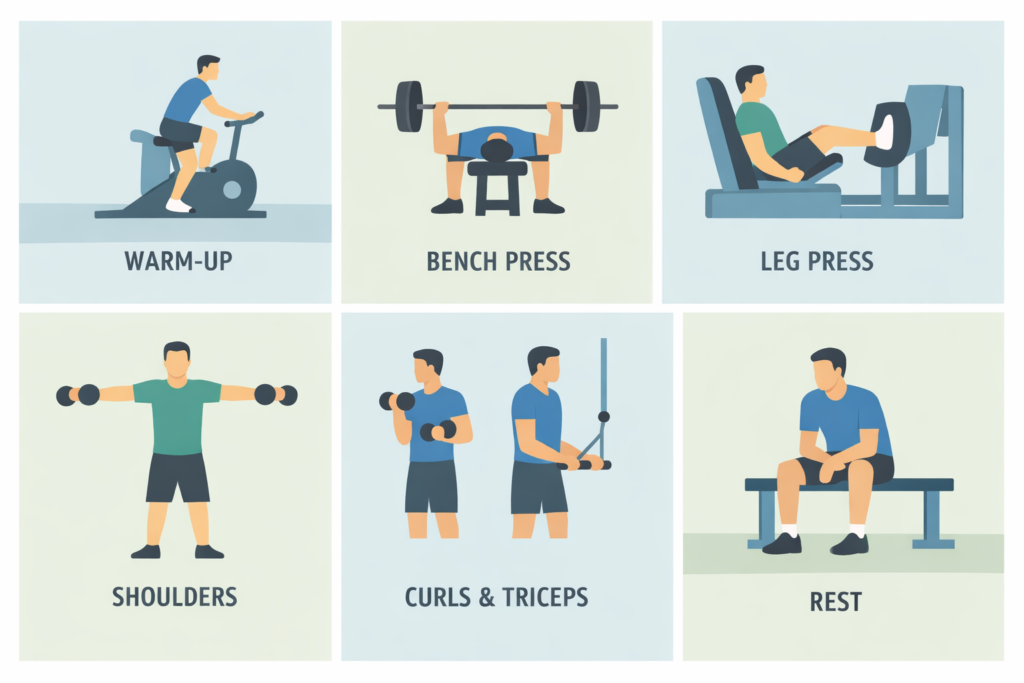
Most of the time, the session started with a generic warm-up.
Five minutes of easy cycling at a pace where talking was effortless.
Then a few shoulder circles and a couple of bodyweight squats, mostly to convince myself I was prepared for adulthood.
The workout looked like this on paper.
Bench press, then rows, then a leg press, then some shoulder work, then curls and triceps.
About 60 minutes total, plus walking around pretending I wasn’t checking if anyone was using the bench.
Bench press was 3 sets of 8 with 70 kg, with 90 seconds of rest.
Rows were 3 sets of 10 with 45 kg, also 90 seconds rest.
Leg press was 3 sets of 12 with 160 kg, 2 minutes rest.
Shoulders were dumbbell lateral raises, 3 sets of 15 with 8 kg.
Curls were 3 sets of 12 with 12 kg dumbbells.
Triceps were cable pushdowns, 3 sets of 12 with 25 kg on the stack.
Everything was “fine.”
Nothing felt wrong.
Which was exactly the problem, because nothing felt right either.
The First Real Clue: Effort Wasn’t Where I Thought It Was
I used to end sets because the number ended.
Eight reps meant eight reps.
Twelve reps meant twelve reps.
That sounds normal until you realize what it quietly removes.
It removes the reason the set exists.
The set exists to challenge a muscle enough that it has a reason to adapt.
So I started paying attention to the last two reps of each set.
Not in a dramatic way.
Just with basic honesty.
On bench press, rep 8 looked the same speed as rep 3.
Breathing wasn’t heavy.
Bar path wasn’t shaky.
That usually means the set ended with a lot left in reserve.
“In reserve” means the number of reps still possible with decent form if you had to keep going.
If three reps were still sitting there unused, the body often treats the set like a casual suggestion.
I didn’t change the whole workout right away.
One small change happened first.
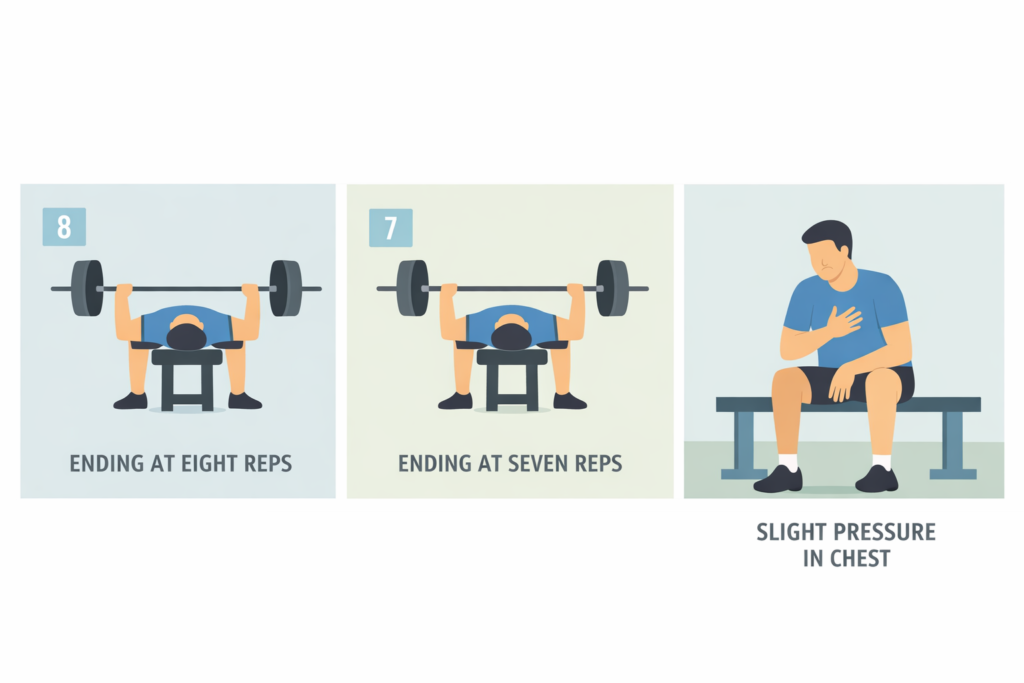
Bench press became 3 sets where the final rep slowed down, without turning into a grinder.
So 70 kg became 75 kg.
Reps became 8, 7, 6.
Rest moved to 2 minutes so those sets weren’t ruined by panic breathing.
Something finally appeared.
Not pain.
Just a faint “pressure” in the chest after the second set, like a light turning on in a room that had been dark for months.
The Thing That Fooled Me: “I Go Hard” Was Mostly Speed
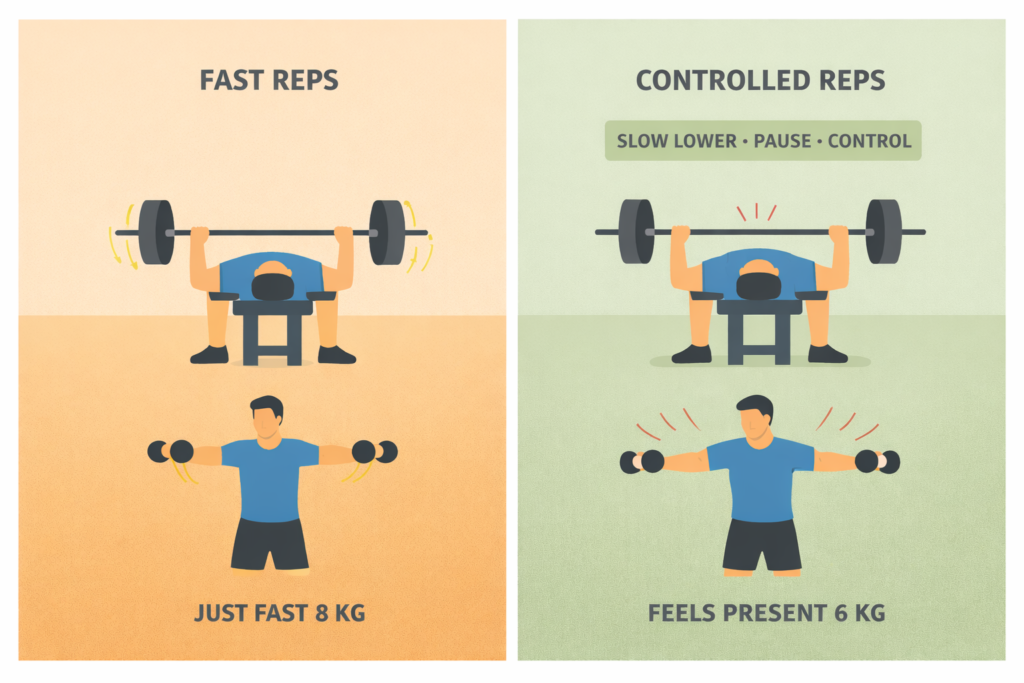
A big chunk of my effort used to be speed.
Reps were quick because quick felt athletic.
Quick also let me avoid the uncomfortable parts of a rep, which is a very human hobby.
Then I tried a boring experiment that felt almost insulting.
I counted tempo.
Tempo is the speed of a repetition, usually counted in seconds.
For a bench press, the “lowering” part is when the bar comes down to the chest.
That lowering phase is where a lot of muscle tension can live, especially if it’s controlled.
The “pressing” part is the bar going up.
I took 70 kg again and did this.
Lower the bar in 3 seconds.
Pause for 1 second lightly on the chest, no bouncing.
Press up normally, not explosive, just strong.
Sets became 3 x 8 with 70 kg, resting 2 minutes.
The weight felt lighter at first because ego loves slow reps… until the last three reps.
Rep 6 started to slow.
Rep 7 made my triceps complain.
Rep 8 felt like a negotiation.
A chest burn finally showed up, not extreme, but real.
Laterals also changed when I slowed them down.
Instead of swinging 8 kg for 15 reps, I did 6 kg for 15 reps with a 2-second lift and a 2-second lowering.
The shoulder cap suddenly felt “present.”
Not sore.
Present, like someone finally turned the volume up from 2 to 6.
Rest Times Were Quietly Stealing the Whole Session

Rest time is the most underrated part of a workout.
Too long and intensity drops because the session turns into a café visit.
Too short and the lungs become the limiting factor, not the muscle.
I realized most of my sets were limited by “I feel tired” instead of “that muscle is cooked.”
So I tested rest in a very specific way.
Same exercise, same weight, different rest, and I watched what failed first.
On rows with 45 kg for 10 reps, I used 60 seconds rest.
Set 1 felt fine.
Set 2 felt like my breathing was doing the rowing.
Set 3 turned into shrugging and momentum.
Then I tried 2 minutes rest with the same weight.
Set 1 felt controlled.
Set 2 had a real back fatigue near the armpit area.
Set 3 still got hard, but the hard part was the pulling muscles, not “I might faint.”
Rows are a good example because beginners often “row” with the arms and the upper traps.
A row is supposed to be a pull where the shoulder blade moves back first, then the elbow follows.
That means the back muscles are doing the job of bringing the upper arm behind the body, not the biceps doing a curl.
With 2 minutes rest, I could actually set my shoulders down and back.
With 60 seconds rest, posture collapsed and the wrong muscles took over.
I Was Strong Enough to Lift, but Not Patient Enough to Feel the Target Muscle
This part surprised me.
Feeling a muscle isn’t mystical.
It’s often just positioning and tension staying where it should.
For example, on bench press, my shoulders used to creep up toward my ears.
That steals work from the chest because the shoulder joint gets unstable.
A stable shoulder lets the chest produce force more cleanly.
So I started setting up like this.
Feet planted, pushed slightly into the floor.
Upper back squeezed into the bench like trying to hold a pencil between shoulder blades.
Shoulders gently down, not shrugged.
Then the bar came down to the lower chest area, not the neck.
Elbows stayed at about a 45-degree angle from the torso, not flared straight out.
That angle is usually kinder to shoulders and helps the chest contribute.
Same weight, cleaner setup, slower lowering, longer rest.
Suddenly “nothing” wasn’t nothing anymore.
It was mild chest fatigue, then triceps fatigue, then that heavy after-set feeling that makes you stare at the floor for five seconds like it owes you money.
The “Volume” Problem Wasn’t Too Much or Too Little

For a while I blamed volume.
Volume means how much total work you do, usually counted as sets times reps times weight.
So I tried doing more, because more is the default human answer.
That backfired in a very boring way.
The session got longer, fatigue got more general, and the target muscles still didn’t get a clear signal.
It was like adding more speakers to a song that’s already muffled.
Then I tried doing less.
Not dramatically less.
Just cutting the fluff and keeping the work that actually felt like it hit something.
Bench stayed at 3 hard sets.
Rows stayed at 3 hard sets.
Leg press stayed at 3 sets.
Everything else became 2 sets instead of 3, but those 2 sets were cleaner and closer to real effort.
Total time dropped from 60 minutes to about 50.
Strangely, the session felt heavier.
Not because it was miserable.
Because the work was concentrated instead of scattered.
Leg Press Taught Me the Difference Between “Hard” and “Targeted”

Leg press is a machine where you sit and push a platform away with your feet.
It’s great because it lets you train legs without balancing a barbell.
It’s also sneaky because you can make it hard in ways that barely load the muscles you think you’re training.
At first, I would do 160 kg for 12 reps with shallow range.
Range means how far the joint moves during the rep.
Shallow range feels easier on the joints and feels faster, but it can also reduce how much the muscles get stretched and loaded.
So I changed two things.
I lowered the weight to 140 kg.
I used a full range where knees bent deeper, without the hips rolling off the seat.
Then I added a pause.
One second at the bottom.
No bouncing.
Sets became 3 x 10 with 140 kg, resting 2 minutes.
That finally made the quads speak up.
Quads are the muscles on the front of the thigh, the ones that straighten the knee.
The next morning, stairs felt different.
Not painful.
Just that mild “I can tell something happened” feeling in the front of the legs.
Cardio Wasn’t the Villain, but Timing Was

I used to do cardio the same day as lifting because efficiency.
Twenty minutes of running after weights.
Heart rate around 150 beats per minute, steady pace.
Running is fine.
The problem was what it did to my recovery signals when everything else was already barely registering.
The legs would feel “tired” but not in a muscular way.
More like overall drained.
So I moved cardio away from lifting days.
Steps still happened daily, around 8,000 to 10,000, because life doesn’t stop.
Running became its own day, 25 minutes, a pace where breathing was heavy but controllable.
Lifting days stayed lifting days.
Energy stopped feeling smeared across the week.
Leg sessions started feeling like leg sessions again.
Sleep and Caffeine Were Quietly Editing the Whole Experience

This part was almost annoying because it wasn’t exciting.
Sleep was averaging 6 hours and 20 minutes.
Caffeine was two coffees and one energy drink, so roughly 350 to 450 mg a day depending on the brand.
When sleep is short, the body’s feedback gets weird.
Sometimes soreness disappears, not because recovery is amazing, but because nervous system sensitivity changes.
Sometimes energy in the gym becomes flat, not because the program is wrong, but because the brain is running on fumes.
So I tightened the basics for two weeks without making it a lifestyle religion.
Bedtime moved earlier by 45 minutes.
Caffeine got capped at one coffee and one small espresso, so about 180 to 220 mg.
Training felt more “alive.”
Not euphoric.
Alive, like the volume knob came back.
Food Wasn’t a Miracle Lever, but Protein and Carbs Changed the Session Feel
I wasn’t under-eating in a dramatic way.
Calories were roughly stable.
The issue was distribution.
Before training, I would sometimes go in with just coffee.
Other times I would eat a random snack with almost no carbs.
Carbs are the main fuel for high-effort sets because they refill muscle glycogen, basically stored fuel inside muscles.
So I settled on a very unsexy pre-workout meal.
About 90 minutes before training, I ate 250 g of Greek yogurt plus 60 g of cereal and one banana.
That’s roughly 35 g protein, 80 g carbs, and not a lot of fat.
During the session, water only.
After training, I ate a normal meal with protein and carbs again.
Chicken and rice, or pasta with tuna, or eggs with bread, nothing fancy.
The difference wasn’t magical strength.
The difference was feel.
Sets felt less like survival and more like focused work.
When Form “Looks Fine” but Muscles Still Don’t Get the Message
This was the part I didn’t expect to matter so much.
The difference between “moving weight” and “training a muscle” can be tiny.
Tiny changes create huge changes in which tissue gets loaded.
Take lateral raises.
That’s the exercise where you lift dumbbells out to the sides to train the side delts, the shoulder muscle that gives width.
Most people swing them.
I was also most people.
So I tried this instead.
Lean slightly forward, like a tiny hinge at the hips.
Raise the dumbbells to just below shoulder height.
Stop there, hold for one second, then lower in two seconds.
Weights dropped from 8 kg to 6 kg.
Reps stayed 15.
Rest was 75 seconds.
The side of the shoulder finally burned in the last five reps.
That burn was the “message” I had been missing.
Not because burn is holy, but because it signaled the correct muscle was doing the job long enough to matter.
The Most Important Shift Was Emotional, Not Motivational
No, not hype.
Not slogans.
Not “beast mode.”
The shift was more like this.
I stopped chasing a workout that felt entertaining.
I started chasing a workout that felt specific.
Specific felt like one muscle getting tired on purpose.
Specific felt like the last rep slowing down because the muscle was actually near its limit.
Specific felt like leaving the gym calm but clearly worked, not fried and confused.
Once that happened, feedback returned in normal human ways.
Appetite increased slightly on training days.
Sleep got deeper on nights after leg sessions.
The next morning, certain movements felt like the body remembered what I did.
The “Dead Ends” That Wasted the Most Time
A few things kept pulling me away from the real fix.
None of them were evil.
They were just seductive because they sounded smart.
Chasing novelty instead of tension
Switching exercises every session felt fresh.
Fresh didn’t build a signal because nothing stayed consistent long enough to push hard.
Counting sweat as success
Sweat is mostly temperature regulation.
Sweat does not guarantee a muscle got trained well, it only guarantees the body is not trying to boil you alive.
Ending sets because the rep goal arrived
Numbers matter, but effort matters more.
When sets always stop too early, the body treats training like practice, not a stimulus.
Short rests that turn strength work into breathing work
If lungs quit before the muscle does, the muscle doesn’t get the full message.
A slightly longer rest can make the same weight finally hit where it should.
What Finally Made Training Feel “Real” Again
A normal session eventually started looking like this, without needing to be dramatic.
Warm-up stayed 6 minutes on a bike at easy pace.
Then two warm-up sets on the first exercise with lighter weight, because joints like being informed.
Bench press became 3 hard sets.
75 kg x 8, then 75 kg x 7, then 72.5 kg x 7.
Rest was 2 minutes, and lowering took 3 seconds with a small pause on the chest.
Rows became controlled instead of yanked.
50 kg x 10, then 50 kg x 9, then 47.5 kg x 9.
Rest was 2 minutes, and each rep started with the shoulder blade moving first.
Leg press stayed boring and effective.
150 kg x 10 for three sets.
Bottom pause was 1 second, full range, 2 minutes rest.
Laterals stayed lighter than ego wanted.
6 kg x 15 for two sets.
Tempo was slow, rest 75 seconds, and the shoulders finally got the spotlight.
Total time was about 55 minutes.
Energy at the end felt like “worked,” not “confused.”
The next day felt subtly different in the muscles that actually trained, and that was the whole point.
Closing Thoughts
Training isn’t supposed to feel like fireworks every session.
Still, it shouldn’t feel like nothing, forever.
When everything is flat for months, it usually means the body never received a clear message.
Clear messages are boring.
Clear messages are consistent.
Clear messages have numbers, tempo, rest, and effort that actually mean something.
Once that clicked for me, the gym stopped being a place where time disappeared.
It became a place where cause and effect came back.
And honestly, that’s the only “exciting” part that really matters.