Truth is, anyone who trains calisthenics at home knows the struggle.
You start with the promise of keeping things tidy, and before long your pull-up bar, bands, and ab wheel have staged a full-blown invasion of your living room.
Suddenly, your so-called minimalist setup looks like a gym exploded mid-renovation.
Small spaces and bodyweight training don’t always play nice — but they can, if you’re smart about it.
Over time, a few simple storage tweaks can make your home look clean again, without killing your workout flow.
Here’s how to keep your training gear invisible when it’s not in use — and ready to go when it’s time to move.
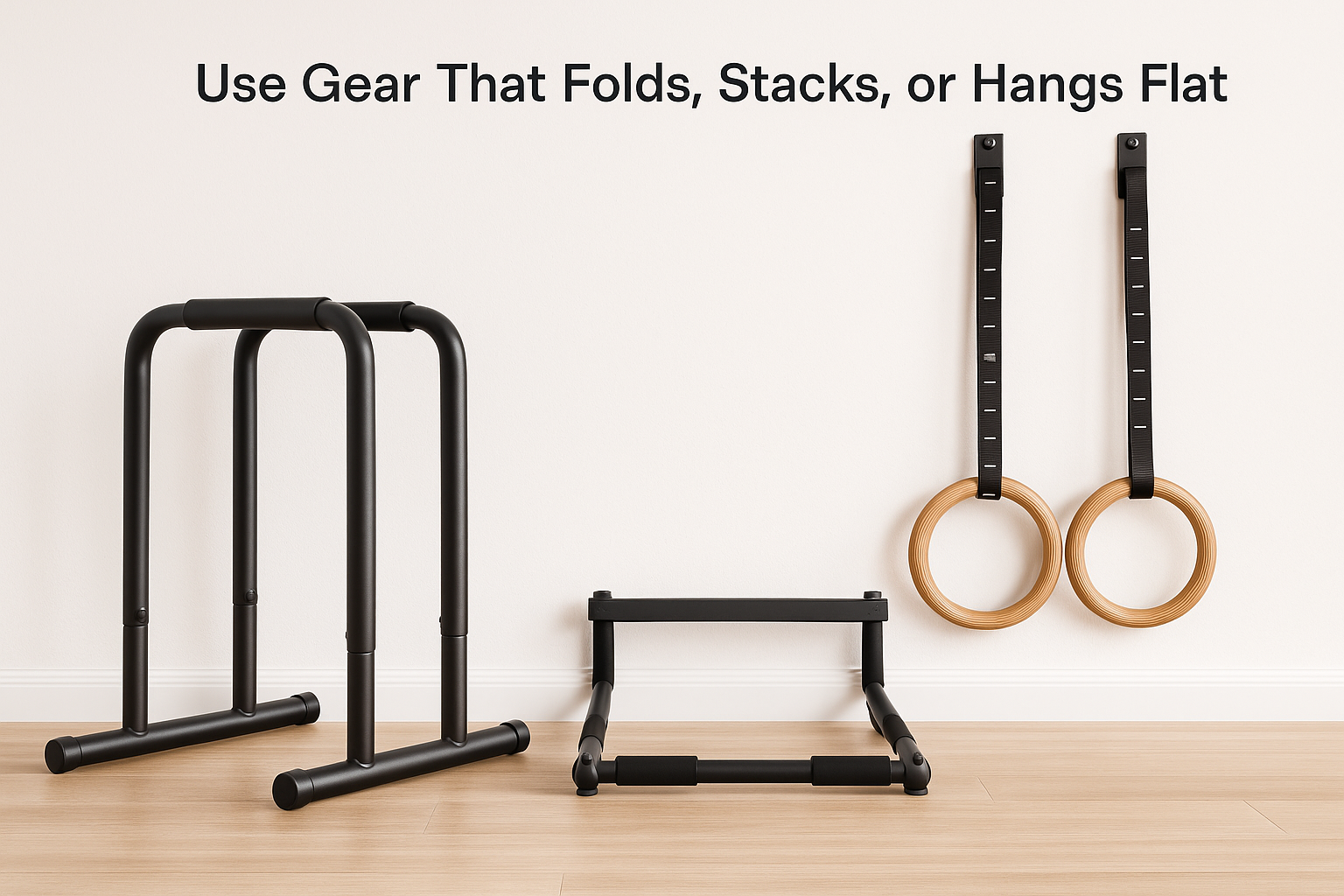
Use gear that folds, stacks, or hangs flat
This is the golden rule.
If your equipment doesn’t collapse, fold, or hang, it’s basically furniture with commitment issues.
Folding dip bars are lifesavers — they collapse to a two-inch profile and can slide under a bed or couch.
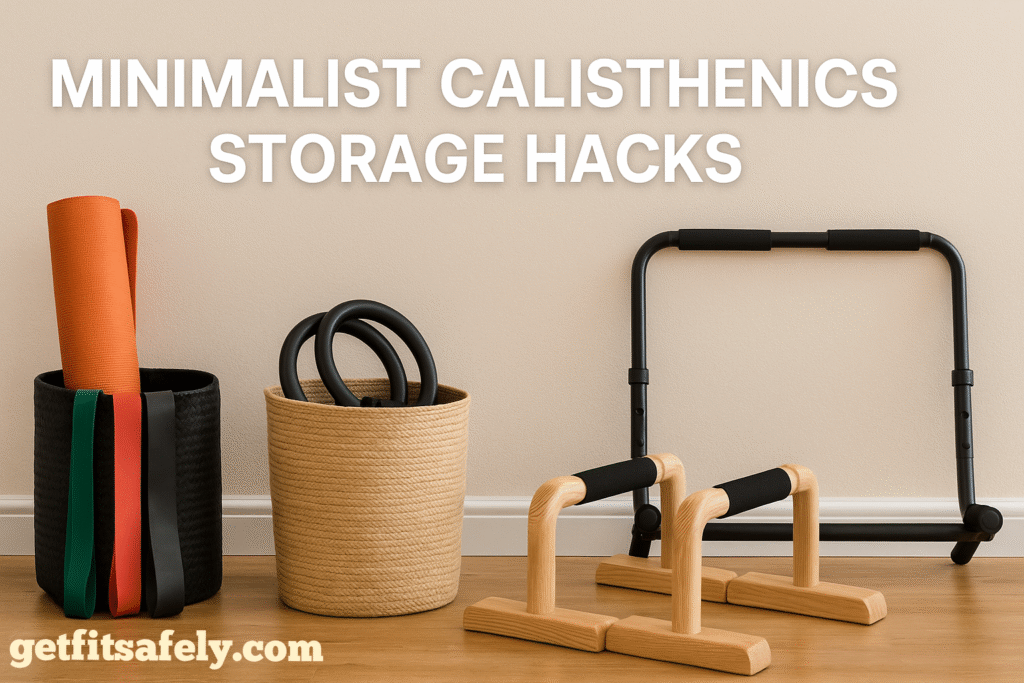
Stackable parallettes made from lightweight steel or hardwood can stand vertically behind a door or next to a dresser.
And doorway pull-up bars? They’re practically the ninjas of home gym tools.
You clip them on, destroy your lats, then slide them under your bed where they vanish like a secret identity.
Here’s the trick: when you buy equipment, imagine where it “sleeps.”
If it doesn’t have a home, it’ll own yours.
The newer foldable setups are also sturdier than people think — most can support 250–300 pounds easily thanks to lock-joint hinges or carbon-steel frames.
Even the compact push-up bars with rotating handles now use non-slip thermoplastic that holds firm on wood or tile.
Turn your walls into storage (without ruining the vibe)
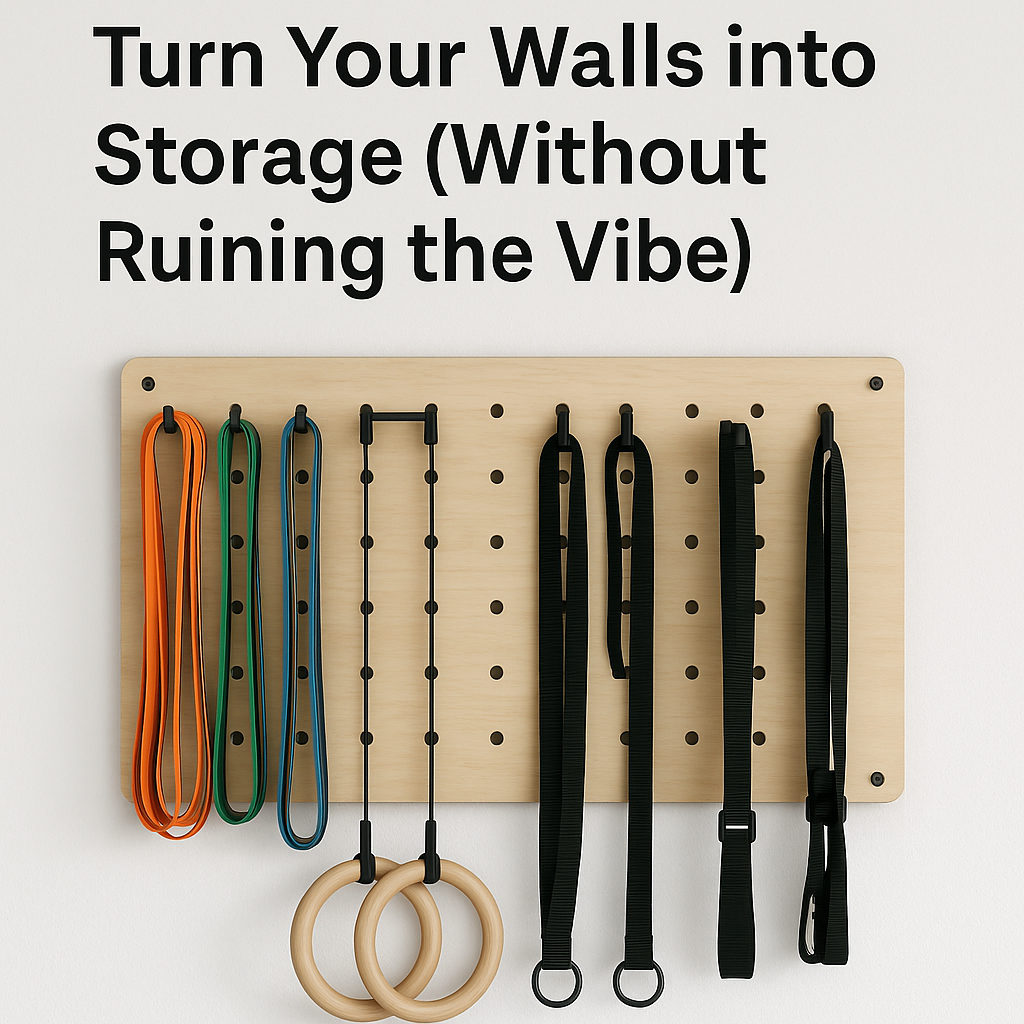
If you have a wall, you have potential storage.
Hooks, pegboards, and hanging racks are lifesavers — especially if you hate clutter but love gear.
Mount a minimalist pegboard and hang your resistance bands, rings, and straps vertically.
It’s not just functional — it looks intentional.
You can match the hardware color to your walls or go bold with matte black hooks for that “Scandi-industrial” vibe.
And if you rent, removable 3M anchors or telescopic racks work surprisingly well for up to 25 lbs of hanging weight.
The best part?
You’re not tripping over tangled bands or missing your handles when you’re ready to train.
Vertical hanging also preserves the natural tension in latex bands and keeps them from cracking.
If you live in a humid area, keep some silica gel packets nearby — they help prevent rubber decay.
I once used to throw all my bands into a drawer.
Every time I opened it, they exploded like a bowl of snakes.
Now, they hang in color order — and somehow, that little detail makes me want to train more.
When your gear looks good, it stops being an eyesore and becomes part of your environment’s rhythm.
Use multipurpose furniture (because your coffee table can train too)
Let’s be real — your furniture’s taking up prime real estate.
It might as well help you train.
Ottomans with hidden compartments?
Perfect for ab wheels, sliders, or ankle weights.
Storage benches double as seats and step-up platforms.
I’ve even seen people use solid wooden stools for planche progressions, then pull them up to the dinner table like nothing happened.
That’s efficiency.
If you’ve got a minimalist aesthetic, look for modular furniture — cube benches or nesting tables that can hold at least 150 lbs of static load.
Those things are basically disguised gym boxes.
A fold-down wall desk can serve as both a laptop station and a stretch station if you clear it after work.
Personally, I keep my parallettes inside a trunk that doubles as my coffee table.
No one suspects a thing.
Hide your equipment in plain sight
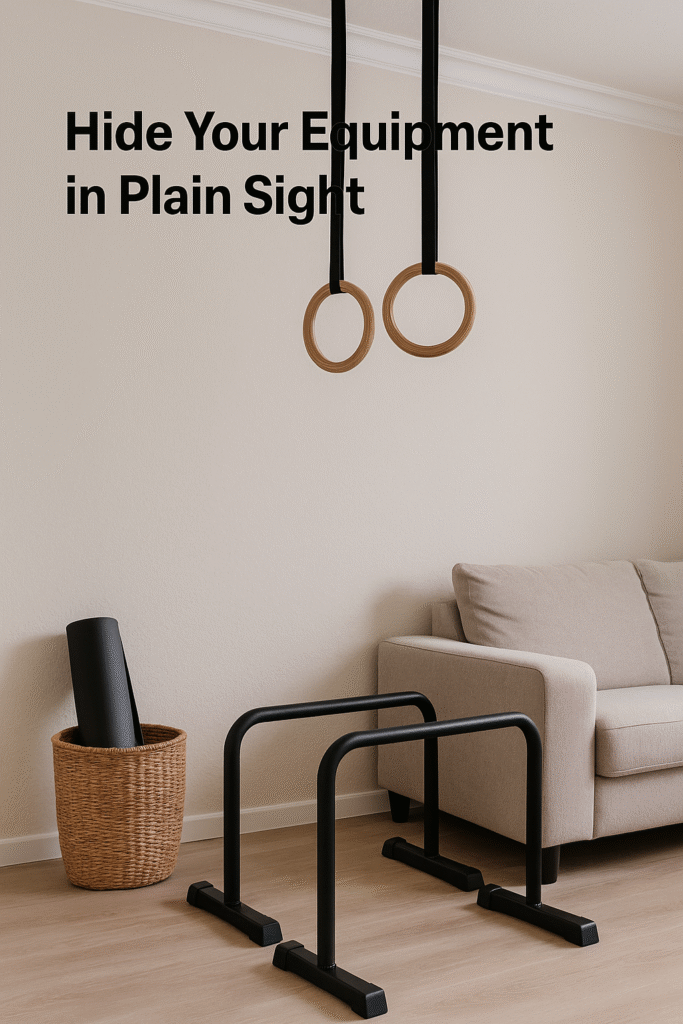
You don’t always have to hide things away — you can hide them cleverly.
Gymnastic rings can hang from ceiling hooks that look like part of the lighting system.
Yoga mats rolled tight inside a woven basket can pass as decor.
Wooden parallettes, if you buy ones with smooth oak finish, look like modern sculpture pieces near your sofa.
When your tools blend with your space, you stop feeling like you live in a training dungeon.
Instead, it looks like you’re someone who values movement and design equally.
And guess what?
That visual harmony reduces friction.
You’re more likely to use your gear when it’s not buried in a closet under winter coats.
Try coordinating colors — neutral bands, wood-tone rings, black steel parallettes.
Even in a minimalist apartment, it all looks cohesive.
When your environment supports your habits, your habits stick.
Go digital minimalist too
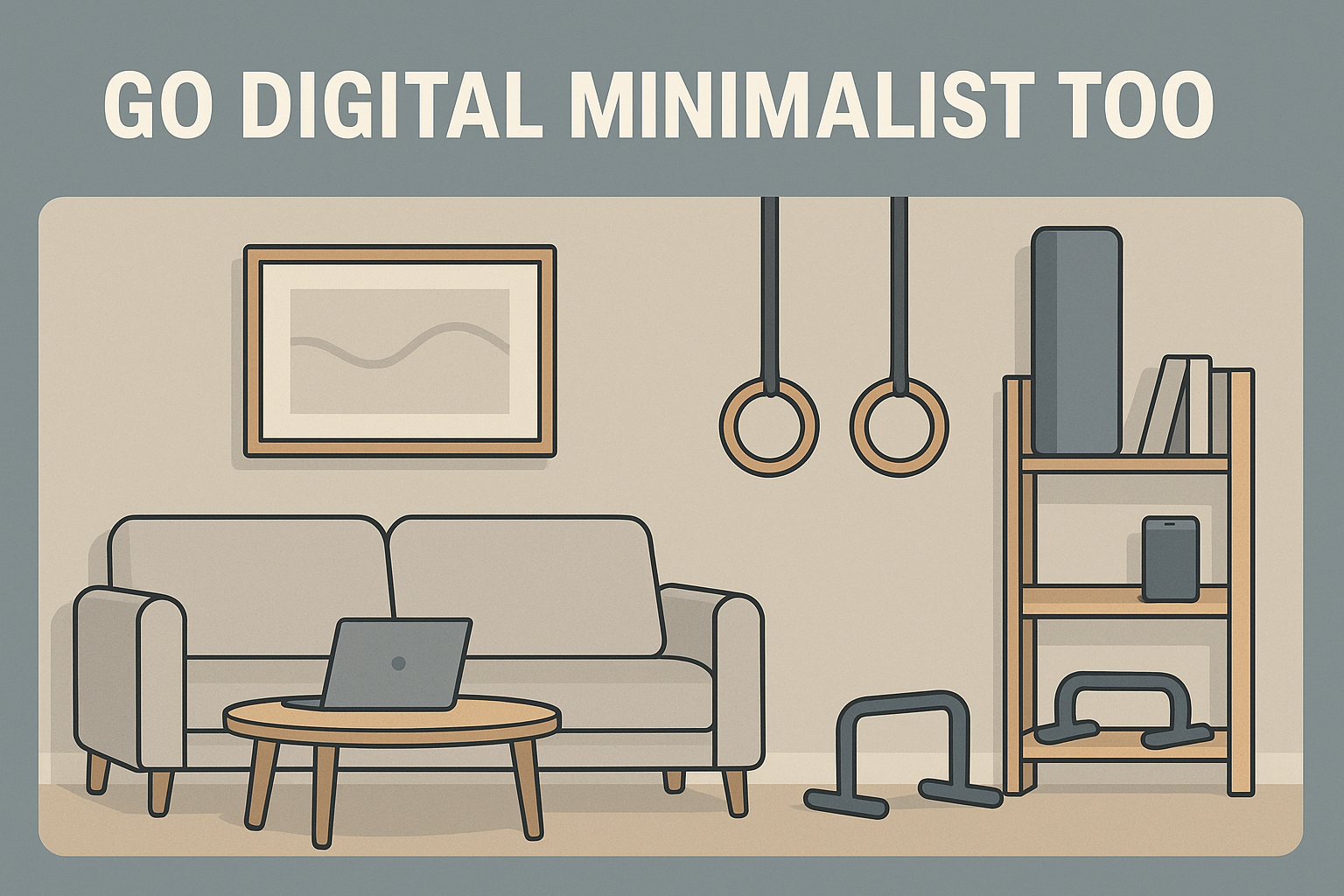
Decluttering isn’t just about physical stuff — it’s mental too.
That endless folder of workout PDFs, screenshots, random YouTube playlists, and four separate timer apps?
It’s noise.
I used to have five workout apps.
Now I use one.
It logs my reps, sets, and rest times all in one place.
That’s it.
The less you switch between tools, the more likely you’ll finish a full workout without distraction.
And yes, it’s the same with physical setup — if your gear is one motion away, you’ll train.
If it takes 15 minutes to “set up,” your brain starts negotiating its way out of training.
Think of it as building a zero-resistance environment.
Your digital and physical space should feel frictionless — so your brain has no excuse not to move.
The secret: make cleanup part of your cooldown
This one changed everything.
I used to leave my gear scattered around thinking, “I’ll put it away later.”
Spoiler: later never came.
Now, I treat cleanup as part of my cooldown.
The moment I finish, I coil my bands, fold my parallettes, slide them under the couch, and breathe while I do it.
It’s meditative.
That ritual anchors my session — body comes down, space resets.
When I come back to the living room an hour later, it looks peaceful again.
And that matters.
Psychologically, a clutter-free space signals closure and control.
It tells your brain, “session complete.”
Plus, it prevents wear and tear — dust, moisture, and tension fatigue all build up when gear’s left out.
A quick wipe with a microfiber cloth before storage keeps metal from corroding and wood from cracking.
If you live near the coast, add a thin silicone oil coat on metal hinges once a month.
Trust me, your bars will thank you.
Renting & Shared Space Friendly Solutions
If you rent or share your place, you’ve got some unique challenges.
Drilling into walls?
Usually a no-go.
But that doesn’t mean you can’t train or stay organized.
Tension-fit doorway bars work wonders and leave zero marks.
Portable pull-up stands fold in half and slide behind a wardrobe.
If you’re in a shared space, under-bed storage boxes or rolling drawers can keep your gear invisible yet accessible.
Label them neatly — visual order keeps the minimalist vibe intact.
For rings, quick-release straps mean you can hang and unhang them in 20 seconds flat.
And if you ever move?
You’ll thank yourself for having a mobile, no-installation setup.
Future-Proofing Your Setup for Growth
Your skills won’t stay the same forever.
Today you’re doing push-ups; tomorrow, you’re chasing front levers.
So think ahead.
Choose storage systems that grow with you.
Wall mounts with multiple anchor points let you add gear later without drilling new holes.
Trunks or modular cabinets with adjustable dividers can evolve with your tools — small bands today, weighted vest next year.
Invest in gear made from high-density materials like aircraft-grade aluminum or hardwood.
They last years and still look stylish.
And keep a bit of “negative space” in your room — an empty wall, a small gap — that’s where your future progress will live.
Final Thought
If you’re serious about training, you’re also serious about your space.
Minimalist hacks aren’t just about looking neat — they’re about making training frictionless, safe, and sustainable.
Take a weekend to re-evaluate your setup.
Give every piece of gear a home.
Turn cleanup into ritual.
And build a space that makes movement feel natural instead of forced.