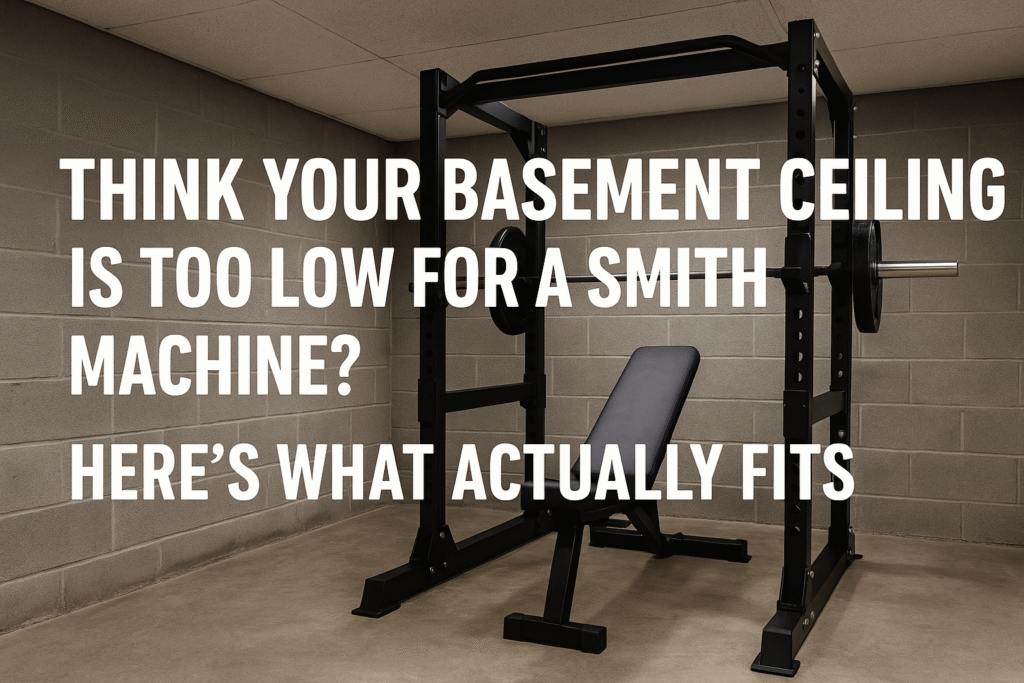
There’s a special kind of heartbreak that only home gym owners know.
You spend weeks planning your setup, comparing brands, measuring corners… and then, when the delivery truck finally arrives, you realize your ceiling is laughing at you.
Yeah.
The Smith machine doesn’t fit.
It’s that moment of standing there, tape measure in hand, staring at your basement ceiling like it betrayed you.
Because technically, the specs said it was “standard height.” Spoiler: most basements aren’t standard anything.
I thought my 7’6″ ceiling was fine until I tried to press inside it — and then I learned the hard way.
The basement ceiling problem nobody warns you about
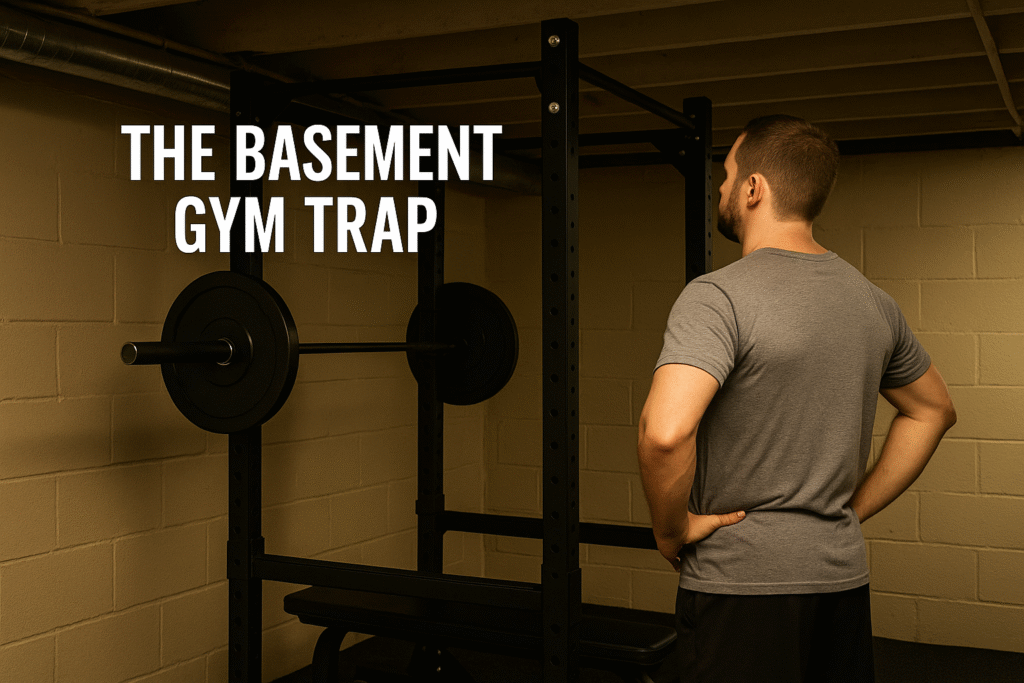
Let’s be real — most American basements hover between 7 and 8 feet tall.
According to multiple home-gym guides, this kind of height is common and often limiting.
That might sound decent until you remember that most Smith machines are between 82 and 94 inches tall (6′10″ to 7′10″) — even more once you account for pull-up bars or top frames.
Translation: even if it fits, you’ll have about two inches of clearance — enough space for a spider, not for an overhead press.
The issue isn’t just height, though.
It’s movement clearance.
When you rack and re-rack, or do pull-ups on a combo rack, your head needs room to move, the bar path needs room to extend upward, and you need to account for flooring thickness, mats, shoes, maybe even a hairstyle.
And nothing kills your gym mojo faster than knocking your skull on a joist mid-set.
Here’s another wrinkle: structural height vs usable height.
Your basement might be “7′8″” from floor to ceiling, but then you have a beam that drops down 4″, pipes that hang 3″, and you’re left with roughly 7′1″ of usable space.
Then add 1″ of rubber mat, maybe a platform… suddenly you’re at 7′0″ or less — which in gym terms means you’re dancing in the “restricted clearance” zone.
When “compact” doesn’t mean “basement-friendly”
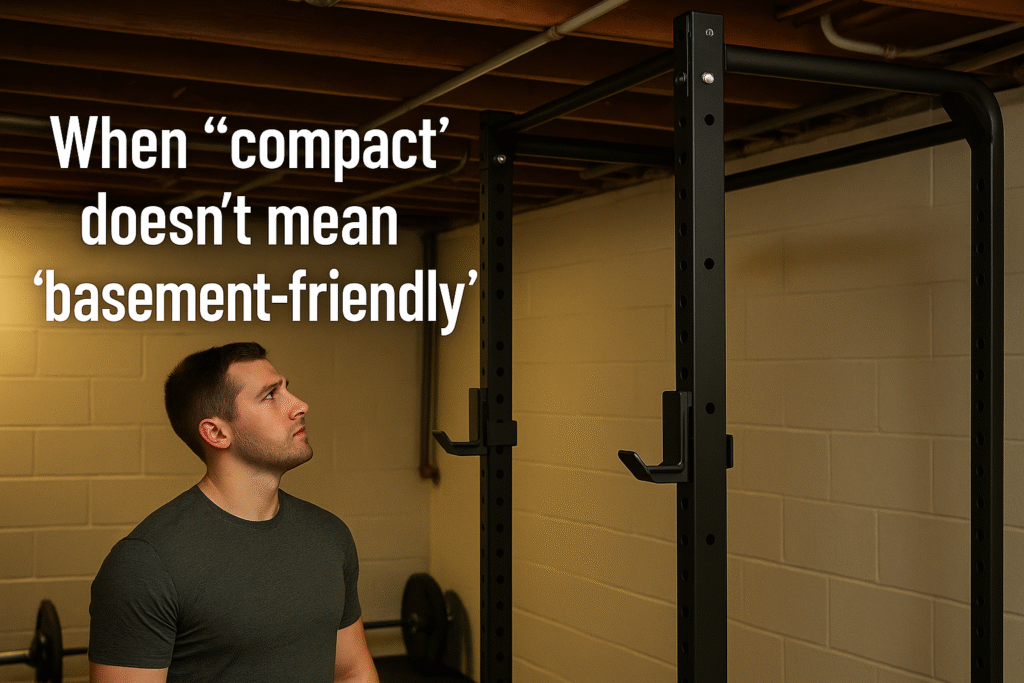
Manufacturers love throwing around the word compact.
But “compact” for them usually means “fits in a garage with a 9-foot ceiling,” not a 1950s basement with pipes hanging like jungle vines.
I once bought a “space-saving” Smith machine that claimed to be perfect for home setups.
The frame itself?
83 inches.
The pull-up bar?
Another 4 inches above that.
You do the math.
That’s how I learned that the pull-up bar height is often what ruins your plan — not the frame itself.
It’s like buying a car that technically fits in your garage but won’t clear the door.
Pro tip: Measure from the floor to the lowest ceiling obstruction (joist, beam, piping).
Then subtract the thickness of any flooring or mats you’ll use.
Many articles mention that mats add another inch or two of height which you must account for.
Also, check what the manufacturer claims.
Often they list “assembled height: 84″” but don’t mention that the “top bar” (pull-up or lighting crossbeam) adds 4″, or the base feet raise it another ½″.
Don’t take “fits under 8 feet” at face value — dig into specs.
What actually fits under a low ceiling
Here’s where the reality check hits.
If your ceiling is under 84 inches (7 feet), you’re going to need to skip the classic commercial-style Smith machines.
But all hope’s not lost — there are legit options that can still give you that smooth guided movement you want, without turning your ceiling into a war zone.
Some good examples include:
- Marcy Smith Cage Compact Trainer (SM-4033) – around ~80 inches tall if you skip some top attachments.
- Inspire Fitness FT1 Functional Trainer – roughly ~83 inches tall but has a lower pulley clearance that’s actually useful for seated/lower movements.
- Body-Solid GS348Q Smith Machine – approx 82 inches tall; tight squeeze but doable with 8-foot ceilings.
- Short rack + Smith attachment setups – like the Titan Fitness short rack with a Smith-bar attachment; these modular solutions often fit under ~80 inches and still feel stable enough for legit lifting.
Also check models like ATX Smith Machine 500, designed for low ceilings at just 198 cm (~78″).
And remember: if you’re at ~7′0″ (84″) or less, you might be better off investing in a functional trainer or cable station instead of a full Smith machine.
It gives you more flexibility and fewer clearance headaches.
In practice: measure your ceiling, subtract for floor mats, subtract for pull-up bar height, subtract for any overhead light/beam — if you’re under ~78-80″ available space, think outside the Smith machine.
Creative workarounds (if you’re stubborn like me)
If you’re already emotionally committed to the idea of a Smith machine, there are a few things you can do before giving up.
- Drop floor mats strategically – Instead of stacking two-inch rubber flooring everywhere, try thinner padding only under the bar path.
- Remove or lower the pull-up bar – Many racks let you detach the top bar. You lose pull-ups, but you gain space for presses.
- Tilt or offset placement – Sometimes turning the rack diagonally or placing it between beams gives you just enough breathing room.
- Recess between joists – Advanced move: cut and reinforce between ceiling beams to gain a few inches.
- Use seated or lying variations – Seated overhead presses, landmine presses, or incline dumbbells can replace standing movements safely.
Is it ideal? Nope.
Is it gym-owner logic?
Absolutely.
Smith machine alternatives that make more sense
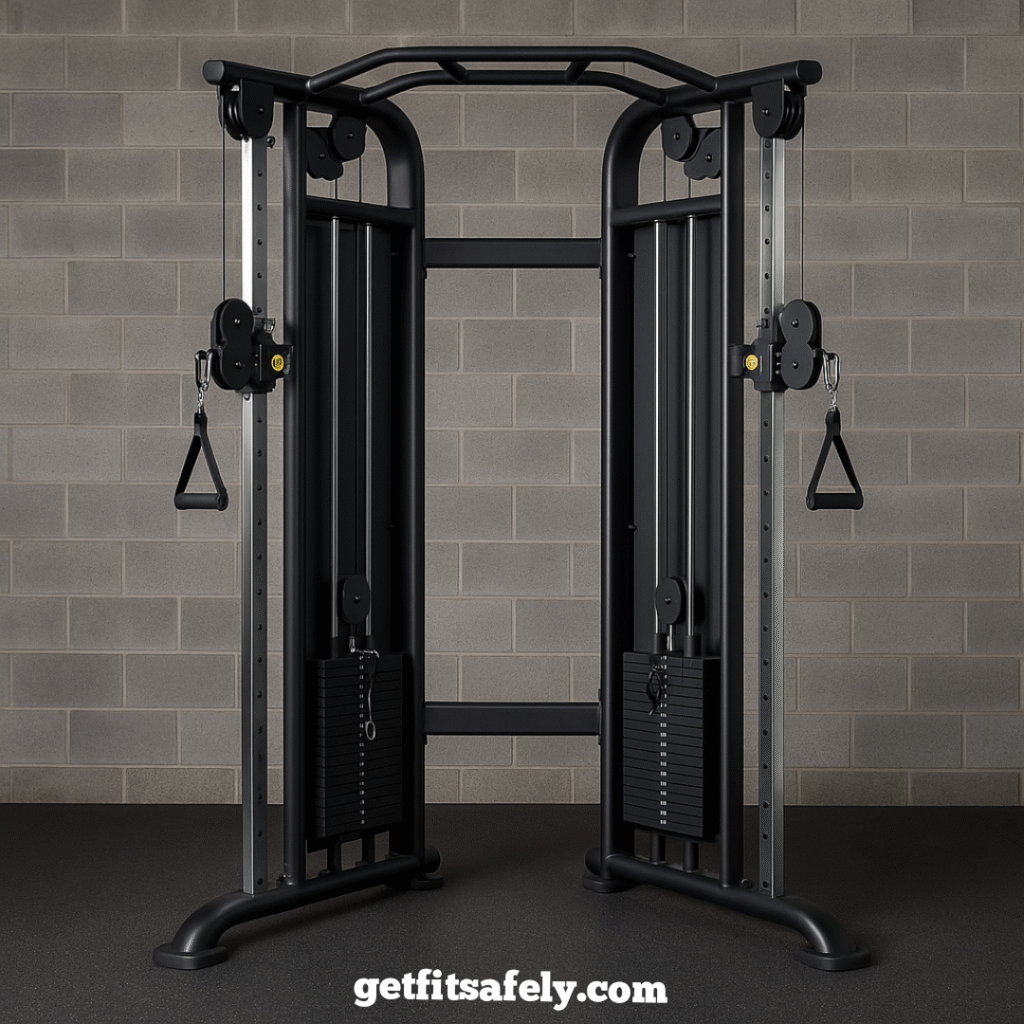
Here’s the thing: if your ceiling’s under ~7.5 feet, you’ll get better results focusing on functional trainers, guide-rod systems, or Smith attachments instead of fighting physics.
A functional trainer gives you similar safety and stability, but the pulleys can adjust lower, and most models fit easily in 7-foot basements.
Even a Smith-V-squat hybrid or a counterbalanced guide bar can give you that controlled feeling without the overhead frame.
And let’s be honest — the Smith machine is just one tool.
You can hit every major lift pattern with a well-set functional cable station or power rack with safety arms.
You don’t need the full tower to get the same grind.
For example, the REP PR-1050 Short Power Rack is designed for low ceilings (6′ tall) and still lets you perform every big lift safely.
Shorter ceilings may force you into more seated work, slower tempos, and fewer ego lifts — but that’s not a loss.
Those controlled lifts often yield better hypertrophy and fewer injuries.
The bigger picture: train smart, not just heavy
The truth is, the Smith machine is overrated for most home gyms.
It looks impressive, sure, but if you’re training solo under a low ceiling, what you really want is clearance, versatility, and safety.
I’ve seen people spend thousands to cram a massive setup into their basement, only to end up squatting with their head tilted to the side like a confused pigeon.
The smartest setups I’ve seen?
Compact racks, adjustable dumbbells, and a pulley system — everything within arm’s reach, everything that actually fits.
That’s the kind of gym that doesn’t just look good — it works with your space, not against it.
Your head might not clear the ceiling, but your triceps sure will.
Designing for ventilation, lighting, and mood under low ceilings
When you’re working with limited height, often you forget about everything else that makes your gym usable — the air, the light, the vibe.
A basement with 7 feet of clearance can feel like a cave if you skip this.
Ventilation: Low-ceiling spaces trap warm air and smells.
Consider an inline fan, a dehumidifier, or a flush ceiling fan so you don’t feel like you’re lifting in a sauna.
Lighting: Avoid hanging fixtures.
Use flush LED panels or wall-mounted sconces.
A well-lit space feels bigger and more inviting.
Color and finish: Light-tone walls reflect light better and shrink the feel of that low ceiling.
Acoustics: Rubber mats absorb sound.
Dropping weights in a low-ceiling basement can shake the house — use vibration pads to stay on good terms with your family.
Mood and motivation: Posters, good music, and smart organization keep your head in the game — literally.
Hidden cost & long-term perspective for low-ceiling home gyms
Let’s talk money, time, and “will I still want this in two years?”
Low-ceiling setups often force creative choices — maybe a shorter rack, maybe no overhead press, maybe seated work only.
That’s fine, but ask yourself:
Will I miss standing overhead presses if I switch to seated?
Maybe a little — but many lifters adapt.
Will resale of a custom low-profile rack be harder?
Yes.
Big racks always have demand; niche ones less so.
Will I upgrade my ceiling later?
If yes, budget for it now.
Some movements become awkward — like Olympic lifts or kipping pull-ups.
If your goal is strength, not CrossFit, you’ll be fine.
Be honest about your training style before you overspend.
Things to Know Before You Bring It Home
- Measure from floor to the lowest ceiling beam or obstruction.
- Account for flooring and platform thickness.
- Stand up and raise your arms — check head clearance.
- Read manufacturer specs including pull-up bar height.
- Watch for pipes, ductwork, or low lights.
- Simulate your movements before buying — unrack, press, re-rack.
- Think about future add-ons like storage or lights.
- Re-measure after flooring installation.
- Leave a few inches of emergency clearance for full extension.
- Keep receipts and verify return policy.
- Film yourself under the spot — you’ll see problems fast.
- Plan for any overhead fans or hooks before drilling holes.
Movement modifications that keep gains alive
If standing overhead press isn’t safe, switch smart:
- Seated barbell or dumbbell press – same burn, less clearance.
- Kneeling landmine press – natural arc, great shoulder work.
- Low pulley face pulls – shoulder balance and posture fix.
- Incline bench rows or seated rows – perfect pull-up substitute.
- Kettlebell half get-ups – insane core and shoulder stability.
Ceilings may cap your height, but never your creativity.
Real People, Real Basements, Real Gains
One Reddit user built a full gym under a 6.5-foot ceiling using a Titan short rack and a cut pull-up bar — still going strong after two years.
Another installed mirrors and flush LEDs to make his 7-foot space feel open.
Thousands of lifters train under basement beams every day.
Measure carefully, adapt intelligently, and tag your setup — because low ceilings never stopped true consistency.
Get the Multifunction Power Rack for Your Home Gym
Conclusion
If your basement feels too small for your dream gym, don’t let that stop you.
Low ceilings don’t kill your gains — poor planning does.
Pick equipment that matches your height and your goals, not just your wish-list.
Whether it’s a short Smith setup, a cable trainer, or a sturdy half rack, your progress depends on consistency, not clearance.
Because at the end of the day, it’s not about how tall your ceiling is — it’s about whether you’ll actually use the gym you built under it.
And if you can do that without cracking your head on a pipe?
You’ve already won.