Let’s be honest.
“Dead bug” sounds like an exercise someone invented five minutes before a PE class started.
Then you actually try it, and suddenly your abs are trembling, your lower back feels personally offended, and you’re thinking:
“Why is this tiny, goofy move harder than half the stuff I do at the gym?”
Let’s break that down.
What the heck is a dead bug really training?
Think of dead bugs as a “core software update,” not just an ab move.
You’re not simply working your six-pack.
You’re teaching your body how to:
- Stabilize the spine while the limbs move
- Coordinate breathing with tension
- Keep the ribcage and pelvis in a healthy, efficient position under load
In practice, the dead bug trains:
- the rectus abdominis (your six-pack)
- the deep core (transverse abdominis, obliques, pelvic floor)
- the hip flexors—but in a controlled way
- the deep muscles of the back that stabilize instead of overworking
It’s like updating your core’s operating system so when you squat, hinge, row, press, sprint, or lift groceries off the floor, your torso knows what to do without panicking.
Why does such a slow exercise burn like that?
Here’s the slightly annoying truth:
Dead bugs take away all your shortcuts.
With faster exercises you can:
- use momentum
- cheat with your lower back
- tense up randomly and hope it works out
Dead bugs don’t let you do any of that.
They put you on your back, pin your spine to the floor, and say:
“Alright, show me if you can move your limbs without losing control.”
It’s difficult because:
- you’re working in slow control, not impulse
- the arms, legs, and breath must coordinate
- the tiniest mistake shows up immediately in your lower back
- the core must maintain constant tension, not just brief peaks of force
It’s basically like going from a button-smashing arcade game to a strategy game where every move matters.
If dead bugs feel impossible, here’s the real reason why
If your brain keeps asking, “How is this so hard?” it’s not because you’re weak.
It’s because dead bugs are an honest test of how well your body coordinates everything in the center.
People who struggle with dead bugs often:
- arch the lower back the moment they lift their legs
- never quite feel the lower abs “switch on”
- tense the neck and shoulders instead of the core
- hold their breath instead of managing it
It’s not a flaw.
It’s a feature of the exercise: it highlights where your system leaks tension.
Step-by-step guide to dead bugs that actually work
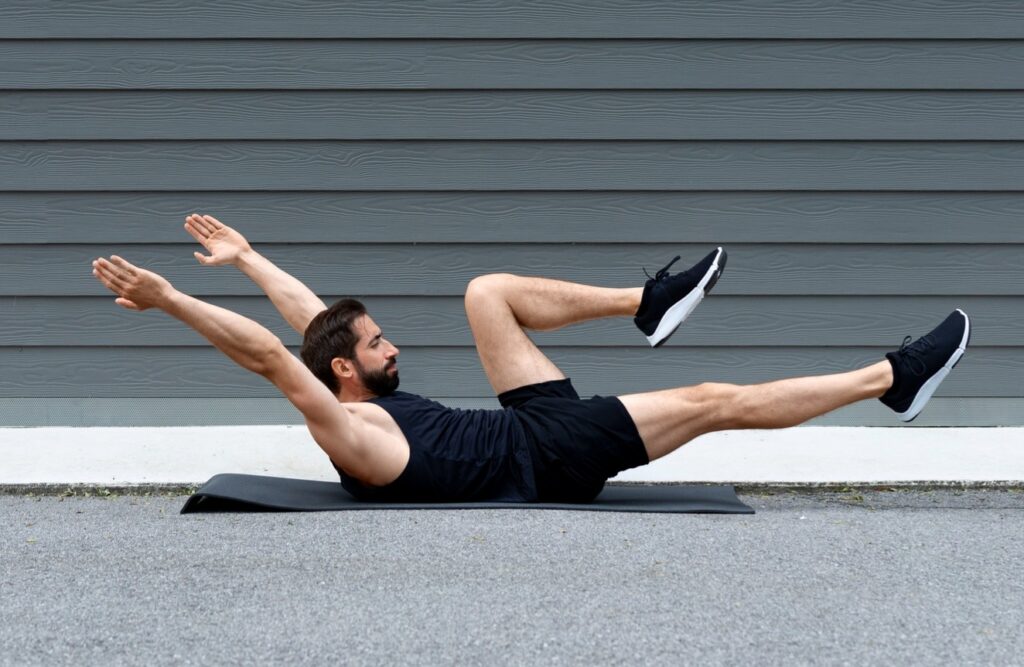
Let’s go super practical.
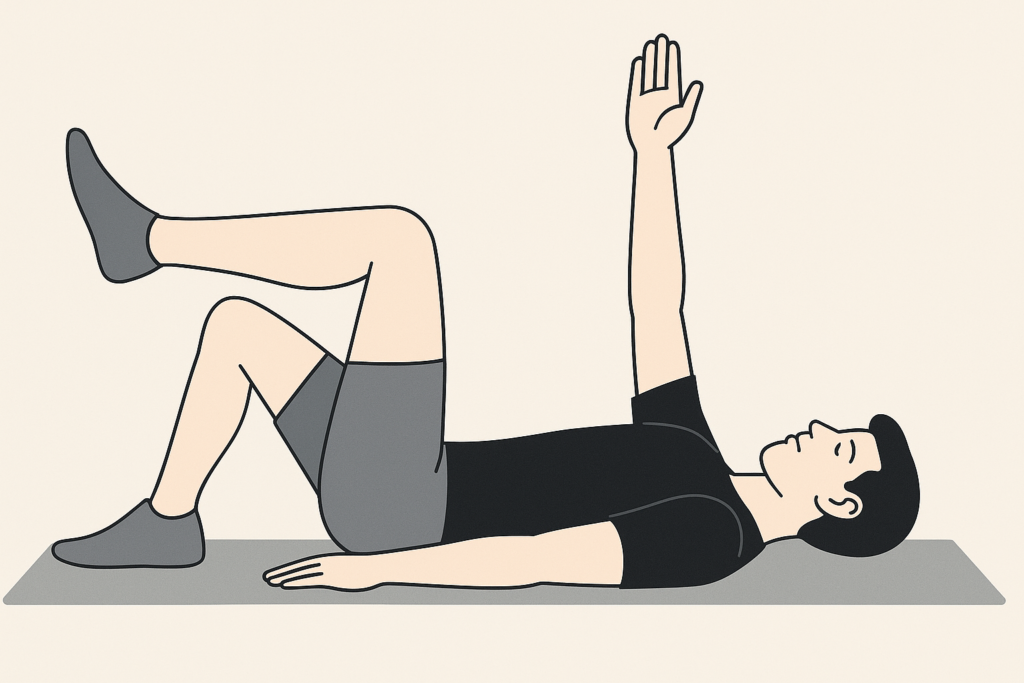
1. Setup
Lie on your back.
Bend your hips and knees to 90°.
Reach your arms straight above you.
2. Set your spine
Exhale slowly through your mouth like you’re fogging a window.
While exhaling, gently anchor your lower back to the floor.
You don’t need to smash it down—just keep it stable.
Imagine “shortening” the front of your torso slightly, bringing the ribcage and pelvis toward each other.
3. Activate the core without bracing like a statue
As you exhale, think of drawing your lower belly inward—not pushing it out.
No crunching, no neck tension.
It’s more like zipping up a jacket from your lower ribs to your belly button.
4. The actual movement
Keep the spine steady.
Slowly extend one leg forward.
At the same time, reach the opposite arm back behind your head.
Important:
If your lower back lifts or your belly bulges outward, stop.
Use a shorter range that you can actually control.
5. Breathe like a human, not a vacuum cleaner
Inhale as you return to center.
Exhale as you extend arm and leg.
Breathing is half the exercise.
How to know if you’re actually doing dead bugs correctly
Instead of obsessing over angles and setup, pay attention to the feedback your body gives you in real time.
Dead bugs work like a built-in diagnostic tool: if something isn’t dialed in, your core will snitch immediately.
Here’s what the exercise should and shouldn’t feel like:
1. Your lower back should feel quietly supported — not floating.
If you could slide a hand under your spine, you’re not stabilizing through your core anymore.
That usually means your hip flexors have taken over and you’ve drifted out of position.
2. Your breathing should stay smooth, not panicked.
If you have to hold your breath just to survive the rep, you’re relying on tension instead of control.
Long exhales help the ribs settle, the abs engage, and the movement actually work.
3. Your ribcage should stay heavy, not pop open.
If your chest lifts the moment you extend a leg, the movement has shifted into your lower back.
That’s the classic “big range, zero control” problem — the leg goes low, but the core loses the plot.
4. Your neck and shoulders should stay relaxed.
If your traps are doing more work than your abs, you’re fighting the movement instead of directing it.
Dead bugs shouldn’t feel like a shrug workout.
5. The movement should be small enough that nothing in your torso changes shape.
When the range gets too big, everything collapses: arching, rib flare, breath holding.
It looks impressive but works nothing you want it to work.
Quick fixes that solve 90% of problems:
- shorten the range until your torso stays completely still
- slow down and use long exhales to keep the ribs anchored
- think “compact torso” instead of “reach as far as possible”
If you nail these signals — steady breath, stable torso, quiet lower back — dead bugs stop being confusing and start becoming one of the best core-control drills you can do.
Smart progressions if dead bugs feel too hard
If full dead bugs destroy you in two reps, that’s perfectly normal.
What’s not normal is forcing them and calling it “core training.”
Here’s how to scale them:
1. Basic isometric hold
Start with the position only (hips/knees 90°, arms up).
Hold for 20–30 seconds while breathing.
2. Leg-only variation
Move just the legs.
Keep the arms pointing to the ceiling.
Reduce the range if your back arches.
3. Arm-only variation
Keep the legs still.
Move the arms back and forth.
4. Short-range dead bug
Move opposite arm and leg, but keep the leg higher and the range smaller.
The goal: no lower-back pain, steady breathing, solid control.
The Best Moments to Use Dead Bugs
Dead bugs are mentally demanding because they’re slow and precise.
That’s why quality beats quantity here.
Realistic ways to plug them in:
- Before squats, deadlifts, overhead presses
2–3 sets of 6–8 slow reps per side to “set” the core. - On mobility or injury-prevention days
Perfect paired with hip and spine mobility drills. - As part of a dedicated core session
Alongside planks, side planks, anti-rotation work.
If you wait until the end of the workout when you’re exhausted, expect your technique to fall apart.
Why Good Dead Bugs Make Other Exercises Feel Easier
The goal isn’t to become “strong at dead bugs.”
It’s what the exercise gives you everywhere else.
Done consistently and with good form, you might notice:
- your lower back tires less during squats and hinges
- planks become less of a psychological battle
- your torso stays tighter during push-ups, pull-ups, and rows
- you feel more stable when sprinting or changing direction
In everyday life, that means:
- fewer random lower-back twinges
- better control when lifting kids, bags, boxes
- a body that feels “organized” instead of wobbly at the center
It’s like upgrading your body’s internal firewall.
You don’t see it, but you’ll definitely feel the difference.
When you should modify or be careful with dead bugs
Even though the exercise looks harmless, it’s not one-size-fits-all.
Be cautious if:
- you have active lower-back pain or radiating symptoms
- you feel sharp pain, not just muscle effort
- hip issues flare up when lifting your legs
In those cases:
- drastically shorten the range
- stick to isometrics for a while
- consider getting personalized guidance from a physio
A well-executed dead bug should not cause sharp back pain.
How Many Dead Bugs You Really Need
No need to turn your week into a Dead Bug Festival.
For most people:
- 2–3 times per week
- 2–4 sets
- 6–10 slow reps per side
That’s plenty to get real results.
Remember: the goal is coordination and stability—not chasing a burn.
Conclusion
If every session starts with you thinking:
“There’s no way this silly exercise should be this exhausting,”
take it as a compliment.
You’re entering the territory where training isn’t just about “lifting heavier,” but about moving better.
This type of progress doesn’t show up in flashy ways, but it does make you:
- more stable
- more resilient
- more efficient under load
Stick with them.
Scale them if needed.
But don’t skip them just because they aren’t flashy.
And hey—if the name bothers you, feel free to call them “core control drills.”
Sounds fancier.
But let’s be honest: they’ll still be those infuriating little dead bugs that make you shake harder than a max deadlift.