I didn’t wake up one morning thinking, “Today is the day I become the Lunges Guy.”
It just… happened.
My hallway is basically a straight line of bad indoor lighting and questionable decor choices, but it’s exactly long enough for ten lunges.
One rushed morning, still half-asleep, I tried a couple just to shake off that “I slept like a brick” stiffness.
Those few lunges turned into a second day.
Then a third.
Then suddenly I was two weeks deep into a daily lunge streak I never actually planned.
And to be completely honest?
Some things hit me way harder than expected — physically, mentally, and in ways that made me question several life choices.
Daily Lunges and the First Wave of Reality
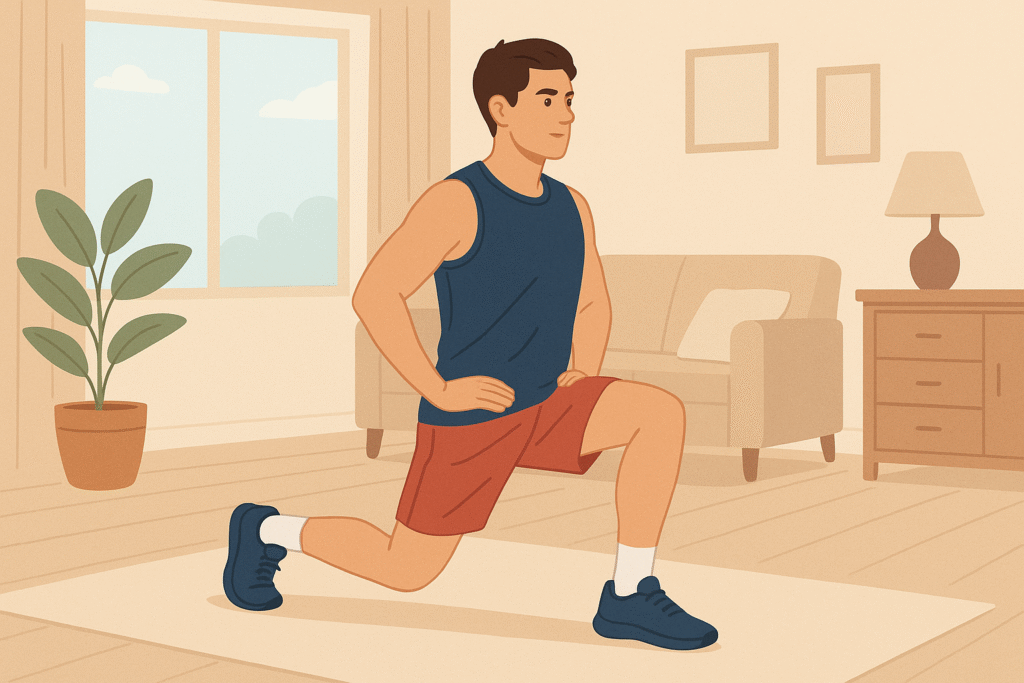
The first lunge of day one felt smooth.
The fifteenth felt like my quads were drafting a complaint letter.
By day three my legs had entered that special phase where soreness isn’t quite pain but also definitely isn’t comfort.
It’s the fitness equivalent of someone tapping you on the shoulder every five seconds just to remind you they exist.
What caught me off guard was how fast my stabilizers woke up.
The wobbly left-side dip I usually have — the one that makes me look like a baby giraffe still learning spatial awareness — began smoothing out by day six.
Not because I magically became an expert mover.
Just… repetition.
Same pattern.
Same setup.
Same demand on my balance.
Neuromuscular adaptation sliding in through the back door like, “Hey, mind if I help?”
Lunges Every Day = Core Activated
I expected leg work.
What I didn’t expect was how much my core got dragged into it.
Every rep challenged my midline.
Every step forward forced my torso to stay upright or risk collapsing like a folding chair at a barbecue.
I wasn’t trying to “activate my core” or perform some enlightened ritual.
It just kicked in out of necessity.
The Two-Week Lunge Challenge and That Sneaky Hip Tightness
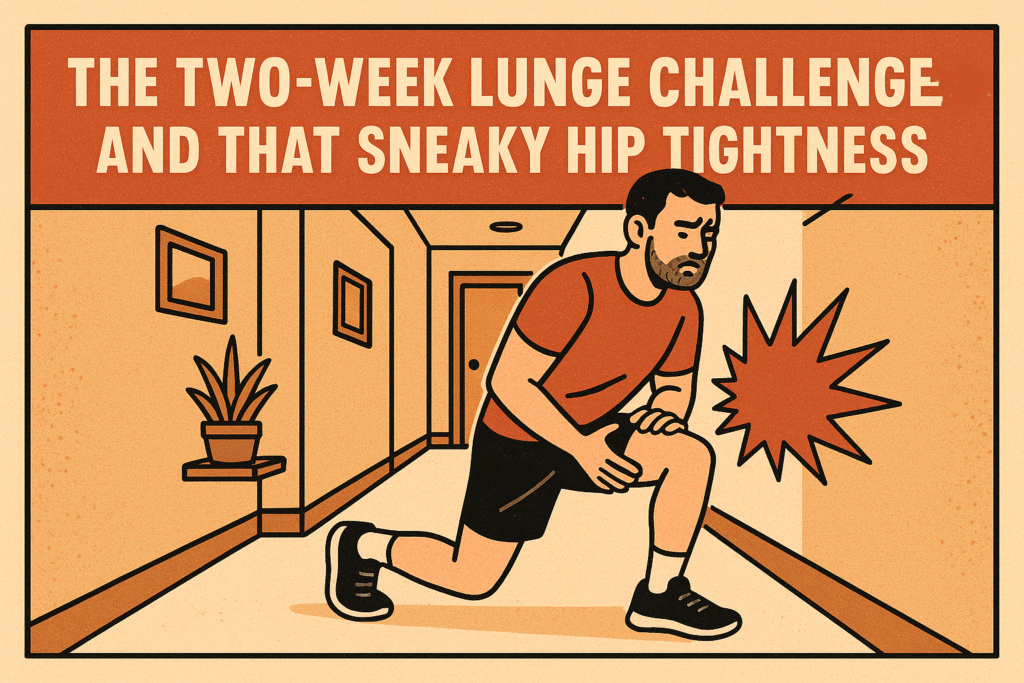
By day eight, a very specific tightness started creeping into the front of my hips.
Not soreness.
Not sharp pain.
Just a firm, “Hey pal, maybe choose something else today?”
Daily lunges stretch part of the hip while loading another.
That repetitive blend can create what feels like micro-rigidity — especially if you sit a lot (hello, laptop lifestyle).
I threw in a couple minutes of mobility: gentle leg swings, a quick couch stretch, and some slow pacing.
Boom.
The tightness backed off without drama.
What Improved Without Me Realizing (AKA the Subtle Wins)
Daily lunges didn’t change my entire physique in two weeks.
But they did change how my body behaved.
A few things became very obvious:
- My balance became cleaner
- My steps became more efficient
- My glutes stopped being passive bystanders
- My quads learned how to share the workload instead of acting like the main character
And the weirdest thing?
I started noticing tiny asymmetries.
My left hip sits a little forward.
My right ankle likes to roll out.
My stance width changes without me noticing.
Daily lunges are basically a built-in diagnostic tool.
You can’t hide anything from them.
The Conditioning Boost I Didn’t Expect
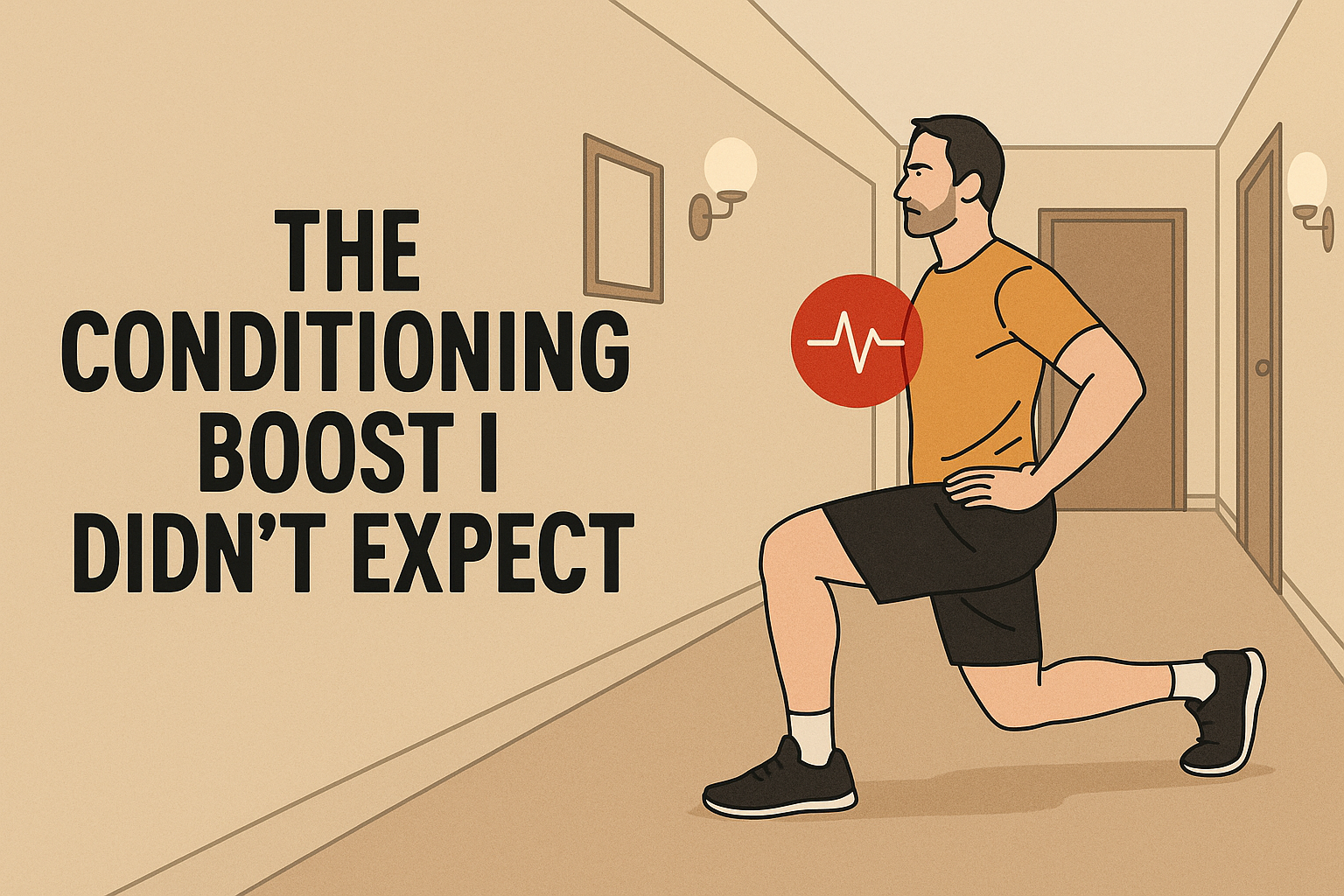
Something unexpected started happening during longer sets.
My heart rate crept up.
Not full-on cardio, but definitely “okay, this is legit work.”
Daily lunges add this low-key conditioning effect that sneaks up on you.
By week two, walking uphill felt easier.
Stairs didn’t feel like a mini quest.
My legs weren’t bigger — bodyweight lunges alone aren’t a hypertrophy miracle — but they felt prepared.
Before and After: The Shift Over the Two Weeks
Here’s the arc that surprised me.
The first 48 hours:
Everything was hesitation.
Balance felt shaky, hips felt weird, and I questioned my own coordination more than once.
Around day 7–10:
Movement felt smoother.
Less wobble, more control, fewer “why did my knee just do that” moments.
My body started trusting the pattern.
By the final stretch:
The movement became automatic in a way that felt strangely satisfying.
Not effortless — but definitely more locked in.
How to Do Daily Lunges Without Regretting It
This is the one piece that would’ve helped me from day one, so I’m dropping it here before your hips start yelling.
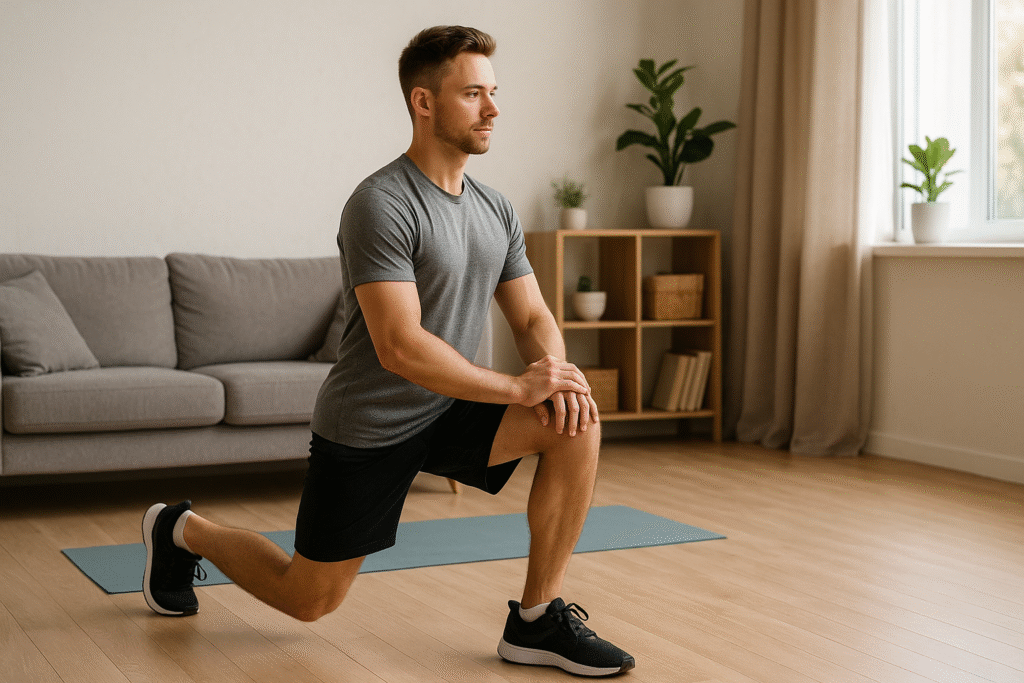
Step 1: Short stride = knee pain, long stride = butt work
If your front knee dives forward like it’s sniffing the ground, your stride is too short.
Take a slightly longer step — you’ll load the glute way more and spare your knee.
Step 2: Keep the torso tall-ish
You’re not a lamppost, but you’re also not a shrimp.
Stay comfortably upright.
Step 3: If your knee feels off, switch directions
Backward lunges are usually more knee-friendly.
Side lunges add variety and unload repetitive stress.
Step 4: If your hips tighten, don’t panic
Two minutes of gentle mobility solves 90% of it.
Step 5: Keep reps manageable
Daily doesn’t mean excessive.
Even 20–40 reps total are enough to notice a shift.
No need to grind your joints into dust.
The magic is in consistency, not volume.
A Quick Look Under the Hood: Why Daily Lunges Hit So Hard

This isn’t a science lecture, but here’s the simple breakdown.
Single-leg work boosts balance fast
Because your center of mass shifts every rep, your brain must recruit stabilizers instantly.
Repetition improves coordination
Your nervous system becomes faster at firing the right muscles in the right order.
Local endurance builds rapidly
Doing the same movement daily trains the tissue to handle repeated loading without complaint.
Core activation is unavoidable
If you don’t stabilize, you fall.
Simple as that.
Daily lunges aren’t magic — they just tap into fundamental motor learning.
RELATED:》》》 Leg Extensions and Weighted Lunges Replace Squats for Muscle Growth?
The Thin Line Between Stimulus and Annoyance
If you do daily lunges forever, your joints will eventually send you a newsletter titled: “We Have Notes.”
It’s not that lunges are harmful.
It’s that repetition creates patterns your tissues adapt to… until they plateau.
Then the movement shifts from training to monotony.
Your knees give tiny nudges.
Your hips send subtle reminders.
Your shins raise an eyebrow.
Not pain.
Just feedback.
Just a hint to mix things up once in a while.
Adding Variations Without Breaking the Streak
If you want to stick with daily lunges longer than two weeks, small tweaks help:
- swap forward with reverse lunges
- add pause lunges
- try walking lunges if you have space
- sprinkle in lateral steps
- add a slow eccentric if you want a spicy challenge
These tiny variations keep the stimulus fresh without turning the routine into CrossFit Gone Wrong.
Empathy Break: What You Might Feel If You Try This
If your first day feels like Bambi-on-ice, that’s normal.
If your hips complain around day five, that’s also normal.
If your balance becomes strangely better without you doing anything special, congratulations — your nervous system is doing its job.
If your legs feel heavier on random days, you’re not broken — you’re adapting.
Daily lunges aren’t a punishment.
They’re a small experiment in body awareness.
What Two Weeks of Daily Lunges Actually Delivered
Here’s the honest inventory of results I walked away with:
- sharper balance
- smoother coordination
- mild conditioning boost
- glutes that finally clocked in
- better awareness of asymmetries
- more confidence in single-leg work
- a reminder that small habits create big momentum
And yes, a bit of hip tightness that forced me to confront the fact that I sit too much.
Would I Keep Doing Daily Lunges Forever?
Probably not.
Not because daily lunges are pointless — they’re the opposite.
But the body thrives on variety.
There’s only so much you get from hammering the same groove repeatedly.
It’s like listening to the same playlist every day.
Feels great… until it doesn’t.
Then you’re craving something new.
Where Daily Lunges Fit in a Real Training Week
If you’re thinking of trying this experiment, here’s a simple way to keep it practical:
- do them as a warm-up
- or plug them into low-effort days
- or use them as a quick “movement snack” during office hours
- or include them in cooldowns to check your balance
No need to turn it into a whole program.
Daily lunges work best when they’re a sprinkle, not the entire recipe.
If You Keep Doing Daily Lunges Beyond Two Weeks
If you ever decide to push past the two-week mark, here’s the honest truth: the experience changes.
Not in a dramatic “my legs transformed overnight” kind of way, but in that subtle, whispery shift where your body starts negotiating with you.
The first thing you’ll notice is that your legs stop reacting with surprise.
They settle.
They cooperate.
They lose that “why are we doing this again?” attitude and start moving like, “Okay, this is our life now.”
But here’s where you need to play it smart.
Your tissues adapt to repetition fast, and once they do, the stimulus isn’t potent anymore.
That’s when daily lunges switch from being a challenge to becoming background noise — and background noise doesn’t build much.
If you keep going, mix in tiny upgrades:
- add a slower lowering phase
- throw in reverse lunges on the odd days
- pause at the bottom for half a breath
- change the tempo instead of the reps
- sprinkle in side lunges to keep the hips honest
You don’t need to turn it into a whole new program — just enough variation to keep your body awake.
A good rule of thumb?
If the lunges start feeling like checking emails — automatic, mindless, zero focus — it’s time to switch something.
And if your knees or hips send you that quiet “ahem… no thank you,” that’s not failure.
That’s your body telling you the streak served its purpose and it’s time to rotate the stimulus.
Go past two weeks if you want the habit, the balance, the control.
But don’t force the progression.
Let it stay a small ritual, not a badge of honor.
Because the moment lunges become a chore, they stop giving you anything valuable.
RELATED:》》》 Did Lunges Feel Way Harder Than Squats at First?
Conclusion
Daily lunges didn’t build superhero legs.
They built something better: consistency.
Two weeks of a simple movement gave me momentum in a time when I needed it.
It reminded me that you don’t need perfection to see progress — you just need repetition with intention.
And sometimes the smallest habits make the biggest difference.
If you want to try your own two-week experiment, your hallway is waiting.
And trust me — your future balance will thank you.