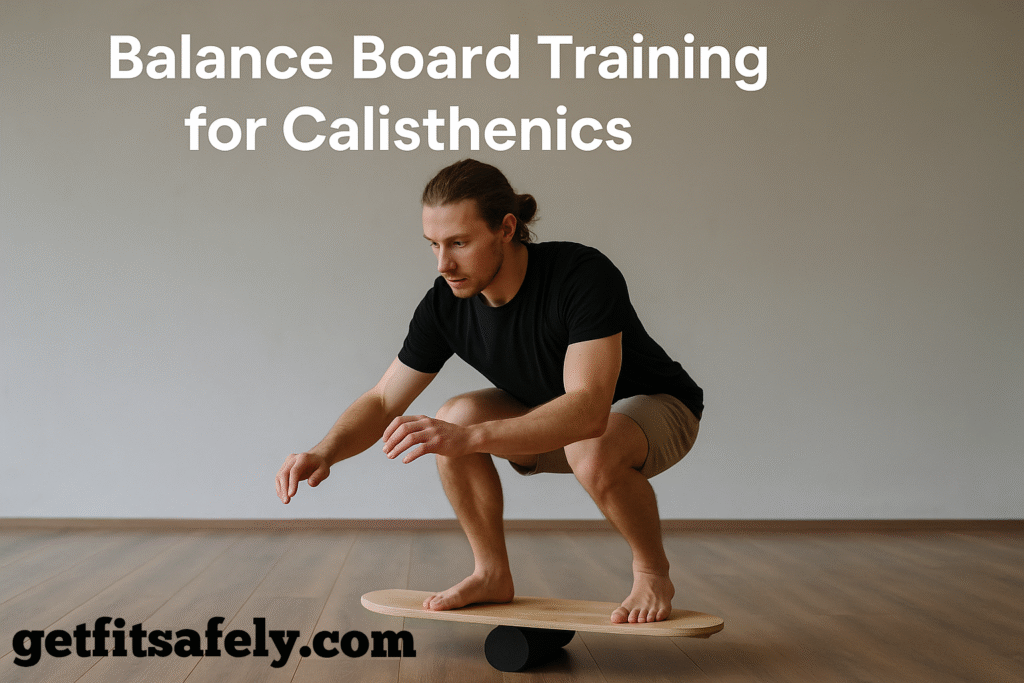
The first time a balance board enters the mix, it feels a bit ridiculous.
The body wobbles, the floor seems to move, and staying upright turns into a full-time job.
There’s nothing graceful about it — just a quiet fight to keep balance and dignity at the same time.
But after a few sessions, something starts to click.
Movements become steadier.
Transitions between exercises feel smoother.
The body begins to cooperate instead of argue with itself.
That’s when it becomes clear: a simple balance board can teach control in ways regular training never does.
Why balance work hits different in calisthenics
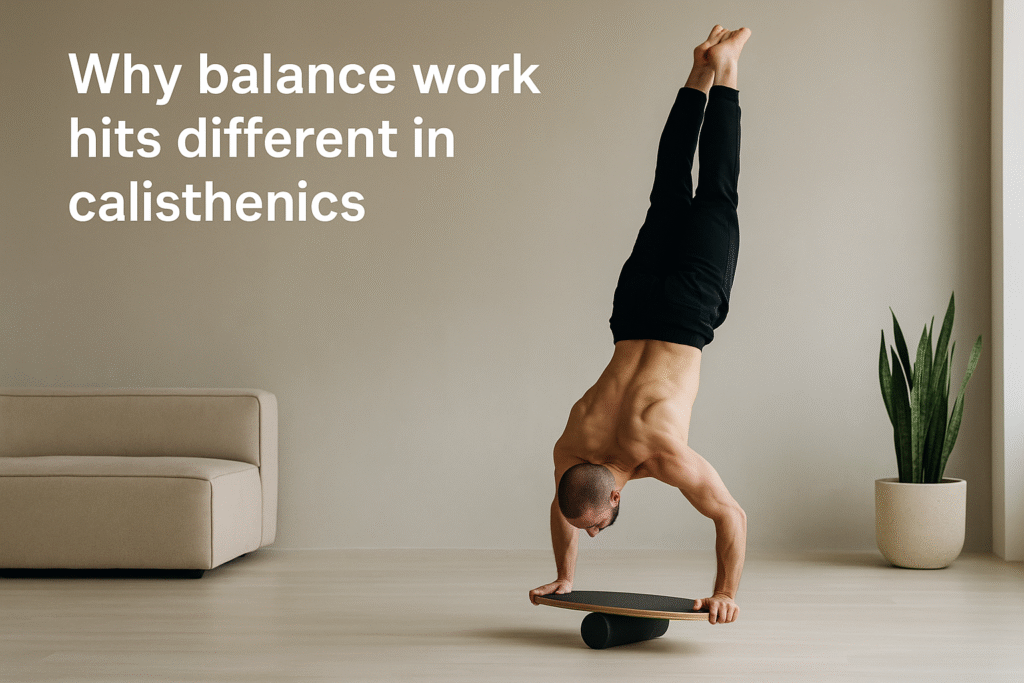
Calisthenics already demands control — you’re not just moving weight, you are the weight.
So when you add instability, it’s like cranking the volume up on every stabilizer muscle you didn’t even know existed.
Your wrists, forearms, scapulae, core — all those tiny players that usually sit on the bench suddenly have to show up and perform.
That’s why a 30-second handstand on the floor can feel totally different from 10 seconds on a balance board.
You’re not just balancing anymore.
You’re teaching your nervous system to make micro-adjustments faster than your conscious brain can react.
How it sneaks into your muscle control
The cool part?
You don’t even realize how much sharper your control gets — until you go back to the basics.
After a few weeks on a balance board, your push-ups feel tighter.
Your planche holds stop shaking like a cheap IKEA chair.
Even your pull-ups move smoother because your body finally learns to hold tension instead of fighting it.
It’s not really about brute strength.
It’s more about precision — how well your muscles cooperate when the ground isn’t doing you any favors.
A balance board forces that cooperation to happen instantly, with zero room for hesitation.
You can’t bluff balance.
Your stabilizers either work together or you’re kissing the floor.
Easy ways to sneak it into your training
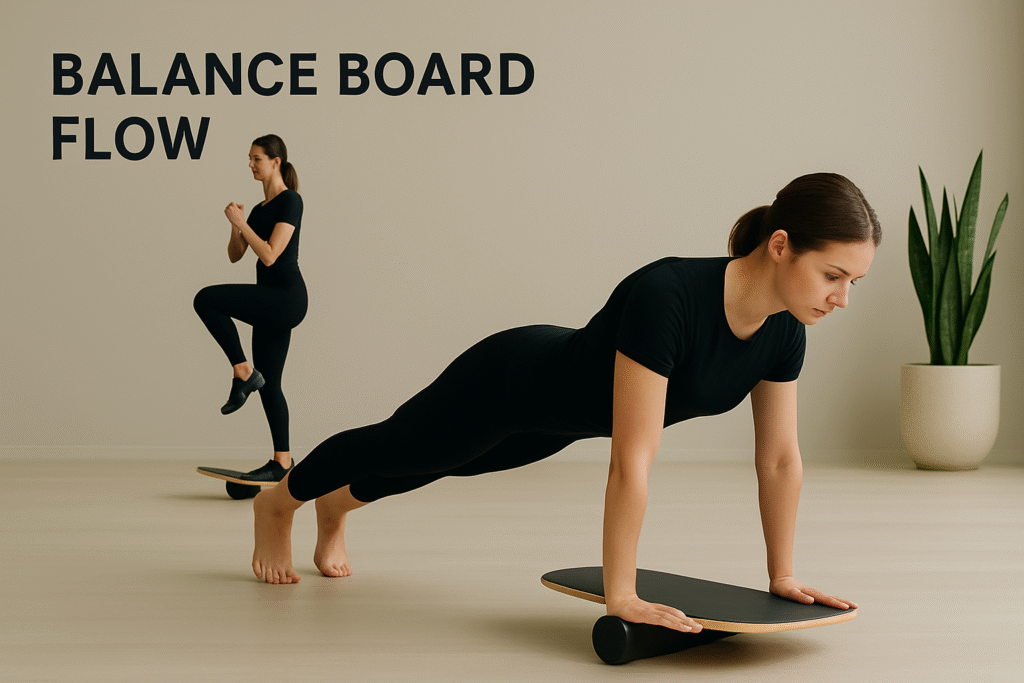
You don’t need to build your whole workout around it — just sprinkle it in.
Try these:
- Warm-ups: stand on the board and shift your weight side to side for 2–3 minutes.
- Handstand prep: place your hands on the board and practice shoulder shrugs or wall leans.
- Core finishers: plank holds or mountain climbers on the board (hello, humility).
- Single-leg drills: squats or toe-taps for ankle control and proprioception.
Keep sessions short and intentional.
The goal isn’t exhaustion — it’s awareness.
The Unexpected Perks of Getting Wobbly
Balance training doesn’t just boost your control — it bulletproofs your joints.
By constantly adjusting to micro-instability, your connective tissues (ligaments and tendons) adapt to stress more intelligently.
That’s a game-changer for calisthenics athletes, especially if you’re working toward high-skill moves like planches, levers, or presses.
Even your wrists — the most abused part of bodyweight training — get tougher when you integrate board work correctly.
And there’s another layer to it.
Balancing on a board demands full attention.
You can’t scroll, think about dinner, or argue with your playlist mid-set.
It’s you, gravity, and that small voice in your head going, “Don’t fall again.”
Not All Boards Are Created Equal
Not all boards are equal.
If you’re going for handstands or advanced balance work, a roller-style balance board (like Revolution or Blue Planet) gives the most dynamic instability.
For general control, rehab, or joint prep, a wobble board (with a dome bottom) does the job beautifully.
And if you want to mix both worlds — get one with adjustable difficulty.
A small hack with huge payoff
Here’s something I wish I’d known earlier: your core isn’t just your abs.
When you train on a balance board, your deep core — the transverse abdominis, multifidus, pelvic stabilizers — lights up in ways traditional ab workouts can’t replicate.
You’re not flexing abs.
You’re regulating balance through breath, tension, and alignment.
It’s subtle, but it’s the reason people who use balance tools tend to have that “solid from the inside out” look.
The kind of strength that doesn’t scream, but shows in how they move.
Proof That Your Balance Work Is Paying Off
You’re not just standing there wobbling for fun.
Let’s make it measurable.
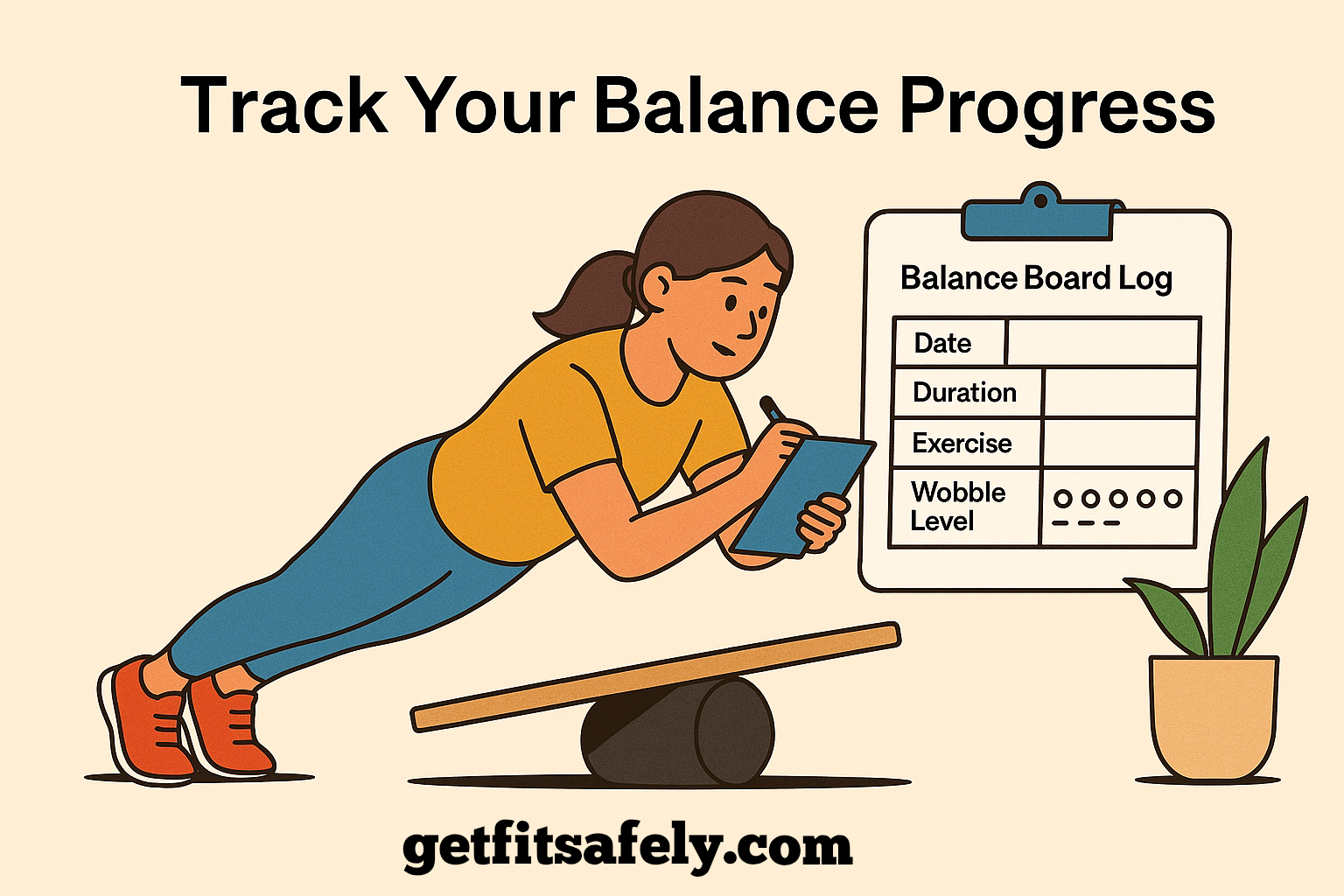
Keep a balance board log: date, duration, exercise type, wobble level (1-10), and how you felt.
Record before/after calisthenics performance: did push-ups feel tighter?
Handstands more stable?
Pull-ups smoother?
Track stabilizer fatigue: if you feel soreness around wrists, ankles, forearms, it means you’re hitting new territory.
That’s good — just keep volume moderate.
Use video analysis: filming your handstand on board vs floor will show micro-shifts in alignment you didn’t know you had.
Classic data point: studies show balance board training improves proprioception and reduces injury risk in rehab/athletic settings. (Healthline)
Use that as proof to yourself when you’re wobbling and doubting.
Why Most People Get Balance Training Wrong
Mistake #1:
Using a board every day like it’s a normal surface — bad idea.
Balance board sessions should be complementary, not replacement for foundational strength work.
Mistake #2:
Jumping into advanced moves too early.
Doing weighted pull-ups on a wobble surface? Recipe for disaster.
The upper body should only use board when your base control is solid.
As one review put it: unstable surface + heavy load = injury risk.
Mistake #3:
Ignoring ankles and wrists.
These are the crash-zones.
Use protective set-up: clear floor, maybe mats, maybe a wall or partner spotting initially.
Mistake #4:
Thinking it’s purely for beginners.
Nope.
Even advanced calisthenics athletes use balance tools to refine their skill — precision matters even at high levels.
How to Integrate Balance Board with Advanced Calisthenics Skills
Say you’re chasing the full planche, or front lever.
These high-skill moves demand not only raw strength but stability through weird leverage.
Here’s how to use a board strategically:
- Use board for hand-to-floor transitions: start standing on board, lean into a press-to-handstand → board adds instability so your entry is cleaner when you go back to floor.
- Partial planche holds with board under hands: you’ll feel wrist stabilizers fire in ways floor holds don’t.
- Front lever negatives: feet elevated, board under hands. The instability forces your scapulae and lats to maintain alignment more strictly.
- Pistol squats on board: one leg on board, other off. Builds ankle/knee/hip chain stability and single-leg control for progression into one-leg stand or shrimp squats.
The point: Use the board not just as additional volume, but as precision tool. When your wobble-training transfers back to the ground and your base moves get sharper, you’ll know you’ve leveled up.
| 💡 Recommended Read:
[Are there minimalist hacks to hide or store calisthenics equipment when not in use?] Discover clever, space-saving tricks to keep your bars, rings, and boards out of sight — without turning your home into a gym storage zone. |
Conclusion
Absolutely — if you’re patient enough to get through the awkward phase.
Because balance work doesn’t give you pump selfies or instant PRs.
What it gives you is precision.
Confidence.
The kind of stability that turns messy attempts into controlled performances.
And once that control kicks in, every calisthenics move you do — from planches to handstands to front levers — suddenly feels more natural, more connected.
So yeah, the penguin phase sucks.
But on the other side of that wobble is pure flow.
FAQs About Balance Board Training for Calisthenics
How long does it actually take to see results from balance board training?
Usually, you’ll start noticing real changes in about 2–3 weeks — not in how long you can stay on, but in how fast you recover balance after losing it.
That’s your nervous system adapting, not your muscles growing.
The more frequently (and consistently) you train those micro-adjustments, the more “automatic” control becomes during regular calisthenics work.
Can balance board work improve body awareness for skills like the planche or handstand?
Absolutely.
What happens is your brain starts mapping your body in space more precisely — a concept called proprioceptive feedback refinement.
So instead of reacting late to imbalance, your body predicts it before it happens.
That predictive control is exactly what turns a shaky handstand into a steady one.
Can balance board sessions help with recovery or mobility?
Yes — if you keep the intensity low.
Gentle rocking and controlled shifts can boost ankle and hip mobility while promoting blood flow.
That’s why some physiotherapists use balance tools in active recovery sessions.
Just avoid pairing it with fatigue-heavy workouts — balance requires alertness, not exhaustion.
What’s the best time to use a balance board in a workout?
Early in the session, right after a warm-up.
At that point your nervous system is fresh, and you can train coordination before fatigue kicks in.
Late in the session, your reaction time drops — that’s when most balance fails (and unplanned dismounts) happen.
Does it really burn calories or help with fat loss?
Not much — at least not directly.
It’s not a “cardio” tool, but it amplifies your energy expenditure by forcing micro-stabilization.
So if you’re doing planks, squats, or push-ups on a board, you’ll burn slightly more calories than on the floor — but the main win is better muscle recruitment, not fat burn.
How can breathing improve balance performance?
Huge factor.
When you hold your breath, your diaphragm stiffens and throws your center of gravity off.
Controlled breathing — especially exhaling slowly through balance transitions — keeps your core engaged but not rigid.
That’s why advanced athletes often sync breath with board movement: inhale for stability, exhale for correction.
How do I progress once basic balance feels easy?
Don’t just stand longer — change variables.
Try closing your eyes to remove visual input, or perform slow controlled movements like overhead reaches or single-arm holds.
These progressions challenge your vestibular system, not just your muscles, giving you a new layer of balance intelligence.
Can balance board work actually prevent injuries?
Yes — but only when used strategically.
Consistent board training strengthens the joint stabilizers that protect your knees, ankles, and wrists from awkward landings or slips.
However, overuse or combining it with maximal-load days can backfire.
Treat it like seasoning, not the main dish.
Is there an optimal surface for training with a balance board?
Use a flat, grippy surface with enough room for failure space.
Hard floors give better feedback, but if you’re practicing dynamic moves (like jump transitions), mats can absorb shock safely.
Avoid carpets — they dull responsiveness and mess with the board’s balance point.
Why does balance work feel more tiring than it looks?
Because your nervous system is burning through coordination fuel.
Every micro-adjustment costs a bit of brain power.
That’s why short, focused sessions (5–10 minutes) often feel more draining than a long static hold — you’re training neural endurance, not muscle fatigue.
Should beginners avoid using the board for handstands?
Not avoid — but respect the process.
Start by using it for scapular shrugs, plank balance, or wall-supported leans.
The board magnifies every mistake, so it’s smarter to earn your stability first before chasing free balance.
Does balance board training have carryover to other sports?
Absolutely.
Surfing, martial arts, parkour, even skiing — all rely on dynamic stability and quick corrections.
That’s why many elite athletes use balance tools to sharpen reactivity and proprioception, not just gymnasts or calisthenics practitioners.
Two or three focused sessions per week is plenty for noticeable results.