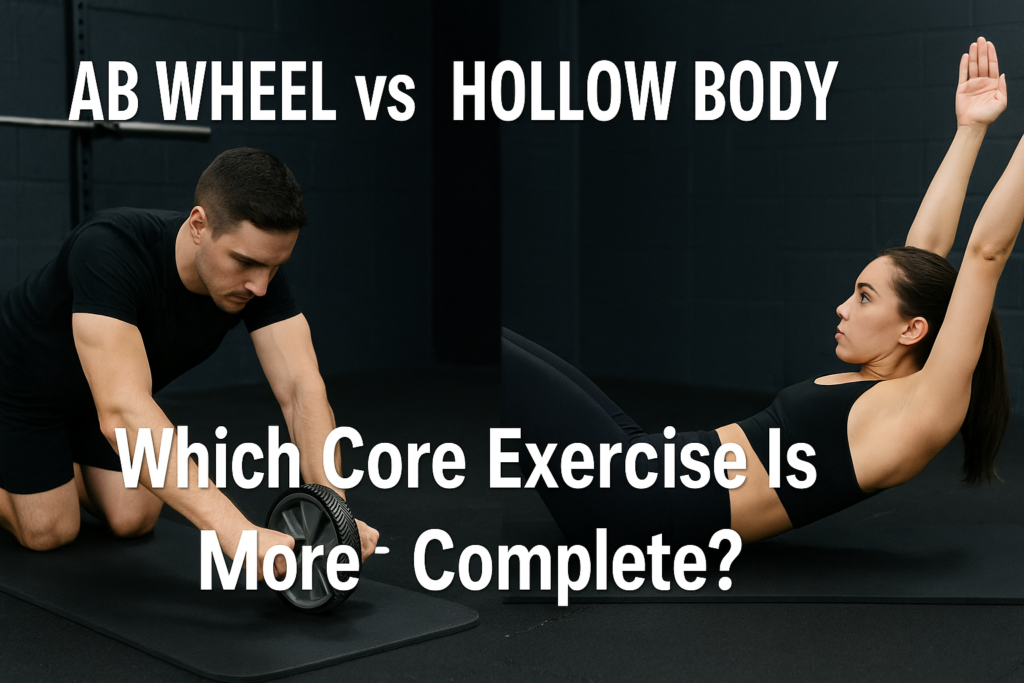
If you’ve ever tried to “fix your core” and ended up stuck between an ab-wheel rollout and a hollow body hold, you’re not alone.
Both exercises get hyped as “the ultimate core move”, both hurt your soul in a slightly different way, and both make you question your life choices around rep 3.
But if you had to pick one as your main core exercise, which one is actually more complete?
Let’s break it down in plain English, no guru talk, no miracle claims.
Quick recap: what each exercise really is
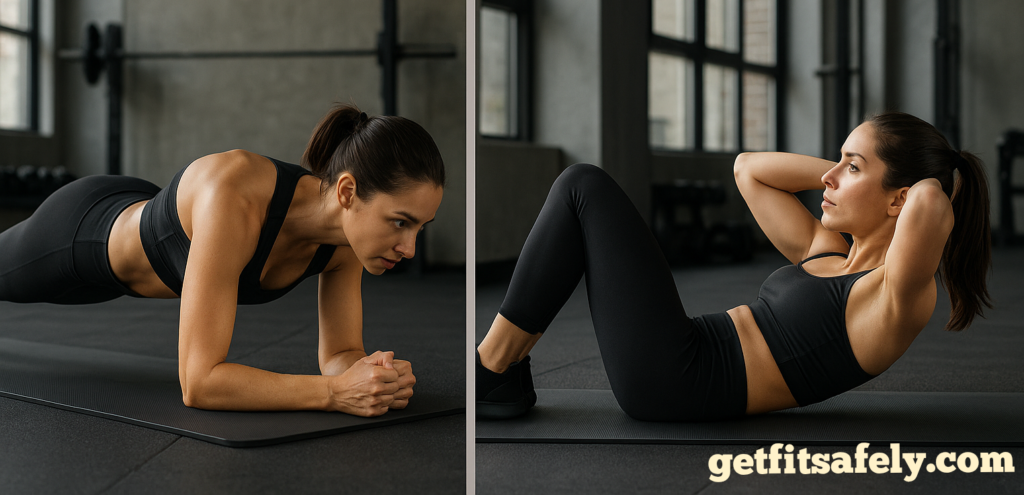
Before comparing, it helps to be super clear about what we’re talking about.
Ab-wheel rollout
You grab a little wheel with handles, kneel down, and roll your body forward while keeping your spine in a “locked” position.
The goal is to resist arching your lower back as your arms stretch out in front of you.
Then you pull back, still keeping everything tight.
In simple terms, it’s a moving plank with extra punishment.
Hollow body hold
You lie on your back, lift your shoulders and legs off the floor, and lightly tuck your pelvis so your lower back stays glued to the ground.
Arms usually reach overhead, biceps by the ears.
Your body turns into a slightly curved “banana” shape.
The goal is to create full-body tension from fingertips to toes without letting your back pop off the floor.
Think of it as “core lockdown mode” from gymnastics.
They’re both core exercises, but they’re not doing the same exact job.
One is dynamic and loaded (ab-wheel).
The other is static and control-based (hollow body).
What muscles are actually working?
Here’s where things get interesting.
Both exercises hit the “abs”, but not in the same way.
What the ab-wheel hammers
When you roll out, you’re doing an anti-extension move under load.
That means your core is fighting the urge of your lower back to sag and your ribs to flare.
Main players here:
- Rectus abdominis (the “six-pack” muscle)
- Deep core muscles (like the transverse abdominis)
- Obliques as stabilizers
- Lats and shoulders helping control the rollout
- Hip flexors and glutes helping you stay aligned
So the ab-wheel is not just “abs”.
It’s more like: abs + shoulders + lats + hips all working together in a long lever.
Very “full chain” vibe.
What the hollow body hold hits
Now the hollow body is more about control than load.
Key muscles here:
- Rectus abdominis (front abs)
- Transverse abdominis (deep brace muscle)
- Obliques keeping you from twisting or losing shape
- Hip flexors keeping your legs lifted
- Quads and glutes lightly engaged to keep position clean
You’re not moving, but you are constantly firing.
It’s like holding a perfect battle stance in an RPG: nothing dramatic is happening, but your character is fully ready to fight.
Bottom line on muscles
- Ab-wheel = more load, bigger lever, more involvement from upper body and lats
- Hollow body = more precision, more pure control, full-body tension with less external load
So if “complete” for you means heavier challenge with more muscles at once, the ab-wheel starts to win.
If “complete” means pure body tension and control you can take into gymnastics and calisthenics, the hollow body is king.
Strength carryover: which one helps more in real life (and training)?
Let’s talk about transfer.
You’re not training your core just to be good at core exercises.
You want carryover to:
- Lifts (squats, deadlifts, presses)
- Calisthenics moves (L-sits, levers, handstands)
- Everyday stuff (picking things up, staying pain-free, moving like a human and not a broken robot)
Carryover from ab-wheel rollouts
Ab-wheel teaches you how to keep your spine stable when your arms move overhead and your body is “opened up”.
That position is very similar to:
- Overhead pressing
- Handstands
- Front levers and back levers
- Heavy barbell lifts where you don’t want your lower back to arch like crazy
If you can do strong, clean rollouts, your “front side” stiffness is usually pretty solid.
It’s like turning up the core difficulty level from “plank” to “boss fight”.
Carryover from hollow body holds
The hollow body is literally a foundation position in gymnastics and advanced calisthenics.
It teaches you how to:
- Posteriorly tilt your pelvis (tiny tuck to protect the lower back)
- Keep ribs down and core locked
- Create tension along one continuous curve
That shape transfers directly into:
- Handstands
- Toes-to-bar and hanging leg raises
- Levers, hollow rocks, and a ton of bodyweight skills
If you want your body to move as one single “unit” instead of random pieces flying around, the hollow body is priceless.
So in terms of carryover, they’re both extremely useful, just in slightly different universes:
- Ab-wheel = more strength + anti-extension in long lever positions
- Hollow body = more control + body awareness for technical skills
Spine safety and injury risk: which one is “kinder”?
This is where many people go wrong.
Neither exercise is “bad”, but both can be brutal if your current level doesn’t match the difficulty.
Risk profile of the ab-wheel
The ab-wheel is unforgiving.
If your core can’t hold the position, your lower back will happily take over.
That usually shows up as:
- Lower back sagging at the bottom of the rollout
- Ribs flaring, butt sticking out
- Feeling the exercise more in the spine than in the abs
Done right, it’s an excellent anti-extension drill.
Done wrong, it’s a fast-track to cranking on your lumbar spine under load.
Risk profile of the hollow body hold
The hollow body looks innocent, but it’s sneaky.
You might feel:
- Hip flexors burning way more than your abs
- Neck strain if you over-crunch with the head
- Lower back arching if you drop the legs too low too soon
However, you have more control over the difficulty.
You can:
- Bend the knees
- Bring the arms down by your sides
- Raise legs higher to reduce the lever
That makes it easier to scale without loading your spine the way an ab-wheel does.
If your lower back is sensitive
Most people will be safer starting with hollow body progressions and only later moving to ab-wheel variations.
So in terms of safety and control, the hollow body usually wins.
The ab-wheel is fantastic, but it’s not a beginner toy.
Skill level: who should start with what?
Not every core exercise is for every phase of your journey.
Let’s keep it realistic.
Great starting point: hollow body progressions
If you:
- Are new to structured core training
- Have a history of lower back discomfort
- Struggle with basic planks or dead bugs
…then the hollow body (and its easier versions) is the smarter place to start.
You can build:
- Basic coordination
- Pelvic control
- Ribcage position
- Core endurance
All without needing extra equipment.
When to bring in the ab-wheel
Strong candidate signs that you’re ready:
- Planks feel solid for 45–60 seconds with good form
- Dead bugs and hollow body variations feel controlled
- You can brace your core properly in squats and deadlifts without your back turning into a hammock
At that point, the ab-wheel becomes an amazing “next step” to add intensity and challenge.
You don’t have to be advanced, but you do need some base competence.
Equipment, practicality, and time efficiency
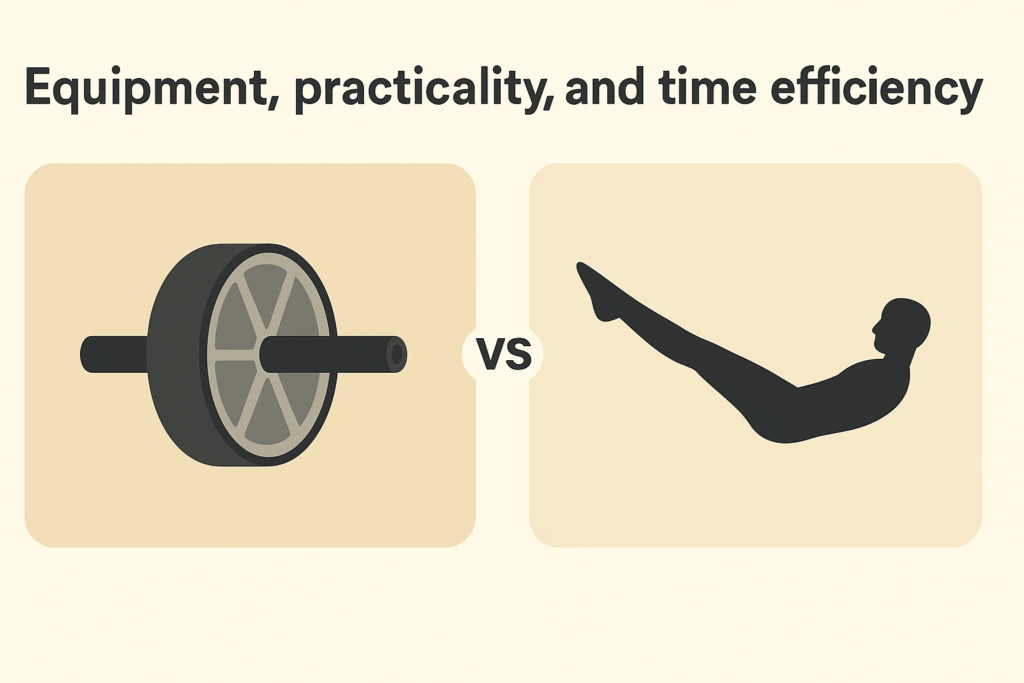
There’s also the boring but important side: logistics.
Hollow body hold wins on accessibility
- Needs zero equipment
- Can be done literally anywhere with a floor
- Easy to slot into warm-ups or cooldowns
It’s the bodyweight equivalent of a pocket tool: always available.
Ab-wheel wins on intensity per rep
- Requires a wheel (or a barbell that can roll)
- Needs some space, especially if you’re tall
- Delivers a lot of stimulus in very few reps
The ab-wheel can give you a huge core hit in 2–3 short sets.
The hollow body, being isometric, tends to require longer time under tension.
If your time is extremely limited and you already have the strength foundation, the ab-wheel gives you more “bang per rep”.
If you’re building your base or working out at home with nothing, hollow body is almost impossible to beat.
Common technique mistakes (and how to fix them)
Let’s quickly clean up form on both so you’re not just suffering for no reason.
Ab-wheel mistakes
- Starting too far from the knees, making the rollout way too deep
- Letting the lower back arch at the bottom
- Rushing the movement and bouncing back
- Holding your breath until your soul leaves your body
Fixes
- Start with partial rollouts and a shorter range
- Squeeze glutes and lightly tuck the pelvis as you roll
- Think “slow forward, controlled pause, strong pull back”
- Breathe out gently as you roll out, inhale coming back
Hollow body mistakes
- Lower back lifting off the floor
- Trying the “full banana” version too early
- Pulling on the neck with the hands
- Letting tension fade halfway through the hold
Fixes
- Start with bent knees and arms by your sides
- Focus on pressing the lower back into the floor first, then lifting legs and shoulders
- Keep the gaze slightly toward your knees, not toward your feet or ceiling
- Use shorter, high-quality holds (10–20 seconds) instead of forcing one long messy set
So… which one is more “complete”?
Here’s the real answer.
It depends on what you mean by “complete”.
If “complete” =
Trains a lot of muscles at once, in a long lever, with high tension
Then the ab-wheel is hard to beat.
You get:
- Anti-extension strength
- Shoulder and lat involvement
- High intensity in low reps
- A very obvious skill/progression element
If “complete” =
Builds deep control, pure body tension, and transfers to technical skills
Then the hollow body is your foundation.
You get:
- Deep core activation
- Pelvic and rib control
- Full-body tension without external load
- A base for calisthenics, gymnastics, and cleaner movement in general
For most lifters and bodyweight trainees, the most honest conclusion is:
Both are excellent.
They’re just different tools.
Where these two actually meet
Instead of asking “which one should I choose forever?”, it’s more useful to ask:
“How do I plug both into my training without dying?”
Beginner-friendly approach
Focus on hollow body first, sprinkle in ab-wheel later.
Phase 1 – Control base (4–6 weeks)
2–3 times per week after your main workout:
- Dead bug or basic core brace: 2–3 sets of 8–10 slow reps each side
- Hollow body tuck hold (knees bent, arms by sides): 3 sets of 15–20 seconds
- Optional: simple plank 2 × 20–30 seconds
Here you’re learning how bracing should feel.
Phase 2 – Add a taste of ab-wheel (4–6 weeks)
2–3 times per week:
- Hollow body hold (one leg extended, one bent): 3 sets of 20 seconds
- Kneeling ab-wheel partial range: 3 sets of 4–6 reps
Keep the range short enough that your back stays neutral the whole time.
Intermediate approach
Now both moves coexist in the same week.
Twice per week core focus, for example:
Day A (Control + Endurance)
- Hollow body hold (full or near full): 4 × 20–30 seconds
- Side plank: 3 × 20–30 seconds per side
Day B (Strength + Intensity)
- Kneeling ab-wheel rollout: 4 × 5–8 slow reps
- Hanging knee raises: 3 × 8–10 reps
Advanced approach
If your core is already solid, you can push both pretty hard.
Twice per week, high challenge:
Day A – Gymnastics-style core
- Hollow rocks: 3 × 10–15 reps
- Full hollow body hold: 3 × 25–35 seconds
- Toes-to-bar or strict hanging leg raises: 3–4 × 6–8 reps
Day B – Strength-biased core
- Ab-wheel rollouts (kneeling, deep range): 4 × 6–10 reps
- Ab-wheel from standing to a wall (short range) or elevated standing rollouts: 3 × 3–5 reps
- Optional finisher: short hollow body holds 2 × 15 seconds just to remind your body how to stay tight
How to choose on a busy week
Sometimes you don’t have the time or energy for both.
Here’s a simple decision tree.
Pick ab-wheel if:
- You feel strong and want a short, brutal core hit
- You’re already warmed up and your lower back feels okay
- You’re focusing on big compound lifts or athletic power and want more anti-extension strength
Pick hollow body if:
- You’re training at home with no equipment
- You want to reinforce control and technique
- Your back feels a bit tired and you still want core work without loading it too aggressively
- You’re working toward calisthenics or gymnastics skills
You can also alternate: ab-wheel one session, hollow body the next.
That way you get the benefits of both across the week without overcomplicating your program.
Realistic expectations: what they will and won’t do
Both of these moves are amazing, but they’re not magic.
They will:
- Make your core stronger and more stable
- Improve your ability to keep position under load
- Help your lifts feel more solid
- Reduce the “noodle midsection” effect in demanding movements
They won’t by themselves:
- “Burn belly fat” in one specific area
- Replace a full program with proper nutrition, sleep, and progressive overload
- Fix every shoulder, hip, or back issue without addressing your overall training
Final verdict
If you define “complete” as:
One single core exercise you’d keep if you had to delete all others.
Then a strong case can be made for the hollow body hold for most people.
Why?
- No equipment needed
- Easily scalable
- Builds pure, technical control you can use in almost every movement pattern
However…
If you’re already past the basics and want a high-intensity, full-chain core move that makes your whole front side work together, the ab-wheel might feel more “complete” for your goals.
The most balanced answer is this:
- Hollow body = foundation and control
- Ab-wheel = upgrade and intensity
Build one, then layer on the other.
You don’t have to turn this into a battle.
Think less “Ab-Wheel vs Hollow Body” and more “Hollow Body first, Ab-Wheel next”.