I remember perfectly my early days in the gym: for me, the “real” chest day was measured by how hard it was to roll over in bed the morning after.
If I didn’t wake up with the feeling of a truck parked on my sternum, I would start to panic.
“Did I even train my chest, or did I just push with my arms for nothing?”
Over time I realized the truth that almost no one tells you at the beginning: post-workout soreness is not the yardstick of muscle growth.
The myth of post-workout soreness
The famous DOMS (Delayed Onset Muscle Soreness) is like that friend who only shows up when it feels like it.
Sometimes you smash a killer session and the next day you feel fresh as a daisy.
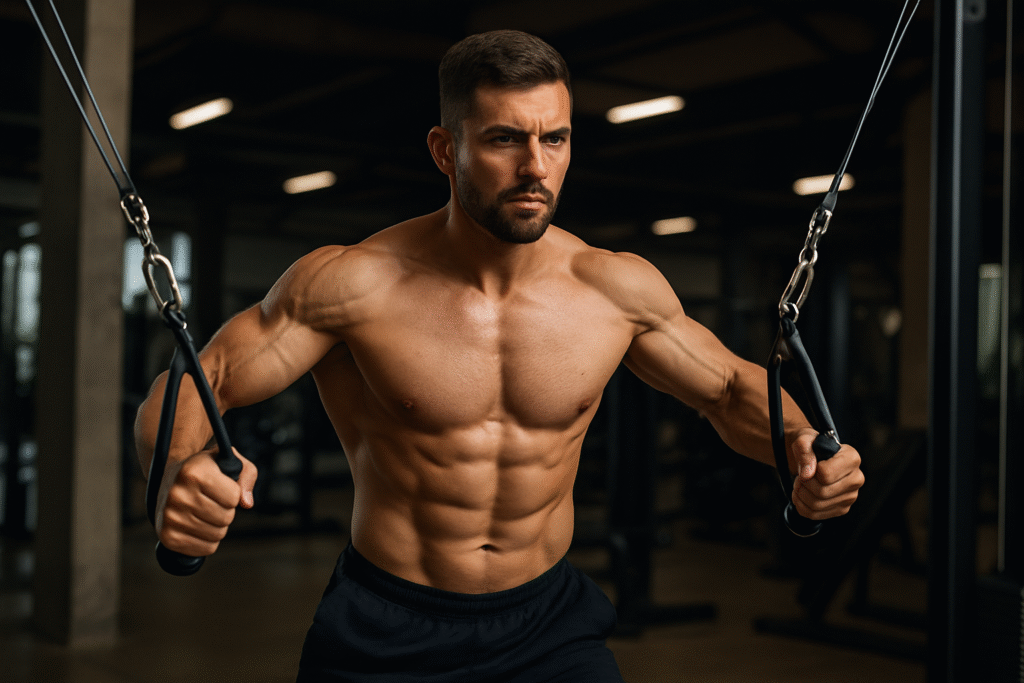
Other times, just one set of cable flyes at a different angle and suddenly you can’t lift your arms to put on a T-shirt.
The reality is that soreness doesn’t mean the workout was more or less effective.
Most of the time DOMS is linked to novelty of the stimulus, not its true value for hypertrophy.
A new exercise, a slower time under tension, an angle you never tried before… the muscles rebel.
But once your body adapts, the soreness fades even though the workout is still stimulating them.
So, if you don’t feel your chest “screaming revenge” the next day, it doesn’t mean your training failed.
It might actually mean your body is becoming more efficient at handling that stress.
Why you never feel your chest after a workout
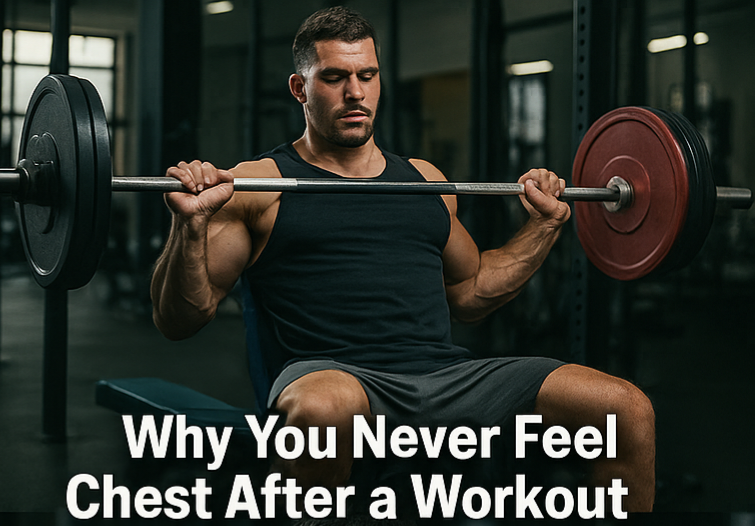
There are several reasons why your pecs don’t seem sore:
- Shoulders and triceps steal the show.
If you push too much with your arms during presses, the chest activation stays minimal. - Adaptation.
If you’ve been doing the same movements for months, your body has already learned to handle them without much trauma. - Limited range of motion.
Half reps may pump you up in the mirror, but often don’t give the stretch and contraction needed to really stimulate the chest. - Genetic and fiber differences.
Some muscle groups just don’t “make themselves felt” much in certain people. Maybe your pecs recover faster than, say, your quads.
Does soreness mean nothing?
Not exactly.
If you never feel your chest working even during the exercise, then there’s a problem.
It could be bad technique, wrong exercise selection, or poor muscle engagement.
For example: if you bench like it’s a tricep extension with a huge powerlifter arch, your pecs won’t be very involved.
On the other hand, if you feel your pecs tense during the set—when lowering a dumbbell slowly in a press or squeezing hard at the end of a fly—you’re on the right track, even if you’re not wrecked the next day.
Practical tricks to fire up your chest
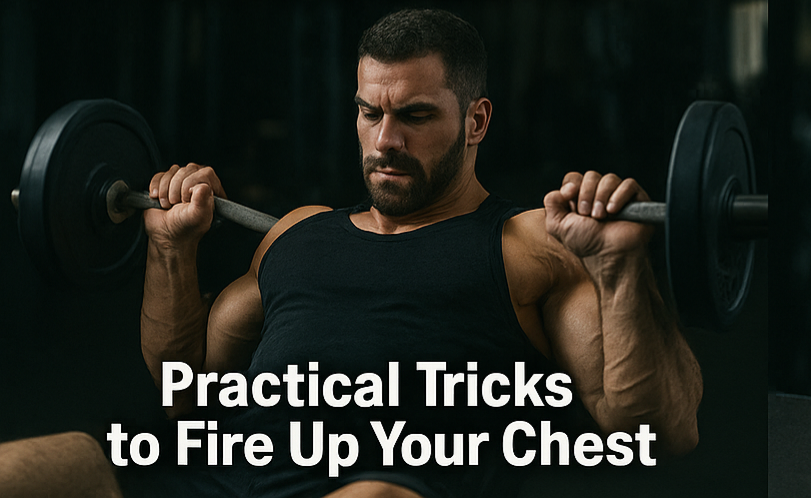
If you want to make sure your chest is the star and not just a background actor, try these tips:
- Control the eccentric phase, the lowering of the weight.
- Add pauses at the chest instead of bouncing the bar.
- Mix dumbbells and cables with the barbell: they offer a bigger stretch and more stabilization.
- Do a light pre-activation with flyes before heavy presses so the muscle is “awake.”
- Play with angles: incline, flat, decline. The chest isn’t uniform; different zones respond differently.
When Soreness Becomes a Distraction, Not a Goal
Chasing soreness is like chasing the feeling of your first crush: exciting, but misleading.
Over the long run, training becomes less about “feeling destroyed” and more about consistency, measurable progress, and raising the bar.
The soreness fades, but the growth stays if you feed your body right and push it progressively.
It’s like brushing your teeth: you don’t need sore gums to know it’s working.
Pay attention to the kind of stimulus you’re giving your chest
Not all stimuli produce the same response.
Sometimes we only focus on heavy loads, other times only on the pump.
The truth is, pecs respond best to a combination of tension, stretch, and max contraction.
A practical example: barbell bench press is great for loading weight, but doesn’t always give maximum contraction.
On the flip side, a cable fly won’t make you a legend with the plates, but it gives an incredible stretch and squeeze.
Moral?
A chest that grows well usually comes from programming that alternates both types of stimulus.
It’s not just about being “strong,” but about giving the muscle more than one kind of stress.
Why Technique Beats Just Moving the Weight
Okay, you don’t need to get mystical in front of the mirror, but a bit of muscle awareness changes everything.
Many train their chest thinking only about moving the weight, when really they should focus on how they move it.
Trying to “press” your palms against each other during a dumbbell press, or squeezing your pecs hard at the top of a movement, may sound simple but amplifies activation.
It’s like switching from autopilot driving to steering with both hands firmly on the wheel: the trip is the same, but the control is different.
When science ruins the myth (and still makes you grow)
I did some detective work through recent studies and blogs, and guess what?
The verdict is always the same: you don’t need to feel wrecked to grow.
Some sports doctors explain that DOMS is just your muscles saying, “hey, we’ve never done this before.”
Then they adapt, and stop complaining even if you’re still pushing them.
It’s like having a roommate who at first complains about every dirty dish, then gives up.
Coaches and pro athletes repeat it too: soreness is not a magic ticket.
If you’re not sore, it may mean you’re recovering better, your nutrition is supporting your muscles, or your body leveled up.
It’s not failure—it’s a sign of adaptation.
And then there’s the hard data: in a recent study, people training with progressive overload gained muscle and strength over eight weeks, no matter how sore they felt.
Translation: real growth comes from adding weight, reps, or volume—not from cursing in the morning when brushing your teeth.
Plenty of coaches hammer this home: no soreness doesn’t mean no progress.
The real metric is seeing your numbers go up, your sets get smoother, your form get better.
Those are the quiet but concrete signs you’re on the right path.
Bottom line: chasing soreness is for beginners.
Chasing progress is for those who want a chest that fills the shirt.
Conclusion
If you don’t feel chest soreness the day after, don’t panic.
It doesn’t mean your workout didn’t work.
Focus on form, progression, and activation during the set, not on how much you groan while sipping coffee the next morning.
Muscles don’t grow because you suffer.
They grow because you stimulate them smartly, feed them, and let them recover.
And if you occasionally want that burning chest sensation?
Just switch up exercises or add new variations. Your body will notice.