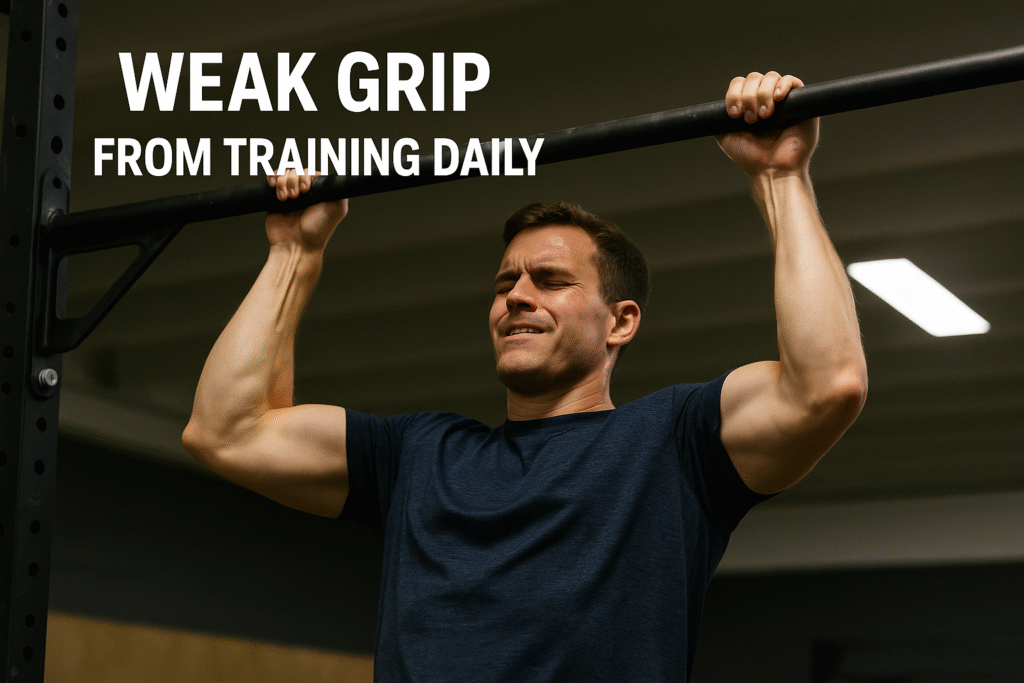
I noticed it the first time while hanging from the pull-up bar after a long week of “I-swear-this-is-my-last-set” calisthenics sessions.
My hands felt like two tired puppies refusing to walk another step.
The weird part?
I was training more than ever.
More hangs.
More pull-ups.
More reps, more sets, more “just one more” moments.
And still… my grip felt softer than day-old pancakes.
If you’ve been there, you know exactly what I mean.
That sinking “why the heck am I getting weaker?” feeling hits hard.
And it’s confusing, because calisthenics is supposed to build insane grip strength — not sabotage it.
Let’s break down what’s really happening, without the boring textbook tone and without pretending like everything is just “overtraining” and calling it a day.
A Quick Guide to Fixing Grip Fatigue in CalisthenicsYour body loves homeostasis — that safe, predictable comfort zone. When you hammer the same pulling patterns every day, your forearms rack up fatigue faster than you notice. That’s why your grip fails before anything else. Rotate your grips. Spread out heavy pulling days. Fuel with carbs on high-volume sessions. And take at least one real recovery day. Do that, and your grip stops dying long before your back or biceps do. |
Grip Weakness From Daily Calisthenics

Grip strength doesn’t just come from training your forearms or doing a million pull-ups.
It comes from recovery, tissue quality, neural readiness, and even basic stuff like your hydration or sleep.
When one of these slips, your grip is the first thing to quit on you — because grip muscles fatigue faster than almost anything else you use during bodyweight training.
What happens is subtle.
Day one feels fine.
Day two feels heroic.
Day three feels “okay, maybe I’m a little tight.”
By day five, your hands feel like they’re typing resignation letters.
Daily calisthenics piles stress on your flexors, your tendons, and the tiny stabilizers around your wrists.
And these tissues don’t magically rebuild overnight just because you posted your workout story on Instagram.
Daily Grip Work Creates Micro Fatigue You Don’t Feel Until It’s Too Late
You know when a rope starts to fray at the edges?
That’s your forearm flexors after too many days of intense hangs, pull-ups, levers, and rows.
Most people never realize how much grip is involved in calisthenics training.
It’s literally the foundation.
When you train every day, you create small pockets of fatigue that stack like bricks.
Your nervous system eventually says, “Buddy… we need a break,” and lowers your power output.
The result?
Your hands feel weaker even though your muscles are technically getting stronger.
It’s like having a Ferrari engine with bicycle brakes — the system can’t keep up.
Grip Strength Relies Heavily on the Nervous System — Not Just Muscles
This part hits people unexpectedly.
Grip strength is a neurological skill.
Your brain decides how strongly you’re allowed to squeeze something.
When you train every day, the nerves running down your arm get tired even if the muscles don’t feel sore.
Your “signal strength” weakens.
You might still feel capable, but the neural output drops like a Wi-Fi connection during a storm.
That’s why sometimes your grip doesn’t fail gradually… it fails suddenly.
One day you hang for 45 seconds.
The next you fall off the bar at 18 and whisper, “What just happened?”
Forearm Tissues Recover Slower Than Big Muscle Groups

Your back might feel ready.
Your shoulders might feel ready.
Your core might feel amazing.
Your forearms are just sitting there like, “We need two business days to process this request.”
Forearm flexors and tendons get less blood flow than large muscles.
Less blood flow = slower recovery.
Slower recovery = grip weakness even if the rest of your body feels unstoppable.
Technique Decay Happens When You’re Fatigued (And You Don’t Notice)
Fatigue makes your form sloppy in micro ways.
Your wrist angle shifts.
Your thumb stops hooking the bar the same way.
Your shoulder blades stop setting tight.
You don’t notice these things because you’re focused on reps.
But your grip notices.
It compensates for tiny technical errors by squeezing harder — meaning it burns out faster.
By the time you realize “wow, my grip sucks today,” the damage is already accumulating.
Your Grip Gets Weaker If Your Lower Body Is Fatigued Too
Wild fact:
If your legs are exhausted — from squats, deadlifts, sprinting, whatever — your grip strength drops even if your arms feel fine.
Why?
Your nervous system doesn’t split energy evenly like a pizza.
It prioritizes big muscle groups.
If your legs demand more recovery or neural bandwidth, your grip is one of the first things that gets downgraded.
This is why climbers who train legs the day before notice their grip feels like wet noodles.
Dehydration Kills Grip Faster Than Cardio Does
This one is brutal.
Your forearm muscles rely heavily on fluid balance.
If you’re even slightly dehydrated, your contractions weaken fast.
Training calisthenics daily — especially with lots of hangs, push-pull supersets, or outdoor sessions — drains water and electrolytes way faster than you think.
If your hands feel like they’re dying halfway through your warm-up, and you also realize you drank exactly “one sad glass of water and two coffees,” congratulations:
Your grip isn’t weak.
You’re just thirsty.
Your Grip Drops When You Don’t Sleep Enough — Even If You Feel Fine
There’s research showing sleep loss can tank strength output even if the athlete says, “I feel totally okay.”
Well… your grip doesn’t care how you feel.
It cares about how well your nervous system is firing.
One bad night won’t destroy you.
But several short nights?
Your reaction time, your muscle firing rate, and your hand endurance all drop.
Suddenly your grip collapses halfway through a set you normally crush.
Calisthenics Is Grip-Dominant — Way More Than You Think

Even exercises that don’t look like grip work still drain your hands.
Push-ups?
Your wrists absorb load that fatigues the flexors.
Hollow body holds?
Your forearms tense more than you realize.
Dips?
Your stabilizers are gripping the bars for dear life.
Row variations, pull-up variations, isometrics…
Your grip never gets a day off.
Daily calisthenics basically turns your forearms into overworked baristas at the 8 a.m. rush.
Eventually something gives.
When Your Grip Weakens, Your Form Changes — And That Creates a Spiral
This part is sneaky.
Weak grip changes the way your shoulders engage.
Weak grip changes your scapular tension.
Weak grip changes your elbow tracking.
All of this makes your upper body work harder to compensate.
You burn out faster, feel “off,” and sometimes even get little aches or niggles you can’t explain.
It’s never just the grip.
It’s the chain reaction behind it.
Nutrition Plays a Bigger Role Than People Admit
Low carbs?
Heavy calorie deficit?
Skipping meals because you “weren’t hungry?”
Your body might survive it.
Your grip doesn’t.
Forearm endurance relies heavily on glycogen — the carbs stored in muscles.
If you’ve been eating like a bird trying to “stay lean,” your grip is probably writing complaint letters to HR.
How to Bring Your Grip Strength Back Without Stopping Calisthenics
You don’t need to quit your daily training to fix this.
But you do need to be smart about how you manage the load.
Here’s what helps without ruining your routine:
- Rotate grip demands: one day heavy hangs, another day more technique work.
- Use different grips: neutral, chin-up, fat grip, towel grip, ring grip.
- Lower your total time under tension once or twice a week.
- Add one actual rest day every 7–10 days (not every 3 days, you machine).
- Increase carbs and fluids on days with more hangs or pulling volume.
- Check your warm-up: a cold grip dies fast.
Think of it like giving your forearms a spa day — but a productive one.
Understanding Grip Weakness Helps You Train Without Losing Steam
Grip weakness isn’t random.
And it’s not a sign that you’re getting worse.
It’s your body waving a yellow flag saying:
“I can keep going… but maybe let’s not be a hero today.”
Calisthenics requires long-term consistency, and consistency requires respecting your recovery cycles.
You’re not losing strength.
You’re managing a system that’s finally telling you the truth.
Once you give your grip the right balance of load, rest, variety, and recovery, something cool happens:
Your numbers climb again.
Your hangs get longer.
Your pull-ups feel smoother and your wrists stop whining.