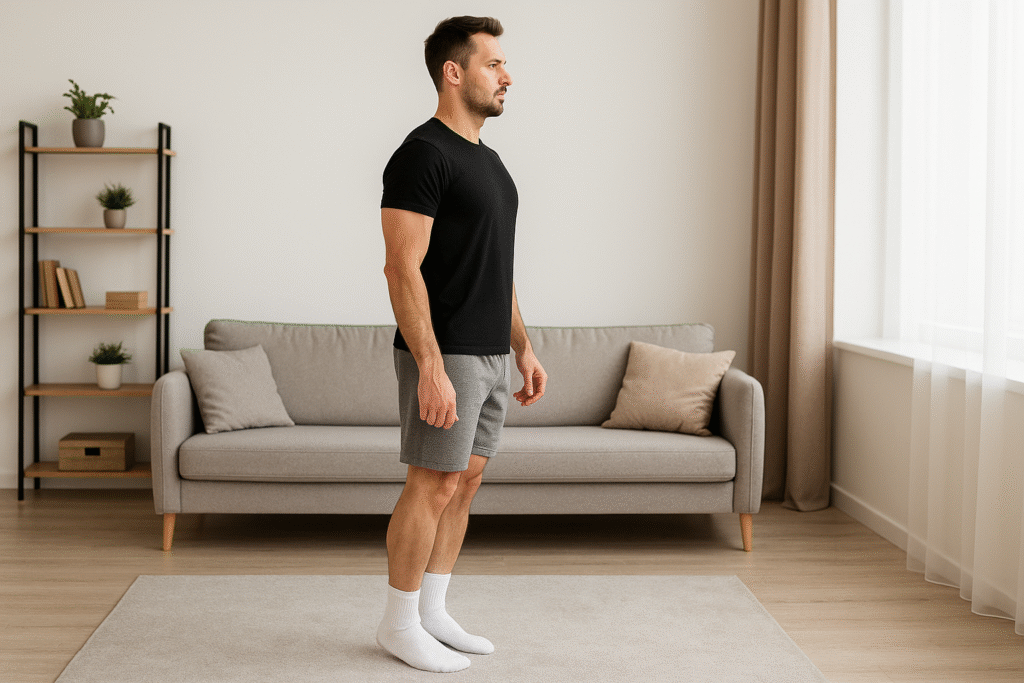
I used to think training calves at home felt like trying to microwave a steak.
The ingredients are technically there, but something about the environment just feels wrong.
No gym.
No staircase.
No dumbbells.
Just me, my living room, and two stubborn muscles that refuse to grow unless I bribe them with heavy weight or borderline humiliation.
But months of working out at home taught me something I didn’t expect.
Calves don’t need fancy equipment.
They need tension, consistency, and a willingness to look ridiculous doing extremely simple movements over and over until your legs finally get the memo.
Why Training Calves at Home Works Even Without Weights
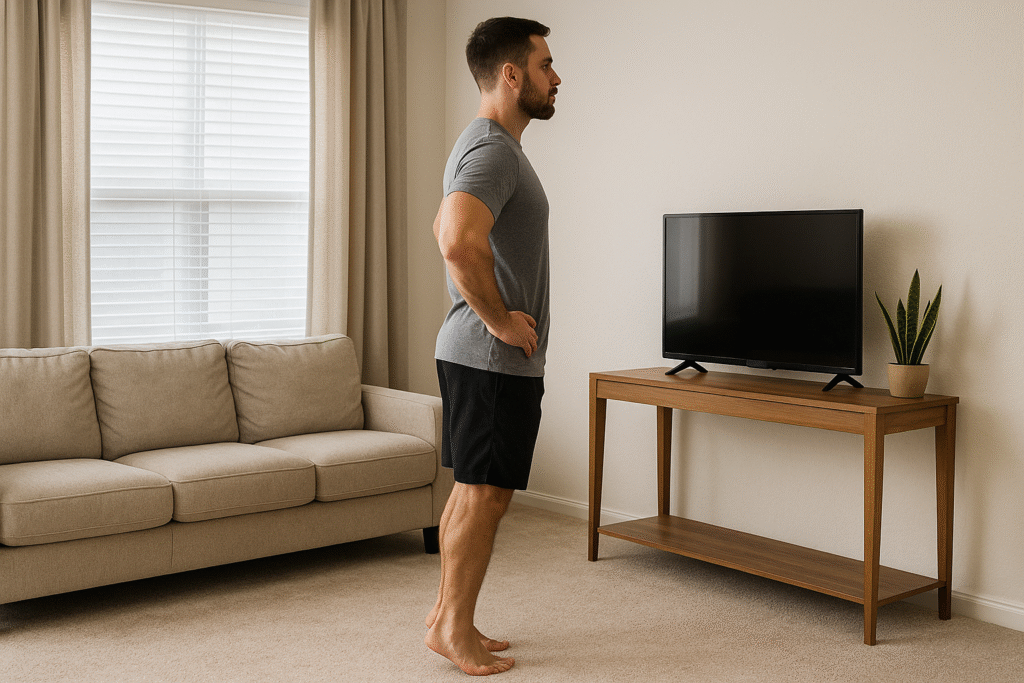
Calves respond primarily to mechanical tension and repeated loading.
That means they don’t only grow from heavy weights.
They grow from load plus time plus fatigue.
Which is perfect, because bodyweight movements can easily deliver two of those three.
And with the right tweaks, they can check all three boxes.
Most people assume you need weights because calf raises feel too easy.
But that’s only true when you do them the standard gym-bro way.
Standing tall.
Quick bounce.
Half-rep.
Walk away thinking you just smashed calves, when in reality you just performed the equivalent of a polite handshake.
At home, without weights, you’re forced to slow things down.
Pause.
Breathe.
Stretch the muscle until it screams.
Then push through that burn longer than your brain feels comfortable.
That’s actually more hypertrophy friendly than rushing heavy reps you don’t control.
How to Train Calves at Home Without Equipment (And Actually Feel It)
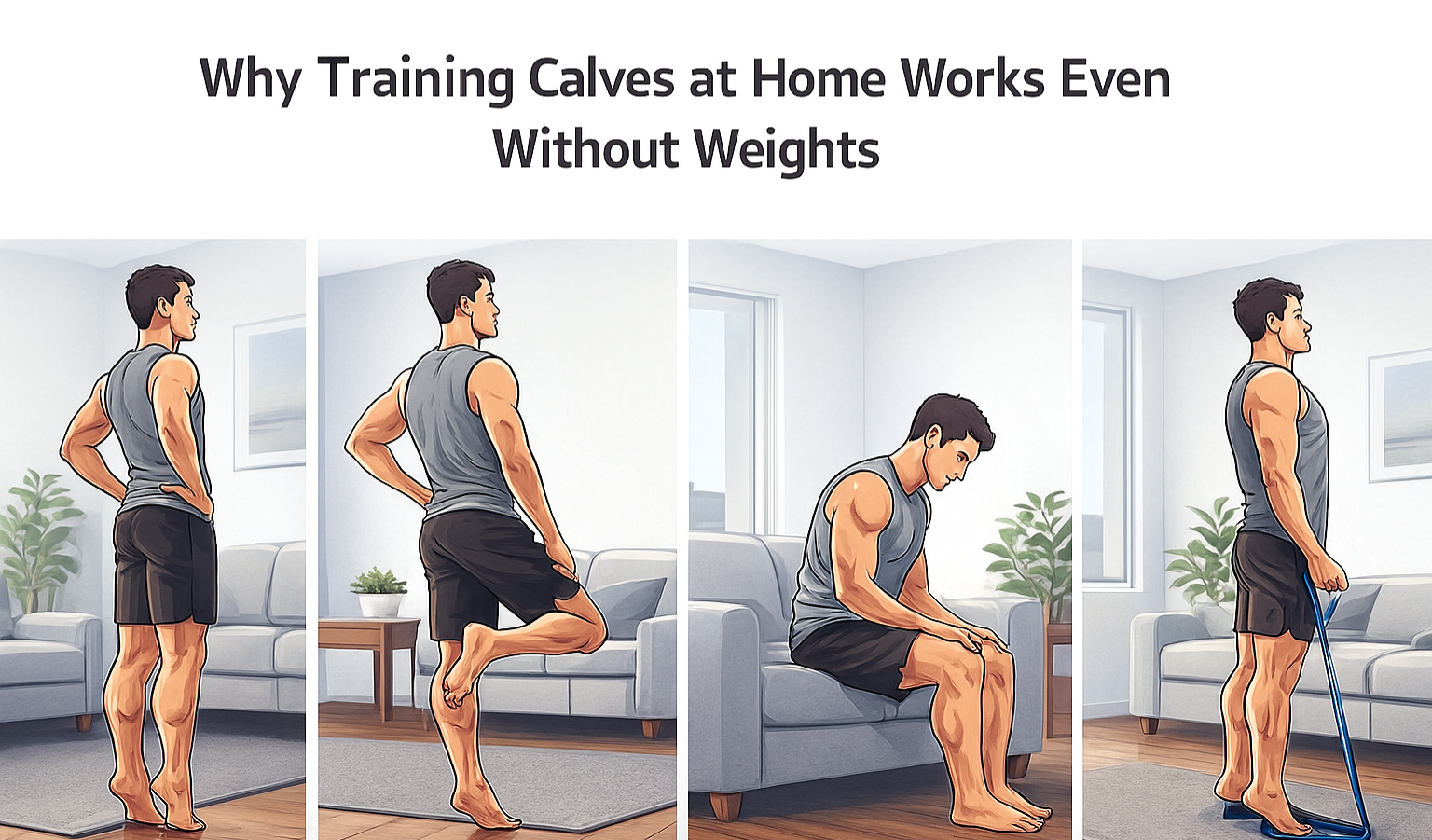
I learned quickly that bodyweight calf work needs fewer reps and more intent.
Slow tempo, deep stretch, and full extension at the top.
Think “pouring cement into the muscle,” not “bouncing like a pogo stick.”
Try this structure:
- 20–30 reps slow tempo (2 seconds up, 2 seconds down)
- Hold top contraction 2 seconds each rep
- At the end, stay at the bottom and stretch 20–30 seconds
That stretch isn’t a spiritual awakening.
It’s metabolic stress.
Blood trapped.
Muscle screaming.
Fibers recruiting.
And the weird thing is, your calves might feel more wrecked than after a heavy machine workout.
Single-Leg Variations: Your Built-In “Weight”
Whenever I switch to single-leg work, I remember I’m not as strong as I pretend.
One leg has to carry your entire body.
That instantly doubles the load without adding equipment.
Plus, unilateral work lets you fix asymmetries that hide when you train both sides together.
And everyone has one calf that looks like it skipped a few meals.
To make it brutal at home:
- Do one leg at a time
- Slow tempo
- Hold the top contraction until it burns
- Don’t let the heel rest on the floor between reps
You’ll hit failure faster than you think.
And that’s a good thing.
Seated Calf Raises Without Equipment (Yes, They Work)
Seated calves sound pointless until you actually lock into slow reps.
The soleus muscle loves endurance-style training.
It’s made of mostly slow-twitch fibers.
Meaning it can handle long sets, deep fatigue, and borderline existential crisis.
Sit down.
Lean forward slightly.
Press your toes into the ground.
Raise slowly.
Pause.
Lower slower.
You don’t need weight.
You need patience.
I’ve had sets where my calves shook like they were trying to communicate in Morse code.
Banded Calf Work If You Have Resistance Bands
Bands make calf training feel more athletic and less like a medieval punishment.
The tension curve is different.
The resistance increases as you stretch.
And the range of motion stays controlled because bands are unforgiving.
You can do:
- Standing banded raises
- Seated banded raises
- Iso-holds with pulses
You don’t need fancy attachments.
Just step on the band and make your calves regret every life choice that led them here.
Home Routines That Actually Make Calves Grow
Here’s a structure I’ve used at home when I want actual growth without turning it into a full workout day.
Routine A
- 30 slow standing raises
- 20 single-leg raises per side
- 1 minute stretch hold
Routine B
- 3 sets seated raises to failure
- No rest between sets
- 30 second stretch per set
Routine C
- 50 reps standing quickly
- Immediately 20 slow
- Immediately 10 single-leg per side
This is the moment where you question why you didn’t just buy weights.
Benefits of Training Calves at Home Consistently
This one has surprised me the most.
My calves actually look better now than when I used heavy machines once a week.
Training at home makes you:
- Use full range of motion
- Slow down reps
- Hit failure safely
- Recover faster
- Train more often
I didn’t plan to get results this way.
But the consistency made up for the lack of metal plates.
Calf Plyometrics at Home Without Gear Can Add a Different Stimulus
Slow calf work can feel like a never-ending marathon of tiny reps.
But calves also respond well to reactive, elastic work, because they’re built to store and release force when you walk, run, or jump.
You don’t need anything fancy.
Simple drills work surprisingly well:
- Fast ankle jumps
- Side-to-side pogo hops
- Single-leg mini hops
- Light box hops if you have something stable
The key is quick contact, not height.
Think light, springy, and snappy, not big, dramatic jumps.
Runners use this style of training to strengthen the Achilles–calf system, and it often leads to smoother, “bouncier” movement in daily life.
Just manage the impact:
- 3 rounds of 20–30 seconds
- Full rest between rounds
- Minimal knee bend
It’s not cardio.
It’s a short, explosive stimulus that pairs well with slower, strength-focused work, so you end up with calves that look good and feel athletic.
Home Calves That Actually Grow
The first week always feels cute.
Then your calves adapt faster than you expect, because they’re used to carrying you around all day.
So you need a simple way to progress without turning every session into a two-hour leg funeral.
Try this weekly bump-up:
- Week 1: 2 sets per exercise
- Week 2: 3 sets per exercise
- Week 3: Add pauses and slower tempo
- Week 4: Add single-leg work or plyo rounds
You don’t need a spreadsheet.
Just stack little stressors on top of each other and let your body deal with the fallout.
Don’t Wreck Your Achilles While Chasing Bigger Calves
Calves love tension.
Achilles tendons don’t love sudden chaos.
So if you jump into high-volume work or aggressive plyometrics out of nowhere, your ankles will throw a protest you can hear in your soul.
Easy rule:
- Don’t bounce aggressively when you’re fatigued
- Avoid “bottoming out” with force
- Add plyo slowly, not like you’re late to the Olympics
Soreness in the muscle is fine.
Sharp pain in the tendon is a red flag the size of Texas.
If something feels “stabby,” stop.
Calf growth takes weeks.
An irritated tendon can take months.
And nothing kills home workouts faster than limping to the fridge.
Final Thoughts
You don’t need a gym to build strong, athletic calves.
You need intensity, repetition, and the discipline to stay in the burn longer than people typically do.
Home training forces you to execute with control.
And that’s what calves have been missing all along.
Quick FAQ: Common Questions About Training Calves at Home
Do I need to train calves every day for them to grow?
Not every day, but more often than most muscles.
Two to four sessions per week is usually the sweet spot.
Daily training can work, but only if volume is low and recovery is dialed in.
Can walking or running replace calf training?
Not really.
Those activities use the muscle, but they don’t overload it enough to trigger growth.
Think “maintenance,” not “stimulus.”
Is soreness required to know I trained hard enough?
No, soreness is just a loud opinion from your body.
The real metric is near-failure with control.
If your calves burn and shake, you’re doing fine—even if you wake up feeling normal the next day.