
Here’s the deal.
If you’ve ever looked in the mirror during a bulking phase and thought: “Why does my chest still look flat even though I’ve been benching for months?” — you’re not alone.
I’ve been there too, staring at the barbell like it was guilty of sabotaging me, wondering if my body was playing tricks on me.
And the question that always pops up in the locker room is this: does torso length really affect how big your chest can get?
The answer is… yes and no.
Let’s break it down without turning this into a boring anatomy lecture.
Long torso, short torso, and visual illusions
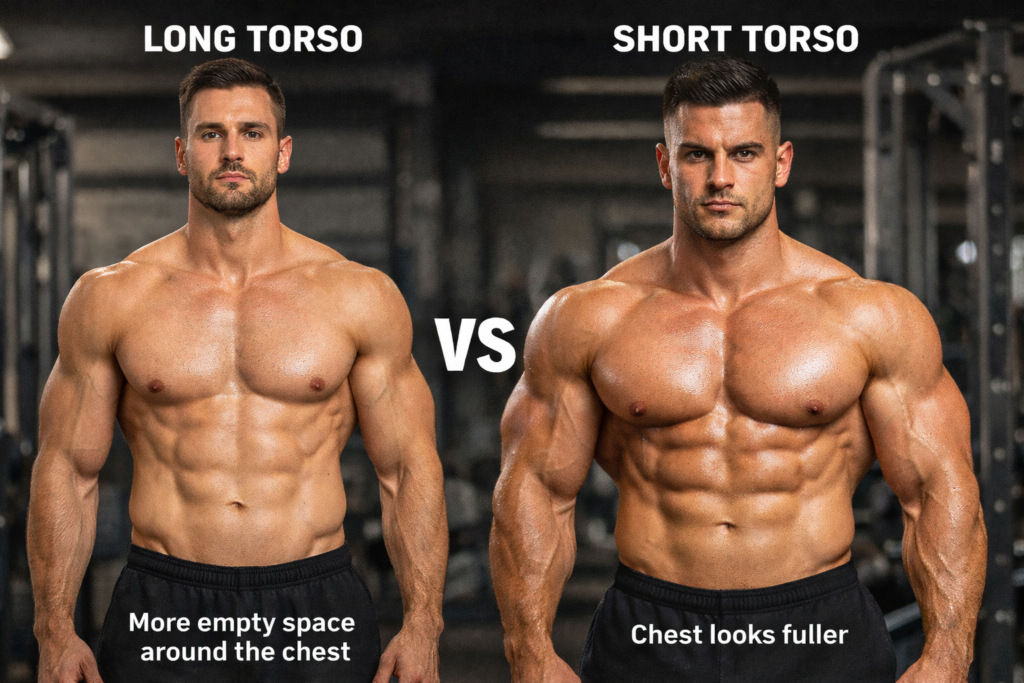
Here’s the truth: torso length doesn’t change how much muscle you can build.
Your pecs are the same: two slabs of contractile tissue ready to grow if you train and feed them well.
But here’s the interesting part.
A long torso can make your pecs look less impressive simply because they have more “empty space” around them.
It’s like hanging a painting on a massive wall — no matter how big the frame is, it looks smaller compared to the context.
On the other hand, with a short torso, every gram of muscle has less distance to cover.
The result?
A chest that pops and grabs attention, giving off that superhero look even before you’ve maxed out your growth.
The lever game: when your body decides how the weight moves
No need for charts or formulas: just watch two people of different heights do the same exercise.
One presses and the movement looks short, direct, all chest.
The other has to take the barbell on a half intercontinental trip.
That’s the simple physics of training: if you’ve got long arms or a longer torso, the bar path changes, and so does the perception of effort.
It’s not a curse, but knowing this helps you pick better variations instead of clinging to the flat bench like it’s sacred scripture.
Muscle belly length
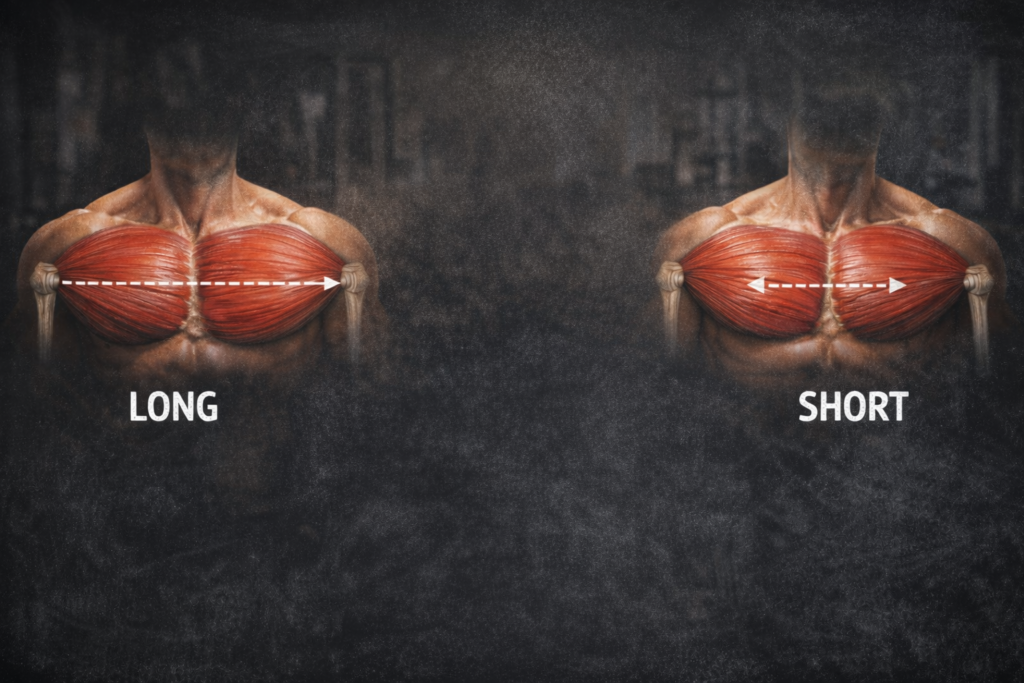
Now here’s the wild card: genetics.
The length of your pec muscle belly — the contractile part between the tendons — sets the upper limit of your growth.
If you have a long muscle belly, you can pack on more mass.
If it’s short, you might max out earlier in terms of volume, but your pecs will look full and round even with less weight on them.
And this has nothing to do with torso length.
You can have a long torso and long bellies, or the opposite.
It’s a lottery no one asked to play, but we’re all in it.
Practical strategies to make your chest stand out
Long torso and a chest that doesn’t pop?
You can work the illusion.
Focus on the upper chest.
Incline presses, low-to-high cable flyes, and landmine presses build that top shelf that instantly screams “armor.”
Build your shoulders.
Wider delts visually shorten the distance and frame your chest better.
Don’t neglect your lats.
A broad back makes your torso look thicker by contrast.
Basically, you’re furnishing the room, not just painting the walls.
With the right proportions, the chest becomes the centerpiece.
Locker room story: the comparison that opened my eyes
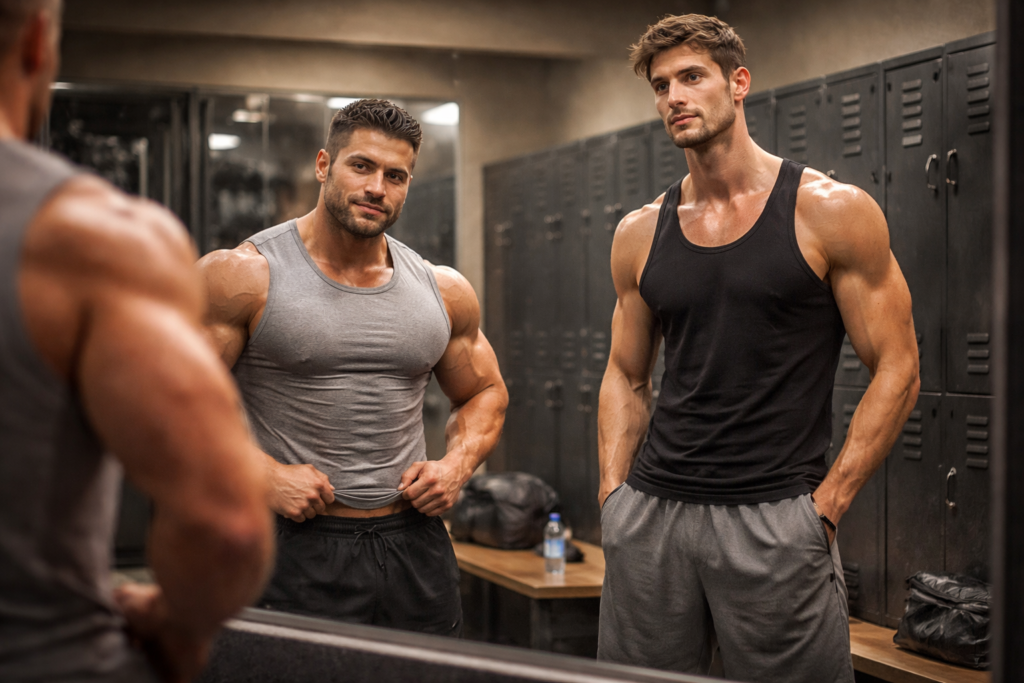
I still remember a scene from a few years back.
I was in the locker room after a brutal chest session and two guys were checking themselves in the mirror.
One was shorter, short torso, wide clavicles — the classic “barrel chest” bursting out of his shirt.
The other was tall, lanky, with a long torso and endless legs.
Both trained hard, but in the mirror, they looked like two different leagues.
The funny part?
When they loaded the bench, the weights were almost the same.
But visually, the shorter guy’s chest looked twice as big.
That’s when I realized the illusion of proportions counts as much — if not more — than the numbers on the bar.
The first time I realized the “torso factor”
My personal epiphany came during a bench session with an old friend.
Me, with my longer torso, struggled to feel my chest firing the way I wanted.
Him, compact and “square,” did the same exercise and after three sets his veins were popping like garden hoses.
At first, I thought it was technique.
Then, rewatching the video, I saw the massive difference in range of motion.
I was traveling round trip, he was doing a shorter but brutal path.
It wasn’t strength or effort.
It was pure leverage.
That day I stopped blaming myself and started changing strategy: more inclines, more cable work, more targeted variations.
And that’s when my chest finally started responding.
When proportions become a secret weapon
Another moment I’ll never forget: the first time I saw a super tall guy with a skyscraper torso and an insane physique.
The trick?
He didn’t rely only on chest.
He had hangar-wide shoulders and wings for lats.
The result: even though his pecs weren’t massive, they looked perfectly integrated, carved right into the middle of an armor plate.
That showed me it’s not just about one muscle.
It’s the whole package that creates impact.
The numbers that matter: volume and frequency for chest growth
Here’s the part backed by research: your chest grows if you give it enough work, not if you smash it randomly.
Studies are clear: to see progress you need at least 6–8 weekly sets, but those chasing a big chest usually land between 12 and 16.
Frequency matters just as much.
Doing everything in one marathon “chest day” might leave you wrecked, but not necessarily bigger.
Much better to split the volume into 2 or 3 sessions per week, so each workout is intense but recoverable, and the muscle gets constant signals without burning out.
It’s like cooking a good steak: blast the flame too high and you char it outside, raw inside.
Chest training works the same — better to manage heat and timing than chase shortcuts.
The final takeaway
Torso length affects the illusion, not the growth limit.
If you’ve got a long torso, it might take extra effort to make your chest pop, but the growth potential is the same.
Don’t get lost comparing yourself to someone with a compact torso.
Build the right frame with delts, lats, and traps, and let your pecs grow at their pace.
At the end of the day, the barbell doesn’t know how long your torso is.