
I was at the gym the other day watching a guy crank out push-ups like he was late for a flight.
His hands were smacking the floor.
Feet bouncing.
Breathing somewhere between “rabid bulldog” and “broken accordion.”
And the only thing running through my head was: Man… are those arms actually growing or just filing a complaint to HR?
That moment sent me right back to a question I’ve heard for years — and honestly asked myself more than once — whether slow push-ups or explosive push-ups build your arms better.
Slow push-ups for arm growth

Slow push-ups are like cooking on low heat.
You don’t burn the meal, but you make every minute count.
When you drop into a slow rep, you suddenly feel muscles you swear didn’t exist five minutes earlier.
Your triceps start talking.
Your chest whispers threats.
Your core gets dragged into the conversation even though it never asked to be included.
Here’s why slow reps help arms grow:
- They increase time under tension, which basically means your triceps are working longer than usual.
- They force your form to be cleaner because you can’t cheat speed when there is no speed.
- They hit stabilizing muscles that explosive reps sometimes skip right over.
Explosive push-ups for arm growth

Explosive push-ups are the opposite vibe.
They’re the caffeine shot of bodyweight training.
You feel athletic.
You feel powerful.
You feel a tiny bit like you’re auditioning for an action movie.
The reason they matter for arm growth isn’t the pump itself, but the way they recruit high-threshold motor units — the muscle fibers that usually wake up only when you lift heavy or move fast.
These fast-twitch fibers are the ones most responsible for adding size and density to the arms.
When you push off the ground fast enough to almost float for a split second, your triceps fire in a completely different way than with slow reps.
It’s more like a “snap” than a “squeeze.”
And if you’ve ever mixed explosive push-ups into a workout, you know exactly that lightning-bolt jolt I’m talking about — the one that makes your arms feel alive, even after just a few reps.
Plus, explosive work teaches your arms to generate force quickly, which actually carries over into weighted dips, bench variations, and overhead pressing.
Your arms become useful, not just decorative.
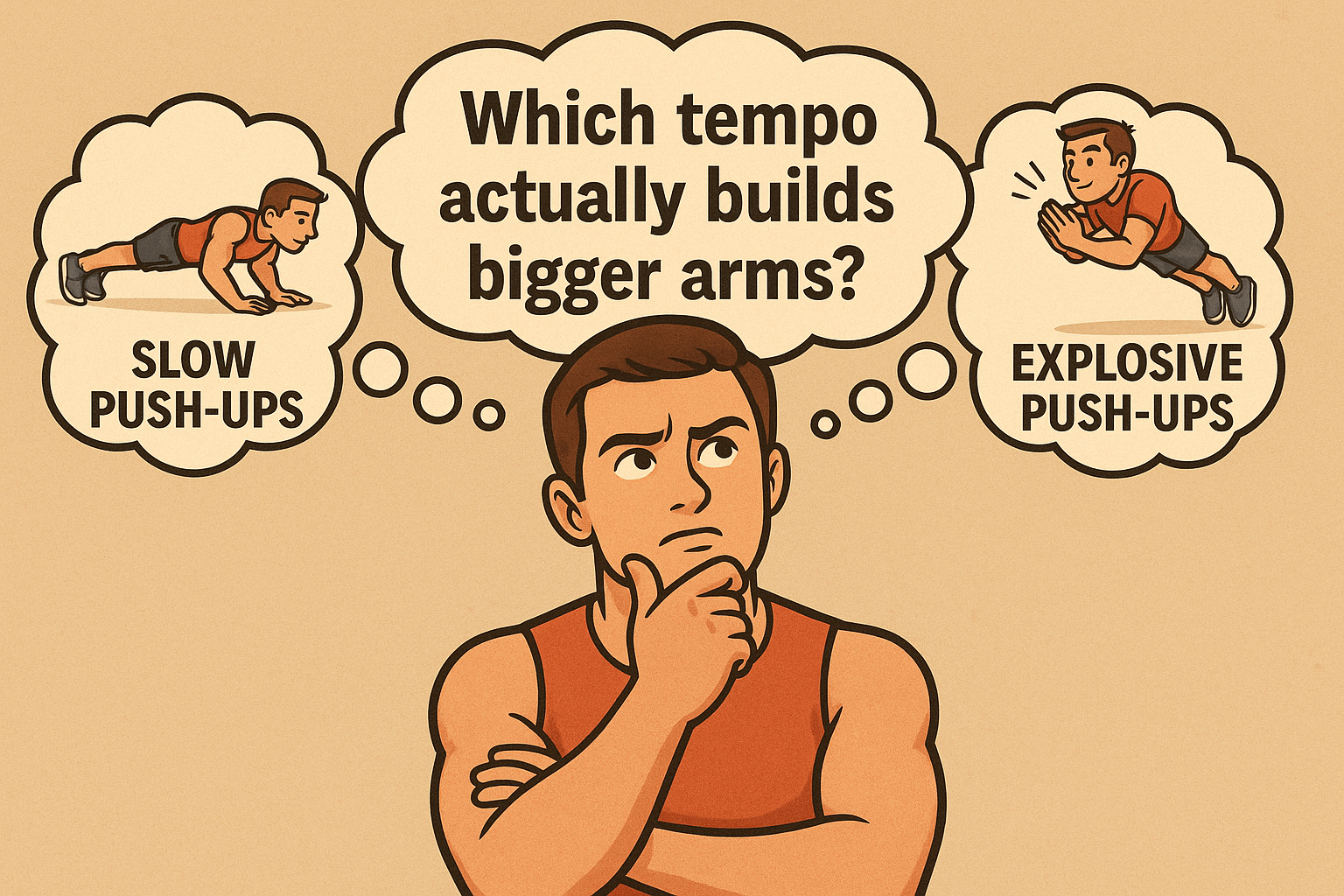
Which tempo actually builds bigger arms?
Here’s the part no one wants to hear but everyone needs:
Both tempos work — just in different ways.
Slow reps give you the pump, the control, and the burn.
They help you feel every inch of the movement and squeeze tension out of it like toothpaste from a tube.
Explosive reps give you the power, the snap, and the deeper muscle fiber recruitment.
They create the kind of adaptation you normally only get under a barbell.
If you pick only one style forever?
You’ll grow… but you’ll hit a wall.
Your arms will adapt, shrug, and say “Cool. What’s next?”
Muscles aren’t complicated, but they do love variety.
And they grow best when they’re challenged in ways they’re not used to.
How to mix slow and explosive push-ups for maximum arm growth
Now we’re getting to the good stuff — how to actually combine the two without feeling like you’re learning choreography for a TikTok dance.
Here’s a simple flow that works insanely well:
1. Start with explosive push-ups while you’re fresh.
Think 3–6 reps per set.
Quality over quantity.
You’re waking up the nervous system and telling your arms, “Let’s move something.”
2. Then switch to slow push-ups for the meat of the workout.
Lower for 3 seconds.
Pause.
Push up with control.
Go for 6–12 reps.
This is where the growth work actually happens.
3. Finish with a burner set using a moderate tempo.
Not fast, not agonizingly slow.
Just clean, smooth reps until your triceps politely ask you to reconsider your life choices.
This combo rivals any machine in the gym for pure arm stimulus.
And it works whether you train at home, in a garage, or next to the guy doing plyometric push-ups like he’s fighting gravity personally.
How to know which tempo YOU need right now
One thing people never talk about is that your ideal tempo actually changes depending on what your arms are missing.
Not every lifter needs more explosive work.
Not every lifter needs more slow, grinding reps.
Sometimes your arms plateau because you’ve been feeding them the wrong “stimulus recipe.”
Here’s the no-BS way to figure out what your arms need — today, not in theory.
1. The strength check (for explosive reps)
Get into push-up position.
Set a timer for 20 seconds.
Now do regular-speed push-ups, not rushed, not slowed — just clean reps.
- If you hit fewer than 10 reps, you’ll grow more right now from slow push-ups.
- If you hit 10–18 reps, a mix works best.
- If you hit 18+, your triceps are ready for more explosive work.
Your rep count reflects your current strength endurance, which decides whether your arms respond better to control-heavy or power-focused training.
2. The tension check (for slow reps)
Hold the bottom of a push-up — chest just above the floor — and breathe.
See how long you last without shaking.
- Under 5 seconds → slow reps will change your arms the fastest.
- 10–20 seconds → you’re stable; mix speeds.
- 20+ seconds → your foundation is solid; explosive reps won’t leak force.
Your stabilizers decide how much force your triceps can use.
If they’re weak, explosive reps never hit the arms as intended.
3. The soreness pattern test
After a push-up session:
- Mostly chest soreness → bring hands closer and slow down.
- Mostly front delt soreness → add explosive work to fix force direction.
- Direct triceps long-head soreness → you’re already doing the right thing.
Soreness isn’t everything, but it reveals where tension went — and tension dictates growth.
4. A sample week based on real goals
If your arms look “soft” → prioritize slow push-ups
Day 1: Slow
Day 3: Slow + 3–5 explosive reps
Day 5: Slow + close-grip finisher
If your arms are strong but not growing → increase explosive work
Day 1: Explosive
Day 3: Explosive + slow mechanical drop set
Day 5: Mixed tempo
If you want balanced size + power → hybrid model
Day 1: Explosive first, slow after
Day 3: Slow only
Day 5: Explosive clusters + normal pace
5. How to track progress that actually matters
Forget tape measurements every 48 hours.
Track this instead:
- Higher explosive “push-off” → fast-twitch fibers improving
- More stable slow reps → higher cross-bridge tension
- Longer pause at bottom → stronger triceps in the hardest zone
- Less twisting on last reps → better arm loading mechanics
6. The safety filter you shouldn’t skip
Before adding explosive work:
If you can’t do 10 perfect slow reps without wobbling, don’t add full explosive sets yet.
Your joints need the brakes before the turbo.
The bigger picture: push-ups aren’t only an “arm exercise”
One thing I wish someone told me earlier is that push-ups are a whole-body negotiation.
Your arms don’t grow in a vacuum.
Your shoulder stability affects how much force your triceps can use.
Your core affects the angle of your elbows.
Your wrists affect the chain of tension.
So if your arm growth from push-ups feels stuck, sometimes it’s not the reps — it’s the setup.
A few small tweaks change everything:
- Hands slightly closer than shoulder-width to hit triceps harder
- Elbows tucked around 30° instead of flaring
- Torso stiff like a plank instead of sagging
These little adjustments shift the load from “mostly chest” to “triceps takeover,” and suddenly every tempo hits way harder.
RELATED:》》》 Are wide push-ups biomechanically doomed to be a front-delt dominant movement?
Final takeaway
If your goal is bigger, stronger, better-looking arms from push-ups, give your body both speeds of stimulus.
Challenge it with explosive reps when you’re fresh.
Work it with slow reps to squeeze every fiber.
Stick with it long enough to see real progress.
And if you’ve tried any of these variations—or have a go-to push-up trick—drop a comment and share what actually worked for you.