

Two months ago I didn’t start this because I wanted to be “advanced.”
I started because my tendons were sending those little warning emails nobody reads until the laptop catches fire.
Not sharp pain.
Not an injury.
Just that weird, slightly cranky feeling around elbows and knees that shows up during bodyweight training and makes everything feel less trustworthy.
So I decided to approach it in a simple, practical way.
No motivational quotes.
No “trust the process” posters.
Just a clear plan, repeated the same way, paying attention to what felt better and what didn’t.
What “Slow Eccentrics” Means (Explained Like You’re 8 Years Old)

Every rep of an exercise has two main parts.
One part is when you lift yourself or push yourself up.
That’s the “up” part.
The other part is when you go back down.
That’s the “down” part.
The down part is called the eccentric.
A slow eccentric means you go down slowly, like you’re trying not to spill a glass of water on your head.
So instead of dropping fast… you lower for 5 to 8 seconds.
That’s it.
It sounds simple.
It feels weird because your tendons suddenly have to “hold the line” for longer.
Why Tendons Feel It More Than Muscles

Muscles are like a car engine.
They get warm fast.
They get tired fast.
They adapt pretty fast.
Tendons are more like the strong towing cable that connects the engine to the wheels.
They don’t “pump.”
They don’t get sore the same way.
They’re strong, but slow to change, and they hate sudden surprises.
When you do fast reps, the tendon acts like a spring.
It stretches quickly and rebounds quickly.
When you do slow eccentrics, you stretch that spring… and hold it stretched.
That’s the weird part.
It feels like the tendon is doing paperwork instead of bouncing.
The Exact Test I Ran for 2 Months
I kept the test simple on purpose.
Because if you change ten things at once, you learn nothing.
So I only changed one variable.
Tempo on the way down.
Everything else stayed as consistent as possible.
Here were the rules I followed.
- Same exercises each week.
- Same days each week.
- Same warm-up each week.
- I did NOT chase failure every set.
- I tracked how my tendons felt during training and the day after.
Then I ran two phases.
Phase 1 was my “normal style” for about two weeks.
Phase 2 was slow eccentrics for the next six weeks.
So I had a baseline, and then I had the experiment.
How the Exercises Were Chosen
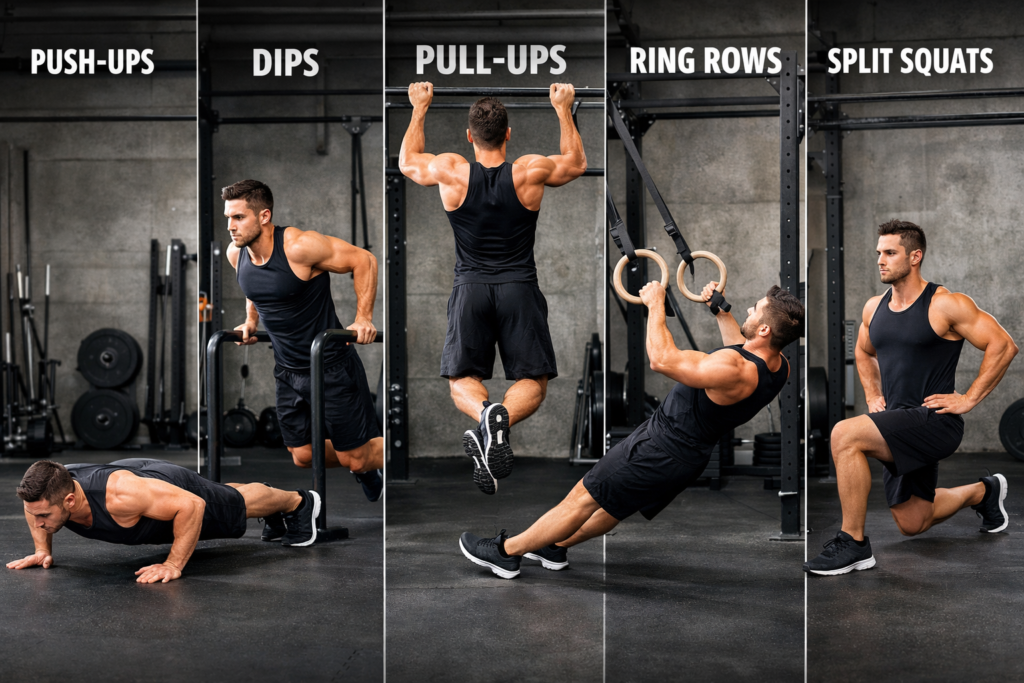
I picked movements that usually make tendons talk.
Not because they’re “dangerous.”
Because they’re honest.
Bodyweight training forces elbows, shoulders, and knees to stabilize without machines saving you.
These were my main movements.
- Push-ups (wrist + elbow + shoulder tendon load)
- Dips (elbows and front shoulder tendons get opinions here)
- Pull-ups or chin-ups (elbows and biceps tendon love to comment)
- Ring rows (same idea but easier to control)
- Split squats (knee tendon and quad tendon get loaded slowly)
I didn’t do all of them every single day.
I rotated them like a normal routine.
But these were the core “test” exercises I repeated enough to compare.
How to Do a Slow Eccentric Push-Up

Start position first.
Hands on the floor.
Hands under shoulders, not way forward.
Legs straight, body like a plank.
Imagine a straight line from head to heels.
Now the rule.
Down is slow.
Up is normal.
Here’s the step-by-step.
- Take a breath in.
- Start bending elbows.
- Count slowly from 1 to 6 while you go down.
- Keep your body stiff like a wooden board.
- Stop when your chest is close to the floor.
- Push back up normally, not slowly.
Common beginner mistake.
Butt goes up first.
That turns it into a weird half-push-up plus yoga pose.
Fix is simple.
Squeeze glutes a little and keep ribs tucked, like you’re bracing for someone to poke your stomach.
RELATED:》》》 Is it better to do slow or explosive push-ups for arm growth?
How to Do a Slow Eccentric Dip

Dips can be amazing.
They can also feel sketchy if you drop too deep too fast.
So for this test, control was the whole point.
Setup.
Use parallel bars or sturdy dip bars.
Start with arms straight, shoulders not shrugged up to your ears.
Now the slow part.
- Bend elbows and lower for 5 to 8 seconds.
- Keep chest slightly forward, not fully upright like a soldier.
- Stop when upper arms are about parallel to the floor.
- Push back up normally.
Beginner version if this is too hard.
Use a resistance band or do bench dips with feet closer.
Also, don’t force deep range if shoulders feel pinchy.
In this test I never chased the deepest dip possible.
I chased the smoothest dip possible.
How to Do a Slow Eccentric Pull-Up (Beginner Friendly)
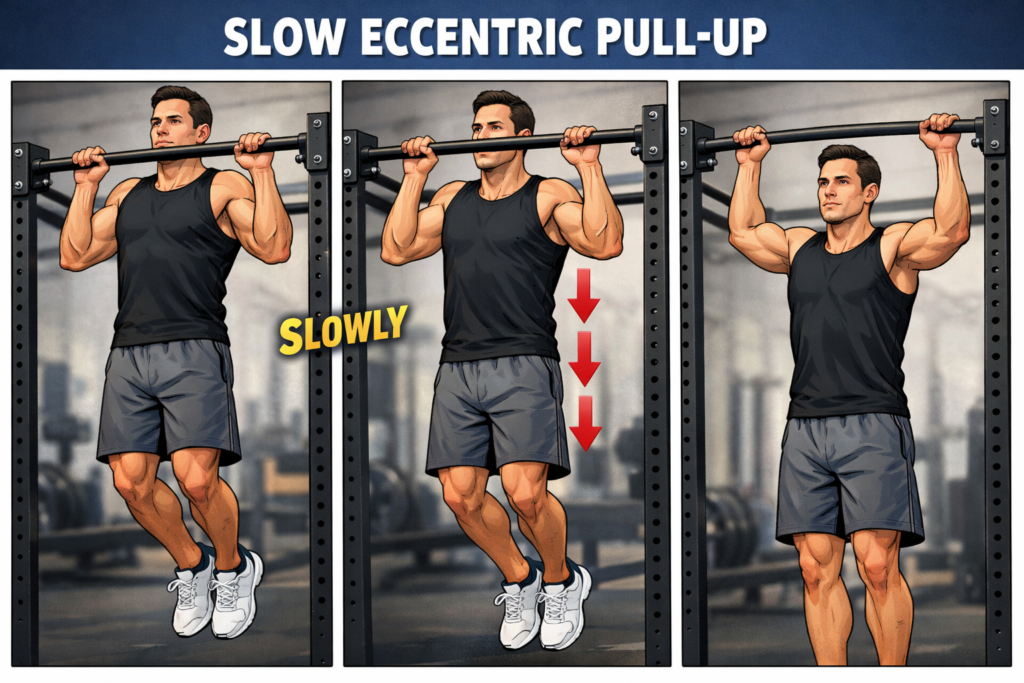
A real pull-up is hard for beginners.
So I used two versions depending on the day.
Option A.
Slow negative pull-ups.
This is perfect if you can’t pull up yet.
Here’s how.
- Step on a box and start with chin over the bar.
- Grip the bar.
- Now lower yourself slowly for 5 to 10 seconds.
- When arms are straight, step back on the box.
- Repeat.
Option B.
Full pull-ups with slow down.
- Pull up normally.
- Pause for half a second at the top.
- Lower for 5 to 8 seconds.
Key beginner cue.
Don’t let shoulders shoot up into your ears at the bottom.
Think “chest proud” and “shoulders away from ears.”
Not exaggerated.
Just tidy.
How to Do a Slow Eccentric Split Squat (Knee-Friendly and Clear)

Split squats are great because they show you every imbalance.
And they load the knee tendon in a very direct way.
Setup.
One foot forward.
One foot behind.
Like a lunge position, but you stay in place.
Now the slow part.
- Lower slowly for 5 to 8 seconds.
- Front knee bends, back knee goes toward the floor.
- Keep front heel down.
- Keep torso tall but slightly leaning forward is okay.
- When back knee is close to the floor, push up normally.
Beginner mistake.
Front heel lifts up.
Fix.
Shorten the stance a little and focus on heel staying planted.
What I Measured (Because “Feels Weird” Isn’t Data Yet)
I tracked three things.
One during training.
Two after training.
During training I noted tendon sensation from 0 to 10.
0 meant “I forget tendons exist.”
10 meant “this is not okay.”
After training I noted soreness the next morning.
And I noted stiffness when I first moved that joint that day.
So if elbows felt stiff when brushing teeth, I wrote that down.
That sounds silly.
But that’s how you notice patterns without lying to yourself.
Weeks 1–2: Normal Tempo Baseline (What “Normal” Felt Like)
With normal reps, everything felt snappy.
Fast down, fast up.
Workouts felt efficient.
Tendons were quiet during training most of the time.
But the next day, that low-grade stiffness existed.
Elbows felt “full.”
Knees felt slightly rusty going downstairs.
Nothing dramatic.
Just consistent enough to annoy me.
That baseline was important because it showed the problem wasn’t in my imagination.
It was repeatable.
Week 3: The First Slow Eccentric Week (When Things Got Weird Fast)
First week of slow eccentrics felt like switching a video game to hard mode.
Same exercise.
Same reps.
Completely different experience.
The strangest part was this.
Muscles felt fine.
Breathing felt fine.
But tendons felt like they were under a spotlight.
Especially elbows on pull variations and knees on split squats.
It wasn’t pain.
It was more like… awareness plus tension.
Like holding a heavy grocery bag very still.
Not tearing.
Just demanding.
Week 4: Strength Improved, Tendons Still Complained Quietly
By week four, I noticed cleaner reps.
Control improved fast.
Even the “up” part felt better because the down part trained my positions.
But tendon sensation didn’t improve at the same speed.
This is the part beginners need to understand.
Muscles adapt fast.
So you can feel stronger before you feel better.
That doesn’t mean slow eccentrics are bad.
It means your body upgrades different parts in different timelines.
Week 5–6: The Turning Point (Where It Started Feeling ‘Solid’ Instead of ‘Odd’)
Around weeks five and six, that background tendon awareness started fading.
Not disappearing in one magic workout.
More like slowly turning down the volume.
Elbows felt more stable in daily life.
Knees felt less creaky in the morning.
And workouts stopped feeling like “tendon management.”
They felt like training again.
That was the biggest win.
Because it showed me the weirdness wasn’t a red flag.
It was an adaptation phase.
What Changed the Most: Control and “Joint Quietness”

The biggest benefit wasn’t muscle growth.
It was how quiet my joints became.
Less random clicking.
Less post-workout stiffness.
More trust when moving fast later.
Slow eccentrics felt like teaching the body to brake smoothly.
Like upgrading from cheap bicycle brakes to good ones.
Both stop the bike.
Only one does it without panic.
The Mistakes I Made (So Beginners Don’t Copy Them)
First mistake was doing too much too soon.
Slow eccentrics feel “safe” because you’re moving slowly.
But they can create a lot of total tension time.
So volume that felt normal before can suddenly become overload.
Second mistake was trying to keep the same rep numbers.
That’s ego math.
If reps are slower, the set is longer.
Longer set means more tendon load.
So you often need fewer reps or fewer sets at first.
Third mistake was ignoring small technique breakdowns.
Slow eccentrics expose weak positions.
If you keep doing reps while form gets messy, you’re practicing messy reps very slowly.
That’s not the plan.
Beginner Rules That Made This Work (Simple and Realistic)
These rules kept my tendons happy enough to adapt.
- Start with 3 to 5 second eccentrics, not 10.
- Use 2 sets instead of 4 at the start.
- Stop a rep early if form gets sloppy.
- If tendon sensation jumps day to day, reduce volume, don’t push through.
- Keep the “up” part normal, don’t slow everything.
The biggest beginner lesson.
Slow eccentrics are not a punishment.
They’re a tool.
Tools work best when you don’t swing them like a maniac.
Why It Felt Weird Specifically on Tendons (The Simple Explanation)
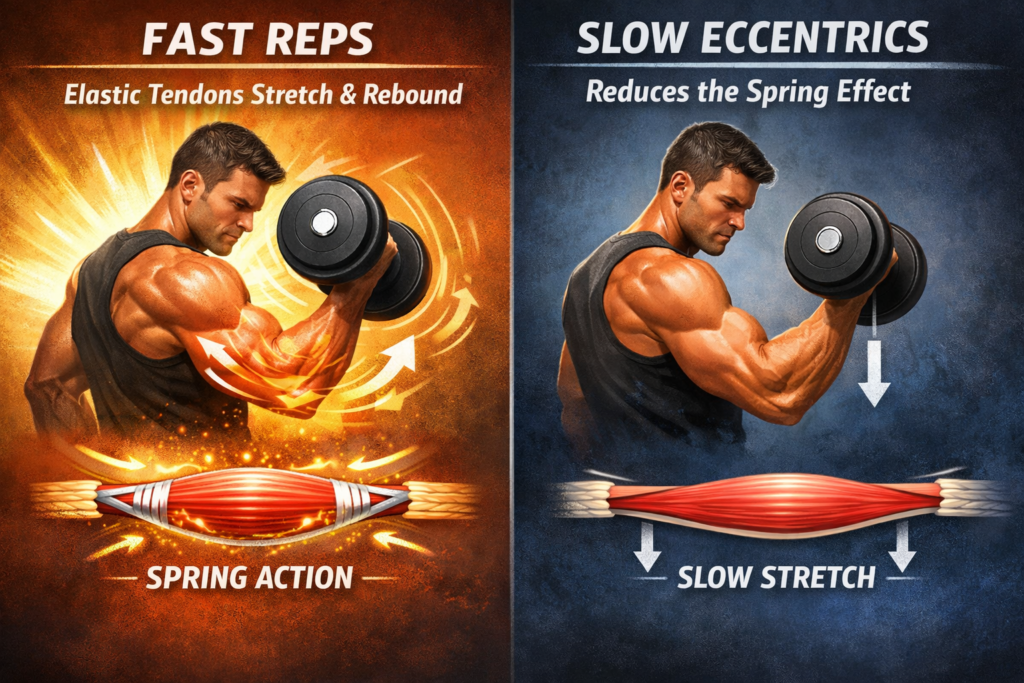
Fast reps use elasticity.
Tendons stretch and rebound.
It feels springy.
Slow eccentrics reduce that spring effect.
Now the tendon is loaded longer without the quick rebound.
So your brain notices it more.
It’s like walking on sand instead of concrete.
Same legs.
Different feedback.
That extra feedback is what beginners call “weird.”
It’s not automatically danger.
It’s just different tissue behavior.
How I’d Recommend Doing This If You’re a Total Beginner
Start with ONE exercise.
Not five.
Pick the one that usually bothers you slightly.
Example.
Slow eccentric push-ups if elbows feel cranky.
Or slow eccentric split squats if knees feel sensitive.
Do this twice a week.
2 sets.
5 reps.
5 seconds down.
That’s it.
Keep everything else normal.
After two weeks, add a set or add a rep.
Then wait again.
This is slow cooking, not microwaving.
RELATED;》》》I Stopped Training to Failure for 30 Days: Recovery Changes You Don’t Expect
Final Thoughts
Slow eccentrics made me feel weird before they made me feel better.
That’s the honest truth.
But the weirdness had a pattern.
It showed up early.
It peaked.
Then it faded as tendons adapted.
And when it faded, I felt more stable, more controlled, and more confident in normal-speed training.
No guru moment.
No “one trick.”
Just a method that rewards patience.
If you treat tendons like long-term teammates instead of disposable parts, they usually respond in kind.