
I learned this the hard way on a day when my shoulder felt like it had a tiny gremlin living inside it.
You know those days.
You load the bar for overhead press, take your stance, breathe in, and your shoulder basically goes, “Nope, not today, buddy.”
So I walked out of the gym wondering if I had just sentenced my delts to eternal mediocrity.
No overhead pressing = no shoulder gains… right?
That’s what everyone says.
That’s what every gym meme jokes about.
That’s the rule… or at least it felt like it.
But here’s what actually happened once I stopped trying to force vertical pressing back into my routine.
My shoulders didn’t shrink.
They didn’t fall apart.
They didn’t stage a rebellion.
They grew.
They got rounder, more defined, and honestly more functional for the stuff that matters in daily life.
Turns out the delts don’t care about tradition.
They just care about tension.
Understanding Shoulder Training Without Pressing

The shoulder joint is basically the overachiever of the human body.
It moves forward, backward, sideways, diagonally, in circles, and into angles your knees would file a complaint about.
So when people say “you MUST overhead press,” they’re really saying:
“train your delts through a vertical force path.”
But your shoulders don’t exclusively grow in straight lines.
Horizontal, diagonal, rotational — they all count.
Deltoids respond to load, volume, control, and angle changes just as much as they respond to pressing something overhead.
Once I wrapped my mind around that, things clicked.
Not overhead pressing doesn’t mean skipping the heavy lifting.
It just means shifting what “heavy” looks like.
How Your Shoulders Actually Grow (Even When You Skip Pressing)
Delts grow when you challenge them through:
- Shoulder flexion (raising arm forward)
- Shoulder abduction (raising arm sideways)
- Shoulder horizontal abduction (moving arm out/back from the front)
- External rotation (rotating arm outward)
Pressing just happens to combine several of these.
But you can hit every single movement pattern with zero overhead involvement.
And here’s the part that made me laugh when I realized it:
Most bodybuilders barely overhead press… yet their shoulders look like carved bowling balls.
Most calisthenics athletes never barbell press… yet their delts look 3D from every angle.
Most rehab athletes avoid overhead loading completely… yet rebuild symmetrical strength.
The Big Lateral Raise Equation (This Is Where Most Gains Come From)
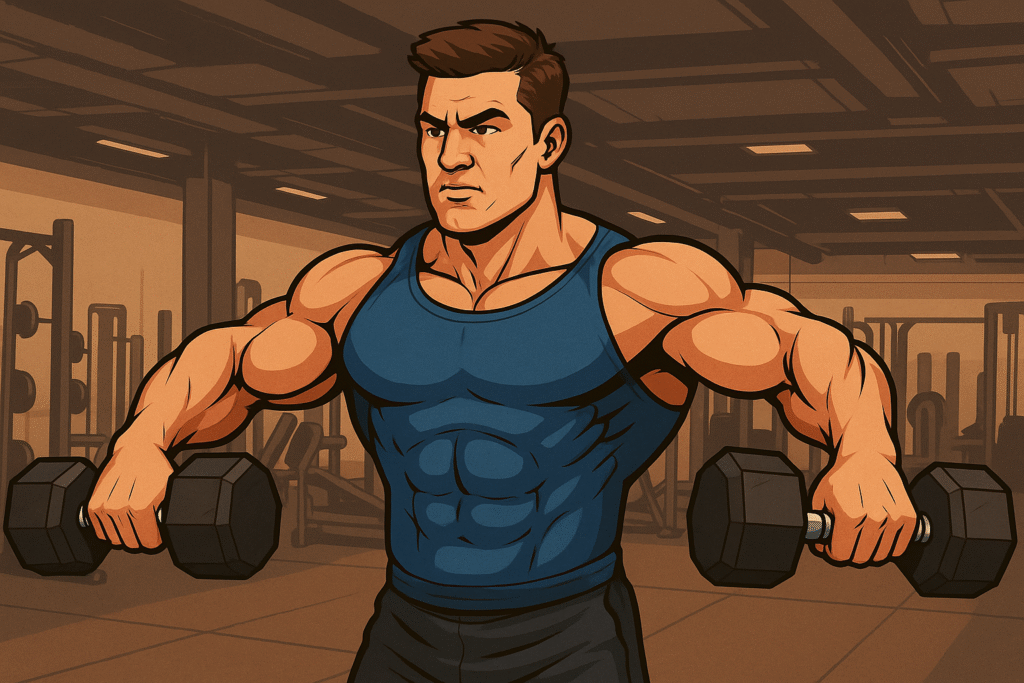
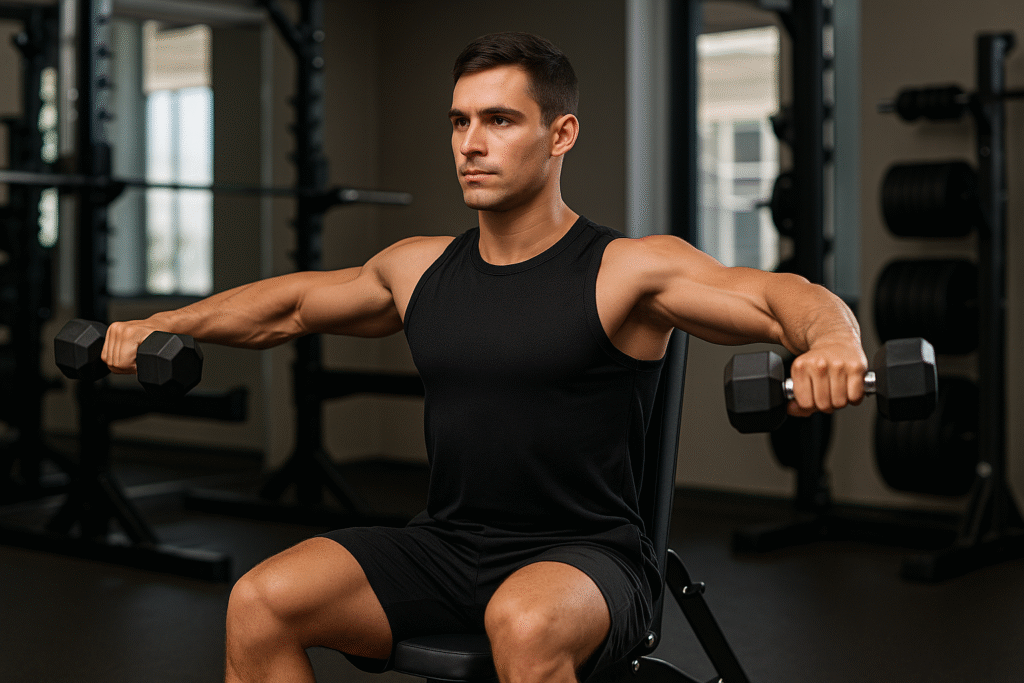
If overhead pressing is a straight highway, lateral raises are that twisty scenic road that actually gets you where you want.
Because for shoulder width, nothing — nothing — beats a well-loaded lateral raise.
And no, I don’t mean the “swing the dumbbells like you’re trying to take flight at the airport” version.
I mean the slow, almost uncomfortable, stretch-at-the-bottom, controlled-on-the-way-up kind.
When you add strategic variations, lateral raises become a whole training universe:
- Seated lateral raises for stricter tension
- Cable lateral raises for constant tension
- Leaning cable raises for deeper stretch
- Machine lateral raises when you just want to zone out and suffer
Rear Delts Without Pressing (The Overlooked Secret Weapon)
Here’s the part that shocked me the most.
When I removed overhead pressing, my rear delts finally started showing up in photos.
Not kidding.
Rear delts love horizontal pulling.
They love slow negatives.
They love angles where you have to “reach” with your elbow behind your body.
Some of my favorites became:
- Cross-body rear delt cable pulls
- Chest-supported reverse flyes
- Bent-over swings
- Rope face pulls with a higher pull-apart
- Wide-grip chest-supported rows
And once my rear delts grew, my whole shoulder looked more “finished.”
You know that sensation when your T-shirt fits better even if you didn’t size up?
That.
Front Delts Without Pressing (Yes, It Works)
Front delts get the most love unintentionally.
Any time you push, brace, or stabilize in front of you, they get involved.
That means:
- Dips
- Push-ups
- Incline dumbbell raises
- Cable front raise variations
- High-angle chest presses
Even some core-focused movements
You’re basically training front delts without realizing it.
So losing overhead pressing doesn’t starve them at all.
Where Strength Comes From If You’re Not Pressing Upward
One thing people worry about is “functional strength.”
The fear is:
“If I don’t press overhead, won’t I be weak at anything overhead?”
Somewhat.
Specificity matters.
Being good at pressing overhead requires… pressing overhead.
No sugar-coating that.
But functional shoulder strength — the kind you use in lifting groceries, carrying suitcases, moving furniture, catching yourself if you slip — comes from stability, rotation, and multidirectional control.
Think of farmers carries, suitcase carries, Turkish get-up progressions, landmine presses (which technically aren’t overhead), even kettlebell flows.
All of them build shoulder capacity without vertical loading.
When you mix those with heavy rows and smart raise variations, your shoulders become resilient in real life, not just under a barbell.
Why Some People Grow Better Without Overhead Pressing
This is the part almost no one talks about.
And honestly, it should be on posters in gyms.
Some people have shoulder structures that simply do not love overhead positions.
Longer clavicles.
Shallower or deeper shoulder sockets.
Past injuries.
Poor thoracic mobility.
Rubbing, pinching, grinding sensations.
You’re not broken.
You’re built differently.
And trying to force vertical pressing when your body hates it is like trying to force a square peg into a round hole — except the peg is your rotator cuff.
When I stopped forcing overhead work, my shoulders started growing fast and stopped hurting after every workout.
How to Build Shoulders Without Overhead Pressing (Complete Practical Blueprint You Can Use Today)
This is the part that actually makes a difference tomorrow in the gym.
If you want real shoulder growth without pressing overhead, you need a structure — not random raises and vibes.
Here’s the full, plug-and-play framework that makes press-free shoulder training insanely effective.
Weekly Structure That Works Even Without Pressing
A great press-free shoulder routine usually follows this pattern:
Day 1 — Side-delt emphasis
- Cable laterals
- Lean-away cable laterals
- Seated dumbbell laterals
- High-angle landmine press (not overhead)
Day 2 — Rear-delt + horizontal pulling
- Reverse flyes
- Wide-grip chest-supported rows
- Face pulls
- External rotations
Day 3 — Front-delt + upper chest synergy
- Incline dumbbell press
- High-incline machine press
- Cable front raises
- Anti-rotation core work
Three days.
Full coverage.
Zero overhead pressing needed.
The Volume That Actually Builds Delts
Here’s the exact weekly volume target that grows shoulders without vertical loading:
- Side delts → 14–20 hard sets
- Rear delts → 10–14 hard sets
- Front delts → 6–8 hard sets
Side delts need the most because they’re small and recover fast.
Rear delts often lag.
Front delts get hit every time you push something.
Intensity Cues That Make Your Raises 10× More Effective
These change everything:
For side delts →
“A sloppy bottom position = the rep doesn’t count.”
For rear delts →
“If you feel traps more than shoulder, change the angle — not the weight.”
For front delts →
“Leave one rep in the tank — let the burn build gradually.”
The Safe Progression Model for Long-Term Shoulder Growth
Use this 7-week cycle:
- Week 1–2 → 10–15 reps, 2 reps in reserve
- Week 3–4 → add 5–10% load, 1 rep in reserve
- Week 5 → add 2–3 reps per set
- Week 6 → deload (half sets or half weight)
- Week 7 → switch variations or angles
Simple.
Repeatable.
Shoulder-friendly.
The Mobility Routine That Makes Press-Free Training Twice as Effective
Do this 4-minute routine daily or before workouts:
- Band pull-aparts — 20
- Doorway chest stretch — 20–30 seconds
- Band external rotations — 15 per side
- Prone Y raises — 10 slow reps
Your shoulders will feel smoother and more stable almost immediately.
Loaded Carries That Replace “Functional Strength” From Pressing
Once a week, include:
- Single-arm farmer carry
- Offset carry
- Landmine march
- Front-rack kettlebell hold
These build shoulder stability that actually matters outside the gym.
RELATED:》》》 Is Training Delts Twice a Week Too Much or the Secret to Mass?
Conclusion
Overhead pressing is a tool.
Some people thrive on it, others feel like it’s a negotiation with their shoulder joints.
If your body loves it, great.
If your shoulders complain, skip it without guilt.
Because what really matters isn’t how high you push the bar.
Your delts don’t care how you challenge them.
They only care that you do.
So whether you press upward, sideways, backward, diagonally, or not at all…
your shoulders can still grow, still look incredible, and still get stronger in all the ways that matter.
And if avoiding overhead pressing keeps you healthier, happier, and more consistent?
That’s the kind of win that builds real, long-lasting progress.