Imagine the scene
Beach, blazing sun, you take your shirt off.
Next to you, there’s your classic gym bodybuilder—chest puffed up like two couch cushions, all proud.
And then there’s you.
You’ve never touched a bench press in your life.
But you’ve clocked hundreds of hours doing push-ups, dips, parallel bar work, isometric holds.
People look.
And they don’t instantly know who’s really “in shape.”
Because you don’t have a “puffed” chest.
You have a chest that’s hard, high, compact.
That “tight” look that seems carved, not inflated.
And now the obvious question arises:
Can you really build a chest like that… just with calisthenics?
Spoiler: yes.
But there’s a lot to talk about.
It’s not just about size: a “tight” chest is about shape, control, and posture
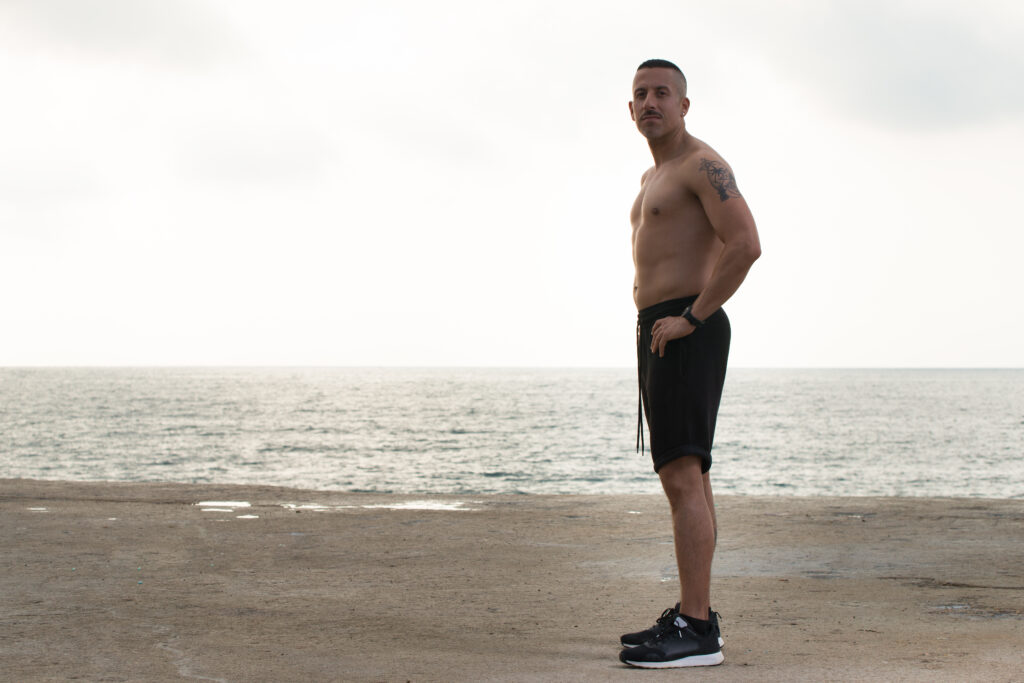
Having a big chest doesn’t automatically mean having a good-looking chest.
You know how many guys I’ve seen with massive pecs… and the posture of an angry vulture?
A tight chest is one that:
- Rises naturally, even when you’re relaxed
- Has a sharp center line, that clearly defined vertical groove
- Separates cleanly from the front delts and triceps
- Doesn’t sag the moment you stop flexing
You don’t get that just by inflating the muscle.
You get it by teaching the muscle to stay under tension, integrating it with your posture, your breathing, your movement.
In calisthenics, you can’t cheat: every push is connected to the rest of your body.
If you lack control, your chest won’t engage the right way.
But when everything lines up?
There it is.
Explosion of definition and tone.
Bench press vs calisthenics: it’s not a war, but well-done push-ups are deadly weapons
The bench press is powerful.
But not all-powerful.
Sure, it lets you lift heavy.
But often in a linear, isolated, passive way.
In calisthenics, every push-up is a neuromuscular coordination test.
When you perform a truly well-executed push-up:
- Your scapulae need to rotate and stabilize
- Your hips must stay aligned (core and glutes engaged)
- Your hands push “into the ground,” not just up and down
In short, it’s a full-body exercise.
And the more complex it is, the more your muscles have to stay “on” even outside the workout.
But here’s something most people overlook:
A well-done push-up is not “light.”
Depending on how you perform it, it can load your chest with the equivalent of 60–70% of your body weight.
Curious to know how much weight a good push-up really puts on your chest?
I break it all down here → How much load are you really pressing with a basic push-up? Spoiler: more than you think
Time to start taking that yoga mat seriously.
And the upper chest? Just change the angle
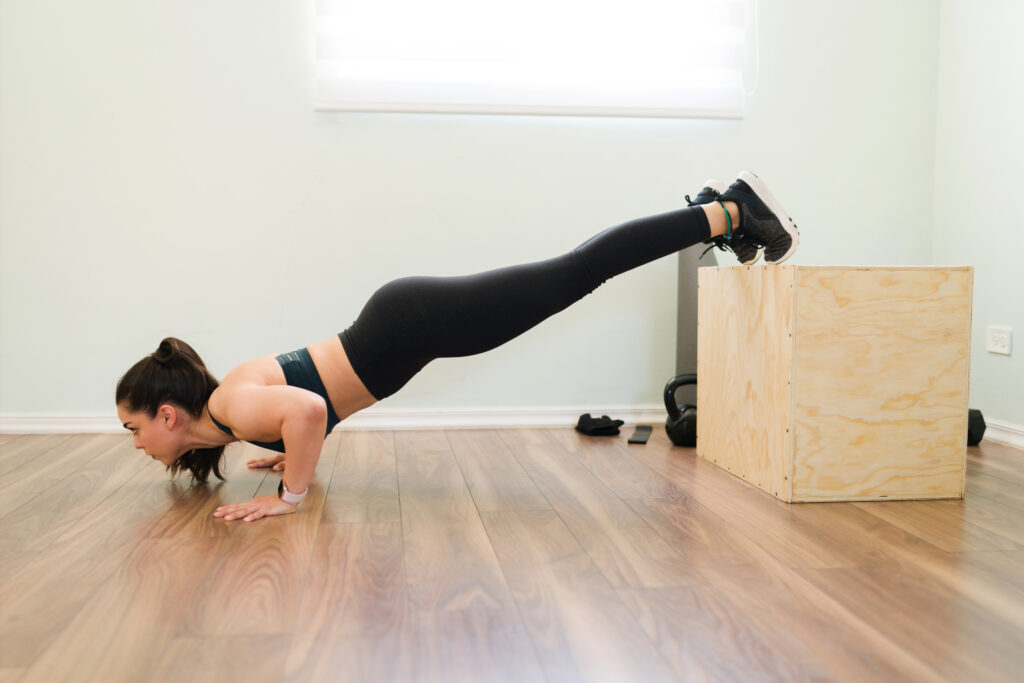
The clavicular part of the chest—the one that creates that famous “top shelf” line—can be activated just by changing your torso angle.
No incline bench?
No problem.
Try this:
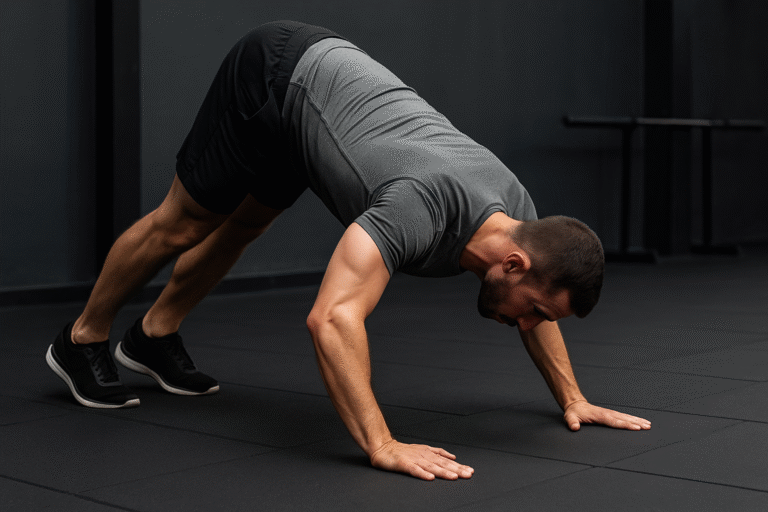
- Push-ups with feet on a chair or box: torso leans downward → directly hits upper chest
- Pike push-ups or wall-assisted handstand push-ups: vertical push → major upper chest activation
- Pseudo planche push-ups: shift your weight forward → huge demand on the upper chest
It’s not just the exercise.
It’s the angle you perform it at.
Change the angle = change the muscle focus.
And with the right angles, the upper chest grows—even without iron.
A different kind of growth: denser, more defined, less bloated
Many bodybuilders have big pecs but lack detail.
Calisthenics, on the other hand, sculpts muscles like they were carved by hand.
Why?
Because many bodyweight exercises emphasize:
- Isometrics (static contraction): hold the position, muscle stays engaged
- Active stretch (load under tension): like in deep dips
- High frequency and continuous tension: every push-up hits many fibers, including stabilizers
This leads to:
- Greater muscle density
- Higher contraction quality
- More compact, visible fibers
Your chest doesn’t just grow—it gets shaped.
And aesthetically, that’s way more impressive than random bulk.
But is there a limit to how far calisthenics can take your chest?
Yes, and it’s a big one: progressive overload is harder.
With the bench press, you just add a couple plates.
With push-ups, if you’re knocking out 40 reps with ease… you’re maintaining, not growing.
Here’s how to fix that:
1. Increase the leverage
- Pseudo planche push-ups → shift weight forward = more difficulty
- Archer push-ups → work one side at a time = more unilateral load
2. Add instability
- Rings
- TRX
- Push-ups on medicine balls
Instability = more fibers recruited to stabilize.
3. Add weight!
- Backpack full of books
- Weighted vest
- Plates in a backpack
You need to add load… creatively.
4. Change the tempo
- Slow push-ups (4 seconds down, 2 up)
- Long eccentrics
- Isometric holds at the bottom
Time under tension is a powerful stimulus.
Bonus benefits you don’t expect (but make a huge difference)
Training your chest with bodyweight also improves other areas often ignored in the gym.
1. Better posture
A controlled chest opens the rib cage.
Less rounded shoulders, more active scapulae = you stand taller effortlessly.
2. Greater thoracic mobility
Deep dips, static stretches, and ring work improve real mobility—not just strength.
You breathe better. You move better.
3. Increased body awareness
Perfect push-ups = feeling your chest work at every point.
Not “just pushing,” but “contracting here, stabilizing there, aligning that.”
This ability stays with you even outside of training.
4. Side-to-side symmetry
Many calisthenics exercises are unilateral or asymmetrical (archer push-ups, ring push-ups).
They fix postural imbalances that bench press often worsens.
The truth about the bench press: must-have or overrated?
Let’s be real: bench press is the most hyped exercise in fitness.
But how many people actually use it to carve out a high, defined, tight chest?
Very few.
Flat bench tends to stimulate mostly the middle and lower chest, and often overworks triceps and front delts—especially when done too fast or too heavy.
Still, used properly, it can be a solid ally.
The key is in the details:
- Scapulae retracted and depressed, not “pushed forward”
- Slow, controlled descent (at least 2–3 seconds)
- Stop before elbows go too far below bench level
- Keep chest open and active throughout the push
And to really hit the upper chest?
Use an incline bench (30–45°) or dumbbells to increase the range of motion.
But remember this:
The bench trains your chest well… if the chest is the star of the movement.
Otherwise, it’s just a show-off move to finish the set.
Want a “tight” chest? Then build a frame around it
Here’s the truth: one of the biggest mistakes I see—whether you bench or do calisthenics—is treating the chest like an isolated island.
Push-ups, bench, dips… and done.
But the chest alone can’t steal the show.
A pulled, defined, visually powerful chest only works if it’s framed properly.
And you don’t build that frame with more push-ups.
You build it like this:
- Strong rear delts → add depth to the upper chest and prevent that puffed-forward chicken pose
- Active lats → naturally pull your shoulders back and open your chest like a gladiator’s cape
- Toned lower traps → save you from the classic bench-slouch posture, keep scapulae down, make you look broader even when relaxed
Practical goal for you
If you want your tight chest to stand out even under a fitted shirt, don’t skip posture and scapular work.
Add these exercises at least twice a week:
- Band face pulls – 3 sets of 15 slow reps
Focus on pulling with mid and rear traps, not your arms - Australian pull-ups – 3×12
Focus on pulling scapulae back and down, chest open - Bodyweight (or banded) pullovers – 3×10
Feel the chest stretch as the lats lengthen under tension
Want your chest to pop? Then stop thinking only about push-ups
You want your tight chest to actually show?
Then there are three “non-muscular” elements you need to treat like a bodybuilder treats his steamed broccoli:
1. Body fat percentage
Men tend to store more fat over the chest, especially the lower part.
If you’re over 14–15% body fat, it’s hard to see the lines—even if your chest is strong underneath.
You don’t need Greek-statue abs, but hovering around 10–12% makes you look more muscular even at the same size.
2. Thoracic posture
The chest opens when:
- Scapulae are down and back
- Rib cage is expanded, not collapsed
- Pelvis isn’t anteriorly tilted (which ruins the whole visual line)
Posture affects how light hits your chest.
And light… is everything.
3. Diaphragmatic breathing
Sounds like Zen nonsense, but trust me: those who breathe well tend to have more active, visible chests—even at rest.
Shallow, upper chest breathing shortens the pecs.
Diaphragmatic breathing expands, opens, strengthens.
Postural and mobility routine for the chest (to pair with your training)
Want to maximize your tight chest gains?
Then you need a bit of muscle “maintenance” too.
Here’s a mini routine to do post-workout or on recovery days:
- Doorway stretch: 3×30” per side
- Vertical foam roller under spine + arms open: 3×1’
- Cat-Cow + Cobra yoga: 2 slow sets
- Diaphragmatic breathing lying down: 5 minutes
This kind of work:
- Releases tension
- Aids active chest growth
- Improves rib cage expansion
- Enhances recovery
Don’t skip it.
It’s the silent part that makes everything else shine.
Is your chest lagging behind? Here’s how to tell—and what to do
Not everyone’s chest responds right away.
In fact, many people—even well-trained ones—end up with weak, flat pecs that barely engage during training.
Frustration grows, especially when shoulders and arms blow up… and the chest looks like a spectator.
But how do you know if your chest is truly lagging behind?
Here are some clear signs:
- During push-ups, you only feel triceps and shoulders
- After dips, your arms are toast but your chest feels like a cucumber
- In side photos, your chest disappears while delts look like mini melons
- Your chest “drops” down instead of rising and opening
- You have a slight upper back hunch that flattens your chest visually
Targeted routine to unlock a lazy chest (2–3 times a week)
The goal is to engage the chest from all angles with constant tension—not just burn it out with random reps.
Phase 1 – Activation (feel the chest)
Do 2 slow rounds before training
- Wall push with squeeze: 2×15 (hands against wall, push and contract chest hard)
- Stretch + dynamic contraction: 2×10 (start in doorway stretch, contract chest without moving)
Phase 2 – Focused work
- Slow push-ups (4-0-2): 3×8-10
4 seconds down, no pause, 2 seconds up - Feet elevated push-ups: 3×6-8
Angle downward = upper chest activation - Controlled dips: 3×6
Don’t push only with triceps. Lean torso forward slightly.
Phase 3 – Isometrics and connection
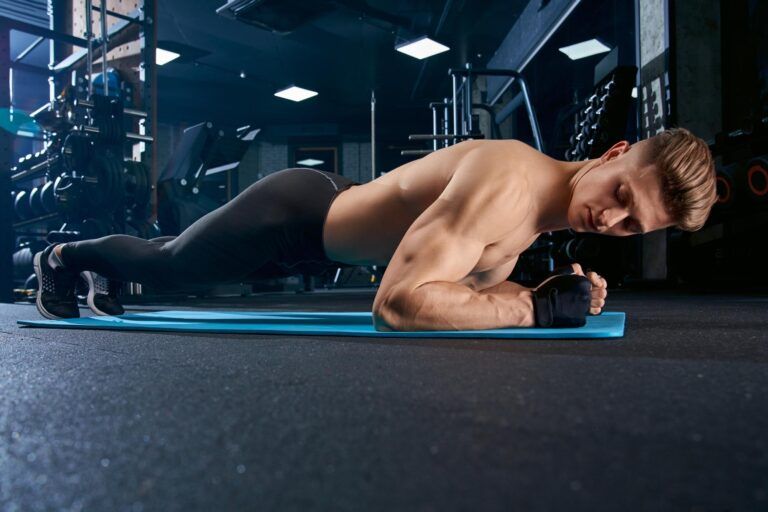
- Push-up low hold: 3×20”
Stop 1–2 cm from the ground, hold, chest tight - Chest stretch + alternating contraction: 2×30” per side
Contract one side while the other is stretched
More crucial tips if your chest won’t grow
- Film your push-ups
If your shoulders rise first, your chest isn’t working - Check your shoulder mobility
Too stiff? Your chest suffers. Use stretches and foam roller - Use active squeeze
In every push, imagine pulling your hands together—even if they don’t move. This instantly fires up the chest - Avoid “random volume”
100 push-ups a day won’t help if done without control. Better 20 perfect ones than 200 sloppy ones
RELATED:》》》Is calisthenics better than bodybuilding?
Conclusion
You don’t need a bench to have a cover-worthy chest.
You need patience, technique, time under tension, and smart programming.
A chest sculpted through calisthenics isn’t just aesthetic.
It’s functional, mobile, symmetrical.
It goes with you anywhere—no machines, plates, or incline benches needed.
And most importantly… it stays active even when the workout’s over.
Every movement becomes training.
Every gesture reinforces that tight, compact line that pops—even under a shirt.
And think: “I train my chest… with the floor.”