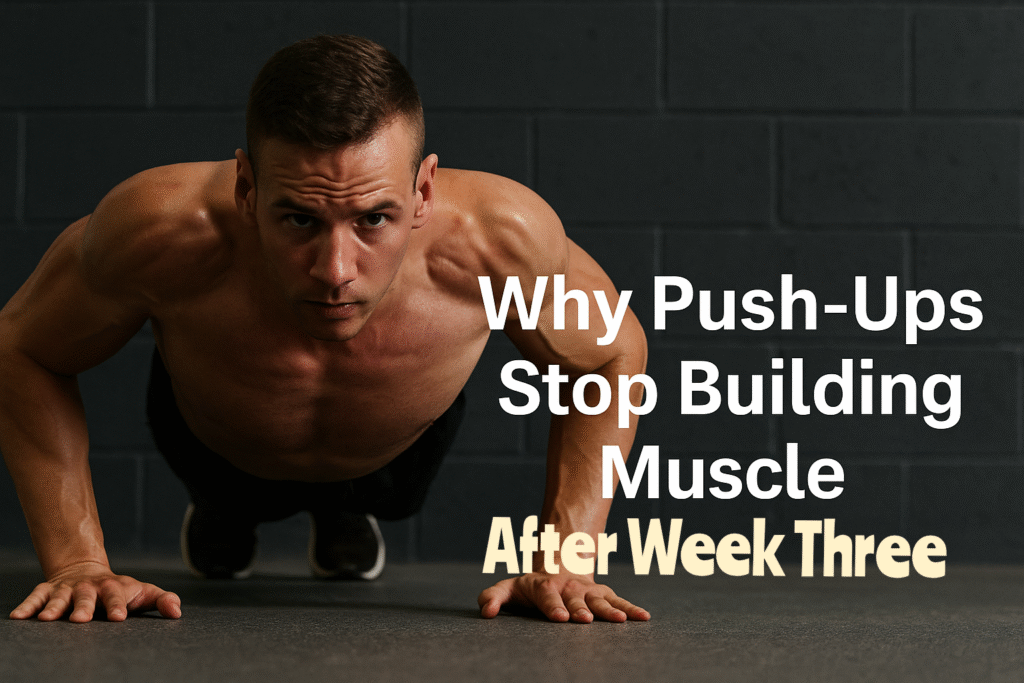
The first week you start doing push-ups again, you feel unstoppable.
Your chest burns, your triceps shake, and you swear your T-shirt fits tighter the next morning.
By week two, you’re already hitting clean sets of 20.
By week three, something weird happens.
You’re still doing the same routine, but it doesn’t feel like much anymore.
Your muscles don’t get sore.
Your chest pump is gone before you even get to the mirror.
And you start wondering — did your body just… stop caring?
Let’s talk about that.
Because no, you didn’t “lose your gains.”
You just outsmarted your own body — or more precisely, it adapted faster than your confidence wanted to admit.
Why the first few weeks feel magical
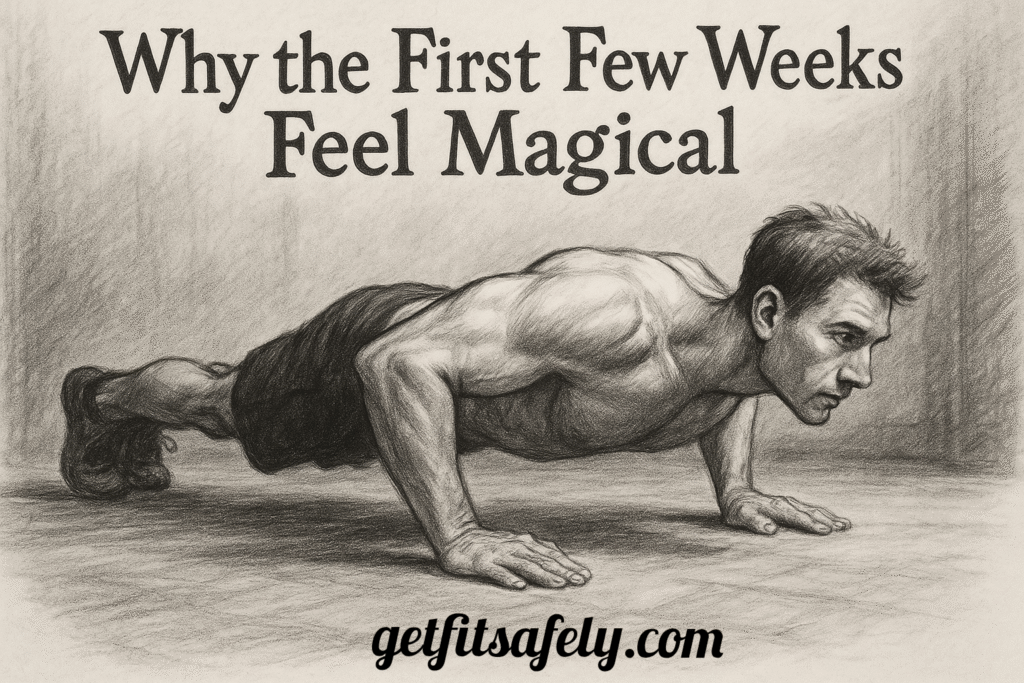
When you start doing floor push-ups after a break, everything fires up at once.
Your nervous system gets better at recruiting muscle fibers.
Blood flow increases.
You’re basically teaching your body, “Hey, this movement matters again.”
That’s why in those early days, even the most basic sets feel productive.
But here’s the catch — your body’s main job is survival, not aesthetics.
Once it realizes you’re doing the same push-ups every day, in the same way, it goes: “Okay, I’ve got this covered.”
And once it’s efficient at something, it stops wasting energy trying to improve it.
That’s adaptation.
And in fitness, adaptation without progression means stagnation.
Why your muscles stop responding after week three
When you hit a plateau around week three, it’s not because push-ups “don’t work.”
It’s because your muscles already know what’s coming.
Same angle.
Same depth.
Same number of reps.
Same load (your body weight).
Without a new challenge — more resistance, new tempo, or fresh variation — your body just coasts on autopilot.
Think of it like driving the same route to work every day.
At some point, your brain checks out.
You don’t even remember the traffic lights anymore.
Your muscles do the same thing.
They check out.
Progressive overload still applies — even to bodyweight training
This is the part most people forget.
Just because you’re using your own body doesn’t mean you’re exempt from progressive overload.
If you want to keep building muscle, you have to make your push-ups harder over time.
That could mean:
- Slowing down your reps (eccentric focus).
- Elevating your feet.
- Adding a backpack or weight plate.
- Reducing rest time.
- Trying one-arm or archer push-ups.
Each of these changes increases mechanical tension — the key driver of muscle growth.
In simple terms: your body needs a reason to get stronger.
Why “more reps” isn’t always the answer
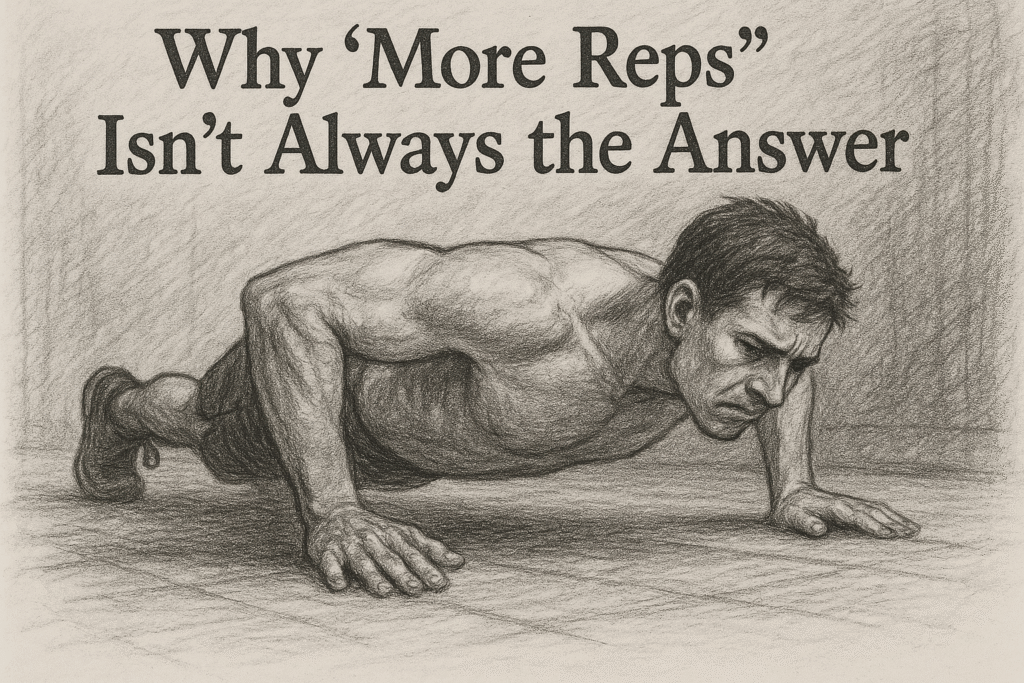
The most common instinct when you hit a plateau is to do more reps.
And yes, volume matters — but only up to a point.
Once you can do 30+ push-ups in a row, you’re mostly training endurance, not hypertrophy.
Muscle growth thrives in the zone where your sets end with genuine struggle — usually between 6 and 15 reps if there’s enough resistance.
So if your push-ups feel easy, adding more sets won’t fix it.
You’ll just burn time and get better at doing lots of easy push-ups.
How to make your floor push-ups effective again
Here’s what actually brings back that “newbie gain” magic: strategic discomfort.
Switch your push-ups into something your body doesn’t recognize.
For example:
- Try tempo push-ups (3 seconds down, 1 second pause, explode up).
- Do hand-release push-ups to reset full range of motion.
- Mix deficit push-ups using yoga blocks or books to extend depth.
- Superset them with another chest or tricep move (like diamond push-ups).
Even a subtle shift — like moving your hands slightly closer or wider — can re-ignite the challenge.
Your muscles love novelty almost as much as your brain does.
When your floor becomes your ceiling
There’s a point where you’ve squeezed all the juice out of basic push-ups.
No matter how creative you get with tempo or angles, you eventually need extra resistance.
That’s not a failure — that’s progress.
You’re not “too weak for weights”; you’re too strong for the floor.
That’s the moment to graduate to loaded movements — weighted push-ups, resistance bands, dips, or even barbell work.
How to Tell If Your Push-Ups Still Build Muscle (And What to Do If They Don’t)
Here’s the thing most people never check: whether their push-ups are still triggering muscle adaptation.
The best indicators aren’t about soreness or “pump.”
They’re about performance and control.
You’re still building muscle if you:
- Struggle to complete the last 2–3 reps with perfect form.
- Feel steady tension across your chest, shoulders, and triceps — not just one spot burning out.
- Notice strength carryover to other movements (like dips or bench presses).
- Can increase reps or resistance weekly without losing form.
If none of that happens anymore, your push-ups have become maintenance work, not growth work.
And that’s okay — it just means it’s time to level up.
To bring muscle growth back into the equation, try this simple weekly structure:
Day 1 – Strength Focus
Weighted or deficit push-ups (3–4 sets of 6–10 reps).
Day 3 – Volume Focus
Bodyweight variations like diamond, pseudo planche, or archer push-ups (4–5 sets of 12–15).
Day 5 – Stability & Control
Tempo push-ups or ring push-ups to challenge coordination and tension.
This blend hits three different muscle adaptation pathways:
- Mechanical tension (strength)
- Metabolic stress (volume)
- Neuromuscular control (stability)
That’s exactly how you keep progressing without turning your push-up routine into a mindless repetition marathon.
The takeaway: build, don’t repeat
Push-ups are incredible — they teach discipline, stability, and control.
But they’re only a tool, not a religion.
Once you’ve mastered the floor, use it as a foundation, not a finish line.
Because strength isn’t built by repeating what you’ve already conquered.
It’s built by daring to outgrow it.
And the moment you realize your push-ups feel too easy?
That’s not the end of your journey — it’s the start of a heavier, stronger one.
FAQs
Can daily push-ups affect your hormones or recovery?
Doing push-ups every day without rest can slightly raise cortisol and slow recovery.
Your nervous system needs breaks to trigger muscle growth and restore testosterone balance.
Add rest days or switch intensity instead of training full force daily.
Recovery rhythm builds strength — not nonstop effort.
Do push-ups really work your core muscles?
Yes, push-ups train your core like a moving plank — but only if your form stays tight.
Once your abs adapt, you need instability to keep growing.
Try ring push-ups, one-leg push-ups, or tempo holds to wake your stabilizers again.
Challenge, not repetition, keeps your core engaged.
Can bad posture limit your push-up progress?
Poor shoulder mobility or rounded posture can block chest activation.
When your scapulae can’t move freely, your triceps and delts take over.
Fix it with band pull-aparts, wall slides, and thoracic stretches before training.
Better posture unlocks strength your chest never got to use.
Why do my wrists hurt during push-ups?
Your wrists aren’t weak — they’re just untrained for heavy extension.
Advanced push-ups load them in ways typing never does.
Warm up with wrist circles and palm rocks to build mobility and strength.
Stronger wrists mean stronger push-ups without pain.