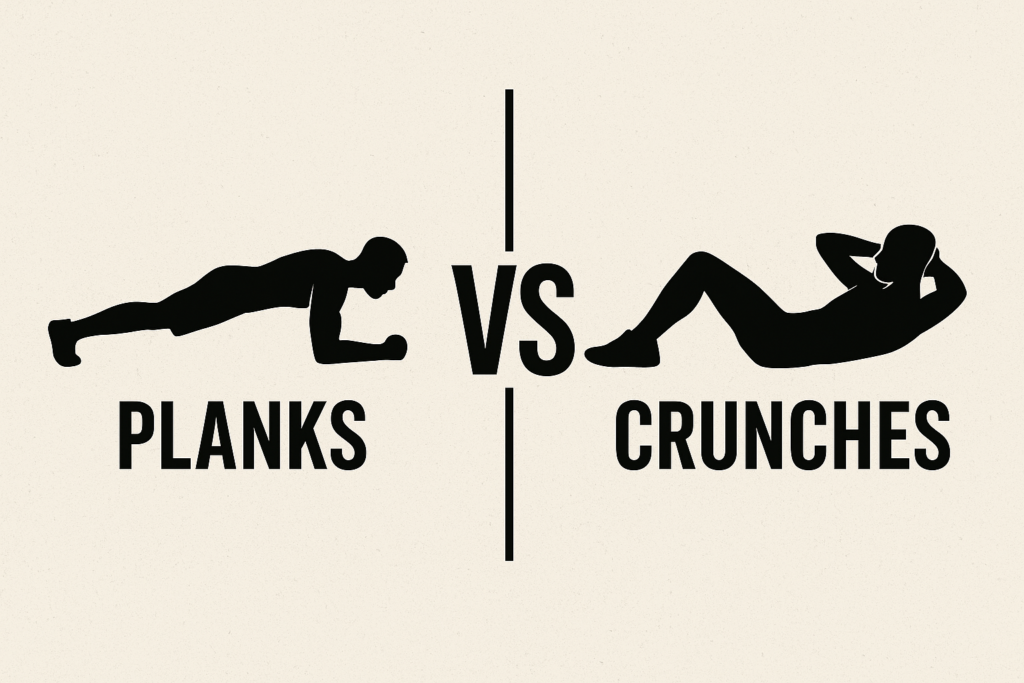
Why does everyone argue about planks vs crunches?
It happens in every gym.
On one side you have the “crunch for the pump” team.
On the other, the “plank is life, core brother” team.
But behind this mini fitness war, there’s a very practical question:
- Which exercise actually builds abs that matter?
- Which one helps you get the famous “six-pack” without upsetting your lower back?
- Which one gives you something more than just a burning sensation across your stomach?
The short answer: there’s no perfect hero or villain here.
The longer answer: one of the two is often overrated for the wrong reasons.
And one of them, done well, is a tiny stability laboratory for your entire body.
What your abs really want (besides mirror photos)
Your abs aren’t just “aesthetic muscles.”
They belong to your core — the central area that handles:
- Spinal stability
- Force transfer between lower and upper body
- Protecting your back when you lift, push, pull, run, jump
Translated into real-world language:
When your core works well, you move better, get injured less, lift more, and fatigue less easily.
And no, feeling “the burn” doesn’t automatically mean you’re training your core intelligently.
You can crank out a thousand crunches and still have weak stability.
Meanwhile, a clean 20-second plank can make you shake like you’re holding up the ceiling.
Crunches: the exercise everyone knows (and often does in the worst possible way)
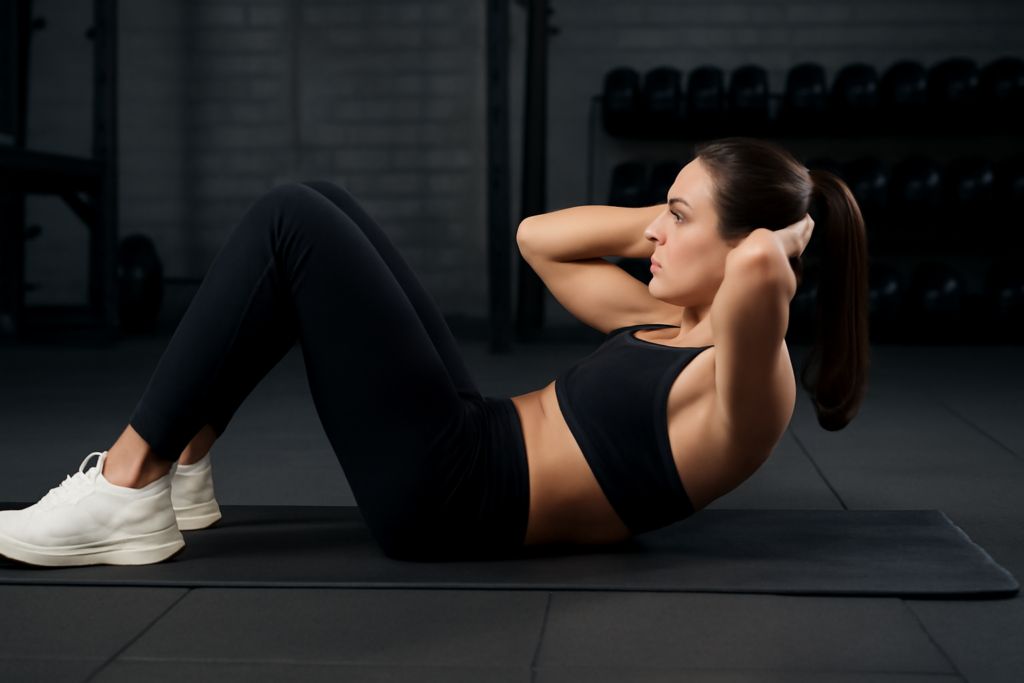
Let’s start with the classic.
A crunch is the movement where you bring your chest toward your pelvis, shortening the rectus abdominis.
It mainly involves:
- The rectus abdominis (your “six-pack”)
- Hip flexors (if technique collapses)
- A touch of obliques, depending on the variation
In theory, it’s a solid flexion exercise.
In practice, it often becomes:
- Pulling yourself up with your neck
- Pushing with your thighs instead of your abs
- Flying through reps without control, almost like a drum roll
Yes, you’ll feel a burn — but that doesn’t mean you’re teaching your body a movement pattern that will help you stabilize your spine under real load.
Why crunches aren’t “the bad guy”… but they’re not the whole solution
Let’s be honest: crunches don’t need to be demonized.
They’re useful when:
- You’re a beginner learning to “feel” your abs working
- You need a simple, low-load exercise to do at home
- You include them as part of a complete routine, not as your only core exercise
But they have clear limitations:
- They don’t train your ability to stabilize the spine against external forces
- They don’t significantly engage the entire chain of muscles in the core
- With poor technique and too much volume, your neck and lower back will complain
And mostly: crunches tend to satisfy your pride (“I did 50 reps!”) more than they truly improve your functionality.
The high rep count just feels impressive.
But quantity isn’t automatically quality.
Planks: the boring exercise that improves almost everything
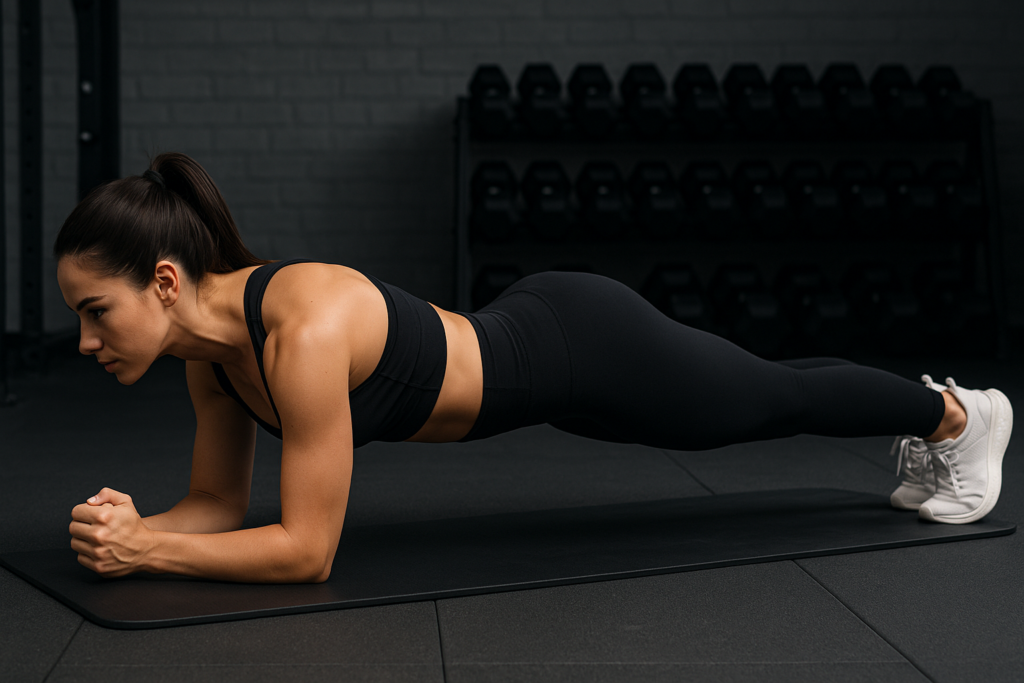
And then there’s the plank.
Static.
Silent.
No spectacular pump.
No glorious selfie moment mid-contraction.
Yet from a muscular and functional standpoint, it’s a minimalist masterpiece.
A plank recruits an entire team:
- Rectus abdominis
- Obliques
- Transverse abdominis (your internal “safety belt”)
- Glutes
- Lower back (which must stay neutral)
- Shoulders and upper back
It’s as if your whole body holds a meeting to maintain stability.
Here’s the key: you’re not “shortening” the abs.
You’re using them to stabilize your spine against gravity.
Which is exactly what your core does in real life.
Planks vs Crunches: who wins in real-world functionality?
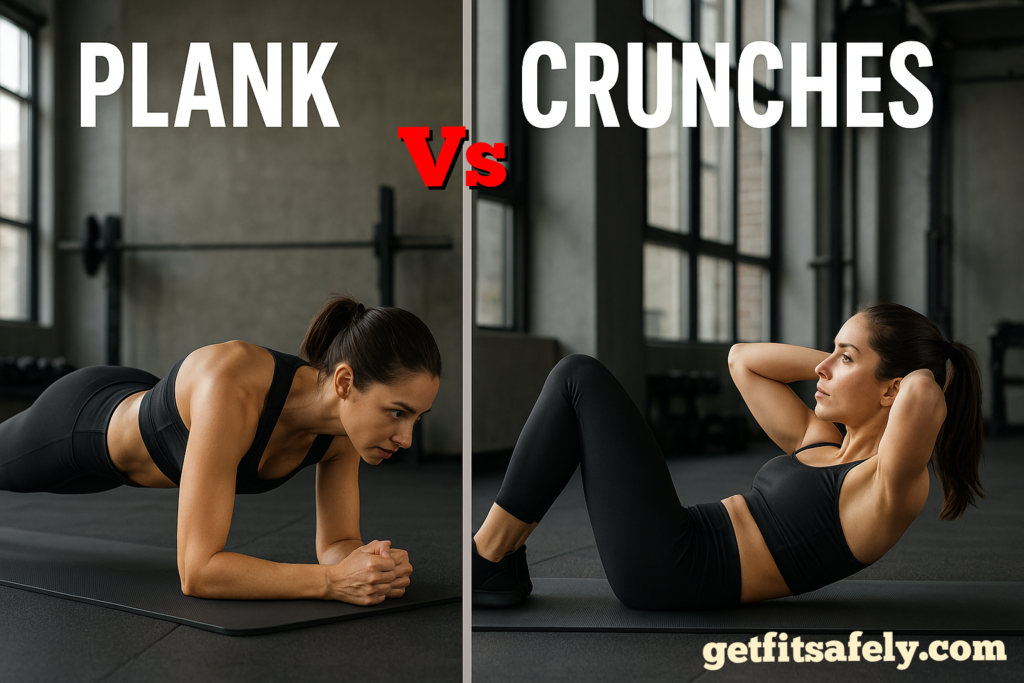
If you think about daily life and training, the question becomes:
“How many times do I perform a perfect crunch…
and how many times do I need to keep my spine from collapsing while lifting, pushing, pulling, or running?”
The answer is obvious: you stabilize far more often than you flex.
That’s why the plank is much closer to real-world core work:
- Teaches you to maintain a neutral spine
- Trains you to distribute tension across abs, glutes, and shoulders
- Improves your ability to “hold” under stress without collapsing in the lower back
Crunches can be a good side dish.
Planks are the main course.
But do planks actually build ab muscle?
A fair question.
If you hold a plank for five minutes, shaking like a leaf, you’re mostly doing endurance work.
But used intelligently, planks can contribute to building muscle in your midsection.
The trick?
Progression — not suffering in silence for as long as possible.
Smart progressions include:
Classic plank → one foot lifted
Start in a classic plank with hands under shoulders and the body in one straight line.
Slowly lift one foot off the floor without shifting the hips or arching the lower back.
Hold the position with full core tension, then switch sides under control.
Classic plank → one arm lifted
Set up in a standard plank, keeping the feet slightly wider for extra stability.
Lift one hand off the ground and extend the arm forward or slightly out to the side.
Keep the torso square to the floor and alternate arms without rushing the movement.
Elbow plank → high plank
Begin in a forearm plank with shoulders stacked over the elbows.
Press one hand into the floor, then the other, moving into a high plank position.
Lower back down to the forearms with control, switching the leading arm each rep.
Front plank → side plank → side plank with leg raised
Start in a front plank, bracing the core as if preparing for impact.
Rotate into a side plank, stacking the shoulders and keeping the body aligned.
Once stable, lift the top leg while maintaining balance and full-body tension.
Think of it as a strength exercise: short, controlled, gradually harder — not endless torture time.
“But don’t crunches make the six-pack pop?”
This is where the misunderstanding lives.
Abs show not because of a specific exercise, but because you have:
- Enough muscle in the area
- Low enough body fat to reveal it
Neither planks nor crunches magically burn belly fat.
Fat loss comes from:
- Nutrition
- Overall training volume
- Long-term consistency
If you combine:
- Solid full-body training
- Smart core work prioritizing planks
- Nutrition aligned with your goals
Then the famous “six-pack” stops being a summer fantasy.
Planks: how to do them without punishing your lower back
A bad plank is as useless as a rushed crunch.
Keep these cues in mind:
- Body in a straight line from ankles to shoulders
- No hips too high (“pyramid plank”)
- No hips sagging toward the floor
- Elbows under shoulders
- Eyes toward the floor
- Abs braced like you’re preparing for a tap on the stomach
- Glutes lightly engaged to stabilize the pelvis
Better 20–30 seconds of clean plank than 2 minutes of “just surviving.”
Crunches: if you’re going to do them, do them properly
You don’t need circus-level variations.
A solid, clean crunch is already respectable.
Key points:
- Lie on your back, knees bent, feet on the floor
- Hands light behind your head or crossed over your chest
- Think about “closing the gap” between sternum and pelvis
- Keep the lower back touching the floor most of the time
- Controlled up and down
- No jerking, no bouncing
Even 2–3 sets of 10–15 reps done with real control are enough in a well-structured routine.
A balanced approach: not a war, but a hierarchy
The real question isn’t “planks or crunches?”
It’s: “What role does each exercise play in my training week?”
A smart structure looks like this:
- Plank and variations → the foundation of core work
- Side planks and anti-rotation → upgrades for oblique strength and torso control
- Crunches → extra work, awareness of the rectus abdominis, small finishing touch
Example of a simple core routine (2–3 times per week):
- Front plank 3 × 20–30 seconds
- Side plank 3 × 15–25 seconds each side
- Controlled crunches 2–3 × 10–15 reps
If you lift weights or do calisthenics
Your core is already involved in many compound exercises:
- Squats, deadlifts, overhead press
- Pull-ups, rows
- Push-ups, dips, parallel bar work
And for that reason, strengthening it with stability-based exercises makes a lot of sense.
The plank is basically the bodyweight cousin of all those moments where you need to maintain your torso position while doing something demanding.
It helps you:
- Feel your body as a single unit
- Transfer force more efficiently
- Reduce the sense of lower-back “collapse” under load
Crunches here become optional extras.
Nice, but not essential.
How to apply this starting next week
Here’s something practical you can use immediately.
Day A (after legs or full-body training)
- Front plank 3 × 20–30 seconds
- Side plank 3 × 15–25 seconds per side
Day B (after upper-body training)
- High plank 3 × 20 seconds
- Controlled crunches 2–3 × 10–15 reps
Track things like:
- When you start shaking
- When your positioning fails
- When you’re ready to progress
Soon you’ll notice:
- Stronger posture during lifts
- Less lower-back fatigue
- A clearer sense of your body working as one unit
Final Thoughts
In a world full of flashy workouts, challenges, timers, and numbers, the plank looks almost too simple to matter.
But often, the least glamorous exercises are the ones that actually change your body.
If you want abs that aren’t just for the beach photo — but support every lift, every run, every jump, and protect your spine — the choice becomes obvious.
Give the plank (and its variations) the space it deserves.
Use crunches with intention, not obsession.
The result won’t just be a flatter stomach, but a stronger, more stable body ready for real movement — not just rep counting.