
Walking into a gym with dim lighting can feel “cool.”
Like a nightclub, but with more grunting and fewer cocktails.
A lot of gyms do it for vibe, ambiance, and that dramatic shadow-on-the-biceps effect.
The problem is that your joints do not care about ambiance.
They care about alignment, stability, and whether you just stepped on a stray plate like it was a LEGO.
Why lighting matters more than people think
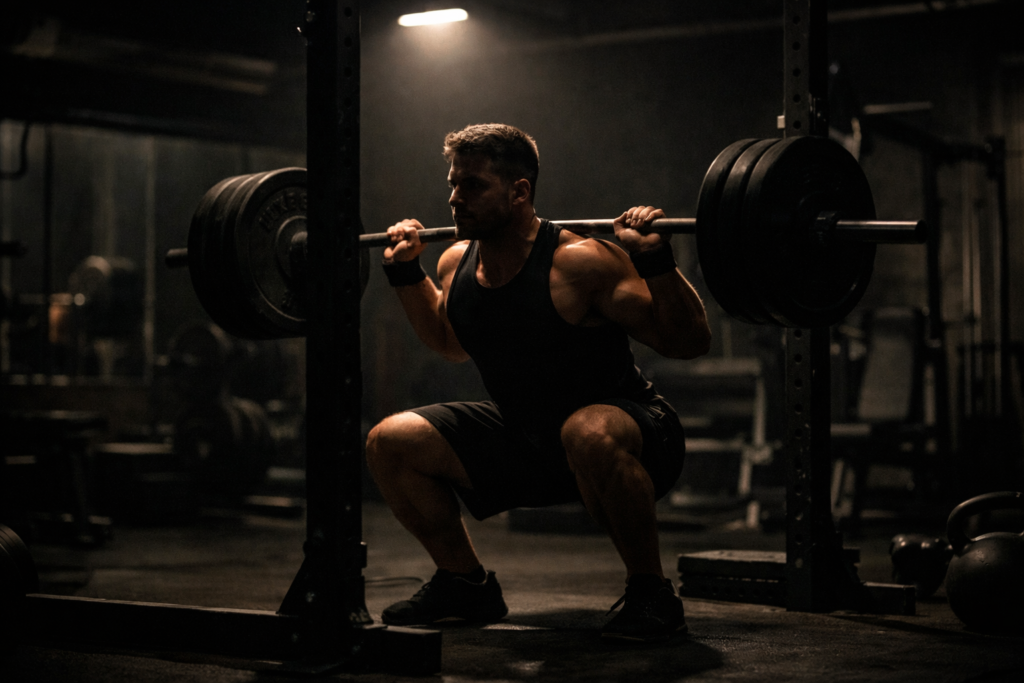
Most lifters think form problems come from weak muscles, poor mobility, or ego lifting.
Those are real, sure.
Yet poor lighting adds a sneaky extra variable: unreliable visual feedback.
Movement is controlled by a team effort between vision, the vestibular system (inner ear balance), and proprioception (your body’s “GPS” for where limbs are in space).
If one sensor lies, the whole system becomes a little more chaotic.
Dim lighting is basically a low-resolution camera feed for your nervous system.
You can still lift.
You just do it with fewer “pixels” of accuracy.
How the body uses vision during lifting
Vision helps you do three big things during training.
It gives you reference points for symmetry.
It helps you judge distance and depth.
It stabilizes balance by anchoring you to the room.
If the room is darker, contrast drops.
Edges get fuzzy.
Shadows hide details like knee collapse, hip shift, and foot angle.
That doesn’t automatically mean injury.
It does mean small technique errors can survive longer without being noticed.
The “dark gym” risks, explained without drama
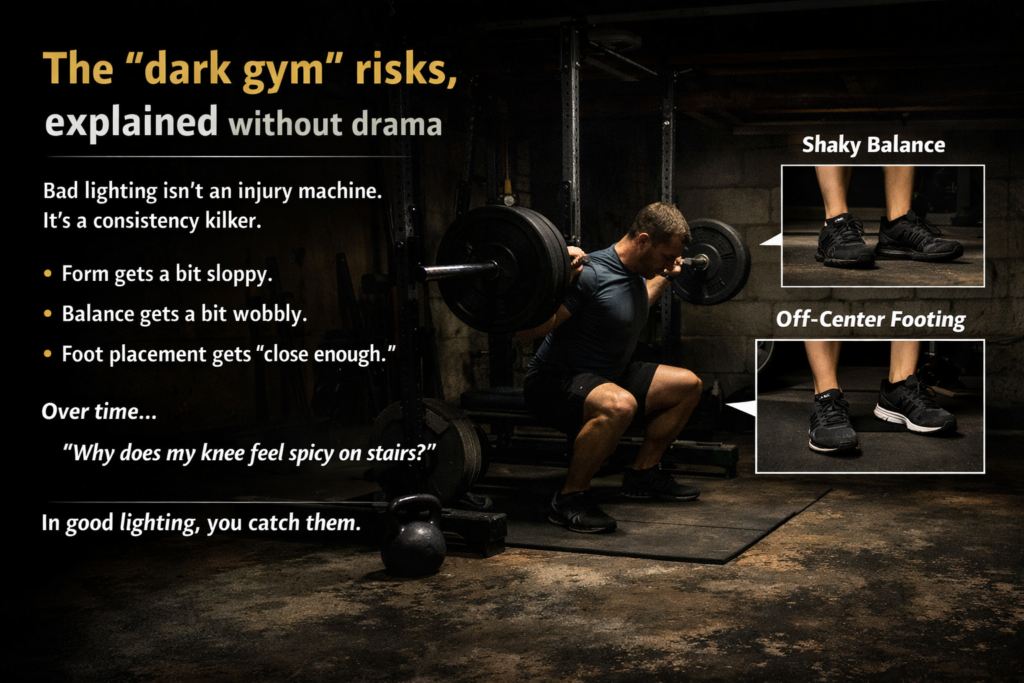
Bad lighting is not a guaranteed injury machine.
Plenty of people train in garages with one bulb and survive.
The risk is more boring and realistic: worse consistency.
Form becomes slightly less repeatable.
Balance becomes slightly less stable.
Foot placement becomes slightly more “close enough.”
Over months, “close enough” can become “why does my knee feel spicy on stairs.”
Form: when tiny errors hide in the shadows
In good lighting, you catch small deviations early.
In poor lighting, you catch them after your body has already rehearsed them for weeks.
Here are common form issues that lighting can make harder to notice.
Knees drifting inward on squats or lunges.
Uneven bar path on bench press.
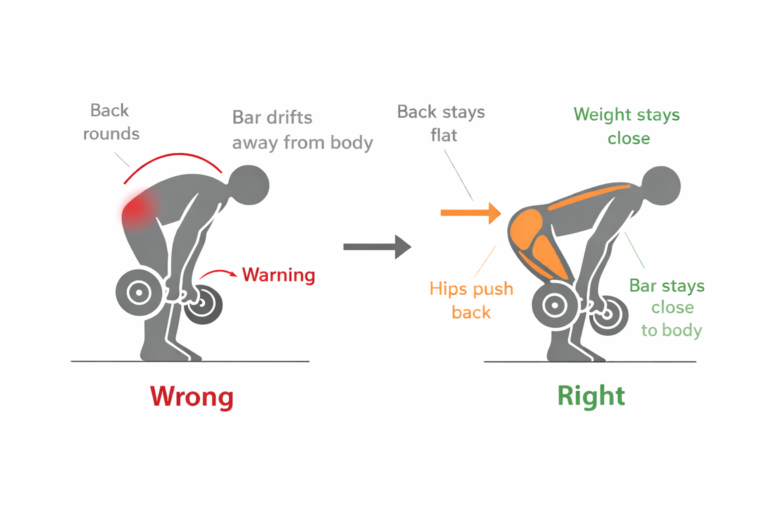
Hip shift on squats or deadlifts.
Foot pronation or rolling outward during heavy sets.
Shoulders creeping up during rows and pulldowns.
Elbows flaring or wrists bending back on presses.
Think of it like coding with a dim monitor.
The program might run.
Bugs still slip in because you literally cannot see what you are doing as clearly.
Mirror dependence gets worse in dim rooms
A lot of people use mirrors as real-time feedback.
That can help, as long as it does not turn into “mirror steering” mid-rep.
Dim lighting makes mirrors less useful.
If the reflection is shadowy, you compensate by twisting your head more to “check.”
Twisting your head changes posture.
Changing posture changes the rep.
Now the thing you were checking has already changed.
It’s like trying to stabilize a drone by watching the laggy video feed.
Balance: the hidden performance limiter
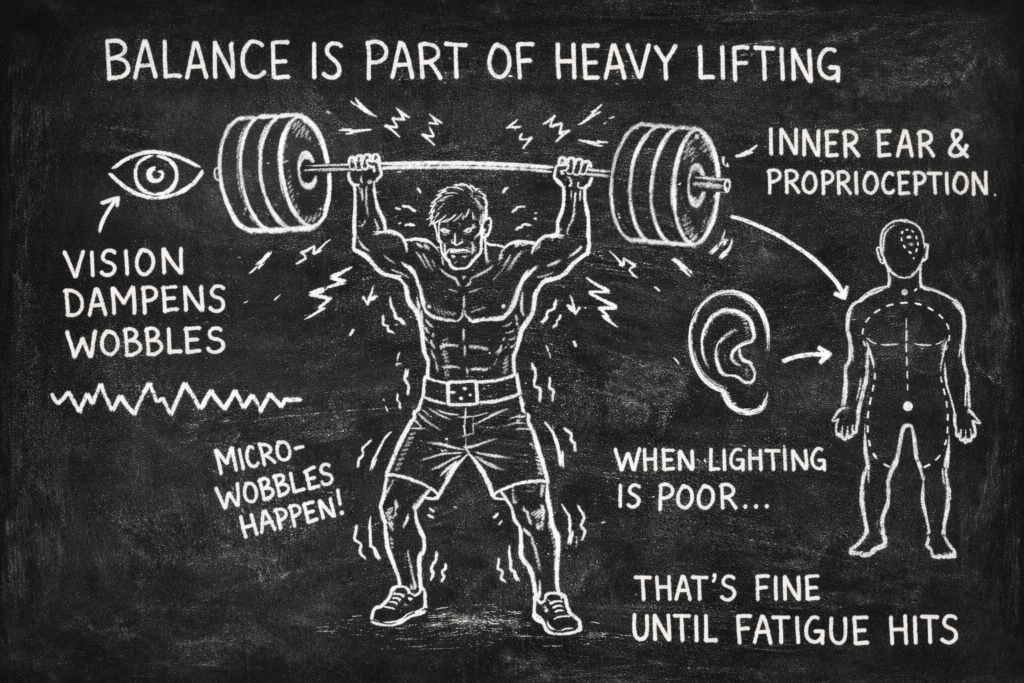
Balance isn’t only for yoga or circus acts.
Balance is part of heavy lifting.
Even in stable lifts, micro-wobbles happen.
Your body uses vision to dampen those wobbles.
When lighting is poor, your brain leans more on proprioception and the inner ear.
That’s fine until fatigue hits.
Fatigue makes proprioception “noisier.”
Now you have less visual clarity and less internal precision at the same time.
That is why the last reps of a set are where weird stuff happens.
Which exercises are most affected by low lighting
Some movements demand more balance and spatial accuracy than others.
Single-leg exercises like Bulgarian split squats, step-ups, and lunges are big ones.
Overhead work like presses and snatches needs strong position awareness.
Walking movements like farmer carries and walking lunges need clear pathing.
Anything on a narrow base, like heel-elevated squats, can feel sketchy faster.
Machines reduce balance demand, but they do not remove it.
You still have to set up correctly.
You still have to align joints well.
Joints: why lighting can influence “wear and tear”
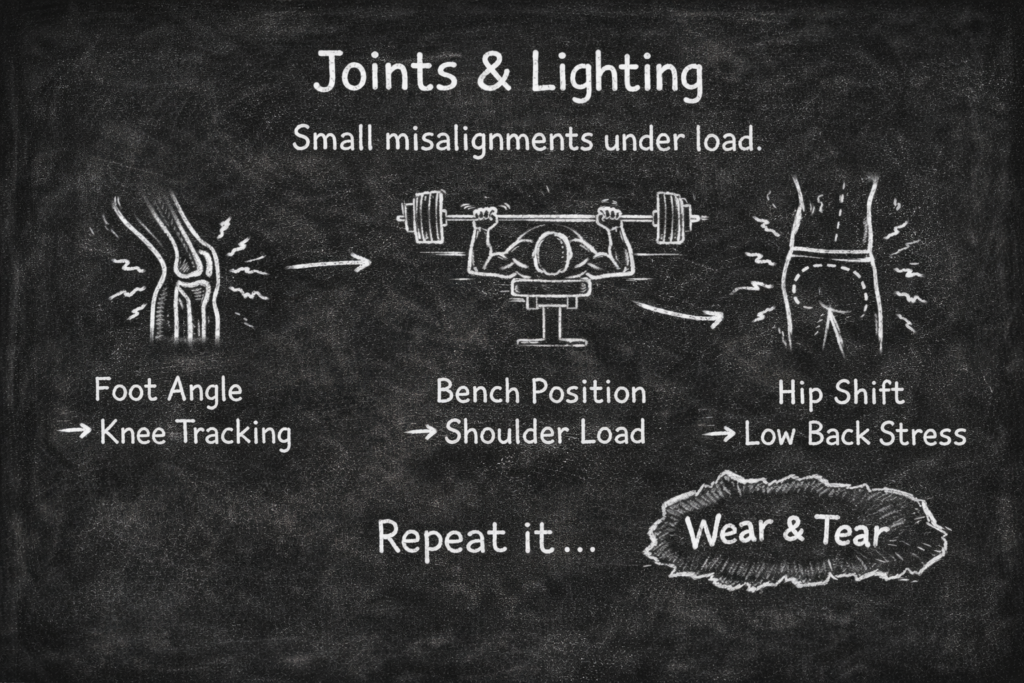
Joints hate surprise angles under load.
They also hate repetitive slight misalignment.
The annoying truth is that injuries often come from repeated small stress, not one dramatic moment.
Poor lighting can increase the chance of those small stresses.
If you misplace the foot by a couple degrees, the knee tracks differently.
If you set the bench slightly off-center, the shoulder loads unevenly.
If you miss that your hips are shifted, your low back compensates.
None of these is instantly catastrophic.
They can become a pattern.
Patterns are what create chronic crankiness.
Depth perception matters more than people admit
Depth perception helps with things like:
Judging how far the bench is behind you before you sit.
Seeing where the bar is relative to J-hooks.
Knowing where the floor is when you lower a deadlift quietly.
Placing feet evenly without staring at them for ten seconds.
Dim lighting reduces contrast.
Reduced contrast reduces reliable depth cues.
That’s why people bump racks, clip dumbbells, and misjudge steps more often in dark gyms.
It’s not clumsiness.
It’s physics plus biology plus a room that’s basically set to “moody cave.”
The under-discussed risk: tripping and setup errors
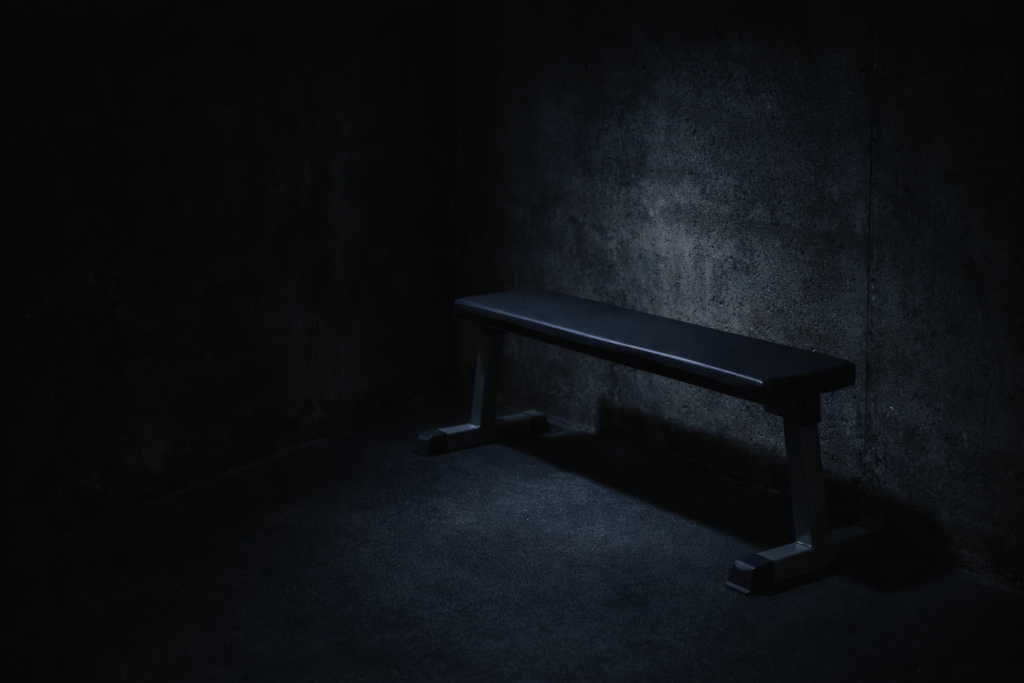
If you want the most practical reason to care about lighting, it is this one.
Most gym mishaps are not “bad squat form.”
They are “stepped on something,” “didn’t see that,” or “misracked a weight.”
Dim rooms make clutter more dangerous.
Black plates on black flooring are basically stealth objects.
A low bench in a dark corner is a shin-hunting missile.
A cable attachment on the floor is a toe’s natural predator.
Good training requires a safe environment.
Lighting is part of the environment.
Is “low light” always bad? Not necessarily
Some people lift better without harsh lights.
Bright lighting can feel stressful.
Harsh fluorescent glare can trigger headaches.
A calmer environment can improve focus.
So the goal is not stadium lighting.
The goal is functional visibility.
You want enough light to see joint positions, equipment edges, and floor hazards.
You want enough contrast to notice asymmetry.
You want enough clarity that you do not need to guess.
Signs your gym lighting is actively affecting you
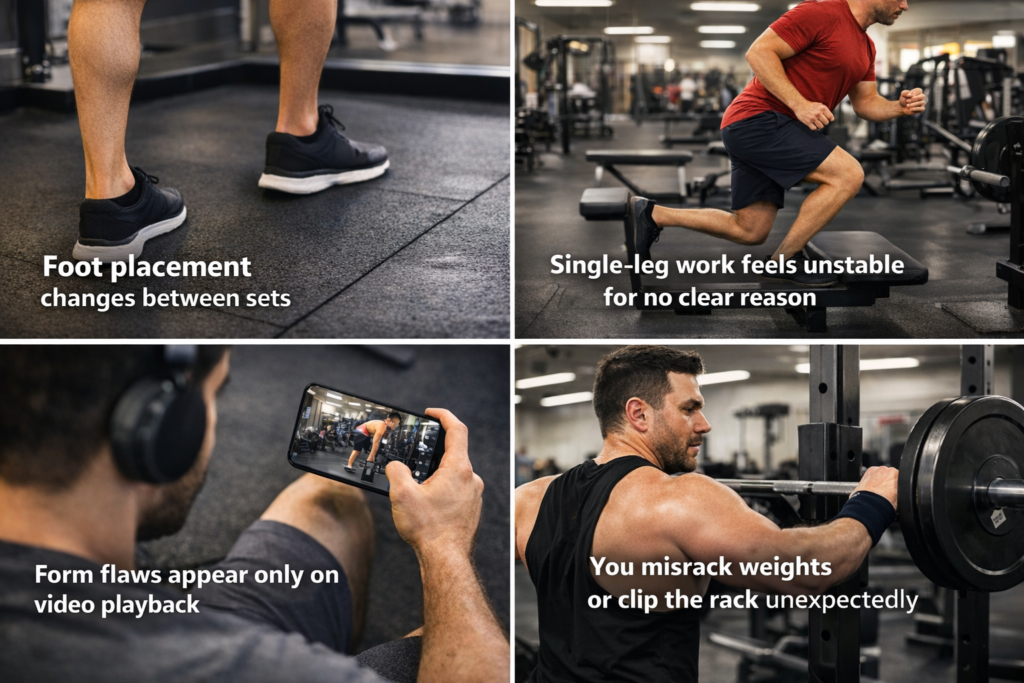
Here are realistic clues that lighting is becoming a training variable.
Foot placement feels inconsistent set to set.
Wobble shows up more on single-leg work than it should.
You notice form issues only when you watch video later.
You sometimes misrack weights or tap the rack unintentionally.
You get more “almost trips” than you used to.
Headaches or eye strain show up after sessions.
You avoid certain areas of the gym because they feel sketchy.
If several of these are true, it’s not you being fragile.
It’s a mismatch between the environment and the task.
What to do about it without becoming “that person”
You do not need to start a crusade against mood lighting.
You just need a few smart workarounds.
Pick a “good light zone” for technical lifts
Save precise, technique-heavy work for the brightest area.
Do squats, deadlifts, Olympic lifts, and single-leg balance work where you can see clearly.
Use darker corners for simpler accessories where form is easier to maintain.
Think “high precision tasks in high visibility zones.”
Use video as your backup sensor
If lighting is dim, your internal feedback might miss details.
A quick side-angle video can reveal bar path, knee tracking, hip shift, and depth.
Video is like adding a second monitor to your setup.
You do not need to record everything.
One or two sets can be enough to spot patterns.
Slow down the setup, not the whole workout
The setup is where lighting hurts you most.
Take an extra five seconds to:
Center your feet.
Check the bench position.
Confirm the bar is evenly loaded.
Make sure J-hooks are at the same height.
Verify collars are on if you use them.
The reps can still be powerful.
The setup should be calm and deliberate.
Choose equipment that increases contrast
This is a sneaky trick.
If you can choose between all-black plates and plates with visible markings, pick the visible ones.
If a bench has a dark frame and you keep banging your shin into it, pick a different bench.
If the floor is dark and the dumbbells blend into it, avoid leaving anything on the ground near your station.
You are basically designing your area for “easy visual parsing.”
That is a nerdy way of saying “make it easier to see stuff.”
Use a small personal light if it’s allowed
Some gyms allow small clip-on lights for filming or setup.
Some do not.
If it’s permitted, a tiny light aimed at the rack area can help you see hook height and symmetry.
If it’s not permitted, video plus better station choice usually solves most of it.
If you have joint pain, lighting isn’t the only suspect
It’s worth saying out loud.
Lighting is rarely the sole cause of pain.
Pain is usually a mix of load, volume, recovery, stress, sleep, previous injury, and technique.
Lighting is more like a multiplier.
If your squat is already borderline, dim lighting might make it harder to clean up.
If your balance is already shaky, dim lighting can amplify that wobble.
If your eyes strain easily, low contrast can fatigue you faster.
So treat lighting as part of the system.
Not the villain.
Who should care the most
Some lifters are more sensitive to lighting issues than others.
Beginners who are still learning positions benefit a lot from clear visual cues.
People returning from injury need consistency and clean alignment.
Older lifters often rely more on vision for balance, especially if proprioception has declined a bit.
Anyone doing single-leg work, overhead work, or complex barbell lifts will notice it more.
People with migraines, headaches, or eye strain should be especially mindful.
A quick way to spot technique issues—no perfect lighting needed
If you train in a dim gym and want to reduce risk, these are high-value habits.
Use a consistent stance width and toe angle.
Use the same setup ritual every time.
Find a fixed visual reference point straight ahead for balance-heavy lifts.
Warm up with slower tempo reps to calibrate position awareness.
Record one set when something feels off.
Avoid rushing unracks and reracks.
Keep the floor around you clean like it’s a lab bench.
If you cannot clearly see a rack’s hooks and pins, relocate.
You are not being picky.
You are being practical.
Conclusion
Training is already hard enough.
The weights are heavy, life is busy, and recovery is not always perfect.
You do not need an extra difficulty setting caused by poor visibility.
A well-lit station is not a luxury.
It’s basic infrastructure for good movement.
If your gym is dim, you can still train brilliantly.
Just train like someone who respects physics.
Clear feedback leads to cleaner reps.
Cleaner reps lead to more consistent progress.
More consistent progress is the most motivating thing there is.