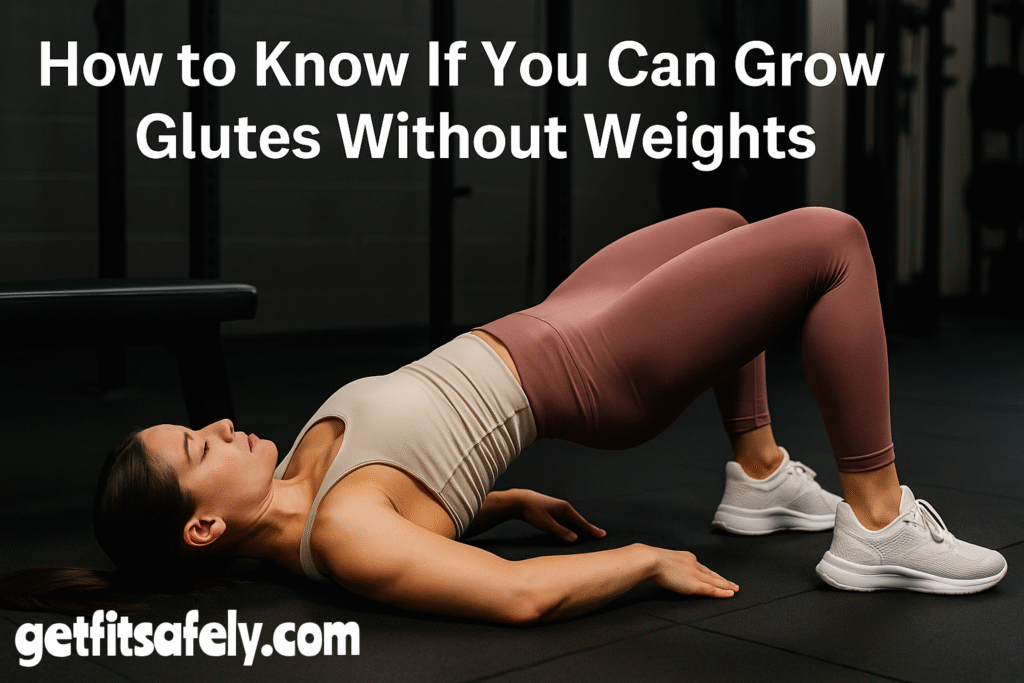
I had this moment once, standing in a park, staring at a friend doing bodyweight glute bridges like he was lounging on a beach towel.
And his glutes were growing.
Actually growing.
From that.
Meanwhile I was doing every hip thrust variation known to humankind, sweating like a rotisserie chicken, and my glutes were… politely declining the invitation to grow.
It made me wonder why some people get glute growth without weights while others need a small garage gym strapped to their backs.
It took time, some experiments, and a few “why is this happening to me” moments, but eventually things started to make sense.
Let’s walk through it together — because if you’ve ever yelled at your own butt in the mirror, you deserve answers.
BODYWEIGHT GLUTE GROWTH DEPENDS ON:
- How well your glutes activate
- How much mechanical tension you can generate
- Your fiber type and structure
- Your movement patterns
- Your ability to progress without weights
- Your technique
How Bodyweight Glute Growth Usually Works
Some people simply respond to bodyweight movements because their glutes are naturally “recruitment-friendly.”
Their nervous system loves those muscles.
It sends clean, high-quality signals.
Like a fiber-optic connection.
For them, bodyweight glute work feels like plugging into the right outlet.
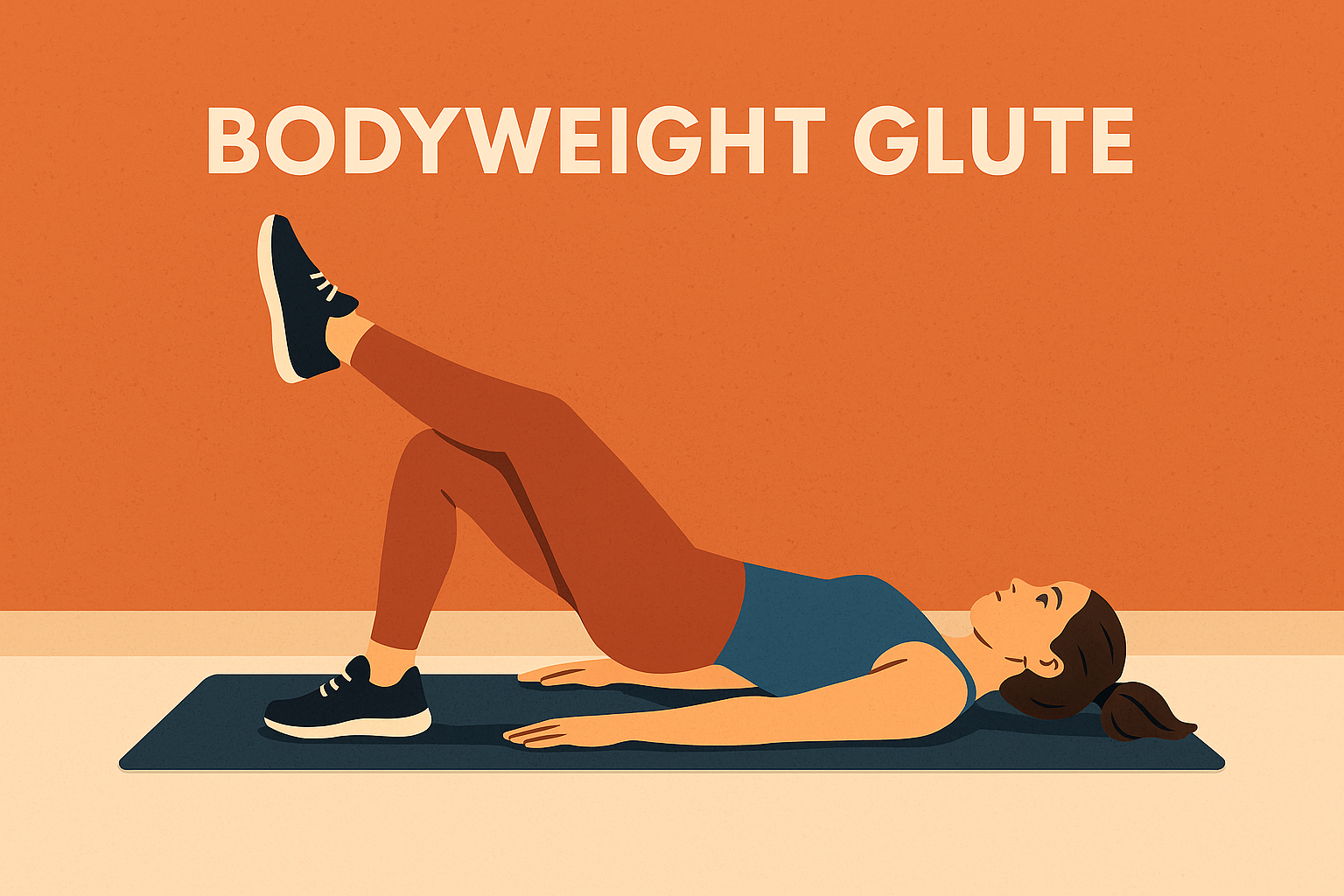
They do bridges, single-leg variations, maybe a few reverse hypers on a park bench, and boom — hypertrophy.
Quick execution cues:
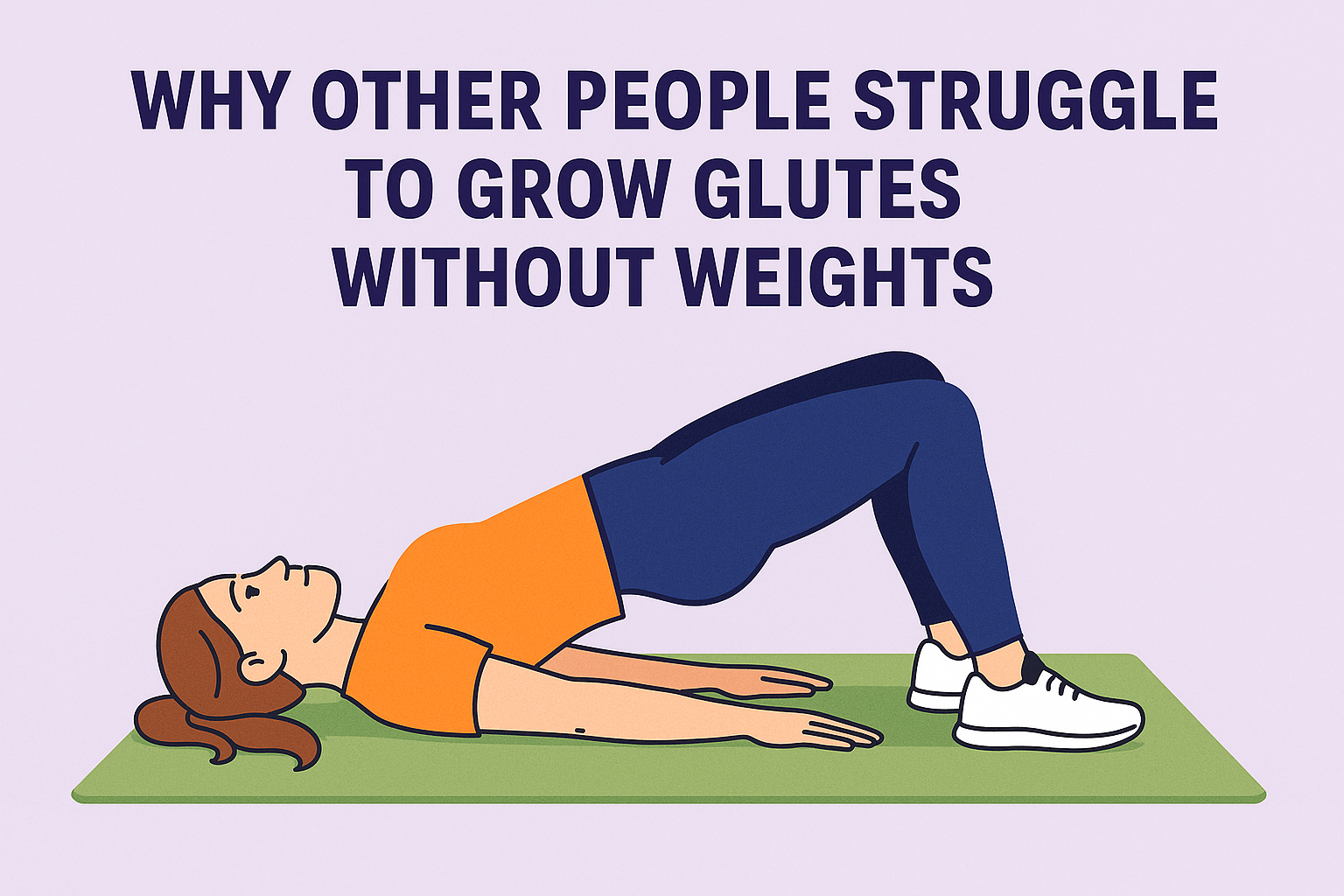
- Glute bridges: lie on your back, feet planted, lift your hips by pushing through your heels, squeeze at the top, lower slowly.
- Single-leg variations: same idea, but one foot stays on the ground while the other leg stays extended.
- Reverse hypers: lie face-down on a bench, hips at the edge, lift your legs behind you using your glutes without arching your lower back.
But that’s just one part of the picture.
Why Other People Struggle to Grow Glutes Without Weights
Here’s where it gets real.
Some bodies have glutes that act like introverts at a party.
They need a formal invitation, a name tag, and a reason to show up.
If your glutes aren’t great at firing on their own, bodyweight training might not reach the tension level required for hypertrophy.
You might feel everything in your quads.
Or in your hamstrings.
Or in that mysterious lower-back region that only exists to complain.
And when the glutes aren’t actually doing the work, they can’t grow — no matter how many reps are performed.
The good news?
You can usually fix this.
But we’re not there yet.
Why Some People Get Glute Growth Without Weights Faster: The “Hidden Factors”
These are never talked about, but they’re huge.
1. Glute fiber composition
Some people naturally have:
- more fast-twitch fibers
- more total glute mass
- better leverage during hip extension
These folks respond to almost anything.
A few sets of bodyweight hip thrusts and the glutes go, “Sure, why not.”
Hip thrust quick cue:
Upper back on a bench, feet planted, drive hips up by pushing through your heels, pause at the top, then lower with control.
Others have glutes that are more endurance-based.
Meaning they can do 50 reps before the muscle even wakes up.
2. Daily movement patterns
If you sit for 10 hours a day, your glutes are basically napping in airplane mode.
Someone who walks a lot, climbs stairs, or carries weight regularly already gives the glutes low-grade stimulation — enough to make bodyweight work more effective.
3. Range of motion differences
Some people naturally hinge deeper.
Their hips fold beautifully.
They hit that long stretch at the bottom of a glute movement without even thinking.
Hinge cue:
Push your hips back like you’re reaching for an invisible chair, then drive them forward until you feel a squeeze — not an arch.
Others hinge like a rusty door.
The glutes never enter their full contractile range.
So bodyweight tension becomes limited from the start.
4. Bodyweight distribution
Heavier individuals create more mechanical tension with the same movement.
A 180-lb person doing single-leg hip thrusts is basically lifting a moderate kettlebell without holding one.
A 120-lb person doing the same movement?
Less load.
Less mechanical tension.
Less stimulus.
It’s physics, not fairness.
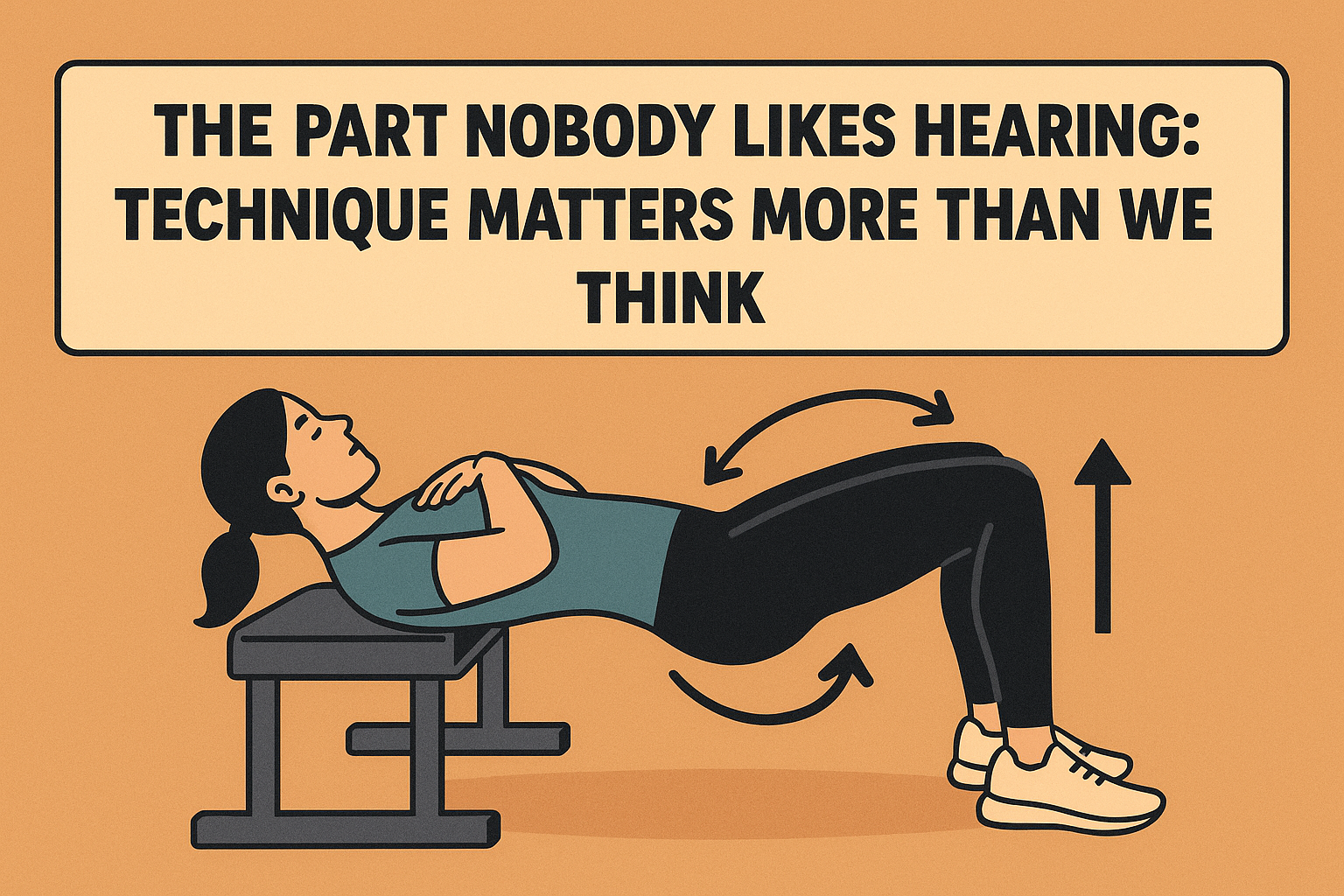
The Part Nobody Likes Hearing: Technique Matters More Than We Think
I resisted this for years.
I thought technique was for people who baked sourdough and alphabetized their spice cabinets.
But glute training is weirdly sensitive to angles.
A tiny shift in foot placement, torso angle, shin position, or the direction you push can completely change whether your glutes or your lower back are doing the job.
Most of the people who grow glutes without weights have accidentally found the angles that maximize tension.
The ones who struggle often haven’t — but that can be fixed with intention and a little patience.
When Bodyweight Glute Training Actually Becomes Enough
People underestimate how hard bodyweight glute work can get.
If you can do:
- single-leg hip thrusts with a long pause
- slow, deep glute bridges with perfect tension
- elevated hip extensions
- reverse hypers
- frog pumps with controlled tempo
- kneeling hinge patterns
…you can absolutely create enough mechanical tension to grow.
Execution cues in one breath:
- Slow bridges: heels down, ribs tucked, lift with control.
- Elevated hip extensions: lie face-down on a bench or couch edge, lift legs by squeezing glutes, no swinging.
- Frog pumps: soles of your feet together, knees out, thrust up and squeeze.
- Kneeling hinges: kneel tall, push hips back, then forward only using glute drive.
But those movements have to be progressed intentionally.
Think:
- slower reps
- controlled eccentrics
- top-position squeezes
- reduced momentum
- single-leg variations
- extended ranges of motion
Bodyweight glute growth isn’t about “no weights.”
It’s about high tension.
Why Glutes Sometimes Grow With Weights but Not Without
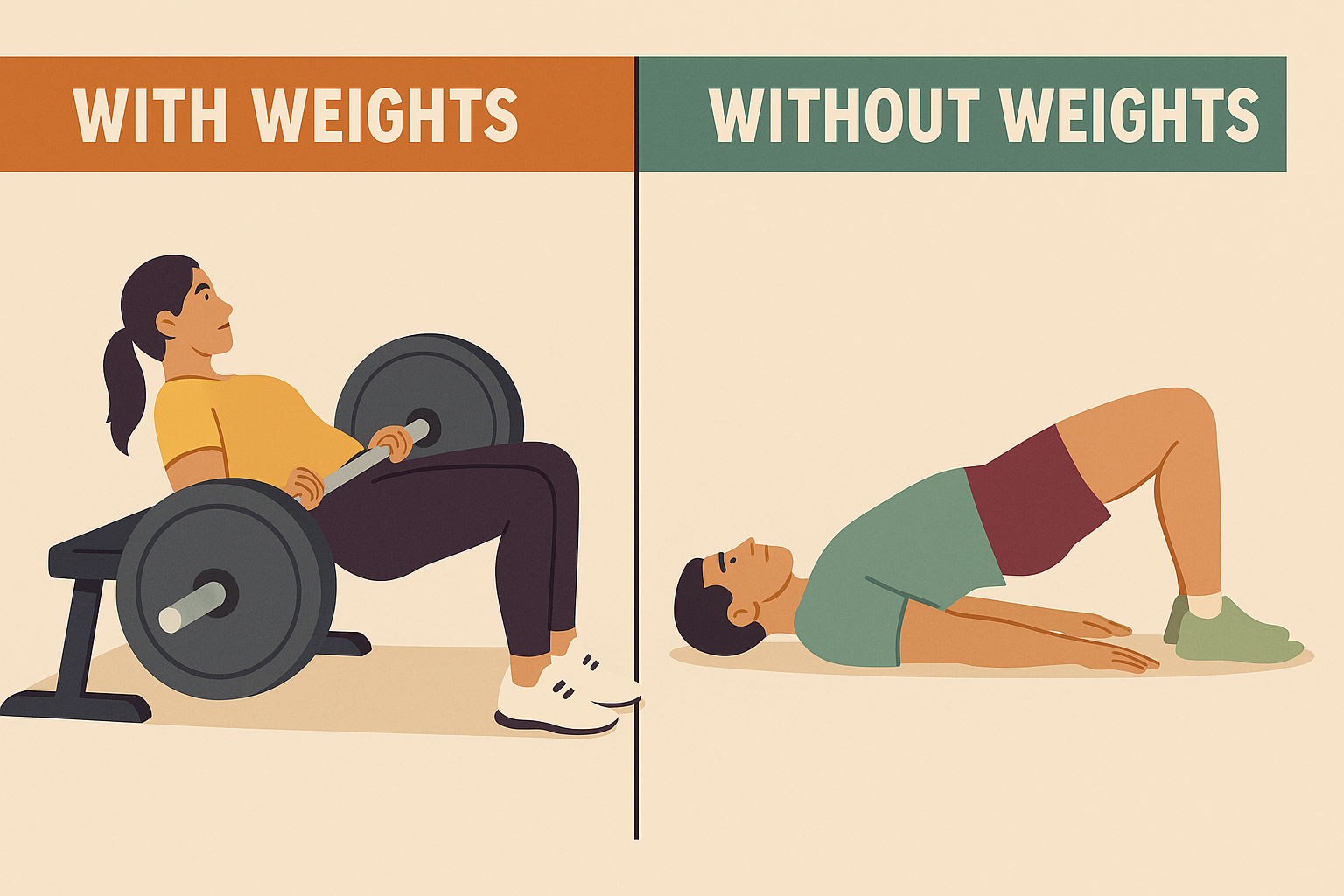
Weights solve one major problem:
They make it almost impossible to avoid tension.
Even if your glute recruitment isn’t amazing, loading forces your body to use bigger muscle groups — and the glutes are one of them.
It’s like turning up the volume on a song you didn’t realize you liked.
Suddenly you go, “Oh, there it is.”
Bodyweight training requires precision.
Weights just require the will to suffer a little.
What This Does to Your Head (Not Just Your Glutes)
Growing glutes without weights can become this weird point of pride online.
Like, if you need weights, you “failed.”
And if you grow glutes with bodyweight alone, you’re some chosen creature blessed by the Glute Goddess.
That mindset is toxic and unhelpful.
Every body has its own strengths, quirks, and ways of responding.
And honestly?
There’s something beautiful about discovering what your individual formula looks like.
I spent years thinking my glutes were broken.
Turns out they were just… shy.
Or stubborn.
Or both.
Once I figured out how to speak their language, things finally changed.
So Can Everyone Grow Glutes Without Weights?
Short answer: yes, but not at the same speed, and not with the same first steps.
Some people need:
- more single-leg work
- more reps at controlled tempo
- more range of motion
- better technique awareness
- occasional external load to “teach” the glutes what tension feels like
Others can grow with the basics.
And that’s cool too.
The Simple Test to See If You Can Grow Glutes Without Weights
Everyone wants to know the same thing:
“Okay, cool story… but which category am I in?”
Here’s the cleanest, simplest way to figure it out — no EMG charts, no biomechanics textbooks, and definitely no TikTok “glute gurus” required.
Step 1 — Do this quick 2-minute bodyweight test
Perform 12 slow single-leg hip thrusts per side.
How to do it briefly:
- Sit with your upper back on a bench or couch.
- Plant one foot, extend the other leg forward.
- Drive your hips up by pushing through your heel, pause at the top for a second, then lower slowly.
- Your ribs stay down, your chin stays tucked, and your hips move straight up.
If you feel:
- that deep burn right in the glute crease
- a solid squeeze on top
- minimal hamstring or quad takeover
…you’re naturally wired for bodyweight glute growth.
If you feel:
- hamstrings grabbing
- quads doing the heavy lifting
- lower back arching and complaining
…your glutes need a different entry point (very common, nothing is wrong).
Step 2 — Choose the right starting path
If your glutes fired well, start with:
Elevated Glute Bridges
- Lie on your back with feet on a low step or couch.
- Push through your heels, lift your hips, pause, lower slowly.
Single-Leg Hip Thrusts
- Same setup as the test.
- Keep the working leg bent, other leg extended, slow tempo, long pause at the top.
Tempo Frog Pumps
- Lie on your back, soles of your feet touching.
- Drive knees out, thrust your hips up, squeeze hard at the top.
Kneeling Hinges
- Kneel upright.
- Sit your hips back like a hinge, then push them forward until you feel a clean squeeze.
- No arching, no swinging.
You’ll grow quickly if you progress these.
If your glutes didn’t fire well, start with:
Short-Range Squeezes
- Lie on your back, feet planted.
- Lift your hips just a few inches and hold tight for 3–5 seconds.
It wakes the muscle up.
Isometric Hip Thrust Holds
- Hold the top of a hip thrust for 20–30 seconds.
- Focus on pushing your hips forward, not up.
Banded Abductions
- Sit or stand, band around your knees.
- Push your knees out without letting your hips roll forward.
Keep it clean.
Slow Bridges With Longer Legs
- Move your feet slightly further away until you feel your glutes more than hamstrings.
- Lift slowly, squeeze intentionally.
These teach your glutes how to contract.
Once they do, you can move to the “grow fast” list above.
Step 3 — A simple 2-week plan to test if bodyweight glute growth works for you
Nothing complicated — just enough structure to reveal what your body responds to.
Week 1
Day 1: Slow bridges (3×15, 3-sec pause) + frog pumps (3×20)
Day 3: Single-leg thrust holds (3×20 sec each side)
Day 5: Kneeling hinges (3×15) + reverse hypers (3×12)
Reverse Hyper quick cue:
Lie face-down on a bench, hips at the edge.
Lift your legs behind you by squeezing your glutes, not arching your lower back.
Small arc, not a swing.
Week 2
Day 1: Single-leg hip thrust full reps (3×10 each side)
Day 3: Bridges with extended ROM (feet on step, 3×12)
Day 5: Hinges (3×12) + frog pump burnouts (40–50 reps)
If after 2 weeks you feel:
- solid glute soreness
- more control at the top
- a “fuller” feeling in the upper and side glutes
…bodyweight glute growth will work great for you.
If instead you feel:
- hamstrings cooked
- quads dominant
- barely any glute fatigue
…you need a small external load temporarily — a dumbbell, a backpack with books, a kettlebell.
Not forever.
Just long enough to teach your glutes what real tension feels like.
Then you can go back to bodyweight and grow just fine.
Step 4 — When to switch from bodyweight to weights (and back)
If you can do:
- 20+ clean single-leg thrusts
- 30+ frog pumps with zero burn
- bridges that feel like cardio instead of strength
…you’ve “outgrown” bodyweight for now.
Add load for a few weeks.
Then return to bodyweight variations once your glutes understand tension better.
You’ll be shocked how much stronger everything feels.
RELATED:》》》 Is it normal to feel glutes during calf raises?
Conclusion
Your glutes aren’t “bad.”
They aren’t “lazy.”
They aren’t “genetically doomed.”
They’re just muscles waiting for the right stimulus.
And your stimulus might look different from someone else’s.
Maybe you’ll grow from bodyweight alone.
Maybe you’ll need a dumbbell at first and then transition to bodyweight progressions.
Maybe your breakthrough will be one tiny technique change.
Glute growth — with or without weights — is more of a conversation than a battle.
And once you learn your glutes’ language?
They talk back.