The day you start planning your home gym is like your first date with destiny.
You’re standing in that dusty garage, maybe sipping a cold coffee, eyeing the space where your car used to live — and now you’re dreaming of squat racks, dumbbells, and the echo of plates hitting rubber mats.
You’ve already argued with your partner about parking the lawnmower somewhere else (it lost that battle), and you’re finally ready to pull the trigger on gear.
But then comes the question every lifter eventually faces:
Do I build my setup around free weights, or do I invest in a few solid machines?
That’s the fork in the iron road — and the choice will shape not just your gym, but the kind of training you’ll actually stick with.
The undeniable charm of free weights
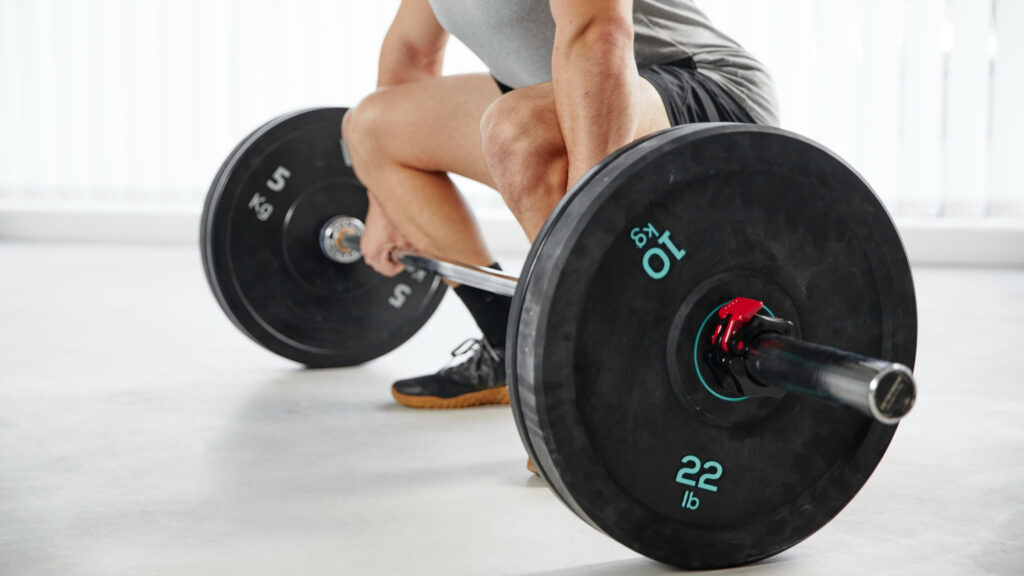
Free weights are the soul of any real gym.
They don’t hold your hand.
They don’t care if your form wobbles.
They demand control, balance, and effort — the kind that makes your body earn every rep.
When you lift a barbell or a dumbbell, your stabilizer muscles jump into action.
Your core fires up, your grip tightens, and your brain has to coordinate a symphony of tiny corrections just to keep everything moving.
That’s not just good for strength — it’s a full-body education in how to move like an athlete again.
Research from BMC Sports Science, Medicine and Rehabilitation (2023) found that free-weight training recruits significantly more stabilizer muscle activity than machine exercises — especially in compound lifts like squats and presses.
That means more muscle fibers firing per rep, more coordination gained per set.
And the best part?
Free weights don’t lie.
You can’t hide behind perfect machine angles or preset paths.
If your squat’s crooked, you’ll feel it.
If your press is unbalanced, you’ll see it wobble in real time.
That feedback loop makes you stronger, not just in muscle, but in awareness and precision.
And let’s be honest — nothing beats the clang of steel plates hitting home.
It’s not just noise; it’s motivation in surround sound.
Why machines aren’t “the lazy option”
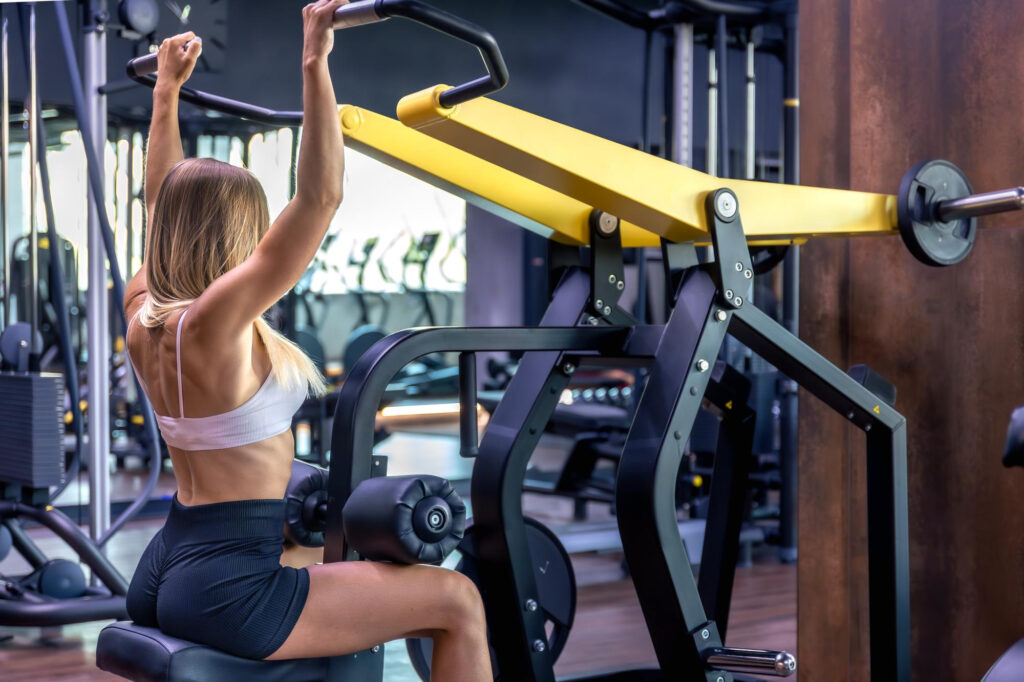
Here’s the thing — machines have an unfair reputation.
People love to act like using one is cheating.
But that’s like saying driving an automatic means you’re not really a driver.
Machines bring something precious to a home gym: safety and consistency.
When you’re training alone — which, let’s face it, is 99% of home gym life — that guided movement path can save your back, your shoulders, and your pride.
Machines let you load up a muscle safely and isolate weak points without worrying about losing balance or being pinned under a failed rep.
They also make “no-spotter training” a lot less nerve-wracking.
And if you’re coming back from an injury, machines can be your bridge back to free-weight work — keeping tension where you want it without unnecessary strain.
A 2023 meta-analysis published on PubMed concluded there’s no significant difference in muscle growth or strength between free weights and machines when total effort and volume are equal.
In other words — the tool doesn’t decide your gains.
Your effort does.
So next time someone says “machines are for beginners,” just smile — and keep training safely in your own garage without worrying about getting trapped under a barbell.
The home gym reality: space, noise, and sanity
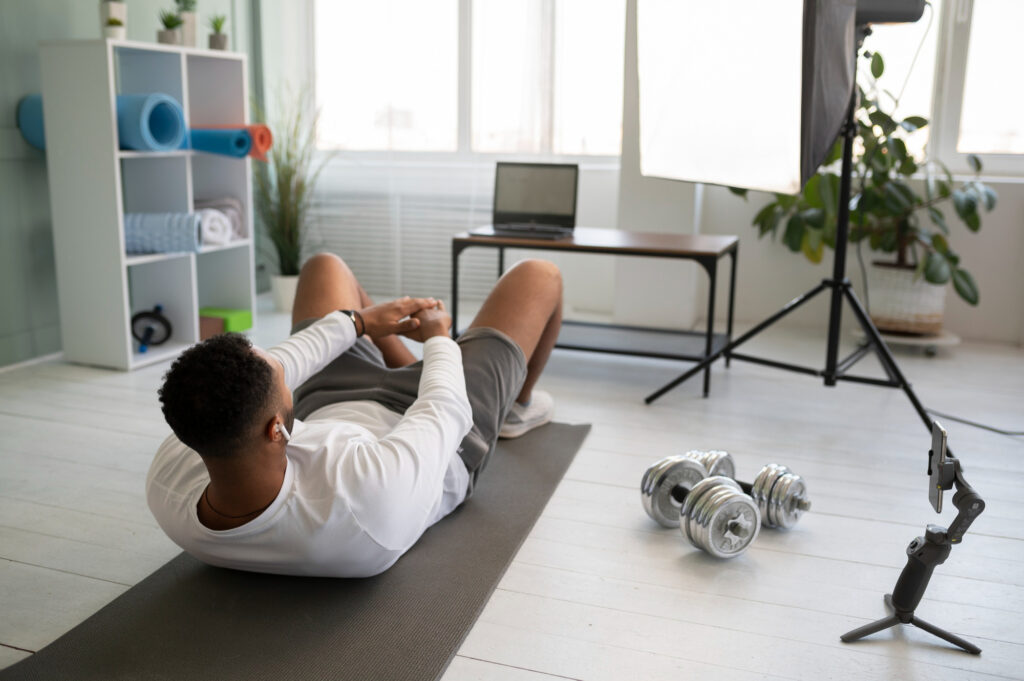
Let’s talk logistics.
Machines are like furniture you can’t move.
Once you set up a leg press or cable tower, it’s not going anywhere.
They’re big, heavy, and hungry for square footage.
Unless you’ve got a two-car garage and a forgiving spouse, space will run out fast.
Free weights, on the other hand, are minimalist heroes.
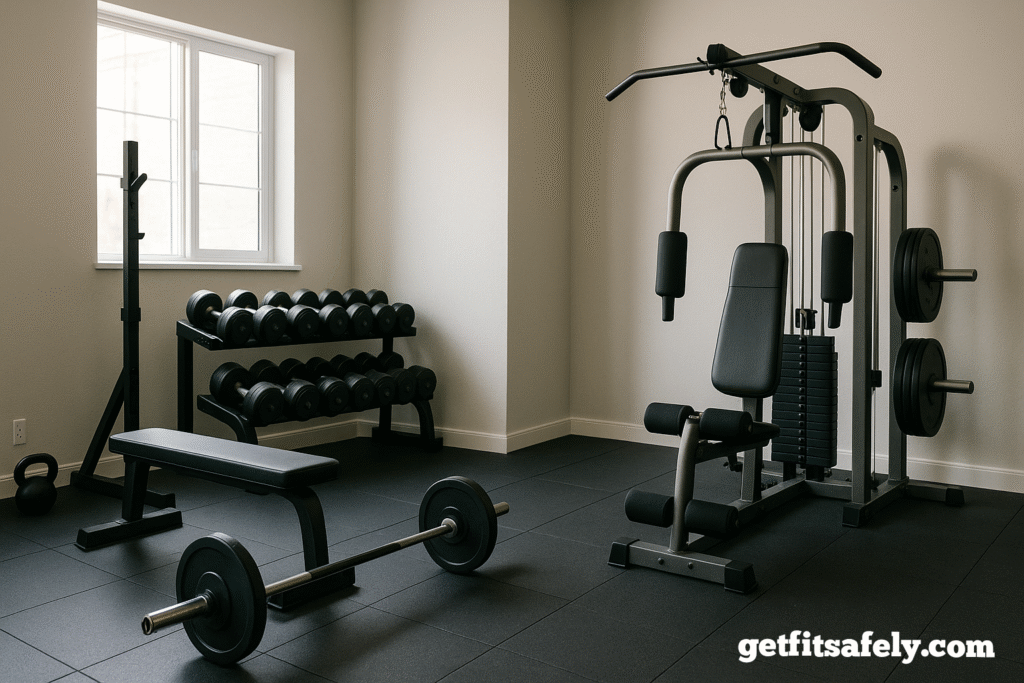
A good power rack, one Olympic barbell, a bench, and a stack of plates — that’s your kingdom.
You can reconfigure, upgrade, and keep expanding without having to sell a kidney.
And noise?
Machines hum.
Free weights thunder.
So if you’ve got kids sleeping upstairs, you might want thicker mats or shock-absorbing flooring (worth every penny).
Niche setups: apartments, basements, and mobility constraints
Not everyone’s building a “garage fortress.”
Some of us are sneaking workouts in apartments where the floor shakes if you drop a spoon.
If you’re short on space or soundproofing, here’s what works best:
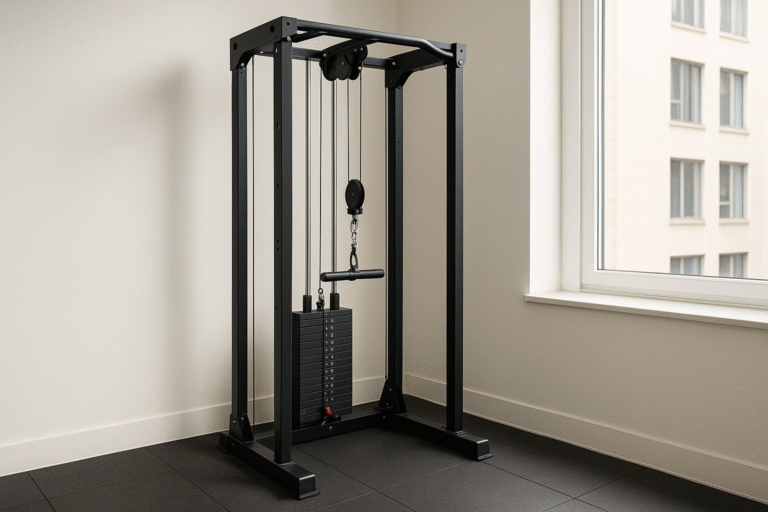
- Apartment setups: adjustable dumbbells + compact pulley system = minimal footprint, maximal versatility.
- Low ceilings: skip tall cable towers; choose foldable wall racks or short racks (under 80 inches).
- Mobility-limited or injury-prone lifters: focus on machines or resistance bands to control range of motion safely.
- Shared living space: look for noise-dampening mats or “quiet plates” that reduce vibrations.
You don’t need a full rack to make progress.
You just need gear that fits your real life — not someone else’s Instagram setup.
The “feel” you can’t fake
You know that first moment when your hand wraps around a barbell knurling and you feel that cold, textured grip?
That’s not just physical — that’s psychological ignition.
Free weights feel alive.
They shift, they challenge you, they make every rep a negotiation.
They reward focus and punish laziness.
Machines, in contrast, feel smooth, predictable — like driving a Tesla after years with a manual Mustang.
It’s sleek, efficient, and you can focus on the contraction without worrying about balance.
Both have their place.
If you’re chasing strength and athleticism, free weights teach you control.
If you’re chasing isolation and precision, machines give you laser focus.
And in truth?
The sweet spot is somewhere in between.
That balance between chaos and control — that’s where most lifters thrive.
Budget breakdown (and the long game)
Let’s not dance around it: machines are expensive.
Even a decent selectorized setup can cost more than your entire rack and plate combo.
And they don’t hold resale value the same way Olympic gear does.
Free weights, meanwhile, age like fine wine and bad jokes — they just get better.
Steel doesn’t go out of style.
You can buy used Olympic plates, mix brands, swap bars, and your setup will still play nicely together.
That’s not true for machines, where every brand thinks their proprietary parts are made of gold.
So if you’re in it for the long haul — building your setup piece by piece, like LEGO for adults — free weights give you freedom.
They’re the one part of your gym that never becomes obsolete.
But here’s the catch: the right machine, used consistently, can still be worth its price.
Especially if it helps you train longer, smarter, and pain-free.
| Condition | Recommendation |
|---|---|
| If you train alone | Prioritize safety — machines or racks with spotter arms. |
| If you have less than 200 sq ft | Compact rack + adjustable dumbbells win. |
| If you’re on a tight budget | Start with free weights and expand later. |
| If you’re recovering from injury | Machines or cables reduce risk. |
| If you love variety | Hybrid setup — barbell for compound lifts, machines for accessory work. |
How I learned to combine both worlds
For years, I was a purist.
If it didn’t clang or rattle, I wasn’t interested.
Then one day, I threw out my back after a long deadlift session.
For weeks, I couldn’t even look at my barbell without wincing.
That’s when I dusted off an old cable machine I’d bought second-hand — and to my surprise, it saved my training life.
It let me stay active, target muscles without strain, and keep my mental rhythm going while my body healed.
And when I finally got back under the bar, I was stronger, more balanced, and less afraid to mix things up.
Now my setup’s a hybrid.
Barbell and dumbbells for big lifts.
Machines and cables for accessory work, pump sets, and recovery days.
It’s not about loyalty — it’s about longevity.
RELATED:》》》 Can You Really Get Gym-Level Strength Without Ever Leaving Your Living Room?
Conclusion
If your goal is strength, freedom, and progression — build your foundation with free weights.
They’ll teach you control, resilience, and discipline.
But don’t write off machines.
In a home gym, they can make your training more consistent, safer, and honestly, more enjoyable when motivation dips.
At the end of the day, the “best” equipment is the one that keeps you showing up.
Some days that’s your barbell.
Other days it’s a cable handle or a leg press seat that just feels right.
Because the real goal isn’t choosing sides — it’s building a space where you want to train, every single day.
That’s your gym.
Your rules.
Your iron sanctuary.