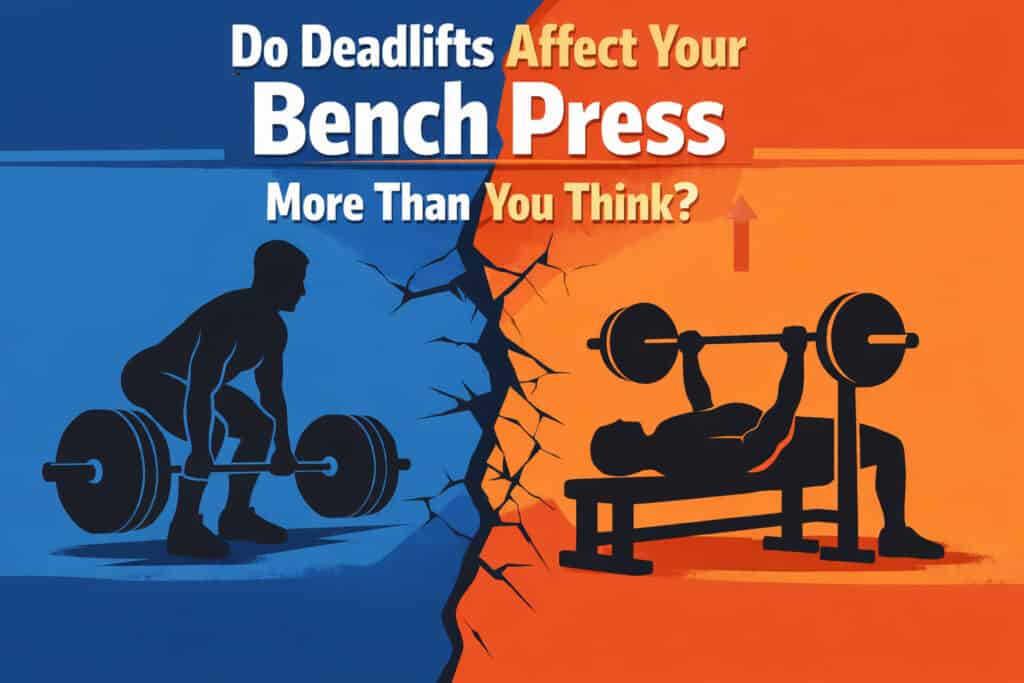
Most people treat the bench press like a pure upper-body lift.
And on paper, that makes sense.
You lie down, grab the bar, lower it, press it, rack it, and go home thinking your chest, shoulders, and triceps handle the whole story.
Then I start paying attention to the days when deadlifts fall too close to bench day, and the pattern becomes impossible to ignore.
The bar still moves on bench day, yet everything underneath it changes a little.
My upper back doesn’t lock in as cleanly.
My chest doesn’t stay as proud on the bench.
My leg drive loses bite.
Even the unrack feels a bit heavier than it should for a weight that usually behaves.
That’s where this whole thing gets interesting.
Deadlifts affect your bench press way more than most people expect.
And it’s not some mysterious gym curse.
It’s fatigue showing up in places people don’t even think about.
Deadlifts don’t just hit your lower body.
They tax:
- Grip
- Spinal erectors
- Upper back
- Lats
- Ribcage position
- Bracing ability
And honestly… your ability to feel like a solid piece of furniture under a barbell.
Bench press needs all of that.
It just asks for it in a different shape.
Bench Press Is Not Just a Chest Exercise
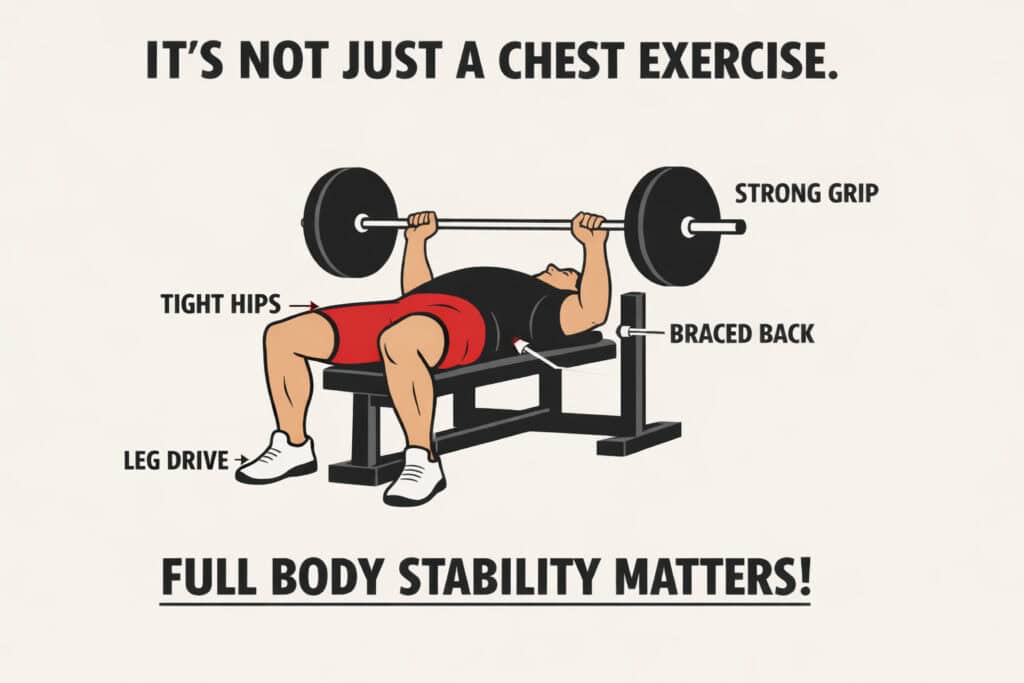
A lot of beginners look at bench press and see a chest movement with some triceps help.
That is understandable, because those are the muscles that burn and pump up the most when the set gets hard.
Still, the press works better when the entire body helps create a stable base from the floor to the hands.
When I bench well, my feet push into the floor, my hips stay planted,
my upper back presses hard into the pad,
my shoulder blades stay tucked into a solid position, and my ribcage stays organized instead of collapsing into a floppy mess.
That sounds technical, yet the idea is simple.
If the body under the bar is stable, the arms have something strong to press from.
If the body under the bar is tired, loose, or shaky, the press starts leaking force in weird places.
Deadlifts can interfere with that base even when the chest itself feels fresh.
That is why a lifter can say, “My pecs are good today,” and still bench like the bar has opinions.
A 225-pound bench that usually moves for 5 clean reps may turn into 3 ugly reps with a slow fourth halfway up, even though the chest is not especially sore.
The missing piece is often not the pressing muscles.
It is the tired support system underneath them.
Where Deadlifts Sneak Into Your Bench Without Asking Permission
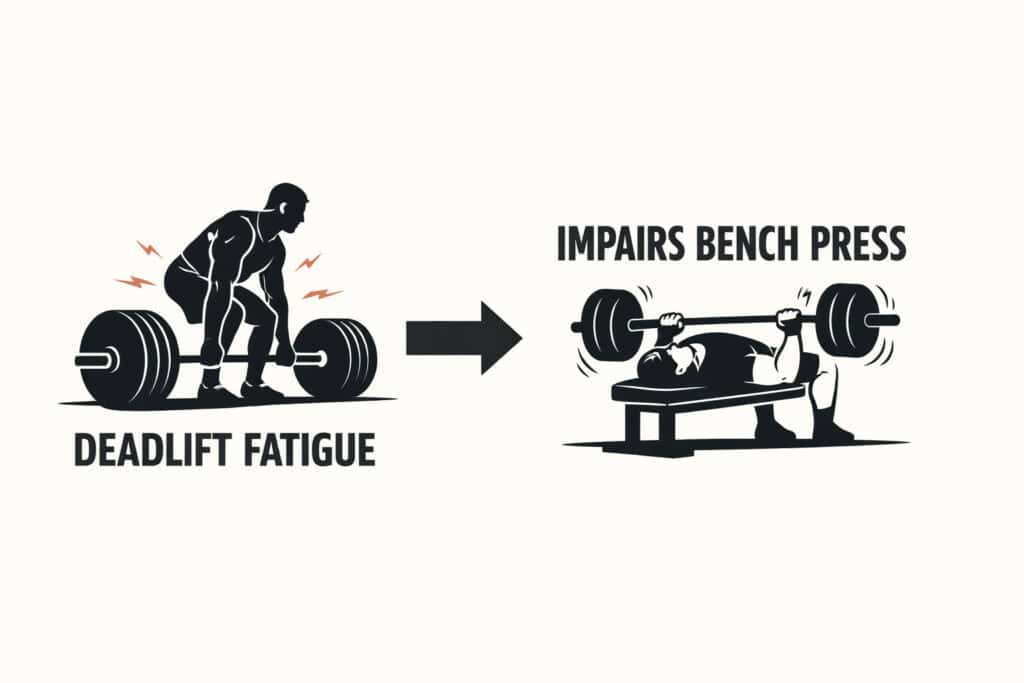
Deadlifts create a broad kind of fatigue.
I am not just talking about sore hamstrings the next morning when sitting down becomes an event.
I mean the sort of fatigue that hangs around in your back,
your hands, your trunk, and your nervous system,
even when you are technically recovered enough to train again.
During a heavy deadlift session,
I might work up to 4 sets of 3 reps at 405 pounds, then finish with 2 back-off sets of 6 at 315.
By the end of that workout, my forearms are cooked, my mid-back feels hot and dense,
my lower back is tired in that deep way that does not scream but definitely sends messages, and my whole torso has spent an hour bracing hard.
Now move that session too close to bench day.
The bench starts asking my upper back to pin itself to the bench,
my lats to guide the bar down,
my trunk to stay tight, and my hands to keep the bar under control.
Those areas may no longer be fresh enough to do their job with precision.
That is the key word here: precision.
Bench press is not only about producing force.
It is also about controlling position from the unrack to the lockout.
Deadlift fatigue can blur that control just enough to matter.
Your Upper Back Takes a Bigger Hit Than You Realize
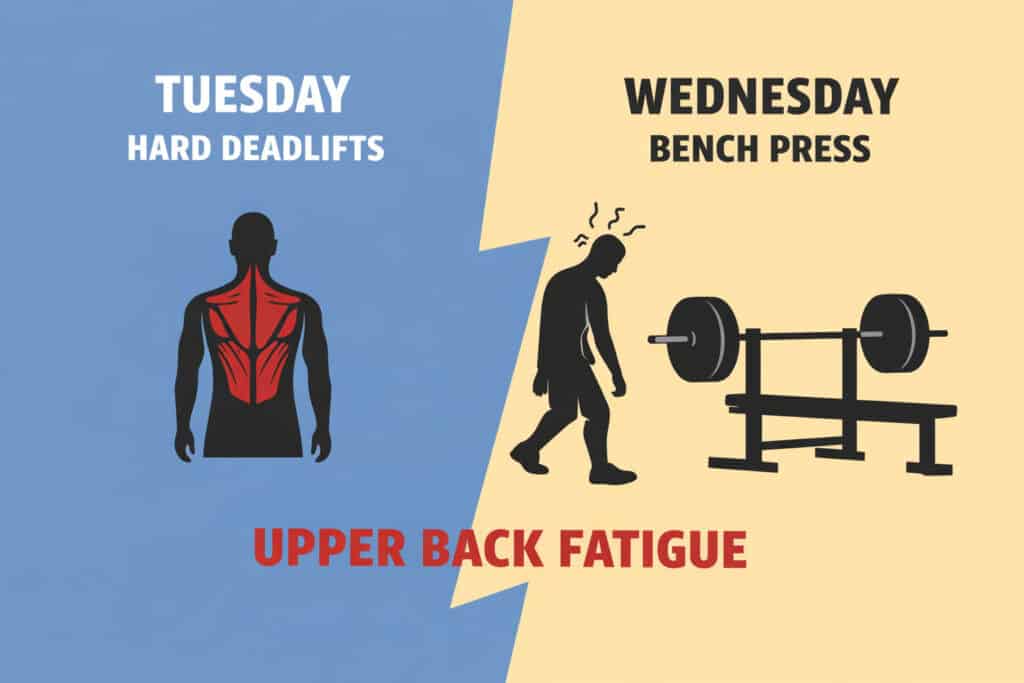
People often focus on the lower back after deadlifts, because that is the area they notice first.
The upper back deserves much more attention in this conversation.
A strong bench press depends heavily on the muscles around the shoulder blades and the upper spine.
These muscles help keep the chest lifted, the shoulders organized, and the bar path more consistent.
When I deadlift hard on Monday and bench on Tuesday, the first thing I notice is the unrack.
A weight that usually comes out of the hooks cleanly starts wobbling a little.
Nothing chaotic, nothing cartoonish, just enough movement to make me spend extra energy settling the bar before the first rep even begins.
Then the touch point drifts.
Instead of lowering the bar toward the lower chest with a calm, repeatable path, I start tapping slightly higher or slightly farther forward.
That usually means my upper back is not holding the position as firmly.
Think of the upper back as the backrest of a solid chair.
When that backrest is sturdy, pressing feels supported.
When it is tired, the whole thing still works, but the job gets messier.
One week I bench 235 for 4 sets of 4 on Wednesday after taking Tuesday easy.
The bar touches in almost the exact spot every rep, and my rest periods stay around 2 minutes and 30 seconds.
Another week I pull heavy sumo deadlifts on Tuesday evening, sleep 6 hours and 20 minutes, then bench the next afternoon.
That 235 still moves,
but now set one feels heavier in my hands,
set two slows down early, set three loses crispness off the chest,
and by set four I am resting 4 full minutes while pretending that is part of the plan.
Why this happens
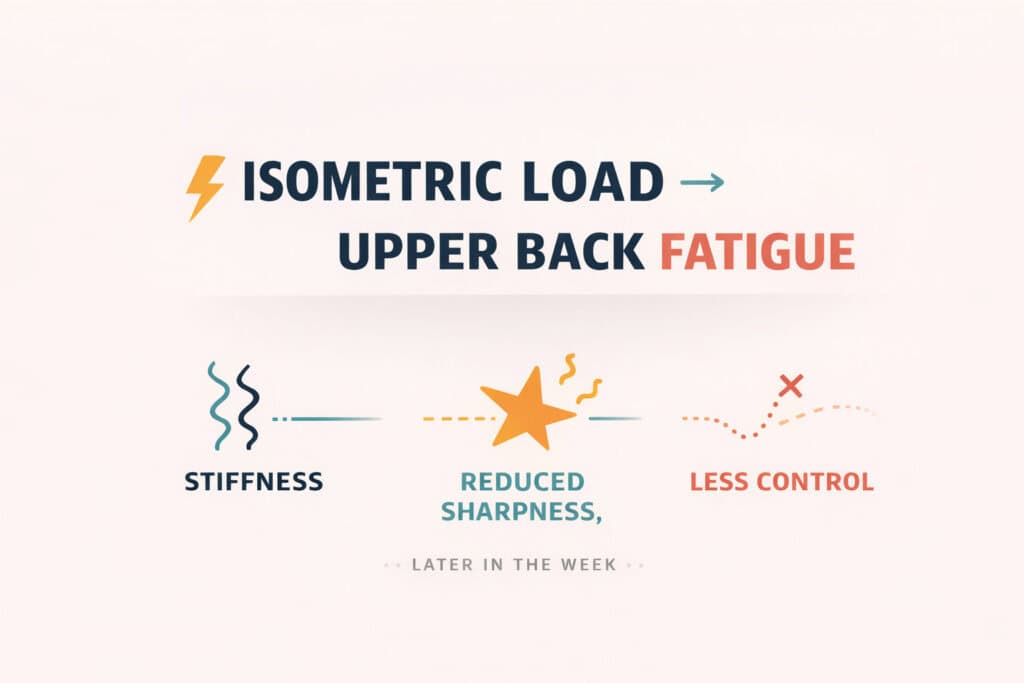
Deadlifts ask the upper back to do a long isometric job.
That means those muscles do not move much, yet they contract hard to keep your spine and shoulders in place while the bar leaves the floor.
Heavy isometric work creates fatigue that does not always feel flashy.
It often shows up as stiffness, reduced sharpness, and a weaker ability to hold a position for repeated reps later in the week.
Bench press notices that immediately.
It is like trying to write neatly with a hand that is not injured, just tired enough to make every letter slightly sloppier.
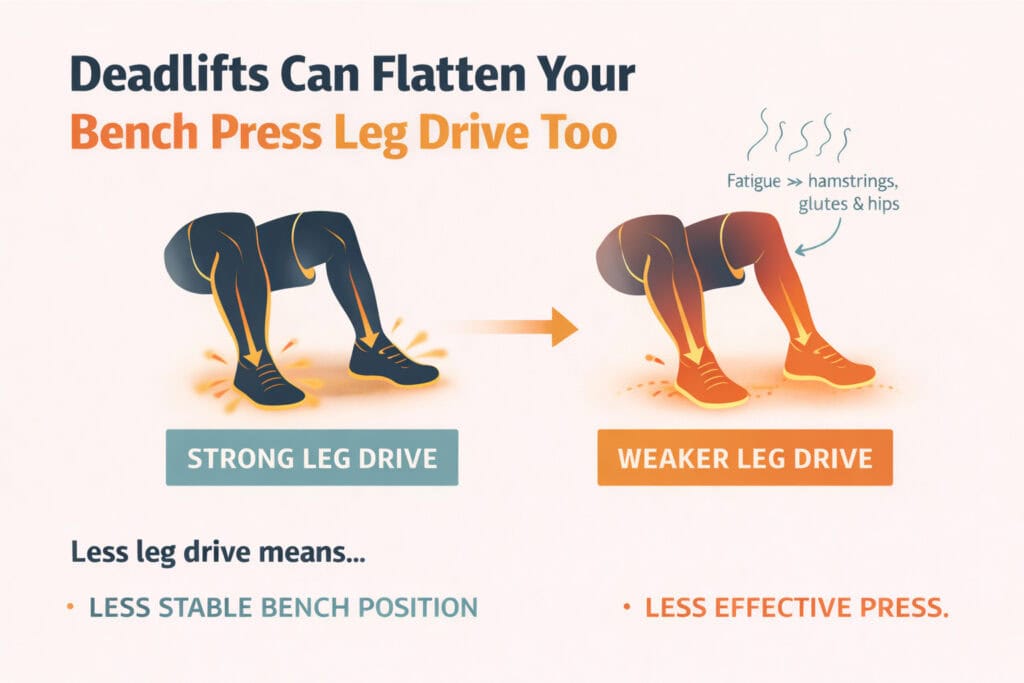
Deadlifts Can Flatten Your Bench Press Leg Drive Too
This part surprises a lot of people.
Bench press includes leg drive,
which means pushing your feet into the floor to help stabilize your whole body and support the press.
Leg drive does not turn bench into a squat in disguise.
It just helps create tension through the lower body so the torso stays firm and the chest stays in a good pressing position.
After a hard deadlift session, the hamstrings, glutes, and hips can still be fatigued even if they are not sore enough to complain.
That matters because many lifters use their feet and hips to anchor themselves during bench.
On a good day,
I place my feet slightly behind my knees, screw them into the floor, keep my glutes on the bench, and push just enough to make my torso feel locked in.
On a deadlift-fatigued day, that push is weaker.
The feet stay in place, yet the pressure into the floor is duller.
The whole bench becomes flatter and less connected.
A beginner might ask, “Why does that matter if the bar is in my hands?”
Because force travels better through a body that is organized from bottom to top.
Take away some of that floor pressure and the chest position softens,
the upper back loses support,
and the press becomes less efficient before the arms even start doing the hard part.
I notice this clearly when I compare two bench sessions at 205 pounds for 5 sets of 5.
On the fresh week, rep 4 and rep 5 still move with decent speed, my feet stay planted, and the bar leaves the chest in a smooth line.
On the tired week, rep 3 already feels sticky, the body shifts a little more on the bench, and I have to concentrate harder just to keep the groove from wandering.
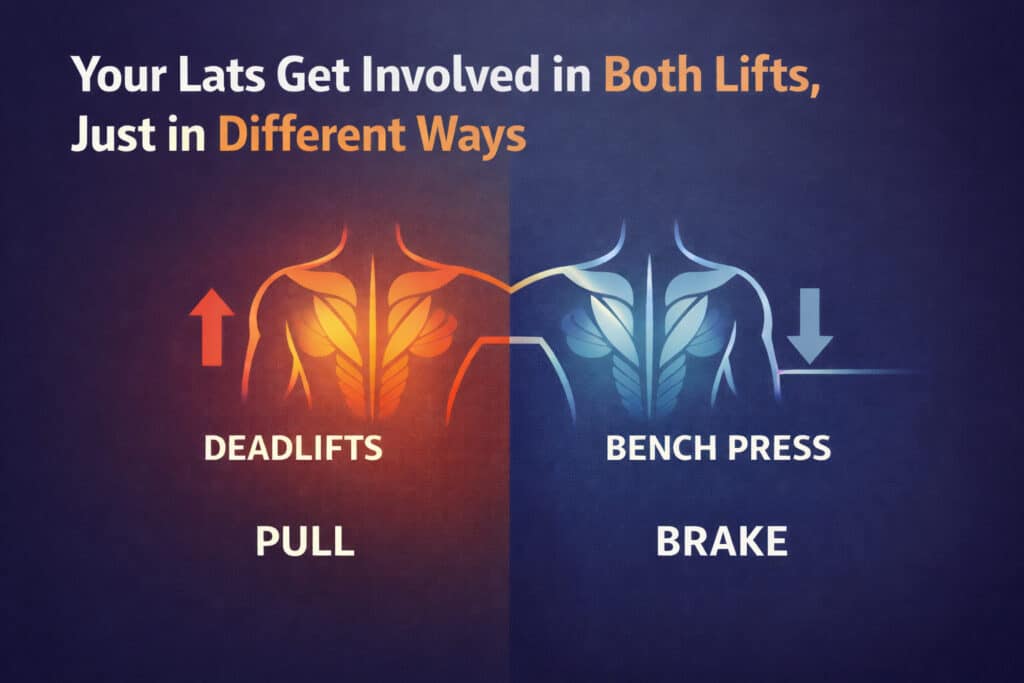
Your Lats Get Involved in Both Lifts, Just in Different Ways
A lot of people think of the lats as pull-up muscles or deadlift muscles.
They are also important during bench press.
On bench, the lats help control the descent, keep the shoulders in a better spot, and support the transition from lowering the bar to pressing it upward.
I start noticing this when the bar drops faster than I want on bench day after deadlifts.
After a demanding deadlift workout, that lowering phase can lose accuracy.
Instead of a controlled descent, it turns into a faster drop that forces me to scramble a bit at the bottom.
That is often tired lats and upper back talking.
A simple way to picture it is this: on the way down, your lats act a bit like brakes.
When those brakes are worn out from pulling a heavy bar off the floor the day before, the bar can arrive at the chest in a less organized way.
That may not ruin the set, but it can absolutely shave reps off the top end.
One of my clearer examples comes from a week where I deadlift 365 for 5 sets of 4 on Monday and bench 225 for an AMRAP set on Tuesday after warm-ups.
Normally, 225 gives me 8 clean reps.
That week I get 6.
Lower Back Fatigue Changes Your Bench Position More Than People Expect
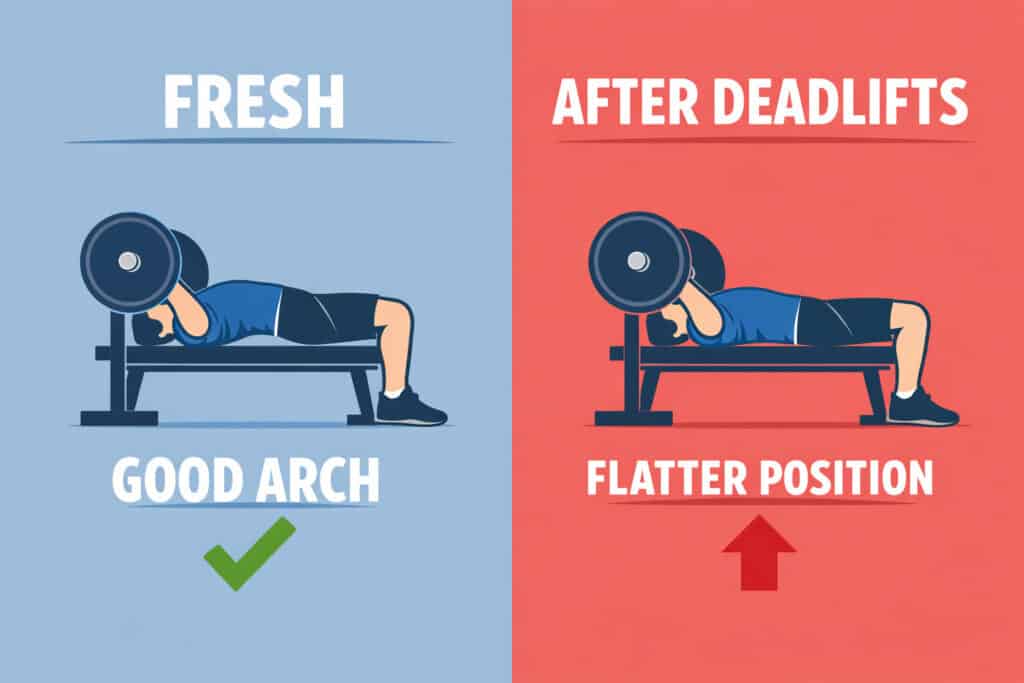
A bench press happens lying down, so it seems logical to assume the lower back gets a vacation.
That is not really how it plays out.
Most lifters use a natural arch on the bench.
I am not talking about turning the bench press into a circus bridge.
I mean a moderate curve that helps the chest stay high and the shoulders stay in a better pressing position.
When the lower back is fatigued from deadlifts, holding that position can become annoying.
Not impossible.
Just less comfortable and less repeatable.
You lie down, plant the feet, tighten the torso, pull the shoulder blades together, and then the lower back starts acting like it would rather negotiate.
That subtle loss of comfort matters over several work sets.
During a normal session, I can bench for 5 working sets with a stable arch and no real distraction from it.
After heavy conventional deadlifts, I sometimes notice that by set three my torso wants to flatten out a little.
Once that happens, the touch point shifts higher, the range of motion changes, and the pressing path becomes less efficient.
A beginner may not see any of this on video unless they look closely.
The rep still counts.
The problem is that the rep costs more.
And once each rep becomes more expensive, performance drops sooner.
Conventional deadlifts usually hit this issue harder for me than sumo
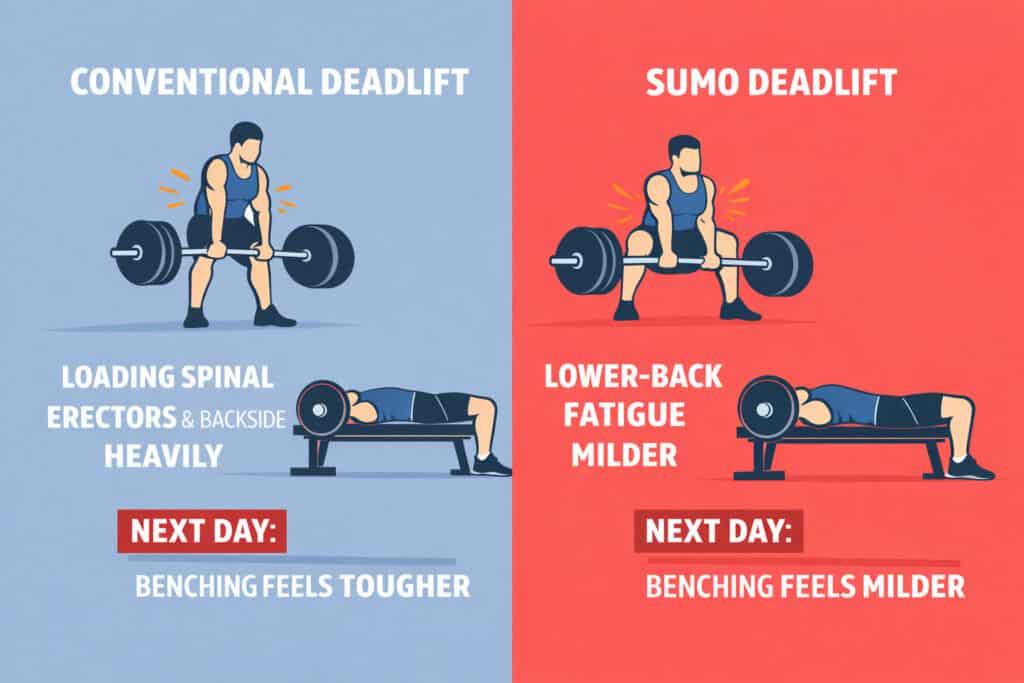
This is not a universal law, yet it is something I notice repeatedly.
Conventional deadlifts tend to load my spinal erectors and entire backside more aggressively.
The next day, benching with a firm torso position feels tougher.
Sumo still creates fatigue, but the lower-back irritation into bench day is often milder for me.
For example, after 5 triples at 425 conventional, my Thursday bench at 215 for 6 sets of 3 feels stiff and oddly heavy.
After 5 triples at 425 sumo, that Thursday bench still loses a bit of sharpness, though the body position holds together better and the bar path stays cleaner.
Grip Fatigue Can Throw Off Your Bench Without You Realizing It
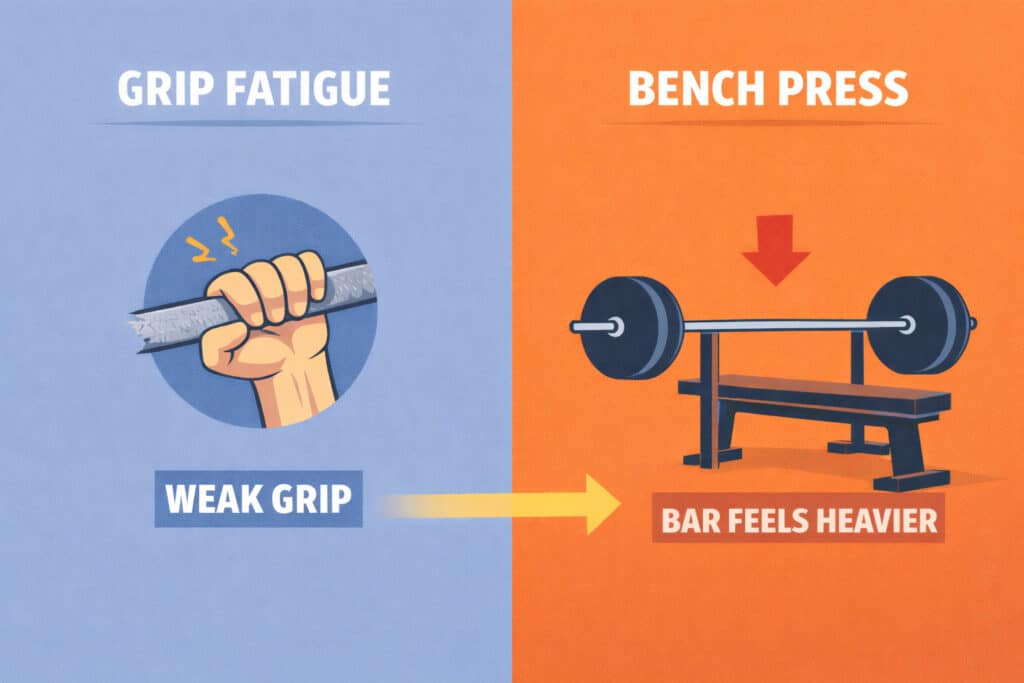
This one does not get enough airtime.
Heavy deadlifts tax the hands, thumbs, wrists, and forearms.
Bench press may not look grip-limited, yet the hands are still your connection to the bar.
When my grip is tired from deadlifts, I squeeze the bar less naturally on bench.
That changes how stable the bar feels in the palm.
It can also change wrist position without me meaning to do it.
Once the wrists get a little loose, the bar starts feeling heavier than its actual weight.
Nothing has changed on the plates.
The connection has changed.
Imagine holding a suitcase with a strong hand versus a tired hand.
The suitcase does not gain pounds.
Your control over it gets worse.
I notice this especially after deadlift sessions with double-overhand warm-ups, hook grip work, and heavy top sets.
The next day, even my bench warm-up with 135 pounds feels more present in the wrists than usual.
By the time I reach 185 and 205, the bar no longer melts into my hands.
I have to think harder about holding it firmly, which is energy I would rather spend on pressing.
Timing Changes Everything

Deadlifts do not ruin bench press by default.
The calendar decides a lot.
When I place heavy deadlifts right before a heavy bench day, performance usually dips.
When I give them space, the problem shrinks fast.
Here is a pattern I see often:
- Heavy deadlifts on Monday evening at 6:00 PM
- Bench press on Tuesday at 1:00 PM
- Bench numbers drop 5 to 10 pounds, or I lose 1 to 3 reps at a familiar weight
Now compare that with this:
- Heavy deadlifts on Monday evening at 6:00 PM
- Easy walking and mobility on Tuesday
- Bench press on Wednesday at 2:00 PM
- Bench is much closer to normal, sometimes fully normal if sleep and food are good
That extra day matters because fatigue from deadlifts is not just muscle soreness.
It is also about restoring tension, coordination, bracing quality, and position control.
If I sleep 7 hours and 45 minutes, eat enough carbs, and separate the lifts by about 40 to 44 hours, bench usually behaves.
If I sleep 6 hours, rush meals, and try to bench 18 hours after pulling heavy, the press often turns grumpy.
There is no mystery there.
That is just recovery showing up in public.
The Heavier You Pull, The More Bench Usually Notices
Light or moderate deadlifts do not always beat up my bench.
The trouble grows when intensity or volume climbs.
A few clean sets of 5 at a moderate weight may leave the next bench session almost untouched.
A hard deadlift day with multiple heavy triples, grinders, or lots of back-off volume is a different animal.
For example, 3 sets of 5 at 275 pounds might leave me perfectly fine to bench the next day.
A session with 455 for 5 singles at 90 to 92 percent effort, followed by 315 for 3 sets of 8, changes the picture a lot.
Now the upper back is more tired, the trunk is more drained, the hands are more cooked, and the next bench day starts with a body that has already paid a bill.
This is why two people can argue about whether deadlifts affect bench and both sound correct.
One person is thinking about moderate pulling.
The other person is remembering a heavy session that turned the next day’s bench into an awkward wrestling match with 80 percent.
Deadlifts Do Not Automatically Hurt Your Bench, But They Absolutely Can
That is the honest answer.
Deadlifts can build plenty of qualities that help the bench in a broad sense.
A stronger back, better bracing, more body awareness, and better total-body tension all matter.
At the same time, the fatigue from deadlifts can carry over into bench press much more than people expect when the sessions sit too close together or the pulling day gets too ambitious.
So yes, deadlifts can affect your bench press more than you think.
Usually the effect shows up through the upper back, lats, trunk, grip, and leg drive rather than through your chest suddenly forgetting its job.
Once I start viewing bench as a full-body skill instead of a chest-only movement, the connection becomes very obvious.
The press does not happen in isolation.
It happens on top of everything the rest of the body brings to the bench that day.
And after a hard deadlift session, that “everything” is often a little more tired than it looks.