There’s a funny thing about injury risk in the gym.
People blame the heavy barbell like it’s a cartoon anvil waiting to fall.
Over time, I realized it wasn’t the real issue.
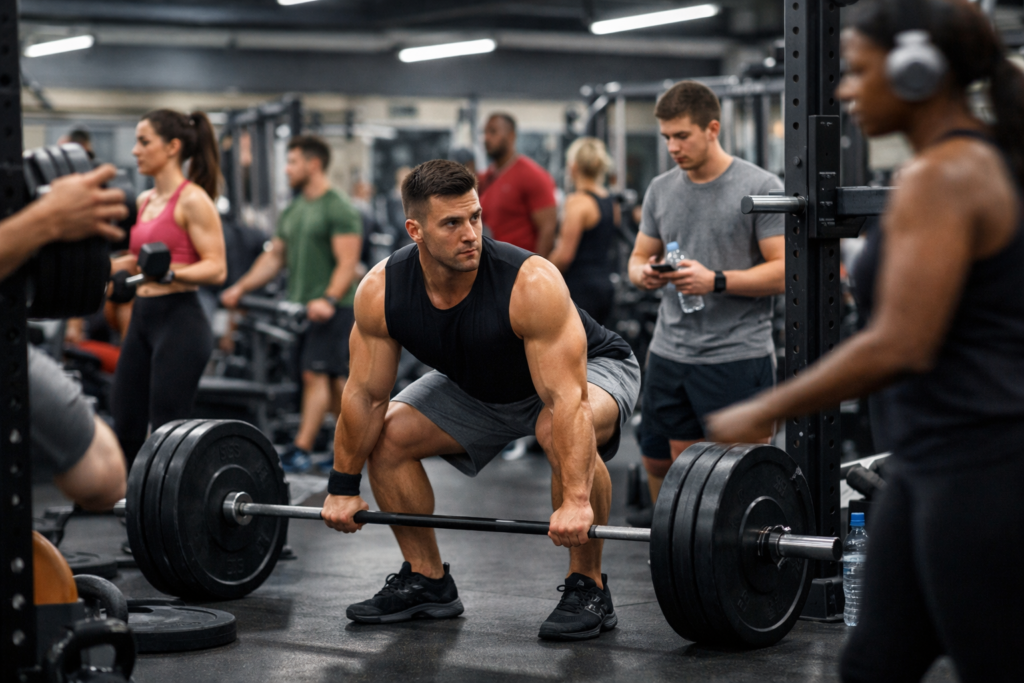
But a packed gym can be more dangerous than the load itself.
Not because “crowds are scary.”
Because crowds quietly mess with the stuff that keeps you safe: space, focus, timing, and setup.
Heavy weights are obvious.
Crowded-gym risks are sneaky.
The big idea

A heavy weight is a clear, predictable problem.
The load stays where it is.
No surprises.
One simple question: can you handle it?
A crowded gym is a shifting environment problem.
People move.
Objects appear where they weren’t a second ago.
Your attention gets split before the set even starts.
One is like playing chess against a strong opponent.
The other is like playing chess while someone keeps bumping the table.
Why crowds increase risk even when the weight isn’t “crazy heavy”
Injury risk usually spikes when small errors stack.
Crowds make small errors more likely.
Not dramatic errors.
Tiny ones that change your positions, your pace, your attention, and your patience.
And those tiny ones add up fast when joints and tendons are the “hardware” running your movement.
If heavy weights are high voltage, crowded gyms are bad wiring.
Space gets stolen, and your movement gets distorted

Most lifts aren’t just “up and down.”
They need space in front, behind, and beside you.
In a crowded gym, that space shrinks without warning.
So the body improvises.
Improvisation is great for jazz.
It’s not great for spinal position under load.
A deadlift that turns into a half-deadlift because someone is two feet behind you is a deadlift with a plot twist.
Common crowd-space distortions
Stance narrows because someone is close.
Bar path changes because you’re trying not to clip a bench.
You rush the walkout because you feel in the way.
You rerack weirdly because someone is reaching around you.
Those are not “technique errors” in the classic sense.
They’re environment errors.
Your body still pays the bill.
The setup phase is where most “stupid injuries” happen
People imagine injuries happening on the hardest rep.
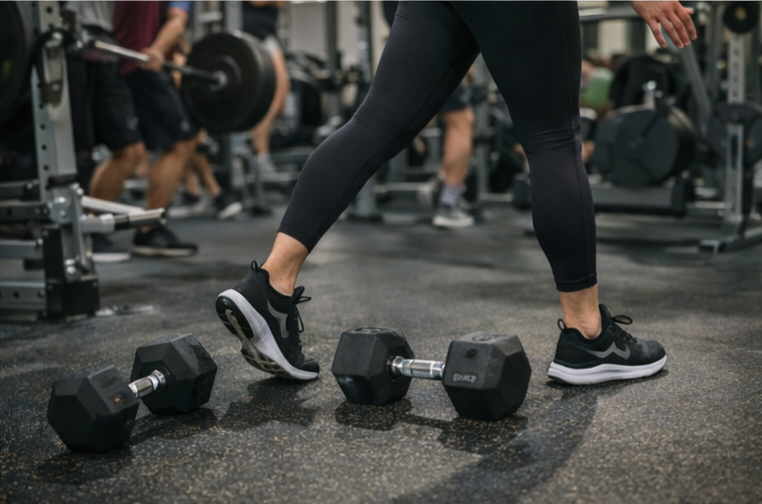
In reality, a lot of real-world injuries happen while setting up:
• Unracking
• Reracking
• Adjusting pins
• Moving a bench
• Turning with plates
• Stepping over dumbbells that look like video game loot
Crowded gyms make this worse.
More objects.
More bodies.
More decisions.
More chances to do something just slightly off.
Why Setup Errors Change the Entire Rep
A clean rep starts with a clean start position.
If you begin slightly rotated, slightly cramped, or slightly unstable, the rep is already compromised.
That’s not fear-mongering.
That’s mechanics.
Your joints don’t care that the gym is busy.
They only care about angles and forces.
Crowds mess with pacing, and pacing messes with form

In a crowded gym, rest times get distorted.
Sometimes you rest too little because you don’t want to “hog” the station.
Sometimes you rest too long because you’re waiting on equipment, then you jump back in cold.
Both situations increase risk.
Too little rest makes technique sloppier.
Too much time makes tissues cool down and coordination feel off.
The nervous system works best on a steady rhythm.
Crowds break that rhythm.
The sneaky fatigue trap
When the gym is packed, you do more walking and more standing.
That sounds harmless.
But fatigue is not just muscle fatigue.
It’s focus fatigue.
It’s “decision fatigue.”
It’s the little drain that makes you forget one cue, then another cue, then you’re basically freelancing your squat.
Attention gets split, and split attention is a skill issue
Lifting safely requires attention.
Not obsessive attention.
Normal, calm awareness.
Crowds pull that away.
You track who’s near you.
You wonder if someone is about to take your bench.
You listen for that guy dropping dumbbells like he’s testing gravity.
Your brain starts running background processes.
And every background process steals performance from the main program.
Nerd translation: fewer resources for clean movement.
Distraction is not just “mental”
Distraction changes breathing.
Distraction changes bracing.
Distraction changes timing.
That’s physical.
If you’ve ever unracked a weight while someone walked too close, you know the feeling.
It’s not fear.
It’s the body reacting to a sudden environmental variable.
Crowded gyms increase “near misses,” and near misses teach bad habits
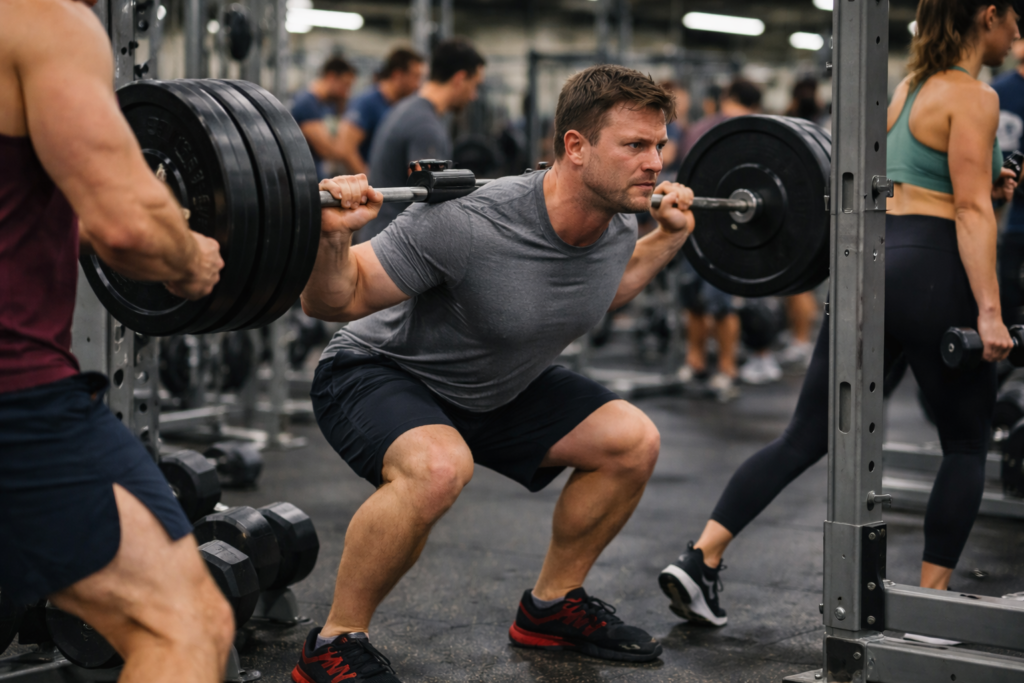
When the gym is quiet, you lift like you were taught.
When the gym is packed, you lift like you’re trying to survive a busy airport.
You start shrinking your movement to stay safe.
You start rushing transitions.
You start cutting warm-ups.
You start compromising range of motion to avoid bumping something.
Those changes might prevent a collision today.
But they can create repetitive strain over weeks.
That’s how the body gets cranky without one dramatic moment.
Equipment sharing adds urgency, and urgency adds mistakes
Sharing is fine.
Rushing is not.
When people are waiting, you feel the invisible timer.
Even if no one says anything, the pressure is there.
Under pressure, people do three classic things.
They skip the last warm-up set.
They jump weight too fast.
They stop paying attention to setup details.
Those are the boring habits that keep shoulders, knees, and backs healthy.
Boring is underrated.
The “traffic pattern” problem nobody talks about

Crowded gyms create movement traffic.
People cut behind racks.
They squeeze between benches.
They step around your bar path.
That turns your lifting area into an intersection without stop signs.
Even if you are perfectly controlled, someone else can create the problem.
That’s not paranoia.
That’s just geometry plus humans.
High-risk zones in a packed gym
- The area behind squat racks during walkouts.
- The ends of barbells during landmine work.
- Dumbbell aisles where people pivot with heavy weights.
- Cable stacks where lines get crossed and people step backward.
- Smith machines where someone thinks “it’s guided so it’s safe,” then forgets spatial awareness.
Heavy weights can be safer than light weights in a crowded gym
This sounds backwards, but stay with it.
When something is truly heavy, people get serious.
They set up carefully.
They brace.
They move with control.
They avoid distractions.
A moderately heavy weight in a crowded gym is where people get casual and rushed at the same time.
That combo is spicy in the worst way.
Heavy loads demand respect.
Crowds demand patience.
When patience runs out, injuries show up.
| Short on time and training in a crowded gym?
This video explains how heavy and light weights compare for muscle growth, so you can choose the most efficient option when equipment, space, or energy are limited — without relying on gym myths. |
Realistic ways to reduce injury risk in a crowded gym
The goal is not to “be fearless.”
The goal is to reduce chaos.
Here are strategies that actually work in real gyms.
Claim space without being weird about it
Set your station up clearly.
Place your water bottle and towel where they mark the boundary.
Keep plates close to your rack, not spread across the aisle.
If someone keeps drifting into your space, make eye contact and politely signal.
Most people respond well to calm clarity.
It’s amazing how effective “Hey, mind giving me a bit of room for the walkout?” can be.
Pick lifts with stable logistics
When it’s packed, choose movements that don’t require a lot of moving parts.
A barbell back squat in a rack is logistically stable.
A circuit across five stations is logistically fragile.
Crowds punish fragile plans.
If your workout requires you to sprint between equipment like you’re speedrunning a dungeon, it’s time to simplify.
Use a “buffer set” mindset
Do one extra lighter set before your work sets if you had to wait a long time.
Treat it like restarting a laptop that’s been asleep too long.
It’s not about ego.
It’s about restoring coordination and joint comfort.
This can be especially helpful for hips, shoulders, and elbows.
Keep rest times consistent, even if it means fewer sets
If the gym is busy, reduce volume slightly.
Keep quality high.
A cleaner 3 sets beats a sloppy 5 sets done under social pressure and cramped space.
Progress does not require maximum chaos exposure.
Choose times and locations like a strategist
If you can train at off-peak times, do it.
If you can pick the quieter corner of the gym, do it.
This is not “avoiding hard work.”
It’s removing random variables.
Good training is already hard.
It doesn’t need extra randomness.
Use headphones, but don’t go full sensory blackout
Music can help focus.
But keep some awareness of movement around you.
If your headphones make you jump every time someone appears, the volume is doing too much.
Awareness is part of safety.
You don’t need to hear everyone’s life story.
You just need to notice footsteps near your bar path.
Walkout and rerack rules that save joints
Never rush the walkout.
Never rerack with someone hovering close.
If the area behind you is blocked, pause.
Ask for space.
Wait five seconds.
Five seconds is cheaper than six weeks of rehab.
A simple “crowded gym safety checklist”
Before each big set, run this quick scan.
Is the space behind and beside you clear.
Is your setup symmetrical and stable.
Is your breathing calm and ready.
Is your bar path unobstructed.
Are you lifting because it’s time, not because you feel rushed.
If one answer is “no,” adjust before the set.
That is what experienced lifters do.
Not because they’re paranoid.
Because they like training more than they like injuries.
What to do if the gym is so packed it’s basically a sardine convention
Sometimes it’s just too much.
On those days, pivot instead of forcing the original plan.
Swap barbell bench for dumbbell bench if the bench area is less chaotic.
Swap walking lunges for split squats if the aisle is crowded.
Swap heavy deadlifts for Romanian deadlifts if platform traffic is wild.
Swap cables for bands if cable stations are a war zone.
This is not quitting.
This is intelligent training under constraints.
| RELATED:》》》 Gym Etiquette |
The motivation piece that isn’t cheesy
Training consistency comes from staying healthy.
Staying healthy comes from making smart choices when conditions are messy.
A crowded gym is messy.
That doesn’t mean you can’t get stronger.
It means the win is controlled execution, not forcing a perfect program in a chaotic room.
If the gym is packed, the goal is to leave feeling accomplished, not lucky.
Quick FAQ
Is a crowded gym actually more dangerous, or does it just feel stressful?
It can be objectively riskier because space, attention, and pacing change.
Stress is part of it, but mechanics and logistics are the big drivers.
Should heavy lifting be avoided when it’s crowded?
Not automatically.
Heavy lifting can be very safe if your station is stable and the area is clear.
The bigger danger is rushing and compromised setup.
What’s the safest “big lift” in a crowded gym?
The safest lift is usually the one with the most controlled environment.
A rack with clear boundaries often beats open-floor movements with lots of traffic.
What’s the best single habit to reduce injuries in crowds?
Stop rushing transitions.
Walkouts, reracks, and setup steps deserve calm attention.