
For years I believed the bench press was the “entry ticket” into the real gym.
It was the exercise that separated beginners from the “real men,” the one that decided who deserved respect in the weight room.
If you didn’t bench, you were nobody.
Then, almost as a game, I started slipping incline push-ups into my workouts.
You know those days when you don’t feel like going to the gym, but you don’t want to feel lazy either?
All I needed was a couch, a low table, or even a wall.
I pushed, without big expectations.
And something strange happened.
My chest seemed to react better.
Fuller, more defined, more… alive.
Meanwhile, the weight on my bench was going up, but my chest stayed the same: flat and shy.
As if all that iron was just inflating pride, not pecs.
So why does this “magic” happen with incline push-ups and not with the sacred bench press?
It’s all about the angle: the detail that changes everything
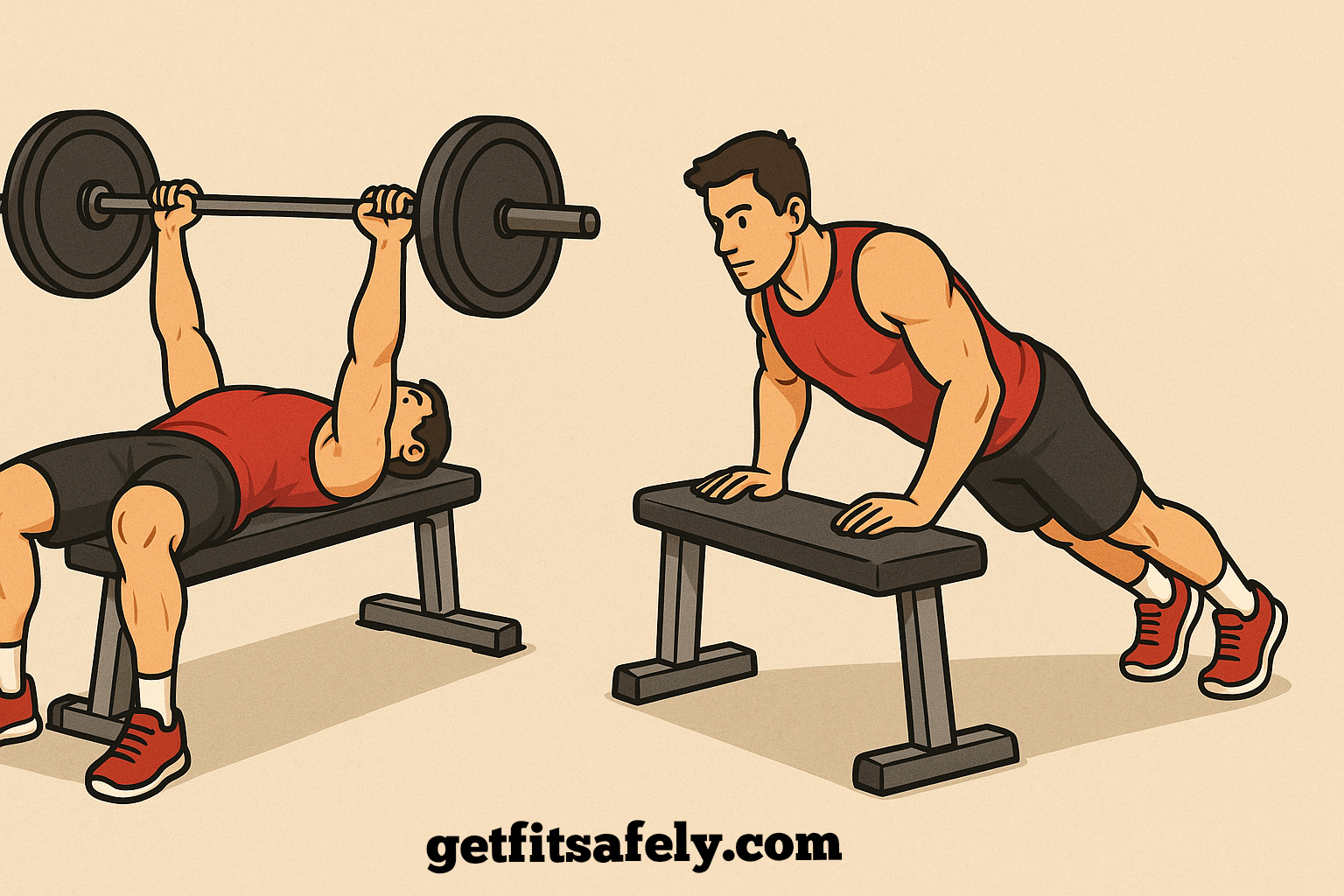
You don’t need a PhD in biomechanics to see it: the angle matters.
When you push upward, the clavicular head of the chest – that upper part just below the collarbone – steals the show.
That’s the very part that gives your torso that three-dimensional effect that makes all the difference in a T-shirt.
With flat bench press, the focus stays in the middle of the chest.
It doesn’t mean it won’t grow, but it often looks “flat,” missing thickness up top.
The visual result is a chest that looks wide but not full.
That’s why so many guys, after years of benching, have some mass but lack that “armor plate” look.
Incline push-ups, instead, wake up neglected fibers, and your body thanks you with visible growth.
Bench press isn’t just chest: shoulders and triceps steal the spotlight
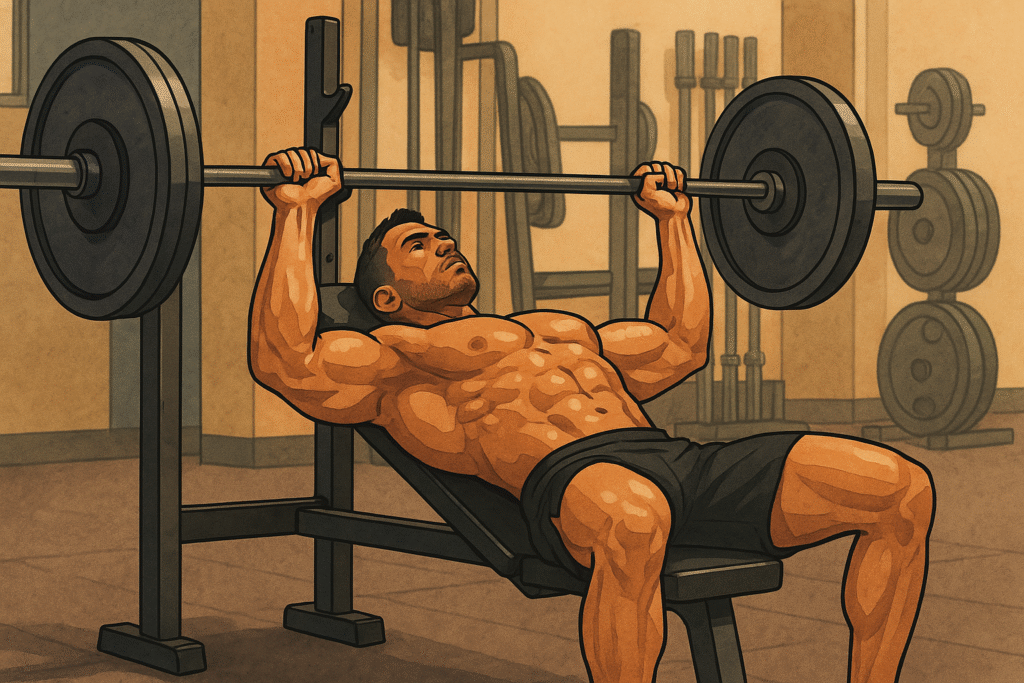
When you lie under a heavy barbell, your chest is never alone.
Your front delts and triceps are always ready to jump in.
And here’s the problem: they often do more than their share.
It depends on your levers, your grip, how you lower the bar.
So it ends up that the muscles you wanted to hit – the pecs – get the scraps.
That’s why some athletes have massive arms and round shoulders, but their chest lags behind.
It’s like the whole team is on the field, but the captain (the chest) is stuck on the bench.
With incline push-ups, the triceps and shoulders still help, but the chest is forced to lead.
Every rep is a direct call to the muscle you really want to grow.
Incline push-ups give more tension than you think
Many dismiss them as “too easy.”
But they’re actually a hidden weapon, especially if done with solid technique.
When your hands are elevated, you can sink deeper than on the flat bench.
That extra range stretches the pecs like a rubber band pulled to its max.
And a muscle stretched under tension gets a huge growth signal.
Plus, without the bench pinning your shoulder blades, the movement feels more natural.
The chest contracts better, fibers fire more fully.
It’s like dancing free instead of moving with your ankles tied.
And if you slow down the descent and push with control, the intensity doubles.
Forget “easy”: it turns into a secret weapon.
The brain knows who’s working
Ever done bench and thought: “But I don’t feel my chest”?
That’s because the nervous system often picks the easiest path, not the one you want.
If you’re not laser-focused on technique, the shoulders and triceps take over.
The brain goes: “Who can push better? Okay, we’ll use them.”
Result: the chest takes a back seat.
With incline push-ups, the chest feeling is clearer.
Every rep burns.
Every pump is localized.
The mind-muscle connection isn’t just a concept anymore – it’s something you actually feel.
And that direct signal speeds up growth.
Volume and recovery: the two forgotten brothers
It’s not just about the exercise, but also about “how much” and “how often.”
With bench, you typically go heavy once or twice a week.
Then you need to recover.
And recovering from a heavy bench day is no walk in the park.
With push-ups, the picture changes.
You can do more, more often, without wrecking joints or frying nerves.
Total volume climbs, frequency increases, and the pecs get constant stimulation.
It’s like catching small doses of sun every day instead of burning in two hours under August heat.
The body prefers the first scenario.
And so do your muscles.
How to get the most out of incline push-ups
If incline push-ups are your secret weapon, here’s how to make them even more powerful:
- Add extra load: throw on a backpack with weights, books, or water bottles. You don’t need 200 lbs – even 20 makes a big difference.
- Play with tempo: 4 seconds down, pause at the bottom, then explode up. You’ll feel the change instantly.
- Try variations: feet on a bench (for extra upper chest stress), or hands on dumbbells for a deeper stretch.
- Train to failure: if you’re used to 5×5 on bench, with push-ups you can go beyond, squeezing every fiber.
When bench press really shines
Let’s not throw it away.
The bench is still fundamental for building strength, muscle density, and gym prestige.
It also carries over to other movements, like overhead presses or even contact sports.
The trick is not seeing it as the one magical exercise.
The bench is just one arrow in your quiver.
If you combine it with smart variations – like incline push-ups – you get the best of both worlds.
More reps, less struggle: the hidden side of push-ups
Here’s something that blew my mind when I read it: with the same relative load, people can do way more reps with push-ups than with bench press.
Not just a couple more, but even 53–77% more according to studies.
And what does that mean in practice?
Push-ups give you tons of volume.
And volume is hypertrophy’s fuel – the gas that really pumps up muscle.
No need to overcomplicate: more reps, more blood flow, more signals to the chest.
A virtuous cycle that bench, because it’s heavier and more limiting, can’t always provide.
Muscle activation: not always where you expect
Another gem from studies is that chest activation (measured with EMG) can look similar between incline bench and push-ups.
But here’s the kicker.
The bench also recruits a lot of triceps and biceps during the concentric phase, while push-ups involve more anterior delts in the eccentric phase and keep the whole move more balanced.
Basically, bench works in “compartments,” while push-ups orchestrate a symphony.
And maybe it’s this synergy that makes push-ups feel more “chesty.”
It’s like the muscles talk better to each other, instead of arguing about who should push harder.
RELATED:》Can Push-Ups replace the Bench and dumbbell? (The truth!)
Angles that work: that famous 30°
Here’s another technical detail people often overlook: the incline.
Studies show that with a bench at about 30°, the upper chest – the clavicular zone – activates way more than on a flat bench.
And guess what?
Incline push-ups recreate almost the exact same angle.
You’re not lifting a powerlifter’s barbell, but the biomechanics are surprisingly similar.
The difference is in the context: on the bench, you’re pinned down with locked shoulder blades and a fixed path.
In push-ups, your body is free, the range often bigger, the feeling more natural.
That’s why you might “feel” the chest more on incline push-ups than on incline bench: same angle, but smoother motion.
|
Curious about the details? This video walks you through everything. |
Core, balance, and chain reaction
Another big difference people underestimate: push-ups are a “closed chain” exercise.
Translation: you’re not just pushing with pecs, but involving your whole body.
The core has to stay tight, glutes keep you stable, even legs chip in.
That means every rep is global work.
Your whole body stays “awake” during the set.
And this demand for balance and synergy is what makes push-ups so effective.
Not just local pump, but a true integrated workout that leaves your chest tighter and more responsive.
Bench press: from enemy to smart tool
At this point, I don’t want it to sound like bench is evil.
It’s not.
If done with proper technique, progression, and context, it’s still a killer exercise.
In fact, it can be the perfect complement: the strength you build on bench helps your push-ups, and vice versa.
The only problem comes when people worship one exercise and forget the rest.
Reality check: you don’t need to eliminate bench, just use it as an “extra weapon,” alongside the functional, steady stimulus of push-ups.
A smart mix beats any barbell obsession.
RELATED:》》》 Flat vs Incline Bench Press: Which Is Better? 7 Differences
Conclusion
The truth is, muscles don’t play favorites.
They don’t read the name of the exercise in your logbook.
They only feel the stimulus and react to it.
If bench isn’t giving you the results you want but incline push-ups are, you’re not cheating.
You’re just finding the path that fits your body.
And that’s the real key to growing: figuring out what works for you and pushing it hard.
Final message?
Stop chasing the “sacred exercise” everyone worships.
Find the one that lights up your muscles, makes you feel alive, and make it your daily bread.
Because the best growth always comes when you stop copying and start listening to your body.
And if your body is telling you it loves incline push-ups… then push, without fear, and let your chest tell the story to the next mirror.