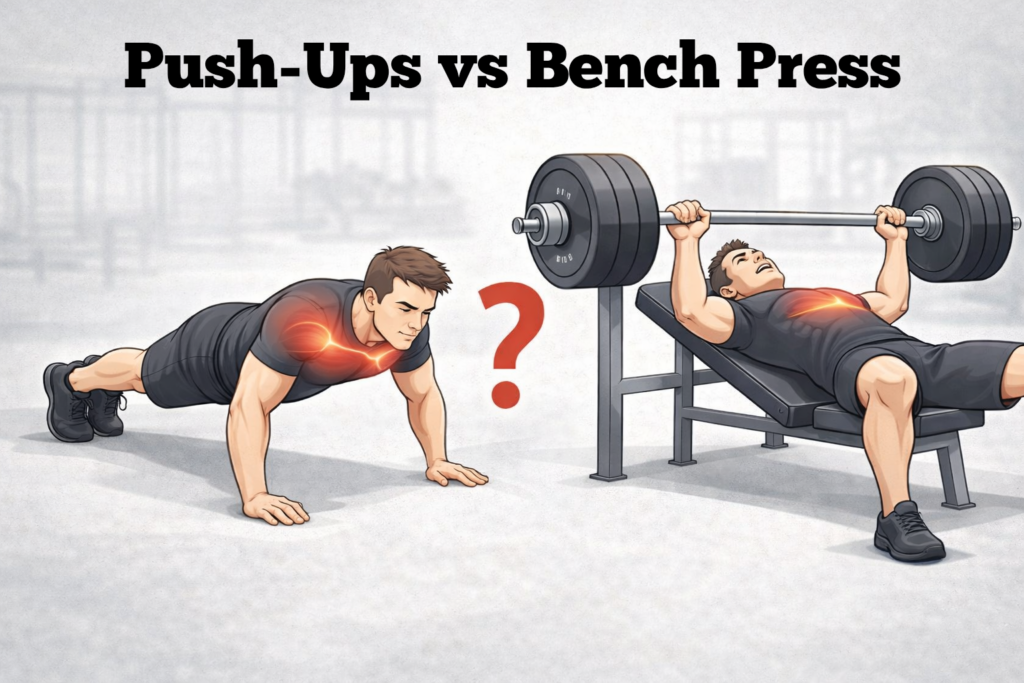
Short answer first, because this topic turns into a debate way too often.
Yes.
You can build a chest that looks very similar with push-ups or bench press.
But only if the push-ups are done in a way that actually challenges the chest over time.
A lot of people compare a structured bench press routine to casual push-ups done between scrolling Instagram and checking the oven.
That’s not a fair comparison.
It’s like comparing a real meal to a handful of crackers and then saying food doesn’t work.
So let’s break this down in the simplest way possible.
Two exercises.
One main muscle.
Different mechanics.
And a lot of small details that decide whether your chest actually grows… or just gets tired.
What “Bigger Chest” Actually Means in Practice

Most people imagine chest growth like inflating a balloon under the shirt.
In real life, it’s more like building a shape by stressing fibers through a range, under tension, repeatedly, while recovering enough to do it again.
That “shape” can look different depending on angles, arm path, and how much your shoulders help.
A chest is not one single slab.
It’s a big fan of muscle fibers that run in slightly different directions, from your breastbone and collarbone area to your upper arm.
Different pressing angles emphasize different fiber directions a bit more, like shining a flashlight from a different corner of the room.
When people ask whether push-ups can build a chest that looks indistinguishable from bench work, they’re usually mixing two questions.
One question is “Can my chest get bigger with push-ups.”
The other question is “Can push-ups stress the chest in the exact way a loaded press does.”
Those are not the identical question, even if they sound like it.
Bench Press and Push-Ups: Same Direction, Different Environment
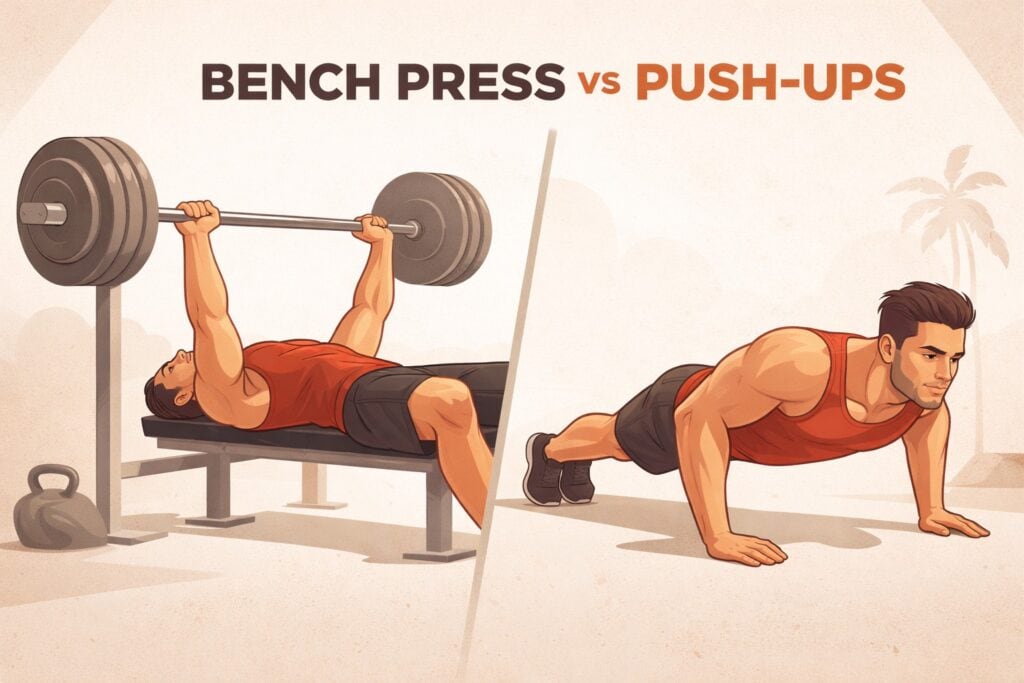
Both movements are horizontal presses.
That means your arms move forward away from your torso while your chest muscles shorten to produce force.
In basic school anatomy terms, your upper arm moves toward the center of your body while your elbow straightens.
So on paper, they look almost identical.
But once you actually perform them, the differences become obvious.
The Stable Surface Advantage of the Bench Press
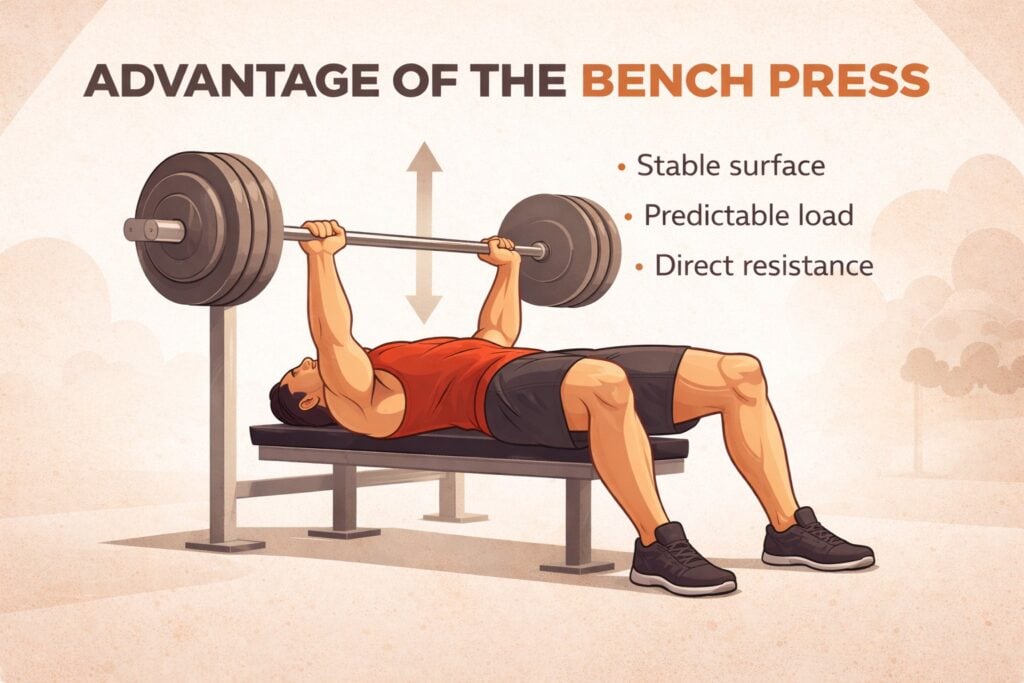
The bench press happens on a stable surface.
Your back is supported, your shoulder blades are pressed into the bench, and the resistance comes from an external weight.
Because your torso is stabilized, more of your effort can go directly into pushing the bar.
You lower the bar under control toward your chest, then press it back up.
The resistance stays vertical and predictable the entire time.
When you increase the weight on the bar, the movement itself doesn’t change.
That’s one of the biggest mechanical advantages of the bench press.
The Dynamic Nature of the Push-Up

A push-up, instead, takes place in a more dynamic setting.
Your hands are fixed to the ground, but your body moves as one solid line.
Your shoulder blades are not pinned against anything.
They glide along your ribcage as you lower and press.
That extra movement changes the sensation in your chest and increases the demand on stabilizing muscles around the shoulder.
You are not lifting a barbell.
You are lifting a percentage of your bodyweight.
That percentage shifts depending on your body angle and how strict your posture is.
Feet elevated makes it harder.
Hands elevated makes it easier.
Letting your hips sag changes everything.
So while the pressing direction looks similar, the environment is completely different.
Push-Ups vs Bench Press: Mechanical Stability vs Body Control
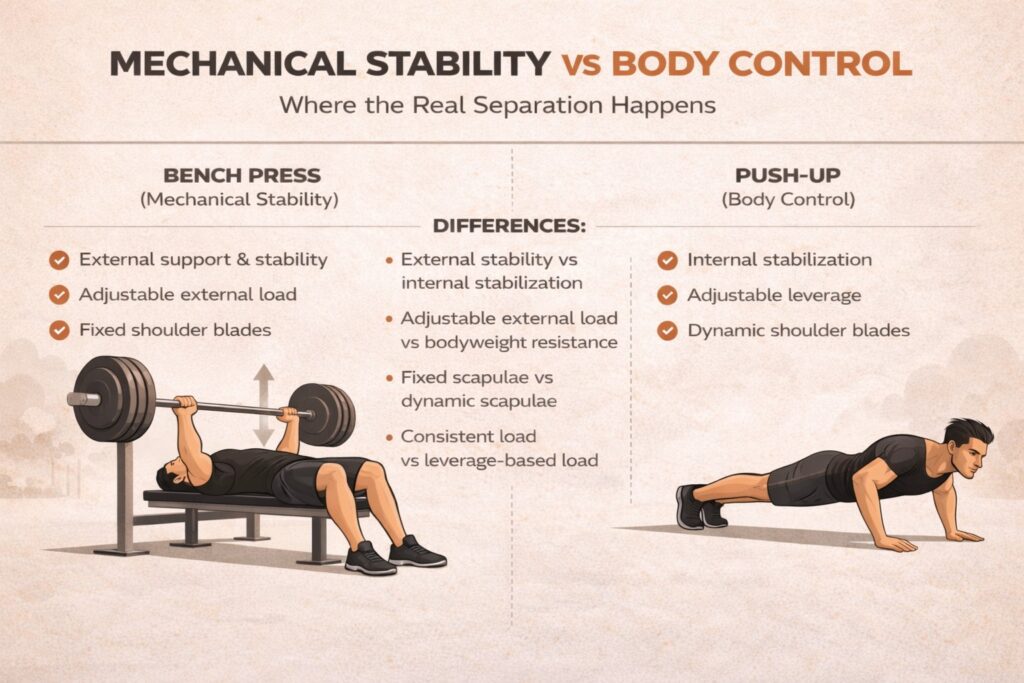
The bench press provides external stability.
The bench supports your torso, your feet anchor you to the ground, and your shoulder blades stay retracted.
This reduces the demand on core stabilization.
More energy can be directed toward pure force production.
That’s why it’s easier to expose the chest to very high levels of tension with heavy loads.
Push-ups demand internal stability instead.
There is no bench holding your back.
Your abs and glutes must stay tight to prevent your lower back from arching.
Your shoulder blades must move in a controlled way rather than being locked in place.
From a biomechanics perspective, both exercises recruit the pectoralis major, anterior deltoid, and triceps.
However, push-ups generally involve more active scapular motion and greater contribution from stabilizers like the serratus anterior.
Bench pressing minimizes scapular movement to maximize force transfer into the bar.
Range of motion also differs slightly.
In a bench press, the bar touches your chest and travels back up.
In a standard push-up, your chest meets the floor, which may slightly limit depth depending on body proportions.
Using handles or parallettes can increase that depth in push-ups, creating more stretch at the bottom.
From a muscle growth standpoint, both movements can stimulate hypertrophy if mechanical tension is high enough and repeated consistently over time.
Scientific research on resistance training shows that muscles grow in response to sufficient tension, regardless of whether that tension comes from bodyweight or external weights.
In fact, studies comparing push-ups and bench press have reported very similar upper-body muscle activation when the resistance is comparable (van den Tillaar & Saeterbakken, 2019).
The difference lies in how precisely that tension can be scaled and how stability is managed.
Bench press equals highly adjustable external load and fixed shoulder blade positioning.
Push-ups equal adjustable leverage, bodyweight resistance, and dynamic shoulder blade control.
The pressing action is similar.
The mechanical context is not.
Why Push-Ups and Bench Press Can Build a Very Similar “Pressing” Chest, Yet Feel Completely Different
I’ll describe a moment that made this click for me.
I had a stretch where I did only push-ups for a while because life was chaotic and a floor is always available.
My shirts started fitting tighter across the front, and I got that “dense” look when my arms were slightly forward.
So far, so good.
Then I went back to a bench, grabbed a weight that used to be comfortable, and it felt like my chest forgot the language.
My triceps jumped in early, my shoulders felt busy, and the press looked shakier than it had any right to be.
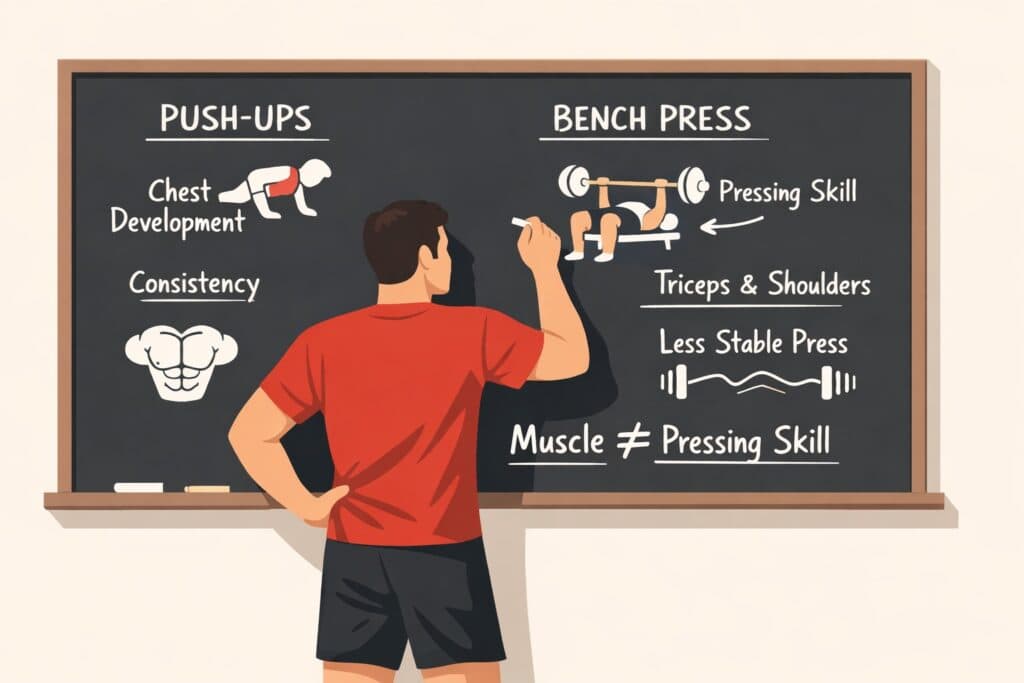
My chest size didn’t vanish.
My skill at that exact press did.
That was my first big lesson.
Chest size and pressing skill are close friends, but they’re not identical twins.
You can grow muscle with one pressing style and still feel awkward when you return to another style.
The Real Question: Can Push-Ups Provide Enough Challenge for Long-Term Chest Growth?
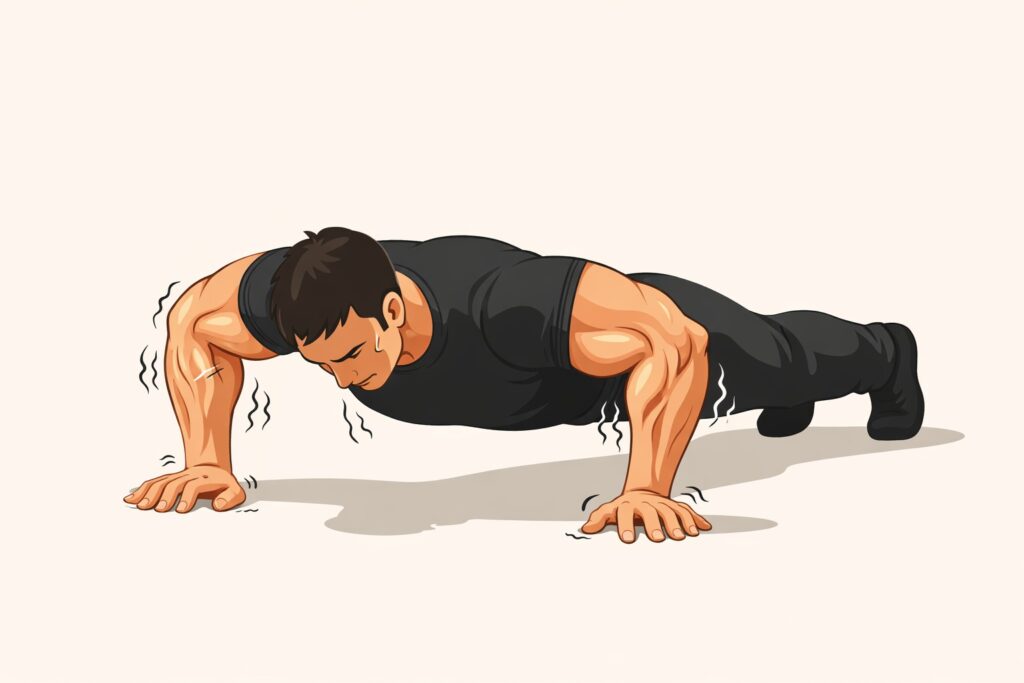
For a beginner, push-ups can be brutally effective.
The first time someone does clean push-ups with full body tension, it hits the chest like a surprise bill in the mail.
Even a small amount of quality work can create soreness and visible changes over time.
The problem shows up later.
Bodyweight stops feeling heavy once your nervous system gets efficient and your technique gets clean.
The movement becomes economical, like your body learned the shortcut route.
At that point, you need ways to make the push-up demanding again without turning it into a messy wiggle.
Bench work stays scalable almost forever because you can add load in tiny steps.
Push-ups stay scalable if you’re willing to change leverage, range, tempo, and loading.
Without those changes, push-ups can turn into “cardio for the triceps” for people who already have decent strength.
How I Noticed Chest Growth With Push-Ups (And What It Felt Like)

My push-up era wasn’t “a couple lazy drops to the floor.”
I treated each press like it mattered, because it did.
The difference between chest growth and “arm pump only” often comes down to how strict the body is.
The session that made me confident push-ups can build serious chest looked like this in real life.
I trained in my living room, on a thin mat, phone timer on the floor, window open, shoulders warmed up for about 6 minutes.
Each repetition lowered slowly, taking about three steady counts before the chest reached the bottom position.
Right above the floor I held the position briefly — just long enough to remove any bounce — then pressed upward with a smooth, controlled drive.
After the first handful of presses, the chest started to feel “full” near the armpit line and across the middle fibers.
By the end, my triceps were warm, but the chest had that swollen feeling like it was wearing a slightly tighter shirt under my skin.
Here’s what mattered most.
I stopped each round while I still had one or two clean presses left, because form collapse changes the target fast.
When I pushed into ugly grinders, my shoulders took over and the chest sensation dropped.
The goal wasn’t suffering.
The goal was keeping the press a chest press.
How I Noticed Chest Growth With Bench Work (And What It Felt Like)
Bench work gave me a different kind of “chest signal.”
Push-ups often gave me a wide, spread pump.
Bench work gave me a deeper, heavier feeling, especially near the mid-chest and toward the inner line.
Not “inner chest isolation,” which is not a real separate muscle.
More like a thicker pressure in the middle because the load was higher and the movement was steadier.
A bench session that stuck in my memory was a quiet gym evening.
I warmed up with very light presses and shoulder blade squeezes for about 7 minutes.
Then I used a moderate load, lowered with control for about 2 seconds, touched lightly, and pressed up with steady speed.
Around the middle of the session, my chest felt like it was doing the heavy lifting, not just assisting.
My shoulders felt parked and calm, and my triceps felt involved but not screaming.
What surprised me was how much tiny technique details changed the feel.
If I let my shoulders roll forward at the bottom, the chest sensation dropped.
If I kept my shoulder blades pinned and my elbows angled slightly inward instead of flared wide, my chest felt more “on.”
It wasn’t anything mysterious.
It was just biomechanics behaving like biomechanics.
Why Push-Ups Sometimes “Miss the Chest” Even When They Look Fine
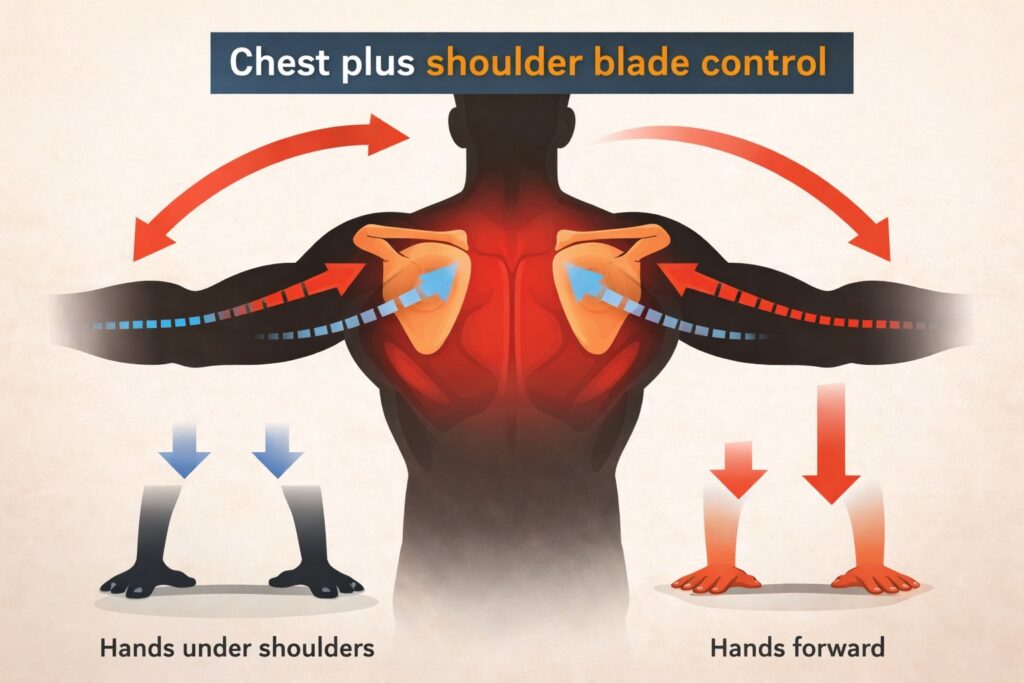
A push-up can look clean on video and still be chest-light in your body.
That usually happens when the movement turns into a shoulder glide plus elbow extension, instead of a chest-driven press.
A few things I caught myself doing, especially when tired.
My hands would drift too far forward, so it became more shoulder-heavy.
My elbows would flare out, and my shoulders would feel cranky at the bottom.
My ribs would pop up and my lower back would arch, which steals tension from the torso.
My range would shrink without me noticing, like I was negotiating with gravity.
If you want the chest to contribute more, the push-up needs structure.
Hands under the shoulder line, not way above the head.
Body like a plank, glutes lightly tight, ribs not flared up.
Lower until the chest is close to the floor without the shoulders collapsing forward.
Press the floor away like you’re trying to widen your upper back while the chest still does the drive.
That last cue sounds weird until you feel it.
The push-up is chest plus “shoulder blade control.”
If the shoulder blades go chaotic, the chest can’t express strength cleanly.
Why Bench Press Sometimes “Misses the Chest” Even When It’s Heavy
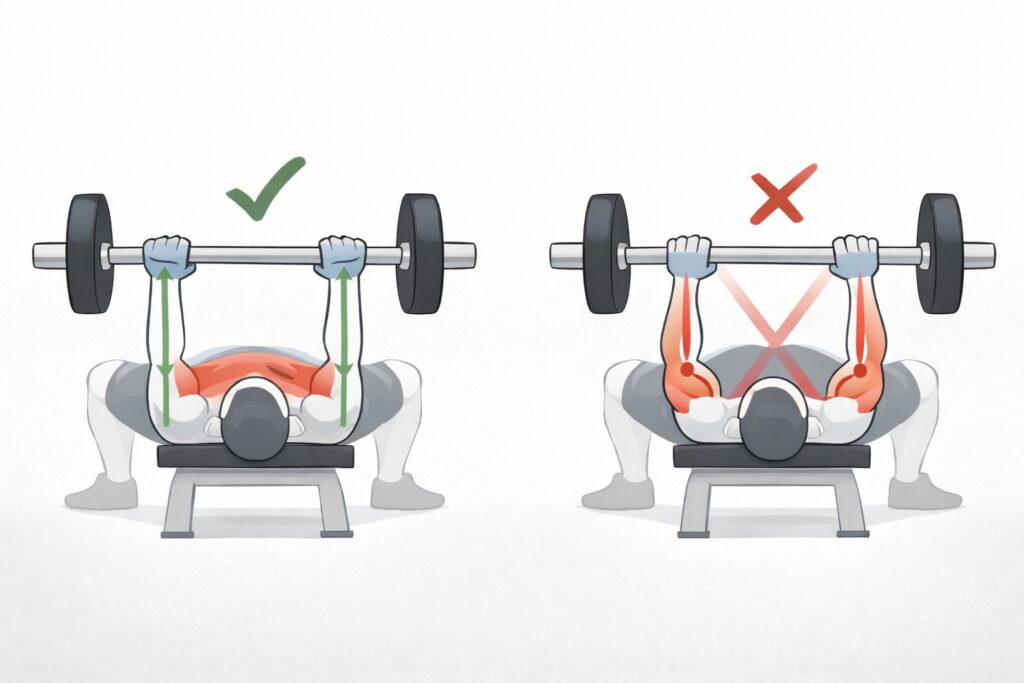
Bench work can also shift away from the chest.
The bar can be moving, but the chest might not be the main worker.
That’s how people end up with huge triceps and irritated shoulders while wondering why the chest looks flat.
Here are a few detours I experienced.
Bouncing the bar off the chest so the hardest part disappears.
Cutting the lower portion short because it feels unstable.
Letting shoulders roll forward at the bottom and turning it into a shoulder press in disguise.
Using a grip so narrow that the triceps do most of the job.
The fix was never a complicated ritual.
It was slowing down the lower, keeping the chest proud without over-arching, and choosing a grip width where the forearms stayed roughly vertical near the bottom.
That vertical forearm detail is a simple check for leverage.
When the forearm is angled weirdly, joints tend to complain and muscles tend to “take turns” in ways you didn’t plan.
Range of Motion: Where Push-Ups Can Beat the Bench (And Where They Can Fall Short)
On the floor, your chest stops when it meets the ground.
That means the bottom range is limited by your torso thickness, not by your shoulder comfort.
For some people, that’s plenty deep.
For others, it’s not much stretch at all.
A bench press can go deeper depending on grip and anatomy, but the bar stops at your chest too.
So both have a bottom stop.
The difference is what happens at the top.
At the top of a bench press, the load is still on you.
At the top of a push-up, many people lock out and “rest” on joints for a split second without realizing it.
That tiny rest can reduce time under tension a lot across a whole session.
When I wanted push-ups to feel more like serious chest work, I removed the top rest.
I kept the top position active, with the chest still engaged, and moved into the next lower smoothly.
Not faster.
Just continuous.
That one change made the push-up feel like a long uninterrupted press instead of a series of mini breaks.
If you want more stretch for push-ups, you can elevate the hands on handles or dumbbells so the chest can travel slightly deeper between them.
That deeper range often creates a stronger chest sensation, especially for people who don’t feel much at the bottom on flat palms.
Loading: Why Bench Work Stays Easy to Scale, And How Push-Ups Catch Up
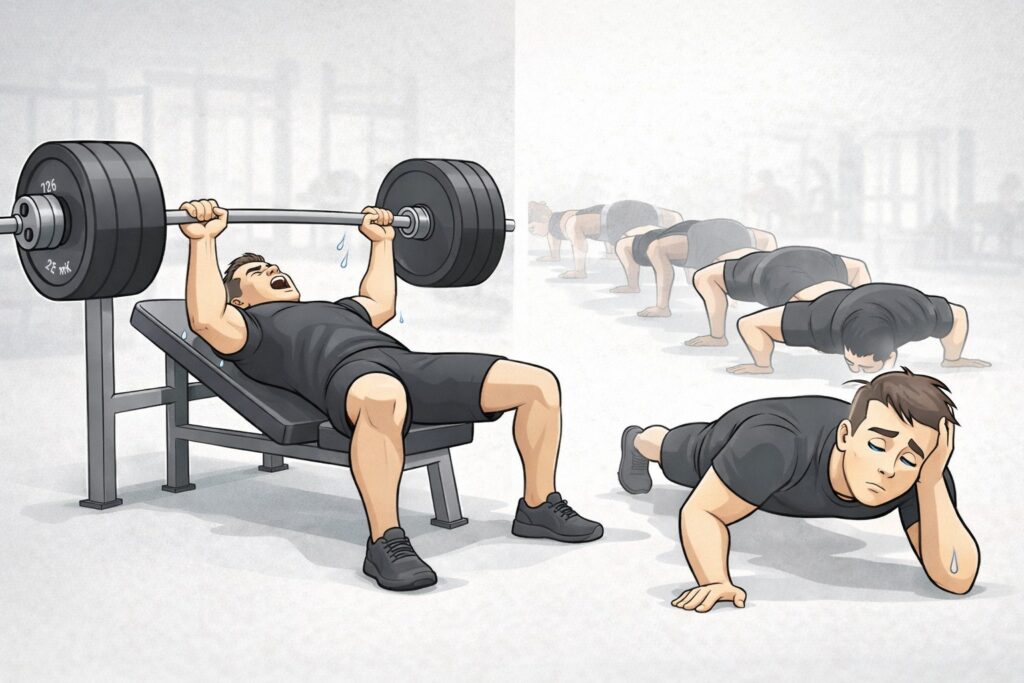
Bench work scales with plates.
Add a little, repeat, grow.
That’s the obvious advantage, and it’s real.
Push-ups scale in different ways.
Leverage changes make the body angle harder, like elevating the feet on a step or bench.
External load means wearing a backpack or a weighted vest so the body itself becomes heavier during the press.
Range adjustments mean using handles or blocks to let the chest travel slightly lower than the hands.
Tempo adjustments mean controlling the descent instead of dropping quickly, sometimes holding briefly near the bottom before pressing upward.
Density adjustments mean keeping the working period compact without turning the movement into rushed, messy presses.
One example that worked well for me came from a very simple setup at home.
I used a backpack with two water bottles at first, then later added a third one.
Water works well because the weight is easy to estimate and the bottles stay stable instead of shifting around like loose plates.
Each press moved down slowly and deliberately until my chest was just above the floor.
I stayed there for a brief moment to remove any rebound, then pushed upward in one smooth drive.
Some rounds ended sooner, some lasted a little longer, depending on how solid the presses still felt that day.
Between rounds I waited until my breathing settled and my arms felt ready to produce clean presses again.
Usually that meant roughly a minute or slightly more, but I never stared at the clock obsessively.
After the second round, the chest pump felt thick across the upper-middle area, while the triceps were clearly working but not exhausted.
Near the final round, the chest felt like it was pushing from deep inside the rib cage, and the shoulders stayed stable instead of feeling pinched.
There was nothing complicated about that setup.
It was simply a practical way to keep the movement challenging once plain bodyweight stopped feeling heavy.
How Push-Up and Bench Angles Shift Chest Tension
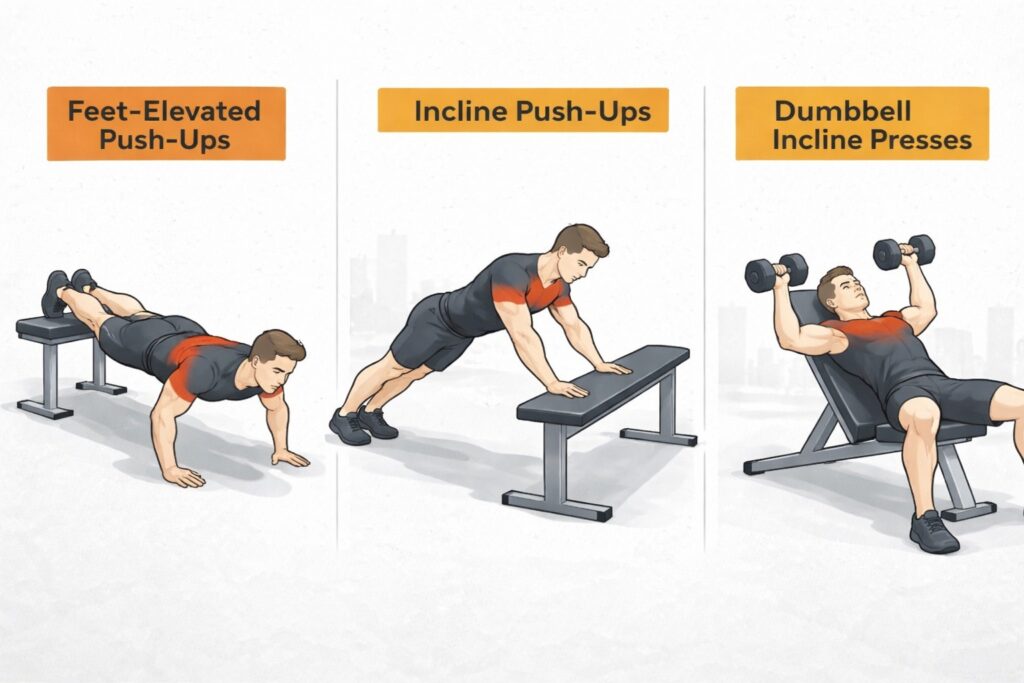
As I mentioned a moment ago, both the flat bench press and the basic push-up are horizontal pressing movements.
The general direction is similar.
Small angle shifts, however, change what you feel.
Feet elevated push-ups tilt the press toward the upper chest fibers a bit more.
Incline push-ups (hands elevated) often feel easier and can be used to keep quality when full push-ups are too hard.
Dumbbell incline presses can emphasize upper chest more, depending on angle and technique.
I noticed this with my mirror and with soreness location.
On weeks where I leaned heavily into feet-elevated push-ups, I felt more tightness near the collarbone line the next day.
On flat push-up weeks, I felt it more across the mid-chest and near the outer line close to the armpit.
On flat bench weeks, I felt dense fatigue across the middle and a deeper “worked” feeling that lasted longer into the next day.
None of that is a rule carved into stone.
Bodies vary.
Still, it’s a useful compass when someone says “I only feel shoulders.”
Often they just need an angle change and tighter form.
Chest “Connection” Without Talking Like a Robot
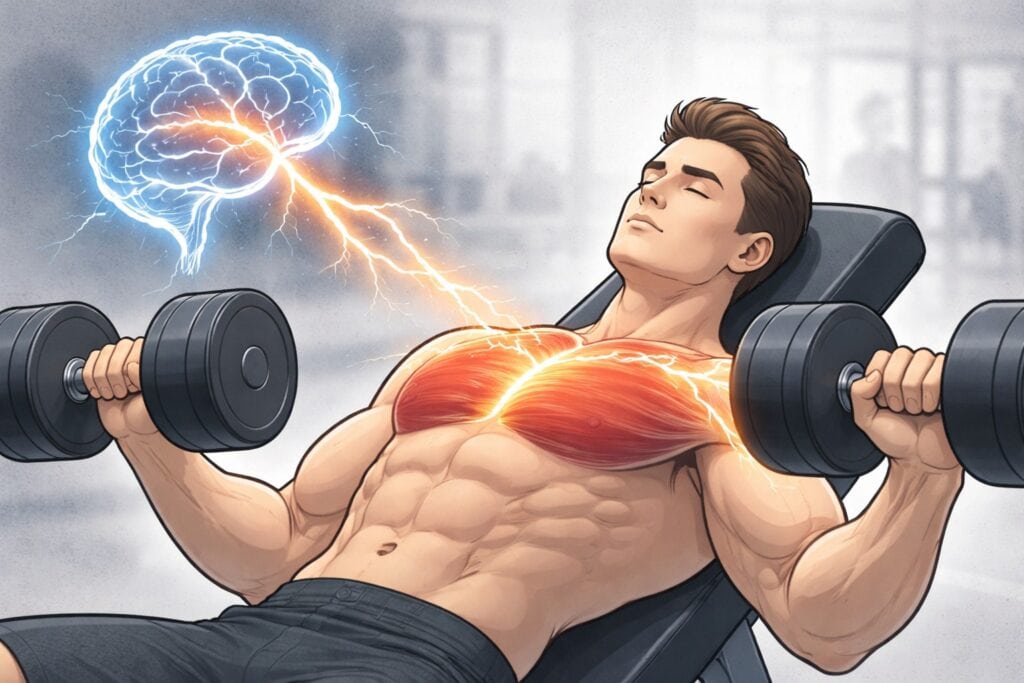
People call it mind-muscle connection.
I’ll call it “Do I feel the chest doing the job, or do I feel everything else.”
That matters because long-term growth tends to follow consistent tension in the target muscle, not random effort scattered across joints.
When I wanted more chest sensation on push-ups, these cues helped me.
- Hands slightly wider than shoulder width, not extreme wide.
- Elbows angled a bit inward, not flared straight out.
- Lower with control until the chest is close to the floor.
- Pause very briefly near the bottom without relaxing into the shoulders.
- Press the floor away while keeping ribs down and body stiff.
When I wanted more chest sensation on bench work, these cues helped me.
- Shoulder blades tucked back and down before unracking.
- Bar lowered under control, not dropped.
- Touch the chest lightly without bouncing.
- Press up with steady speed, keeping shoulders packed.
- Grip width chosen so forearms don’t angle weirdly at the bottom.
If a teen asked me what that all means, I’d say this.
“Make the press look controlled enough that a strict teacher would approve.”
“Make the shoulder joints feel quiet, not crunchy.”
“Make the chest feel like the engine, not the passenger.”
How The Results Can Look Extremely Close, Yet Not Identical in How You Got There

If you push push-ups hard enough, long enough, with smart loading and angles, you can build a chest that looks very close to a chest built with bench work.
One interesting study actually compared push-ups and bench press using similar relative loads.
Researchers adjusted the push-up difficulty so the load matched about 40% of a bench press 1-rep max, and both groups trained for several weeks.
Increases in chest muscle thickness and strength ended up being very similar between the two groups, which lines up pretty well with what many people experience in real training.
I’ve seen that outcome in regular gym environments, not just highlight clips online.
I’ve also felt it in my own shirts and in photos where my chest looked fuller even without touching a barbell for a long stretch.
Where the difference tends to show up is “peak loading.”
Bench work makes it easier to expose the chest to very high tension because external load is straightforward.
Push-ups can reach high tension too, but you often need creativity, discipline, and sometimes equipment like a vest, rings, or a loaded backpack.
Without those tools, push-ups can become too easy once you’re past the beginner stage.
Another difference is skill carryover.
Push-ups make you good at push-ups, including shoulder blade control and full-body stiffness.
Bench work makes you good at bench mechanics, including bar path, tightness on a bench, and handling heavier external loads.
Your chest can grow from both.
Your “comfort” in each movement will follow what you practice.
Where People Get Stuck With Push-Ups and Bench Press
The most common detour is staying in the comfortable version of the movement.
Comfortable push-ups become fast and bouncy.
Comfortable bench work becomes half-range and shoulder-y.
Both can look like training while quietly reducing the chest stimulus.
Another detour is chasing fatigue instead of quality.
When the last portion of the session turns into ugly presses, the chest often contributes less, not more.
The body starts borrowing from shoulders and elbows.
The movement still happens, but the target shifts.
A final detour is never changing the challenge.
If a movement feels identical month after month, your body is probably paying less attention.
That’s when you change leverage, add load, slow the lower, deepen the range, or choose a different press angle.
Not because you need variety for entertainment.
Because muscles adapt to what they can handle.
Can Push-Ups Build a Chest That Looks Indistinguishable From Bench Work?
For beginners and many intermediates, yes, push-ups can build a chest that looks extremely close, especially if you load them and treat them like real training.
I’ve watched that happen, and I’ve lived it when my gym access disappeared for stretches.
Bench work makes it easier to keep scaling tension for a long time, and that matters if you’re chasing maximum size potential.
Push-ups can keep up if you’re willing to load them, change leverage, and keep technique strict enough that the chest stays the engine.
If you’re just getting into training, here’s the simplest truth.
A chest grows when you press with control, challenge the muscle, recover, and repeat that process consistently.
A floor can do that.
A barbell can do that.
Your job is making the press difficult enough without turning it into sloppy reps.