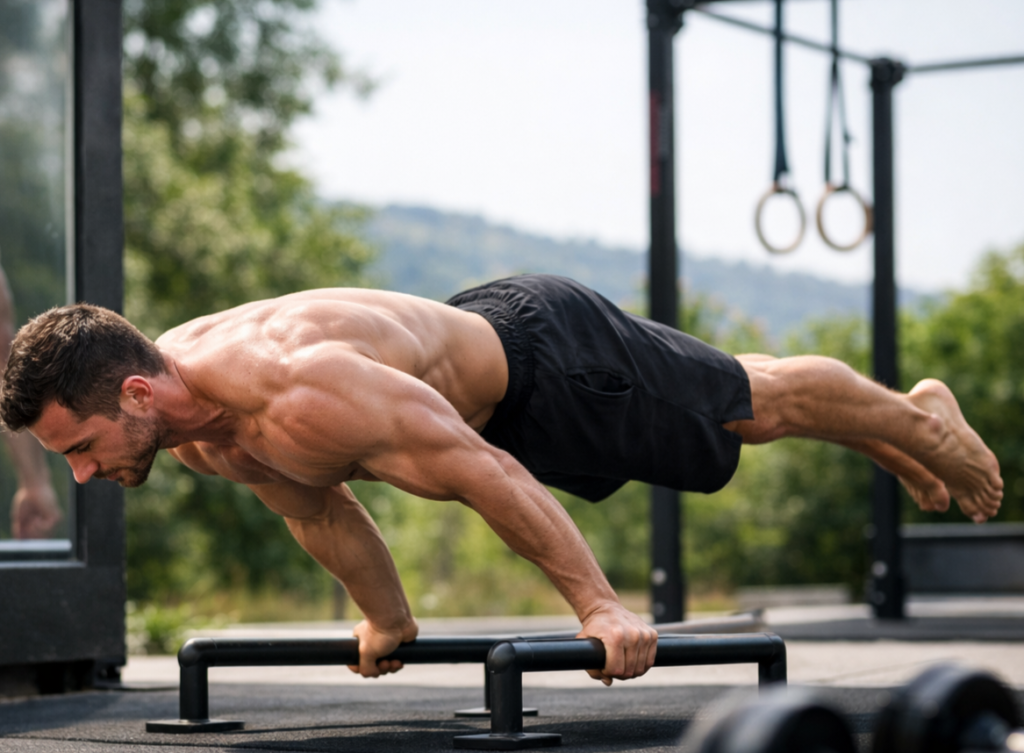
I ran into this the exact same way a lot of people do.
The skill numbers were climbing.
The mirror was acting like nothing happened.
And at first it feels like some weird scam.
Like the universe is saying, “Congrats, you can do cooler things now, but no visible upgrades for you.”
So I treated it like a problem worth testing, not a vibe worth complaining about.
This is the full breakdown of what I learned, explained simply, but without cutting corners.
The Exact Situation That Made Me Notice the Gap
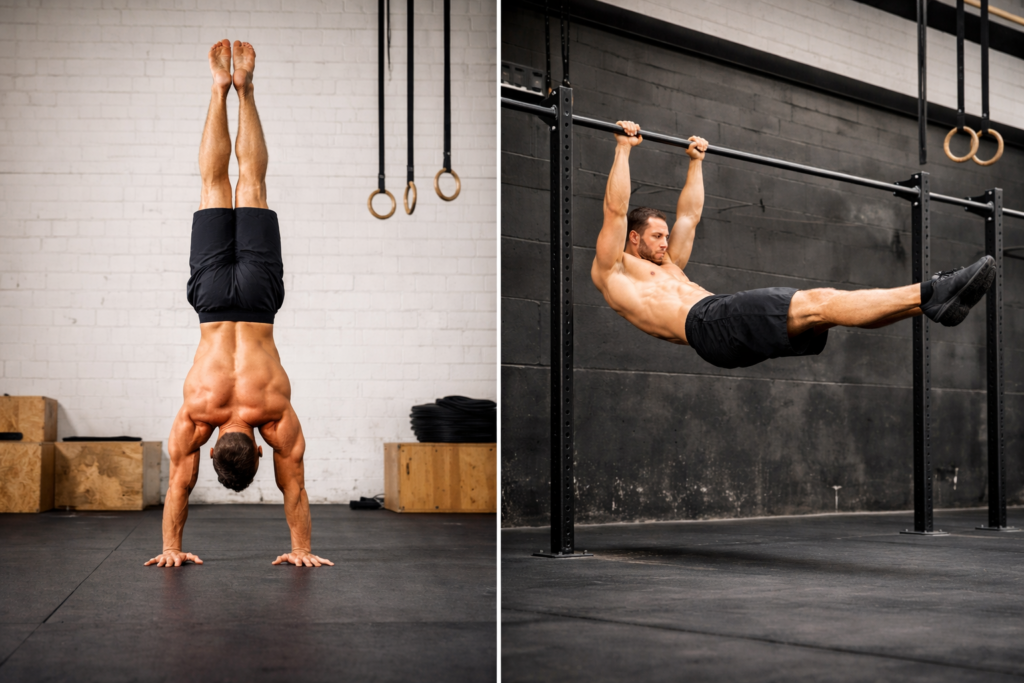
It started during a phase where I was practicing skills consistently.
Handstand work, lever progressions, and cleaner pull patterns were the main goals.
I wasn’t training randomly, but I also wasn’t running a “bodybuilding” setup.
It was classic calisthenics logic: practice the thing, get better at the thing.
Within a few weeks, the changes were obvious in performance.
Holds got longer.
Attempts got less shaky.
Transitions got smoother.
But visually, it was subtle at best.
Not “zero,” but not what someone expects when they feel stronger week to week.
That contrast is what pushed me into full nerd mode.
Not spreadsheets-for-fun nerd mode.
More like “if I don’t quantify this, I’ll keep inventing explanations” nerd mode.
How I Tested It Instead of Guessing
I set up my training in blocks, then tested one thing at a time.
Because if you change everything, you learn nothing.
And calisthenics already has enough variables to make the brain overheat.
So the approach stayed intentionally simple.
Testing always happened on the same day.
Warm-up sequences never changed.
Exercise order stayed consistent.
Rest timing was kept identical.
The tests were boring on purpose.
Because boring testing is exactly what produces clean data.
For skills, I tracked things like hold duration, quality score, and number of good attempts.
For physique, I tracked bodyweight averages, tape measurements, and progress photos under the same light.
And I also tracked stuff people pretend doesn’t matter.
Sleep.
Calories.
Stress.
Training density.
Because those “side” variables quietly decide whether your body builds tissue or just gets better at controlling tissue.
What Improved Fast: A Real Example With Numbers

Let’s use one skill as a clean example.
Front lever progressions.
I picked a progression I could almost hold, because that’s where neural improvements show up quickly.
I tested max clean hold time once per week.
Week 1: 7 to 9 seconds depending on the day.
Week 4: 12 to 14 seconds with noticeably better body line.
Week 8: 18 to 20 seconds with fewer ugly shoulder shakes.
That’s a big jump in a short time.
Now here’s what happened at the same time visually.
Bodyweight barely moved.
Tape measurement changes were within “water and glycogen noise.”
Photos looked like the same person with slightly better posture.
Which is not the superhero transformation you assume you’re earning when you feel stronger.
So the question wasn’t “why isn’t it working.”
The question was “what kind of progress is this, and why is it so fast.”
The Core Answer: Skills Improve Through ‘Software Updates’
Early skill progress is mostly neural.
It’s coordination, timing, joint positioning, and tension management.
It’s your nervous system learning the shortest path to produce force in a very specific shape.
That’s why calisthenics skills can improve without dramatic muscle gain.
Because you’re upgrading the operating system first.
The hardware can stay the same and still run better code.
If you’ve ever optimized a slow laptop by removing background processes, you know the feeling.
Nothing new was installed, yet everything suddenly runs smoother.
Calisthenics works the same way on the body.
Wasted tension gets stripped away.
Energy leaks disappear.
Muscle recruitment becomes more precise and better timed.
As a result, skill performance can jump quickly even when body size hasn’t changed much yet.
Why Your Physique Isn’t Keeping Up: Muscle Growth Is Slow Biology
Hypertrophy is not a “learned skill.”
Tissue remodeling is what’s really happening.
That process requires repeated mechanical tension, sufficient volume, proper recovery, and often a calorie surplus to support growth.
From a biological standpoint, the cost is high.
Neural adaptation moves faster because the nervous system is improving control rather than building new structure.
Your muscles adapt slowly because they’re literally building new structure.
That process is measured in months, not weeks, if you want visible change.
Especially once you’re past the beginner “everything grows because you exist” stage.
So if skills are sprinting and physique is walking, it doesn’t mean you’re doing something wrong.
It often means you’re watching two different systems adapt at two different speeds.
The Big Hidden Factor: Calisthenics Rewards Efficiency, Not Exhaustion
This is where calisthenics can mess with expectations.
In bodybuilding-style training, being inefficient can still build muscle.
If your technique is slightly off, you might still load the muscle hard.
Sometimes you load it harder because the movement is messier.
In calisthenics skills, inefficiency gets punished immediately.
A tiny body line error turns a hold into a fail.
A small shoulder angle leak turns control into shaking.
So your body learns to become efficient fast.
It learns to create tension without wasting it.
That’s amazing for skills.
But “efficient skill execution” doesn’t automatically mean “high hypertrophy stimulus.”
Because hypertrophy often loves controlled suffering.
Skills love clean precision.
Those aren’t enemies, but they are not the same target.
Leverage Improvements Make You Look Stronger Without Adding Muscle
This turned out to be one of the biggest “ohhhh” moments.
Attempts were filmed and frames compared across different training phases.
The shift wasn’t just about raw strength.
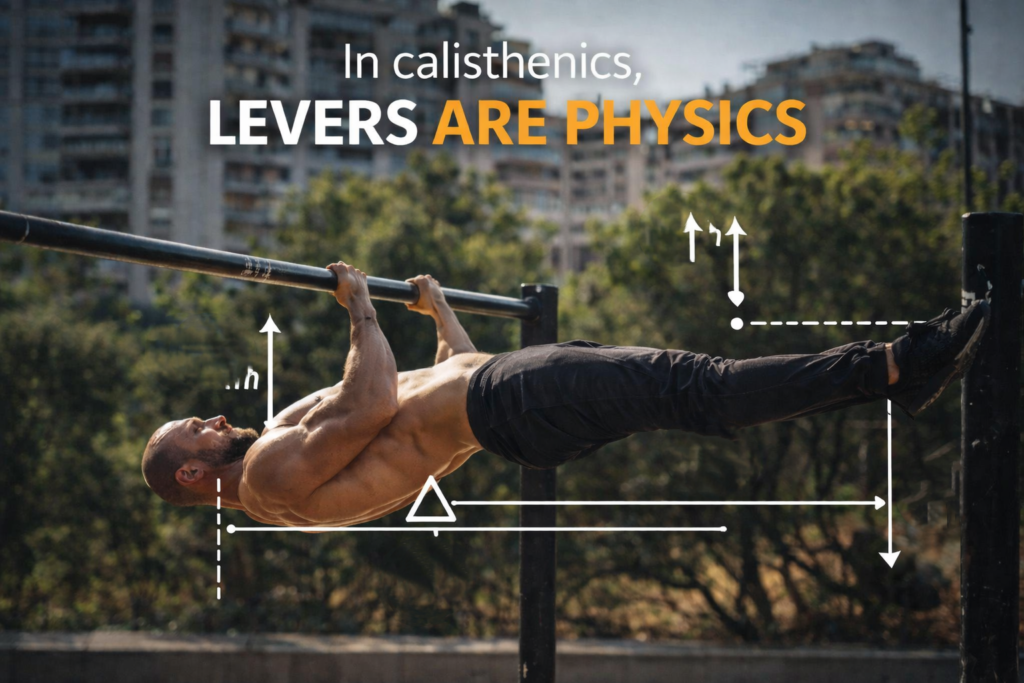
Leverage was the real variable changing.
Hip piking gradually disappeared.
Scapular positioning became more stable.
Rib flare decreased.
Body lines tightened up.
Those adjustments alone can nearly double performance without doubling muscle size.
Because in calisthenics, levers are physics, not vibes.
If the center of mass shifts even slightly, the difficulty drops dramatically.
So “strength” can appear to increase in the skill while muscle size stays almost identical.
It’s like learning to carry a heavy box closer to the body.
Same box.
Same arms.
Way easier.
My ‘Hypertrophy Set Count’ Reality Check
This was the part that hurt a little.
Because I thought I was training a lot.
I was training frequently.
I was training hard.
I was training long sessions.
But when I counted hypertrophy-effective sets, it wasn’t that impressive.
A lot of my time was skill attempts with long rest.
Holds, partials, technique reps, micro-adjustments.
Great practice.
Not a huge muscle-building dose.
If you do five sets of handstand holds, your shoulders might feel worked.
But the hypertrophy signal depends on how close the muscles got to a meaningful fatigue threshold.
Skill practice often ends because form breaks, not because the muscle is truly challenged.
That matters.
Because hypertrophy cares less about “you tried a lot” and more about “did the muscle get enough mechanical tension for long enough.”
Static Holds Build Strength Differently Than Dynamic Volume
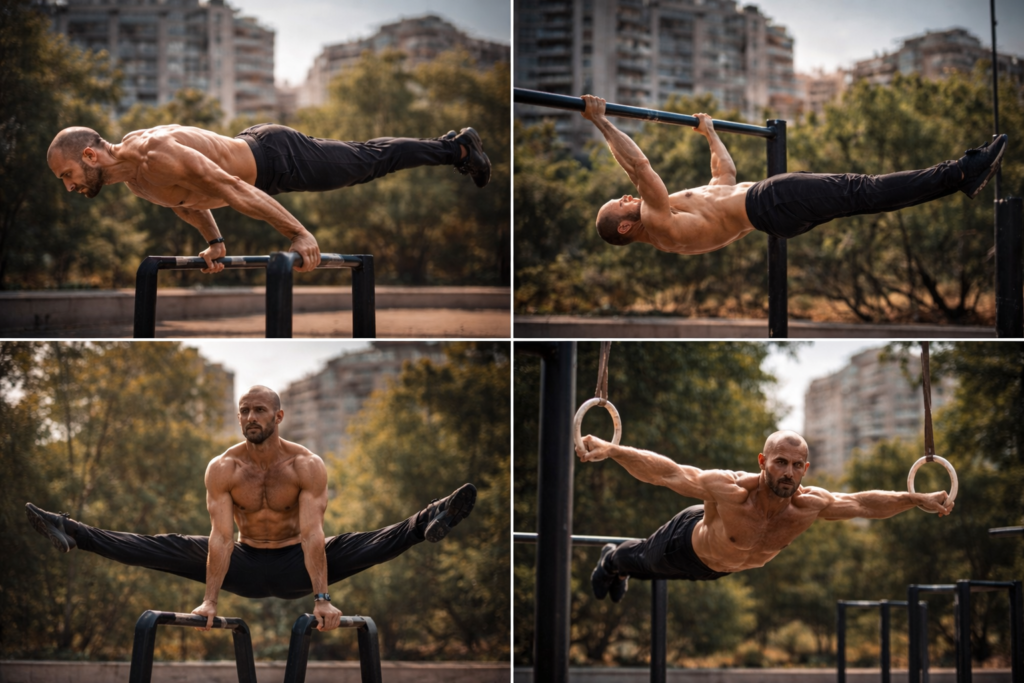
Isometrics are useful.
They build strength at specific joint angles.
They build tendon tolerance.
They teach you to generate tension without movement.
But they can be sneaky for hypertrophy.
Because the time under tension can be short, and the stress can be more neural than metabolic.
A 10-second hold might feel brutal.
But from a hypertrophy perspective, it’s not the same as a 30 to 45-second set taken close to failure through a full range of motion.
This is one reason skills can jump ahead.
You’re practicing a high-skill, high-tension action.
But you might not be accumulating enough volume for size.
So you’re becoming better at being strong, not necessarily bigger.
Why Reps Go Up Without Visible Change
I also tracked basics like pull-ups and dips.
And I saw the same pattern.
Pull-ups climbed from around 10–12 clean reps to 16–18.
Dips went from around 18–20 to 28–30.
That’s a big increase.
But measurements didn’t explode.
Because rep increases can come from better groove, better scap control, better breathing, better pacing, and better recruitment.
You’re learning to use what you already have.
You’re not automatically building new mass.
A lot of people assume “more reps = more muscle.”
Sometimes yes.
But often, especially early, “more reps = better efficiency.”
That’s still progress.
Just not the kind progress that screams in the mirror.
The Mirror Is a Lagging Indicator, and That’s Not Your Fault
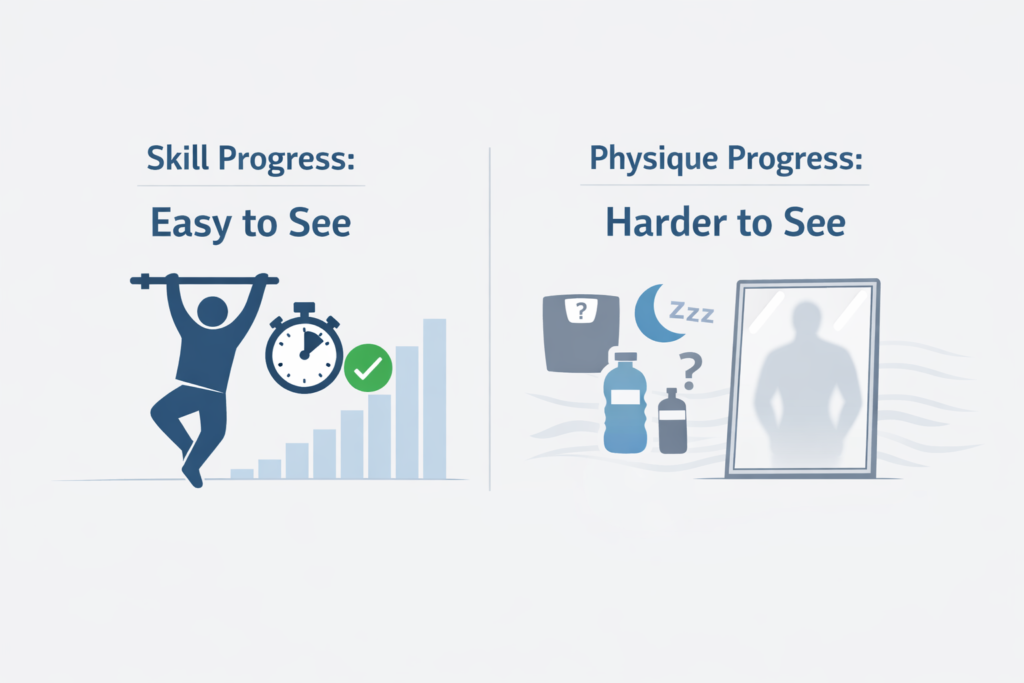
The mirror is not tracking weekly adaptation.
Tracking reflects structural change mixed with lighting, hydration, posture, and stress.
Skill improvements show up immediately because performance is easy to measure.
An extra second on a hold stands out clearly.
A cleaner rep is easy to notice.
Reduced shaking during an attempt is obvious as well.
Physique changes move more slowly, appear more subtly, and are often hidden by normal day-to-day fluctuations.
If you gain half a pound of muscle in a month, that’s great progress.
But it can be visually invisible if you also lost a pound of water, or had worse sleep, or stood slightly differently in photos.
So the skill progress feels “real” and the physique progress feels “imagined.”
That doesn’t mean the physique isn’t improving.
It means it’s improving on a different timeline.
Calories: The Unsexy Variable That Decides Your Look
I tested this by running two different phases.
One phase was “eat normally” while training skills.
Another phase was “intentional surplus” while keeping skills but adding hypertrophy work.
In the first phase, skills improved fast.
Physique improved slowly.
In the surplus phase, physique finally responded more clearly.
Not instantly, but noticeably.
Because muscle growth needs resources.
And calisthenics training, especially skill-heavy sessions, doesn’t always create the appetite and calorie push that heavy leg day does.
Also, skill sessions often have a lot of rest.
Which is great for quality attempts.
But it means the total training energy output may not be as high as you assume.
If you’re accidentally eating at maintenance, skills can still rise.
Your physique might not change much.
So if someone is improving in skills but staying visually the same, calories are one of the first boring things I’d audit.
Not because food is magic.
Because biology is accounting.
The ‘Beginner Gains’ Trap: Why This Feels Worse Over Time
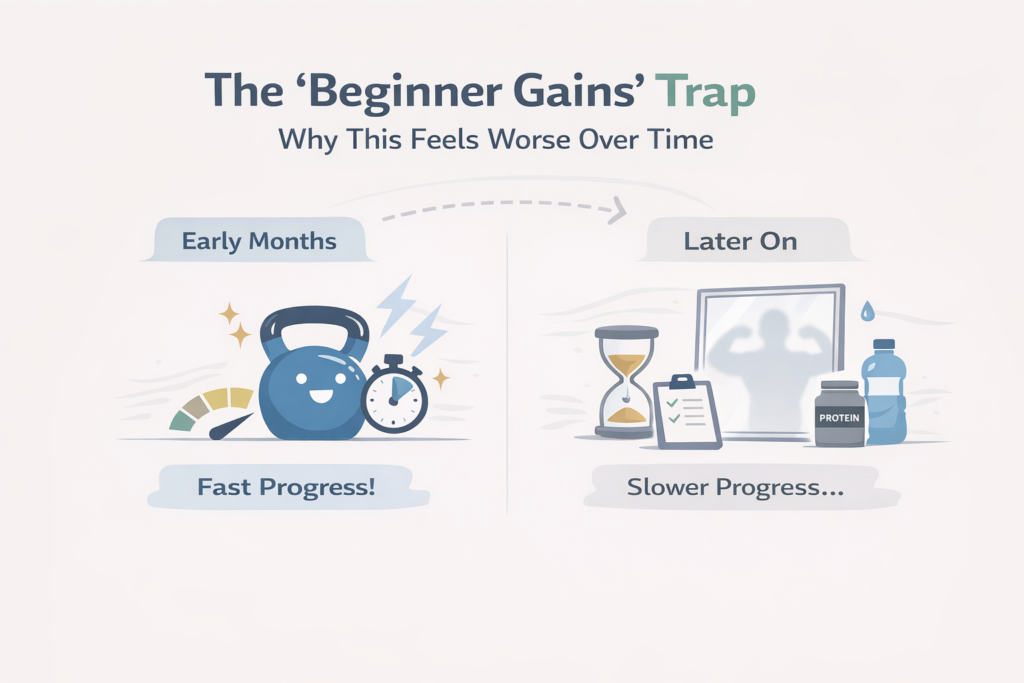
If you were a true beginner at first, the early months can be misleading.
You get neural improvements and hypertrophy together.
Everything feels fast.
Then one day, skills keep moving but the mirror slows down.
And you think you broke something.
You didn’t.
You just left the beginner honeymoon.
Now hypertrophy requires more targeted stimulus.
More volume.
Better recovery.
Better nutrition.
More patience.
Skills can still progress because technique and leverage can always improve.
But muscle size becomes a more deliberate project.
Like going from “learning to drive” to “building a race car.”
Both are progress.
One just demands a more specific plan.
My “Two Lanes” Model: Skill Lane vs Physique Lane
This mental model helped me stop feeling confused.
Imagine you’re driving on a highway with two lanes.
One lane is skills.
One lane is physique.
They’re going in the same direction, but they don’t have the same speed limit.
Skills can accelerate quickly because coordination improves quickly.
Physique moves slower because tissue growth is slow.
If you only train for skills, you’re basically putting most of your gas into the skill lane.
The physique lane still moves, but it’s not getting the same fuel.
If you want both lanes to move, you need to plan for both.
Not by doing everything at once every day.
But by making sure the muscle-building lane gets enough weekly stimulus to justify visible change.
What I Changed to Make Physique Catch Up Without Killing Skills
I didn’t throw skills away.
I just stopped letting them eat the entire session.
I kept skill practice early in the workout, when fresh.
But I capped the total attempts so it didn’t become a two-hour technique marathon.
Then I added hypertrophy work that actually targets muscles through a full range.
Slow eccentrics on push-ups.
Regular push-ups.
- Lower the body very slowly (3–5 seconds), staying in control all the way down until the chest is close to the floor.
- The push back up can be normal.
- The goal is to feel the work in the chest, shoulders, and triceps, not to bounce.
Deep deficit push-ups.
- Push-ups performed with the hands on raised surfaces (parallettes, dumbbells, or blocks).
- The chest drops below hand level.
More depth means more work for the chest and front delts. - Movement stays controlled, body remains in a straight line.
Ring rows with tempo.
- Horizontal pulls on rings.
- The body stays rigid like a plank.
- Pull the chest toward the rings under control, then lower slowly.
- The tempo prevents momentum and forces the upper back and lats to do real work.
Pull-up variations with controlled lowering.
- Pull-ups on a bar, assisted if needed.
- The upward phase can be normal.
The lowering phase is slow and controlled, around 3–5 seconds. - This increases muscle stimulus while reducing unnecessary stress on elbows and shoulders.
Accessory work for delts, arms, and upper back.
- Support exercises like lateral raises, curls, triceps extensions, face pulls, and reverse flys.
- These fill in the gaps that calisthenics skills often leave behind.
- Light weights or bands, clean execution, constant tension.
Because calisthenics skills can be oddly specific and still leave gaps.
And I used clear hypertrophy targets.
Sets that end close to failure.
Rep ranges that actually create fatigue.
Enough weekly volume to matter.
I also kept an eye on joint health, because calisthenics can be very tendon-heavy.
So I didn’t chase failure on everything every day.
I programmed it like someone who wants to train next month too.
How Training Structure Changed Everything
This is the kind of split that made sense for me.
Two or three days per week had a skill priority plus hypertrophy finishers.
Those finishers can include the same exercises mentioned earlier,
but they can also include other simple strength exercises.
Nothing fancy.
Nothing technical.
Things like:
Incline push-ups.
- Hands on a bench or box.
- Body straight like a plank.
- Lower the chest toward the hands.
- Push the floor away to come back up.
Pike push-ups.
- Hips high.
- Legs mostly straight.
- Hands on the floor.
- Lower the head toward the ground between the hands.
- Push back up using the shoulders.
Assisted pull-ups or band pull-downs.
- Use a resistance band or a low bar.
- Pull the chest toward the hands.
- Elbows move down and back.
- Lower slowly until the arms are straight again.
Bodyweight rows on a low bar or rings.
- Feet on the floor.
- Body straight like a board.
- Pull the chest to the bar or rings.
- Lower slowly without dropping the hips.
Simple arm work.
- Band curls for biceps.
- Hold the band.
- Bend the elbows to lift the hands up.
- Lower slowly.
- Band or light weight push-downs for triceps.
- Elbows stay close to the body.
- Push the hands down until the arms are straight.
- Return slowly.
The goal of these exercises is simple.
Make the muscles tired.
One or two days were mostly hypertrophy with minimal skill maintenance.
That means skills are just touched lightly.
A few easy reps.
No stress.
One day was light movement and mobility work to keep shoulders and wrists happy.
Arm circles.
- Arms straight out to the sides.
- Make small circles.
- Slowly make them bigger.
- Go forward and backward.
Band pulls.
- Hold a band with straight arms in front of the body.
- Pull the band apart by opening the arms.
- Squeeze the shoulder blades.
Return slowly.
Easy hangs.
- Hang from a bar with the feet on the ground or lightly supported.
- Let the shoulders relax.
- No pulling.
- Just breathing.
Gentle wrist movements.
- Hands in front of the body.
- Slow circles with the wrists.
- Bend them forward and backward.
- No pain.
Skill work stayed high quality because it wasn’t buried under fatigue.
Hypertrophy work stayed effective because it wasn’t skipped “because skills took too long.”
That balance is the real trick.
Not the perfect exercise list.
The real trick is not letting one goal silently steal all the time from the other.
What You Should Expect If You’re In This Phase Right Now
If skills are improving faster than physique, failure is probably not the issue.
What’s happening instead is a very normal adaptation process.
The nervous system is learning quickly.
Technique is becoming more refined.
Leverage is getting cleaner and more efficient.
All of this allows strength to be expressed more efficiently, even without immediate visible changes.
If the mirror is expected to catch up, at least one adjustment usually becomes necessary.
Greater emphasis on hypertrophy-focused volume.
Training intensity pushed closer to true muscular fatigue.
More consistent calorie and protein intake.
And, often overlooked, patience with the visual timeline.
Not all of them at once.
But at least one of them, deliberately.
Because skills will improve with practice.
Physique improves with stimulus plus resources plus time.
That’s the deal.
No guru slogans required.
The Realistic, Encouraging Ending I Wish I Heard Earlier
If you’re getting better at calisthenics skills, that is real progress.
It’s not “fake strength.”
It’s not “only coordination.”
Coordination is part of strength.
Control is part of strength.
And calisthenics is a sport of control.
But if your goal includes looking more athletic, you can absolutely build that too.
You just have to stop assuming skill practice automatically equals hypertrophy work.
Treat skills like learning a language.
Treat hypertrophy like building a house.
You can speak better quickly.
A house takes time.
That doesn’t mean the house isn’t being built.
It means you’re watching two different projects on two different clocks.
Keep the skill work smart.
Add the muscle work on purpose.
Feed the process like it deserves.
And give the mirror enough time to finally catch up to what your body already knows how to do.