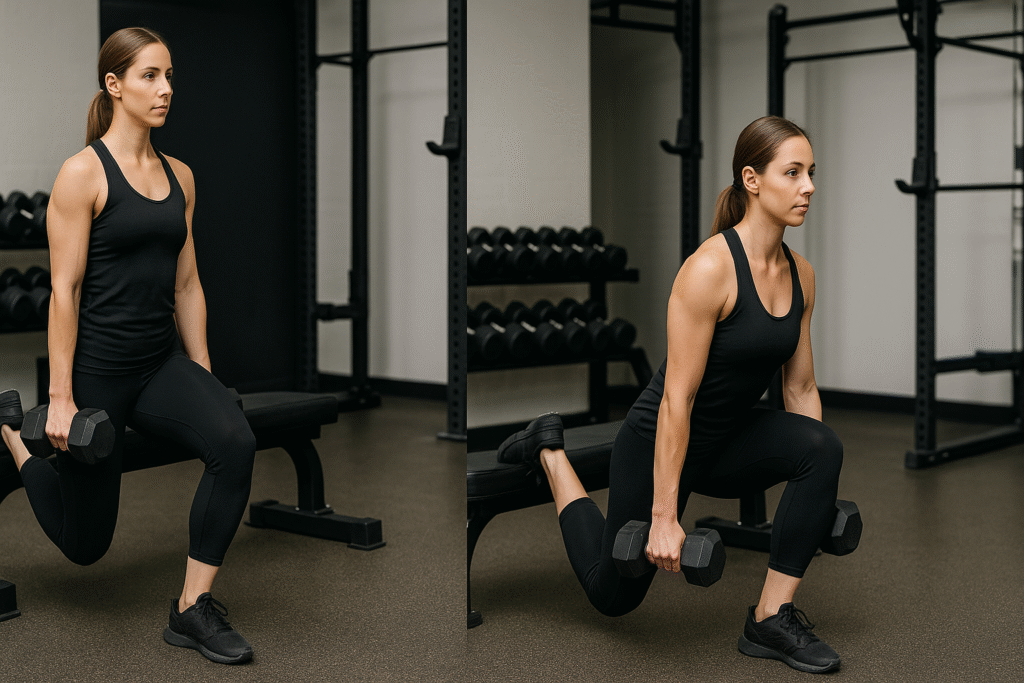
There’s that gym moment where someone does Bulgarian split squats, wobbling like they’re on a boat, barely holding onto their dumbbells.
And you watch them thinking, “Dude… are you training your legs or auditioning for a circus act?”
I’ve been that dude.
I’ve also been the guy who thought, “Why does everyone hype these so much?
My legs look exactly the same, my balance sucks, and this exercise feels like a prank invented by gym sadists.”
And then it hit me.
People don’t get results from Bulgarian split squats because they’re doing them like a “diet version” of squats.
Not as a standalone, heavy, brutal, leg-builder that can embarrass barbell back squats on leg day.
So if your legs still look the same, the problem isn’t genetics.
It’s how you’re doing these things.
Bulgarian Split Squats For Leg Growth Aren’t a Balance Drill
Most people walk into the movement like they’re trying to stand on a tightrope with 20-pound dumbbells.
Knees shaking.
Arms shaking.
Core shaking.
Soul leaving body.
The entire rep is a balance circus, but the muscles are barely doing any work.
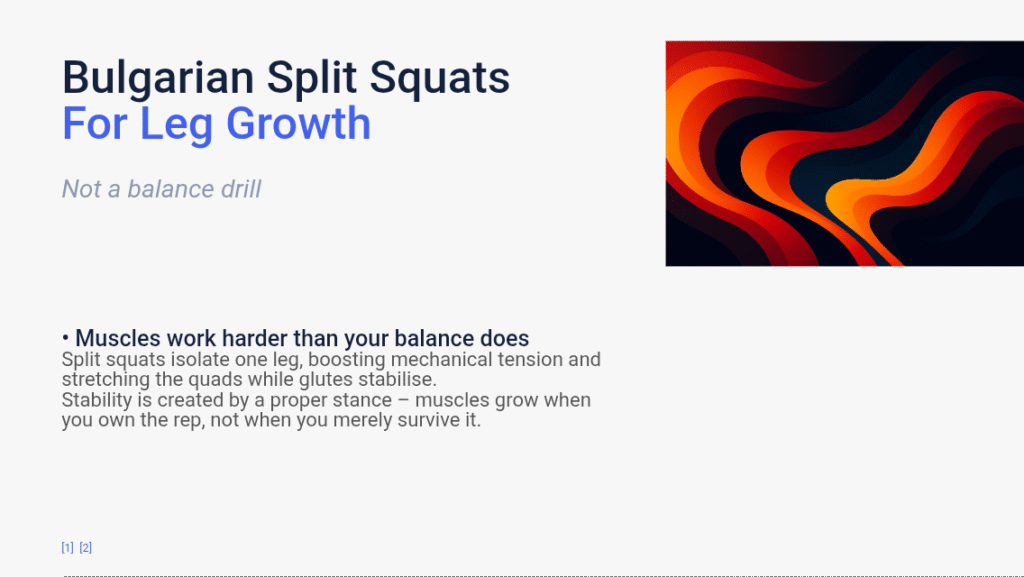
Bulgarian split squats are brutal because they isolate one leg at a time, increase mechanical tension, stretch the quads under load, and force your glutes to stabilize while producing force.
That’s hypertrophy gold.
But only if the muscles can actually take over.
And they can’t do that if the body is too busy trying not to fall over like a drunk flamingo.
So, first big shift:
Stop trying to be stable by “actively balancing.”
Create stability by setting up the position correctly.
Because muscles don’t grow from surviving reps.
They grow from owning reps.
Bulgarian Split Squat Form Cues That Actually Build Muscle
The usual advice is: “Chest up, forward lean, back foot elevated, knee over toe.”
Cool general tips.
But the real magic is in the tension.
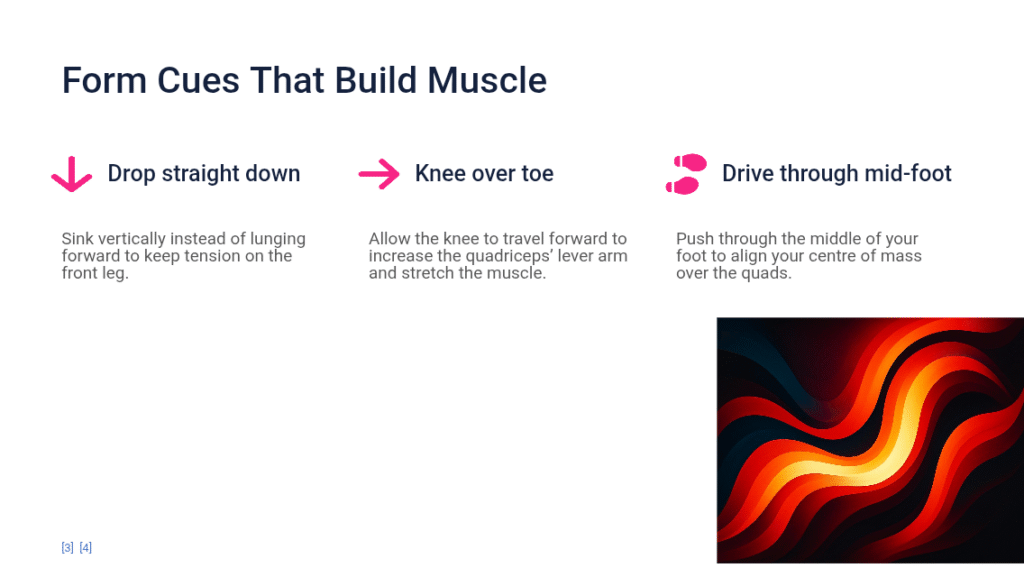
If you want these to change your legs, focus on three brutally simple cues:
- Drop straight down, not forward
- Let the front knee travel over the toe
- Drive through the mid-foot, not the heel
That last one is where most people lose leg development.
Everyone is obsessed with “heels only” because they’re still married to back squat technique, thinking “glutes first.”
But Bulgarian split squats aren’t mini-squats.
They’re a quad stretch-and-drive movement with glutes assisting, not dominating.
So pushing through only the heel turns it into a weird, hip-dominant half-lunge that barely loads the quads.
Mid-foot drive keeps your center of mass where it belongs.
Right over the muscle you’re trying to punish.
Bulgarian Split Squats and Knee Tracking: Stop Babying Your Quads
There’s always that guy yelling, “Don’t let the knee go past the toe!”
And I get it.
Knee safety fear-mongering ran so deep in the 2000s that a whole generation avoided the deepest, most hypertrophy-friendly ranges of motion.
But here’s the truth:
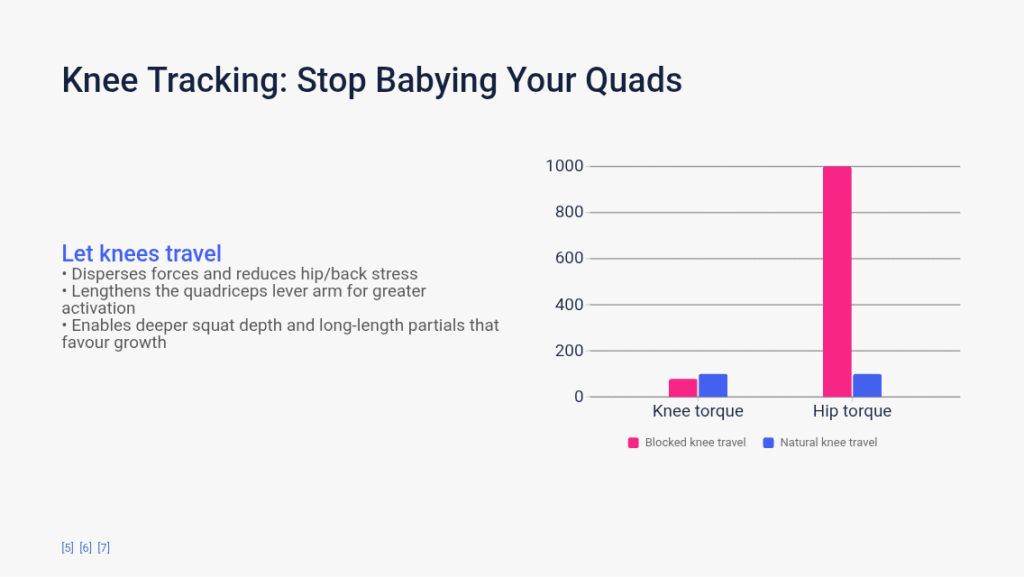
Letting your knee travel forward increases moment arm, loads the quads harder, and stretches the muscle in its lengthened position — the exact position where muscles grow the most.
Studies show lengthened partials can lead to more hypertrophy because they crank up mechanical tension while the muscle is stretched.
You don’t need to cite a study for this though.
You feel it.
Your quads light up like they’re paying rent.
Your glutes earn their paycheck.
Your legs suddenly understand why people call this exercise “humbling.”
Bulgarian Split Squats Hurt Because They Work, Not Because They’re Dangerous
Bulgarian split squats have a reputation for being painful.
People assume that pain equals risk.
But this is the kind of pain that comes from high tension in end ranges.
Not from joints falling apart.
Unless you’re dropping into weird angles, twisting the torso, or holding weights like fragile teacups, the movement is mechanically safe.
The discomfort is metabolic and mechanical, not structural.
Translation:
It sucks because it makes muscles grow.
Why Bulgarian Split Squats Feel Like You Can’t Breathe
There’s a meme-level truth to this:
Bulgarian split squats don’t just train legs.
They train your cardiopulmonary system to question its purpose in life.
One set feels like a full Tabata workout wrapped in the guilt of every skipped leg day.
That doesn’t mean you’re out of shape.
It means the exercise pulls from so many systems at once that your body goes into “full system panic mode.”
Which is exactly why people stop early.
And exactly why your legs don’t change.
Why Bulgarian Split Squats Haven’t Changed Your Legs
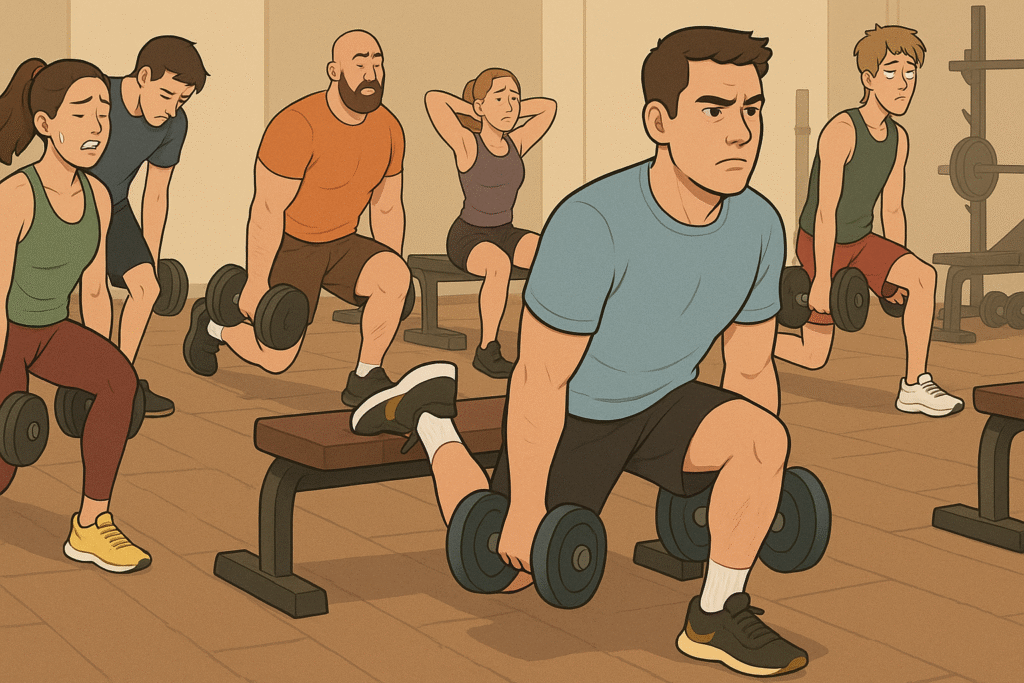
You probably fall into one of these categories:
- Using weights you could juggle
- Cutting the range short because it burns
- Leaning forward like you’re bowing to a king
- Bouncing with zero tension
- Rushing reps because you hate being alive
Or the classic:
- Treating them like “accessory work” instead of the main event
Bulgarian split squats can be your main lift.
Not the side quest.
Not the warm-up.
Not the “optional finisher.”
They have enough loading potential to stimulate hypertrophy better than barbell squats for some lifters.
Especially tall lifters.
Especially people with quad-dominant goals.
Especially people who suck at bilateral squatting.
How to Load Bulgarian Split Squats for Actual Growth
If you want these to change your legs, move beyond tourist mode.
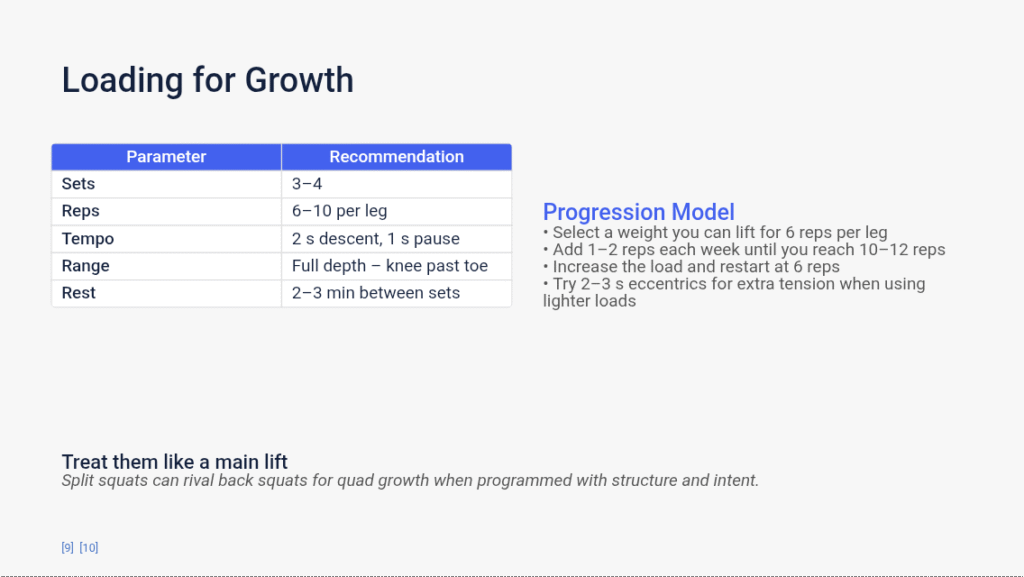
Try this structure:
- 3–4 sets
- 6–10 reps
- 2-second descent
- 1-second pause at the bottom
- Full depth
- No “escape reps”
And then rest long enough to question your existence.
Because short rest intervals don’t make you hardcore.
They make you weak.
Bulgarian Split Squats for Real Progress: Stop Randomly Picking Weights
One of the big reasons people don’t change their legs with Bulgarian split squats is simple.
There’s no progression plan.
They grab the same dumbbells every week.
Do the same reps.
With the same tempo.
And then wonder why nothing changes.
These aren’t curls.
You don’t “just do them.”
You progress them.
Here’s a simple, effective method:
Week-to-week progression model
- Pick a weight you can hit for 6 reps per leg
- Keep the tempo controlled
- Add 1–2 reps each week until you hit 10–12
- THEN increase the weight and restart at 6
This is boring.
This is predictable.
This is how muscles actually grow.
Not by guessing.
Not by “feeling it out.”
Not by doing whatever burns.
But by applying progressive overload in a structured way.
If you want even more tension, try this:
Add a 2–3 second eccentric every rep
You’ll need less weight.
You’ll feel more stimulus.
You’ll eliminate half-reps and ego lifting.
Bulgarian Split Squats Variations If You Keep Falling Over
Not everyone can jump into the “full version” of these.
Balance, mobility, hip structure, and ankle strength all play a role.
And instead of suffering through reps that look like a Bambi-on-ice audition, scale the movement so it still builds muscle.
Option 1: Front-foot elevated split squat
- Less balance demand
- More quad stretch
- Easier to hit depth
If regular Bulgarians feel like chaos, this feels like therapy.
Option 2: Static lunge with forward torso lean
- Least balance demand
- Still unilateral
- More glute involvement
Not as “quad-focused” but a perfect entry point.
Option 3: Using a safety bar or holding onto support
No, this isn’t cheating.
It’s optimizing.
If your balance is trash, grab something so your legs can actually work.
Don’t think in terms of pride.
Think in terms of stimulus.
If holding a rack lets you push harder — hold the rack.
Bulgarian Split Squats in Your Program Without Ruining the Rest of the Workout
People don’t know where to put these.
Before squats?
After squats?
Instead of squats?
Two sessions per week?
Here’s a realistic breakdown:
If you want quad growth
Do Bulgarian split squats early in the workout
Right after activation / warm-up
Before leg extensions, lunges, or machines
Because these are strength-based hypertrophy work
Not cardio
If you squat heavy and don’t want to die
Alternate weeks:
- Week 1: back squat heavy + single-leg accessory
- Week 2: Bulgarian split squat heavy + squat light or skip
This saves your spine
Keeps volume high
And prevents dead-man-walking syndrome
Frequency guidelines
- Beginners: 1x per week is enough
- Intermediates: 2x per week with different rep ranges
- Advanced: rotate stances, tempos, and loading strategies
If your legs are a priority, treat these like bench day for bros.
Not “when you have time.”
Bulgarian Split Squats Can Replace Leg Machines If You Let Them
You don’t need a hack squat if you dial these in.
You don’t need leg extensions if you program these hard.
You don’t need fancy gym equipment if you push unilateral loading to its limits.
But that means you have to treat them as a primary hypertrophy driver.
Not “the side salad of leg day.”
| The Real Reason Your Legs Still Look the Same |
| Not because Bulgarian split squats don’t work. |
| But because you’re doing them like cardio with weights. |
| Because you’re prioritizing balance over tension. |
| Because you think discomfort means something is wrong. |
| Because you think hypertrophy comes from “doing exercises,” not doing hard things well. |
RELATED:》》》 Can dumbbell squats effectively replace barbell squats?
Final Thoughts
Bulgarian split squats are awful.
They’re exhausting.
They’re humbling.
They steal your breath.
They leave you questioning why you ever joined a gym.
But they’re also one of the most accessible, effective, low-equipment tools for building strong, defined legs that actually look trained.
If your legs still look the same, don’t blame the movement.
Blame the way you’ve been coasting through it.
Slow down.
Load up.
Go deeper.
Drive through the mid-foot.
Stay in tension when every cell in your body wants to quit.
That’s where growth comes from — not from surviving the set, but from owning it.
And if you’re willing to do that consistently, Bulgarian split squats won’t just change your legs.
They’ll change your work ethic.
And eventually, your physique will reflect it.