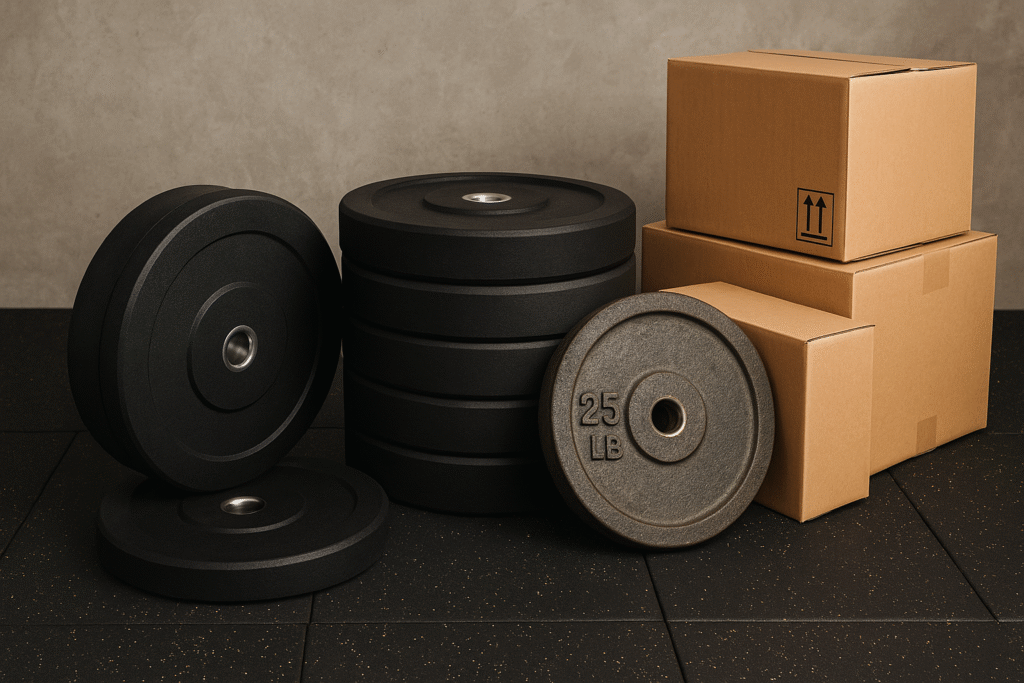
Alright, let’s talk about the dark temptation of budget bumper plates — the kind you find online for half the price and double the promise.
I’ve been there.
Scrolling through fitness websites late at night, credit card in hand, convincing myself that those “eco-friendly recycled rubber plates” are basically the same as Rogue’s.
They look round, they say “45 LB,” and they’re black.
How bad could they really be?
Well, here’s what I’ve learned — the hard way.
| Graph Time: What Happens When Plates Age |
|---|
| Let’s talk data — the kind that makes you stare at your plates like, “Wait, is that… bending?” |
| When I started dropping budget bumpers week after week, I tracked how much they warped over time. |
| I measured edge curvature and inner ring separation after every 20 deadlift drops. |
| At first, the curve was almost invisible — maybe a millimeter of give. |
| But after month two, the edges began curling slightly, like the outer lip of a cheap pizza crust. |
| By month three, the deformation hit 3–4 mm. |
| It doesn’t sound like much, but when your bar starts rocking during setup, you feel it. |
| If you graphed it out, the line wouldn’t be a straight climb — it’d curve upward fast after the first 100 drops. |
| Premium plates? Their curve stays nearly flat even after months of punishment. |
| That’s the beauty of higher-density vulcanized rubber — it compresses and rebounds cleanly instead of “remembering” every hit. |
| So yeah, data confirms what your instincts already told you: cheap plates don’t just age — they sag into retirement. |
The first lift feels fine… until it doesn’t
At first, everything’s great.
You unbox them, they smell like burnt tires, and you’re hyped.
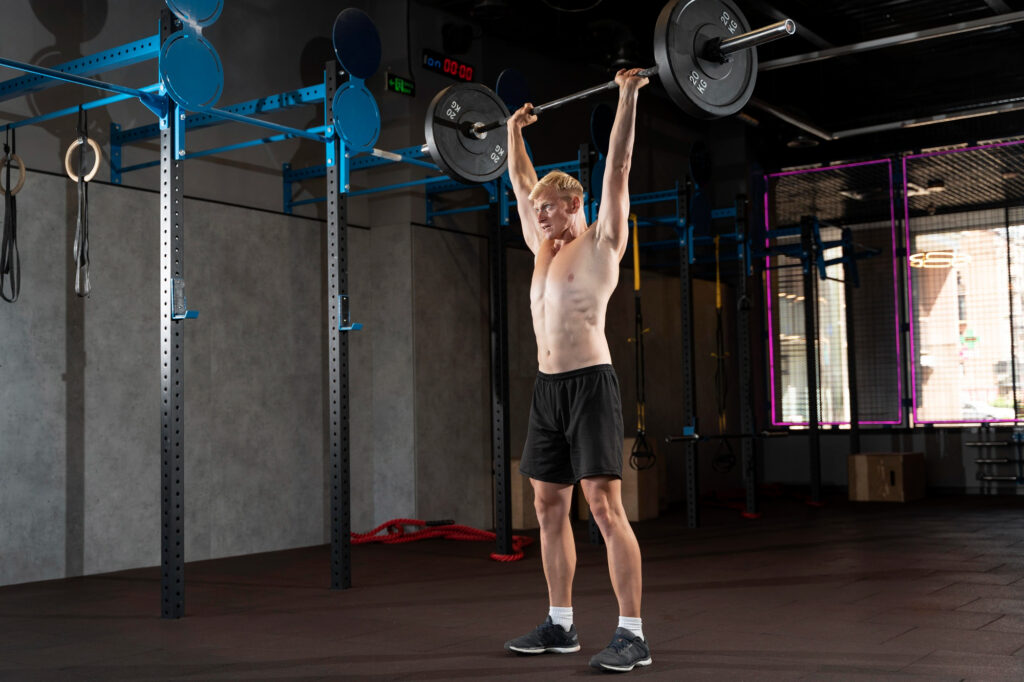
You load the bar, grip tight, and pull that first deadlift like a garage gym warrior.
The bounce feels decent.
The weight hits the floor with a satisfying thud.
You feel like you just robbed a commercial gym.
But then you notice something weird.
After a few weeks, one plate sits slightly crooked.
Another starts to wobble on the collar.
And when you drop the bar?
One side bounces higher than the other like a drunken kangaroo.
That’s when you realize not all bumpers are created equal.
Density and diameter
Here’s where the technical stuff sneaks in.
Good bumper plates have consistent density — the ratio between the plate’s mass and its volume.
Cheaper plates?
They often vary slightly in thickness or material composition.
That means your “45-pound” plate might actually weigh 43.6 or 46.2 pounds.
Not a huge deal on paper, but over time, it throws off your balance and form, especially on heavy lifts.
And the diameter?
Regulation plates measure 450 mm (about 17.7 inches).
Some budget ones are a few millimeters smaller or larger — which means the bar hits unevenly when it lands.
That uneven stress adds up, not just for your plates, but for your floor, barbell sleeves, and even your lower back.
The bounce dilemma: friend or foe?
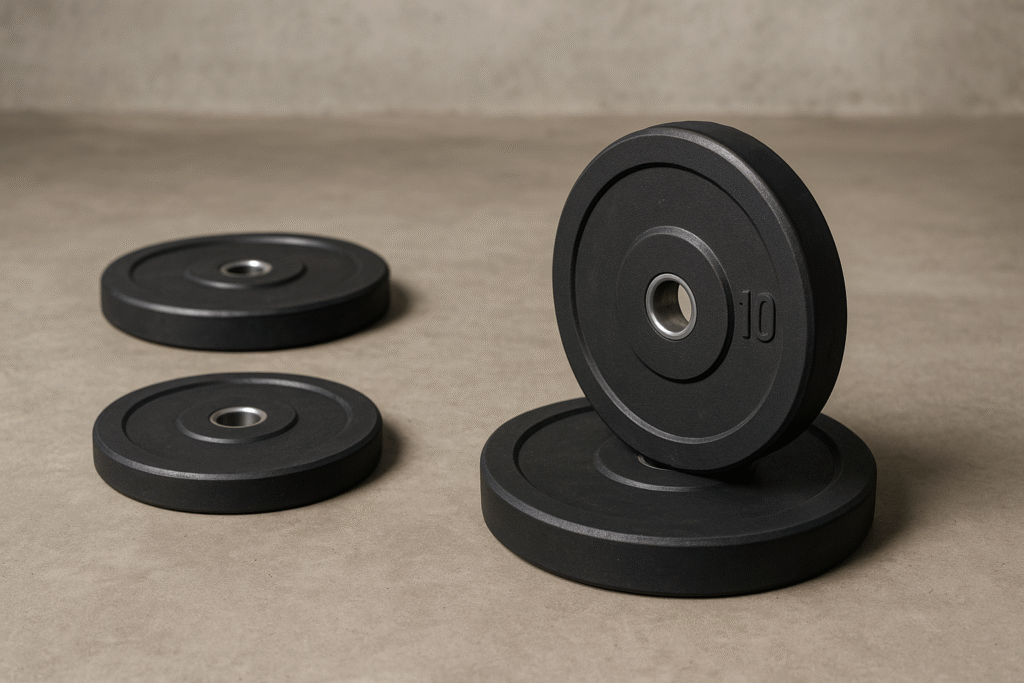
One thing I didn’t expect from cheap bumpers was how much they bounce.
Drop them from hip height, and suddenly your bar is moon-walking across the garage.
High-bounce bumpers usually mean low-density rubber.
It’s not dangerous at first, but if you’re training in a tight space, it can be a nightmare.
You drop your deadlift and spend the next 10 seconds chasing your barbell like it’s trying to escape cardio.
Premium plates, on the other hand, are low-bounce — denser, heavier, more controlled.
They hit the ground, absorb impact, and stay put.
It’s a subtle difference that feels like driving a BMW instead of a go-kart.
The test of time and temperature
Cheap bumpers don’t age well.
After a few months, the edges start to chip.
The rubber cracks a little, especially if you train in a cold garage.
And once that metal hub gets loose? Game over.
Good plates use vulcanized rubber — a process that bonds the material tighter and makes it resistant to cracking.
Cheaper ones often use crumb rubber pressed together with glue and hope.
If you ever dropped one and saw black flakes scatter across your floor like confetti, congrats — you just hosted a gym funeral.
The middle ground actually exists
But here’s the thing: you don’t have to drop $600 on bumpers to get something decent.
Brands like Fringe Sport, Titan, or Rep Fitness offer mid-tier plates that are surprisingly durable.
They might not have Rogue’s prestige, but they’ll hold up for years of regular home use.
Look for:
- Steel or stainless inserts, not just glued hubs.
- Low bounce rating (dead bounce preferred).
- Warranty of at least one year.
- Reviews that mention consistent diameter and true weight accuracy.
Basically, don’t buy the absolute cheapest set you see on Amazon.
But don’t feel like you have to take out a small loan either.
So… will you regret going budget?
It depends on your goals.
If you’re casually deadlifting a few times a week and not dropping from overhead, budget bumpers can be fine — for a while.
But if you’re planning to train heavy, often, or emotionally (we’ve all been there), cheap plates will eventually betray you.
You’ll notice the wobble.
The bounce.
The sound of regret as a corner of rubber peels off your 25-pound plate like a sad banana.
That’s when you’ll think, “Maybe I should’ve just waited one more paycheck.”
How budget bumpers actually perform under pressure
You can read specs all day, but nothing beats a little “garage reality check.”
After a few months of using cheaper bumpers, I started doing what I call the “garage drop test.”
Basically, I’d deadlift 315 lbs, then drop it from mid-shin height ten times straight.
Then I’d repeat that every week for two months.
The result?
The plates that looked good on paper started to lose their shape.
Edges got slightly concave, and the inner ring began separating from the rubber shell — a tiny gap at first, then a noticeable rattle.
What surprised me wasn’t just the wear — it was how inconsistent it was between plates from the same set.
One would stay solid, the other looked like it aged 10 years overnight.
That’s when I learned that cheap bumpers don’t fail instantly — they slowly deform until your lifts start to feel… off.
If you’re serious about training consistency, that’s a slow killer.
How your floor plays a massive role
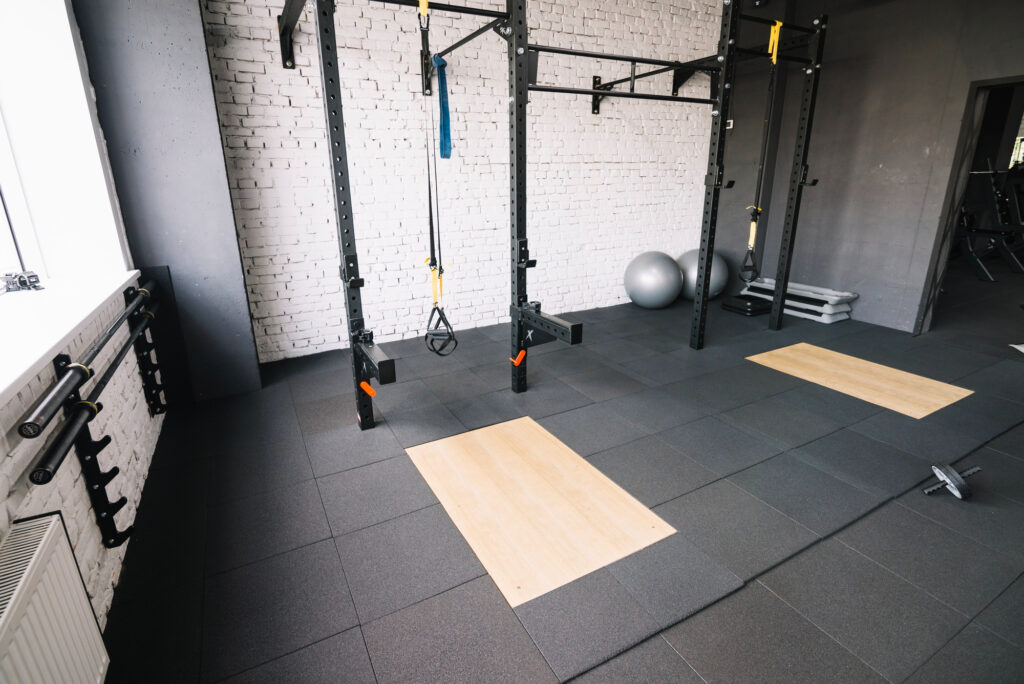
Nobody talks about this enough — your floor matters more than your brand of plates.
Dropping bumpers on plain concrete is basically asking for disaster, no matter how expensive they are.
The impact doesn’t just travel through the plate; it shoots back up through the barbell sleeves and even into your wrists over time.
If you’re lifting at home, invest in:
- 3/4″ rubber stall mats (the kind used in horse stalls)
- A simple plywood platform under your deadlift zone
- Or at least foam crash pads if you’re training in an apartment
A good platform turns even a mediocre bumper plate into a solid long-term companion.
It absorbs shock, protects your bar, and keeps your neighbors from calling the cops.
Temperature and storage
If your garage turns into a sauna in summer and a freezer in winter, that’s rough on budget bumpers.
Rubber expands and contracts with temperature changes.
Cheaper compounds don’t handle it well — they start to harden and micro-crack around the insert.
Once that happens, every drop speeds up the decay.
If you want your plates to last longer, treat them like a pet:
- Keep them off direct sunlight.
- Store them vertically, not stacked.
- Avoid leaving them in contact with oil, salt, or metal shavings (common in garages).
Those small habits easily add an extra year or two to their lifespan.
The Confidence Effect
There’s also something psychological about using cheap versus quality plates.
When your gear feels solid, your brain trusts it — and you lift with confidence.
When it wobbles, rattles, or bounces unpredictably, your body subconsciously holds back.
You hesitate on the pull.
You grip tighter. You get tired faster.
I didn’t expect it, but upgrading plates actually improved my form — not because they were heavier, but because I stopped thinking about them.
It’s like driving a car that doesn’t shake: your focus goes to the road, not the dashboard.
That peace of mind is a legit performance enhancer — one most people underestimate.
When cheap plates make sense (and how to make them work)
Let’s be real: not everyone can or should blow half their paycheck on gym gear.
If you’re going budget, just be smart about it.
Here’s how to make the most of them:
- Rotate usage — don’t always load the same pair on the inside.
- Avoid drops from overhead (use controlled descents).
- Inspect the inserts monthly — if they start to separate, use epoxy before it’s too late.
- Pair them with a quality barbell, because cheap + cheap = early retirement.
Do that, and even the humble Amazon bumper set can last you years without drama.
You won’t have the prestige, but you’ll have the progress — and that’s what really matters.
The Thickness Trap Nobody Warns You About
Here’s a sneaky problem I didn’t realize until I started stacking plates like pancakes — some of those budget bumpers are thicc.
Not the good kind of thicc either.
I’m talking “can’t-fit-another-45-on-the-bar” thick.
The first time I loaded my bar to 405 with a budget set, I ran out of sleeve space before I ran out of strength.
It looked like I was about to deadlift a cartoon wheel.
And yeah, it technically worked… but the whip was wild.
The bar started bending mid-lift, wobbling just enough to make the whole thing feel sketchy.
That’s because cheap plates are made with lower-density rubber, which means they need to be thicker to reach the same weight.
Less density = more width = less room for gains.
If you’re planning to pull heavy or chase PRs, check the plate width per weight before buying.
The good ones list it clearly — if the brand doesn’t, that’s usually a hint.
I learned it the hard way: the stronger you get, the more you’ll regret that extra inch of rubber.
🛒Shop Olympic Weight Plates Set on Amazon
Mixing Bumpers and Iron
We’ve all done it.
You start with a budget bumper set, then add a couple of old iron plates from Craigslist because, hey, they’re cheaper and thinner.
The result?
A Frankenstein barbell that looks fine until you drop it.
The bumpers absorb shock.
The iron?
Not so much.
So when they hit together, one side flexes, the other slams — and that uneven impact travels straight into your barbell sleeves.
I once heard a noise so sharp I thought I’d cracked my garage floor.
Turns out it was just the bar protesting my budget creativity.
If you do mix them, here’s the fix:
- Keep bumpers on the outside, iron plates closer to the bar center.
- Make sure diameters match (450 mm).
- Avoid dropping from height — or be ready to order new bearings next month.
It’s not a disaster if done right, but it’s definitely not the long-term solution for serious training.
RELATED:》》》Are Trap Bar Deadlifts Safer Than Straight Bar Deadlifts for Avoiding Injuries?
Final thoughts
Here’s the truth I wish someone told me earlier:
Your home gym isn’t just a cheaper version of a commercial one — it’s your space.
Every piece of gear you buy sets the tone for your training.
When you invest in better plates, you’re not just buying metal and rubber.
You’re buying consistency.
Safety.
Peace of mind.
And honestly, that’s worth more than the $100 you saved on discount bumpers that now rattle like maracas.
So if you can wait a bit longer and save for something solid — do it.
FAQs:
Can mixing bumper brands mess up my barbell balance?
Yeah, it actually can.
Different brands use slightly different rubber densities and diameters, even if they all claim “standard 450 mm.”
So if you mix, say, Rogue bumpers with no-name Amazon plates, the bar won’t land evenly.
That subtle tilt can throw off your setup and increase wear on the sleeves over time.
If you must mix, group similar densities together — keep softer plates on one side and denser ones on the other — or better yet, use matching pairs for your main lifts.
Do bumper plates lose their true weight over time?
Not technically — the metal hub and rubber still weigh the same.
But what does change is how they distribute that weight.
As the rubber warps or compresses from repeated drops, the plate’s balance shifts slightly outward.
That means your lifts might feel heavier on one side, especially during dynamic pulls.
It’s not enough to throw off your PR, but it’s one of those sneaky reasons why form starts feeling “off” months later even when the numbers haven’t changed.
How do I know when it’s time to replace them?
When you start hearing that hollow “clunk” instead of a thud.
That sound means the inner hub has separated just enough to move under load.
It’s your plate whispering, “I’ve done my part — let me go.”