
When bodyweight exercises stop feeling challenging too early, the shift is easy to notice.
Bodyweight training is expected to feel demanding at the start, so that change stands out.
At first, the movements feel effective.
Push-ups load the chest and arms.
Pull-ups require full upper-body effort.
Squats engage the legs in a clear, direct way.
Then, often sooner than expected, those same exercises feel familiar.
Not easy.
Just predictable.
The workout still works.
It just no longer feels demanding in the same way.
Bodyweight training adapts quickly because the body adapts quickly.
Movements become smoother.
Effort becomes more efficient.
That’s where questions usually start.
When Easier Doesn’t Mean Worse
Feeling less challenged is not automatically a bad sign.
Sometimes it means you’re getting stronger.
Sometimes it means your technique got smoother and you waste less energy.
Sometimes it means you’re resting better, eating better, and showing up more consistently.
All of that is progress.
The problem is when “less challenged” turns into “no reason to adapt.”
If your reps keep going up, but your strength, muscle, or athletic look doesn’t move, then the workout became maintenance.
Maintenance is not evil.
Maintenance is just not the same as building.
If the goal is to keep growing, your training needs a reason to keep changing you.
That reason is usually progressive overload.
Bodyweight progressive overload exists.
It just wears different clothes than “add 2.5 kg and call it a day.”
How to tell the difference between real progress and fake easy
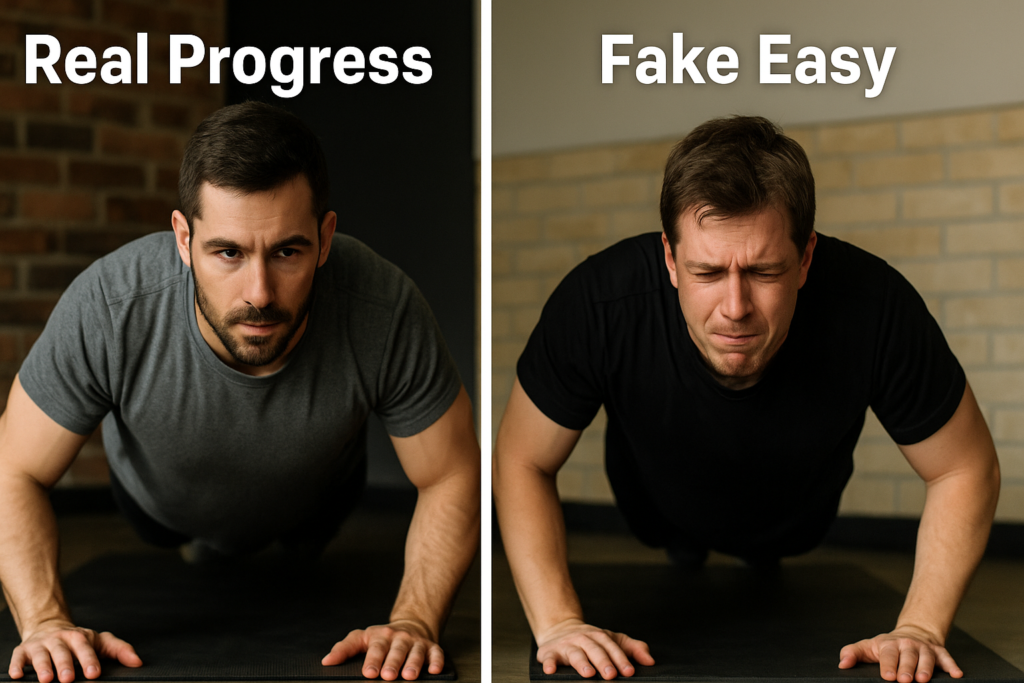
A workout can feel easier for good reasons.
A workout can also feel easier because your body found shortcuts.
Here are signs you’re improving in a good way.
Reps feel smoother but the last few still demand focus.
Form is cleaner without you having to “think hard” about it.
Rest times can be shorter without performance collapsing.
You can control tempo without shaking like a shopping cart with one bad wheel.
Here are signs you’re getting efficient in a way that reduces stimulus.
Reps fly up but you feel nothing in the target muscles.
Range of motion shrinks without you noticing.
Tension shifts into joints or momentum instead of muscle.
Your sets end because you’re bored, not because you’re challenged.
If that second list sounds familiar, congratulations.
You are human.
Now you get to train like one.
Why bodyweight stops feeling hard so fast
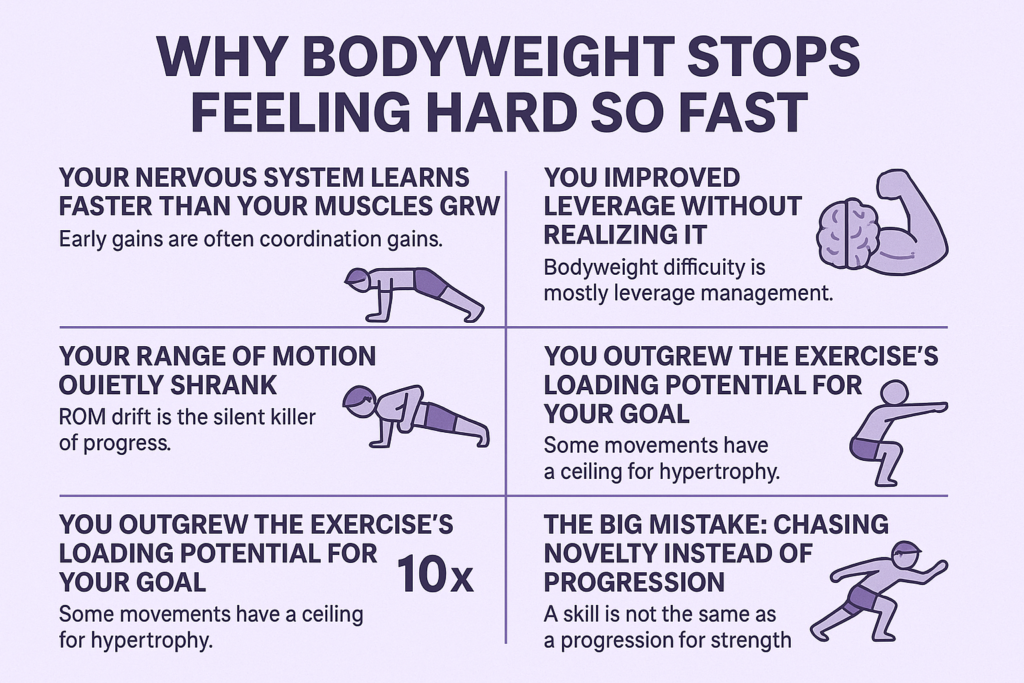
Your nervous system learns faster than your muscles grow
Early gains are often coordination gains.
You recruit better.
You brace better.
You stabilize better.
You stop fighting yourself.
That can make a movement feel dramatically easier in a couple of weeks.
It’s like updating your software.
Same hardware.
Better performance.
Your muscles may not have grown much yet, but your execution got efficient.
That efficiency is awesome, and it’s also why the same rep count stops feeling spicy.
You improved leverage without realizing it
Bodyweight difficulty is mostly leverage management.
A tiny shift in joint angle can turn “hard” into “manageable.”
Hands slightly higher in a push-up.
Hips slightly piked in a pike push-up.
Knees not as deep in a squat.
Chin reaching the bar only when you’re feeling generous.
None of this makes you a bad person.
It just makes your body a clever engineer.
Your body is always looking for the cheapest way to complete the task.
If you don’t control the rules, your body will rewrite them.
Your range of motion quietly shrank
ROM drift is the silent killer of progress.
A push-up becomes a half push-up.
A dip becomes a dip-ish.
A pull-up becomes a neck-to-bar situation where the neck does most of the traveling.
ROM reduction makes reps easier.
ROM reduction also reduces stimulus.
If a movement stopped feeling challenging early, ROM is one of the first things to audit.
You’re training the same rep zone with the same intent
If you always do the same number of reps, your body learns exactly what to prepare for.
If you always stop at the same effort level, your body never has to expand capacity.
If you always do “comfortable hard,” you become really good at “comfortable hard.”
That’s not nothing.
That’s just not the fastest way to keep changing.
You outgrew the exercise’s loading potential for your goal
Some movements have a ceiling for hypertrophy, depending on your strength and body size.
Bodyweight squats can stop challenging your legs fairly early.
Standard push-ups can stop challenging your chest fairly early for some people.
Planks can stop challenging your core in the way you want.
That doesn’t mean the movement is useless.
It means you graduated from that version of it.
Graduation is not betrayal.
Graduation is progress.
The big mistake: chasing novelty instead of progression
When things feel easy, the tempting move is to chase cooler exercises.
One-arm push-up attempts.
Random handstand holds.
Explosive everything.
Advanced skills look fun, and they are fun.
Skills also punish impatience.
A skill is not the same as a progression for strength or muscle.
A skill is a coordination project.
A progression is a stimulus project.
Sometimes they overlap.
Sometimes they don’t.
If you chase novelty without a plan, you get a lot of exciting sessions and very little accumulation.
Your body adapts best when the challenge changes in a trackable way.
Trackable beats flashy.
So what do you do when it stops feeling challenging
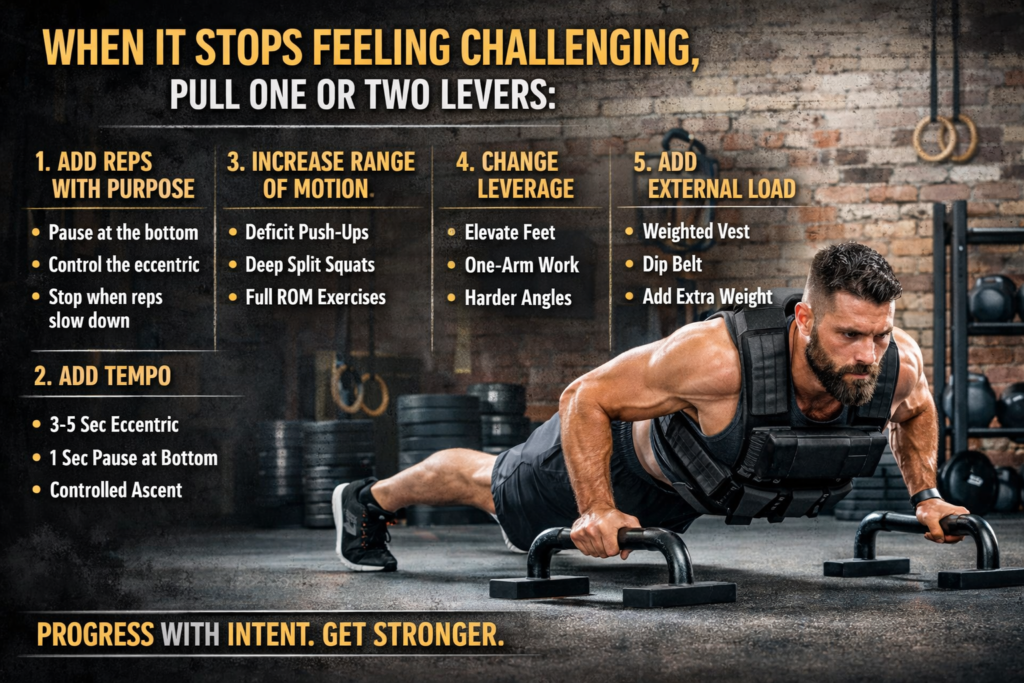
You have five main levers.
Pick one or two.
Don’t yank all five at once like you’re trying to launch a spaceship.
Lever 1: Add reps, but with a purpose
More reps can work.
More reps without intent often becomes cardio with a pump.
If you want reps to stay challenging, control the quality.
Add a pause at the bottom.
Control the eccentric.
Keep full ROM.
Stop the set when reps slow down, not when your mind wanders.
A good rep should look like you meant it.
If you can add reps while keeping tension high, that is real progression.
Lever 2: Add tempo
Tempo is the simplest “free weight.”
Slow eccentrics make basic moves spicy again.
A 3–5 second lowering phase changes everything.
Pauses at the hardest point change everything.
You don’t need to turn every set into a meditation retreat.
You just need enough tempo work to make the movement honest again.
A simple template works well.
Use a 3-second lower.
Pause 1 second at the bottom.
Come up with control.
That’s it.
Now push-ups feel like a different exercise without any new equipment.
Lever 3: Increase range of motion
More ROM often means more stimulus.
Deficit push-ups using handles or parallettes increase chest stretch and demand.
Deep step-ups or split squats increase hip and quad work.
Ring push-ups can increase depth if you control them.
Just don’t chase extreme ROM if your joints aren’t ready.
ROM is a tool.
Tools are great until you use them like a hammer for every problem.
Lever 4: Change leverage
Leverage is the core language of calisthenics progressions.
Move hands farther forward.
Elevate feet.
Shift more load to one side.
Move from two limbs to one limb support.
Use harder angles.
This is where “bodyweight has no ceiling” becomes true in practice.
The challenge is choosing the next step that is hard in the right way.
Harder should mean more tension in the target muscles.
Harder should not mean “my wrists are screaming and my elbows filed a complaint.”
Lever 5: Add external load
Weighted calisthenics is not cheating.
Weighted calisthenics is just math.
If you can do clean pull-ups for sets of 10 and they feel easy, a little weight makes sense.
If you can do deep push-ups for sets of 20 and they feel easy, a weighted vest can make sense.
External load is the most straightforward way to keep progressive overload obvious.
The key is staying clean.
Load should not turn your reps into survival footage.
A practical progression map for the most common moves
Let’s make this painfully usable.
Here are progression routes that keep challenge alive without turning your training into chaos.
Push-ups

Standard push-ups stop feeling challenging early for many people.
That’s normal.
Try this path.
Perfect full-ROM push-ups with control.
Slow-eccentric push-ups.
Feet-elevated push-ups.
Deficit push-ups on parallettes or handles.
Ring push-ups with strict control.
Archer push-ups or uneven push-ups.
Pseudo planche push-ups.
Then, if strength is the goal, add load or move toward planche-specific progressions carefully.
If hypertrophy is the goal, you may not need to go full circus.
A weighted vest plus strict ROM can take you very far.
Pull-ups

Pull-ups can stay challenging longer, but they also get “efficient” quickly.
Try this path.
Strict pull-ups with dead hang and full scap control.
Tempo pull-ups with slow eccentric.
Pause at the top with chest high.
L-sit or hollow-body pull-ups for stricter trunk control.
Archer pull-ups if shoulder health allows.
Weighted pull-ups for clear overload.
If your goal is reps, use density blocks.
If your goal is strength, use lower reps with more load.
If your goal is muscle, live in that tough 5–10 rep zone with strict technique.
Dips

Dips feel amazing until they don’t.
Depth and shoulder position matter a lot here.
Try this path.
Strict parallel bar dips with controlled depth.
Tempo dips with slow lowering.
Ring dips only if shoulders are prepared.
Weighted dips for overload.
Be cautious with chasing extreme depth and big loads at the same time.
Your joints do not get medals for suffering quietly.
Squats and legs
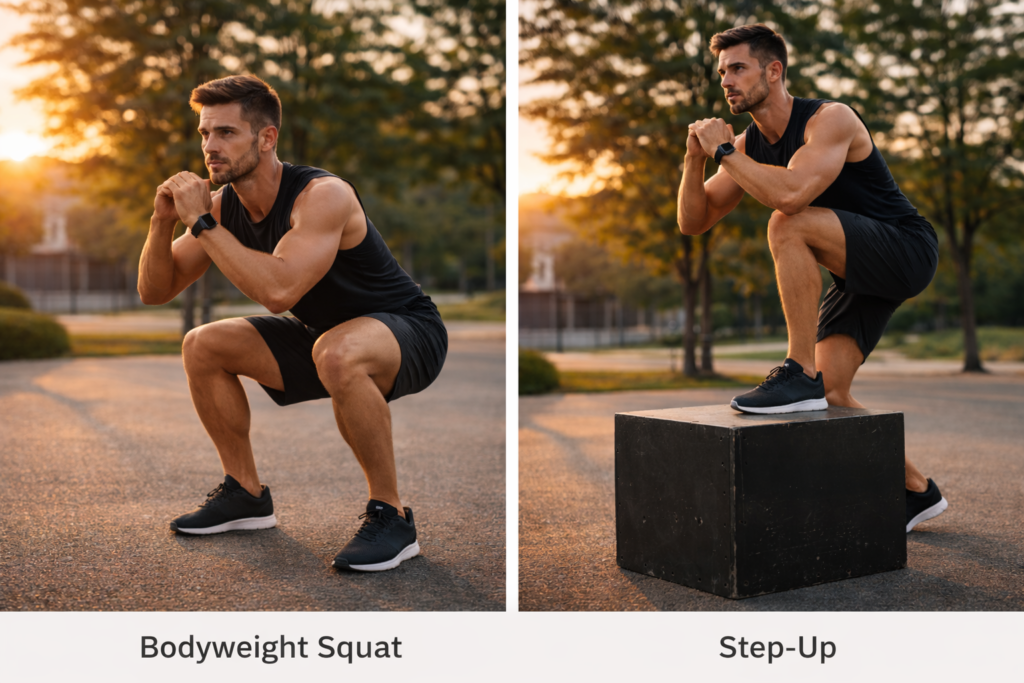
Bodyweight legs can get easy fast, especially if you’re not very light.
Try this path.
Deep bodyweight squats with pauses.
Tempo squats with long eccentrics.
Split squats with strict ROM.
Bulgarian split squats with slow tempo.
Step-ups with controlled descent.
Single-leg hinge work for posterior chain.
Then add load.
Legs often need load.
That’s not a failure of bodyweight.
That’s just legs being legs.
Shoulders without equipment

Shoulders are tricky because pressing your bodyweight overhead is a big jump.
Try this path.
Pike push-ups with good scap mechanics.
Feet-elevated pike push-ups.
Tempo pike push-ups with pauses.
Wall-supported handstand holds for stability and comfort.
Partial range handstand push-up negatives with control.
Full ROM progressions only when joints feel stable.
If you want shoulder size, don’t ignore lateral and rear delt work if you have even basic bands or light dumbbells.
If you have nothing, use leverage and tempo creatively, and accept that size may grow slower than skill.
Programming fixes that keep “hard” from disappearing
Sometimes the issue is not the exercise.
Sometimes the issue is the plan.
A plan can accidentally make everything feel easy.
Here are fixes that work without pretending you have infinite recovery.
Use a rep range instead of a fixed number
Fixed reps teach your body the exact target.
Rep ranges keep training honest.
Pick 6–10 reps, or 8–12 reps, depending on the movement.
When you can hit the top of the range with clean form across all sets, progress the difficulty.
This is simple and brutally effective.
Leave one rep in reserve sometimes, not always
Training to failure all the time is a fast way to stall and feel beat up.
Never training hard enough is a fast way to stagnate and feel bored.
A balanced approach wins.
Keep most sets around 1–2 reps in reserve.
Push one set closer occasionally.
Let intensity be planned, not emotional.
Rotate emphasis weeks
If everything is trained the same way every week, your body adapts and gets comfy.
Rotate the emphasis without changing your identity.
One week emphasizes tempo.
One week emphasizes harder leverage.
One week emphasizes density or shorter rest.
That keeps stimulus fresh without being random.
Deload before you think you need it
When people say “it stopped feeling challenging,” sometimes they’re actually tired.
Fatigue can make effort feel weirdly flat.
A short deload can restore performance and make training feel meaningful again.
Deload does not mean doing nothing.
Deload means doing less.
Reduce sets by a third.
Keep movement quality high.
Come back hungry.
The common fear: “If it feels easy, am I wasting time”
Not necessarily.
Easy sessions can build skill and reinforce technique.
Easy sessions can support recovery.
Easy sessions can keep habits strong.
The problem is living there permanently while expecting growth.
You need a mix.
Some training builds.
Some training supports.
If everything feels easy, you’re under-stimulating.
If everything feels brutal, you’re under-recovering.
The sweet spot is where training feels challenging enough to demand focus but sustainable enough to repeat.
Repeatability is underrated.
Repeatability is where results live.
A simple weekly template that keeps progress moving
Here is a clean structure you can run for 6–8 weeks.
Pick 4 training days.
Use two upper days and two lower days, or two push-pull splits, depending on preference.
Keep it boring in the best way.
Upper Day A
Push-up progression: 4 sets in a 6–10 rep range.
Pull-up progression: 4 sets in a 5–8 rep range.
Accessory core: 3 sets, controlled.
Optional shoulder stability: 2–3 sets.
Lower Day A
Split squat or Bulgarian split squat: 4 sets in an 8–12 rep range.
Hinge pattern: 4 sets.
Calf or tib work if you can: 2–3 sets.
Core anti-rotation or carries if possible: 2–3 sets.
Upper Day B
Dip progression: 4 sets in a 6–10 rep range.
Row variation or inverted row: 4 sets in an 8–12 rep range.
Tempo work on one movement: 2–3 sets.
Lower Day B
Step-up or single-leg squat progression: 4 sets.
Hamstring emphasis: 4 sets.
Mobility work as dessert, not punishment: 5–10 minutes.
Progress one variable each week.
Add one rep per set.
Or add tempo.
Or move to the next leverage step.
Don’t do all of them at once.
What to do if the problem is motivation, not difficulty
Sometimes “it’s too easy” is code for “I’m not excited.”
That is also human.
Motivation does not stay constant.
If boredom is the issue, build structure first, then add novelty in a controlled way.
Use a new variation as a reward after you earn it.
Set a small goal that is measurable.
Add a rep.
Add a slower eccentric.
Hold a cleaner position.
Tiny wins make training feel alive again.
Training does not need to entertain you every minute.
Training needs to move you forward.
Forward is the fun part, even if it’s quiet.
Final thoughts
If bodyweight exercises stop feeling challenging too early, you didn’t “hit your limit.”
You probably hit the limit of that specific version of the exercise.
That is good news.
That means you’re ready for the next lever.
Progress in bodyweight training is not about hunting for the hardest-looking move.
Progress is about controlling the rules so the stimulus keeps evolving.
Keep range honest.
Keep tempo intentional.
Keep leverage progressive.
Add load when it makes sense.
Most importantly, keep your training repeatable enough that you can stack months, not just heroic days.
That’s how “bodyweight stopped feeling hard” turns into “my body changed anyway.”
And that’s the kind of boring success story that’s secretly the best one.